GetGrant analysis of official data: how many Own Business (Vlasna Sprava) grants Ukraine awarded in 2022–2026, who receives them by sector and region, what is known about rejections, the current Own Business 2.0 rules, bank scoring points and an applicant checklist.
Own Business (Vlasna Sprava) is Ukraine’s largest state grant programme for small businesses. Since July 2022 tens of thousands of sole proprietors and small companies have gone through it, and since 9 September 2026 it has run under entirely new rules: grants of up to UAH 2.5 million, bonuses, bank scoring points and a tax obligation covering the full grant amount. So the question is no longer “will they give it to me” but “will I pass the scoring and can I pay the grant back in taxes”.
We collected every official figure on the programme that the Ministry of Economy, the Cabinet of Ministers and the State Employment Service published from 2022 to November 2026 and put them into one picture: how many grants were awarded each year, who receives them, what is known about rejections and what changed with the new resolution. The final section is practical: how to prepare an application for the bank check. Figures were checked as of 15 November 2026.
Short answer
- In four years, from July 2022 to August 2026, 42,000 Ukrainians received state support under the programme worth almost UAH 12 billion, including more than 38,000 micro-grants worth UAH 10 billion and more than 3,500 veteran grants worth almost UAH 2 billion.
- The programme peaked in 2023–2025 with 10,000–11,000 micro-grants a year worth UAH 2.4–2.7 billion. Targets were missed, though: in 2024 the government planned 14,000 grants and awarded 11,000; in 2025 it planned 15,000 and awarded 10,600 micro-grants.
- The average micro-grant over the whole period is UAH 263,000. Under Own Business 2.0 it has grown to about UAH 1.07 million: the 260 winners of the first waves received almost UAH 280 million.
- The typical recipient is a sole proprietor (68%), a woman (61%), aged 35–50, in trade or car repair (33% of grants). Lviv region has the most winners (13%).
- The government does not regularly publish the rejection rate. The only official “applications vs grants” pair is for 2022: more than 16,000 applications and more than 3,300 recipients, so roughly one applicant in five received a grant.
- Since 1 September 2026 Resolution No. 616 applies: the bank awards up to 200 points (threshold 99), the interview adds up to 50, and a grant requires at least 130 out of 250. The Procedure lists 13 grounds for rejection.
- Taxes and social contributions paid over the project term must be at least equal to the grant. For a UAH 300,000 grant over 36 months, a group 3 sole proprietor with no employees needs average revenue of about UAH 107,000 a month.
Methodology
The analysis is based on official releases of the Ministry of Economy (now the Ministry of Economy and Environment), the Cabinet of Ministers and the State Employment Service from July 2022 to 3 November 2026, as well as the texts of Cabinet of Ministers Resolution No. 616 of 15 May 2026, Ministry of Economy Order No. 2 of 22 July 2026 on application assessment, and the service page on Diia. Rules and points are taken from the current versions of these documents.
There are three limitations. The programme has no open dataset, and press releases count differently (“winners”, “positive decisions”, “received funds”, not always separately from veteran grants), so annual figures do not add up exactly to the cumulative total. The number of applications and the rejection rate have been officially published only for 2022. The breakdown by sector and region is known only for the whole period, as of August 2026.
Wherever we calculate something ourselves (for example, the share of recipients among applicants or the average grant in the new programme), it is explicitly marked as a GetGrant calculation.
Trends: from 3,300 grants in 2022 to 10,000–11,000 a year
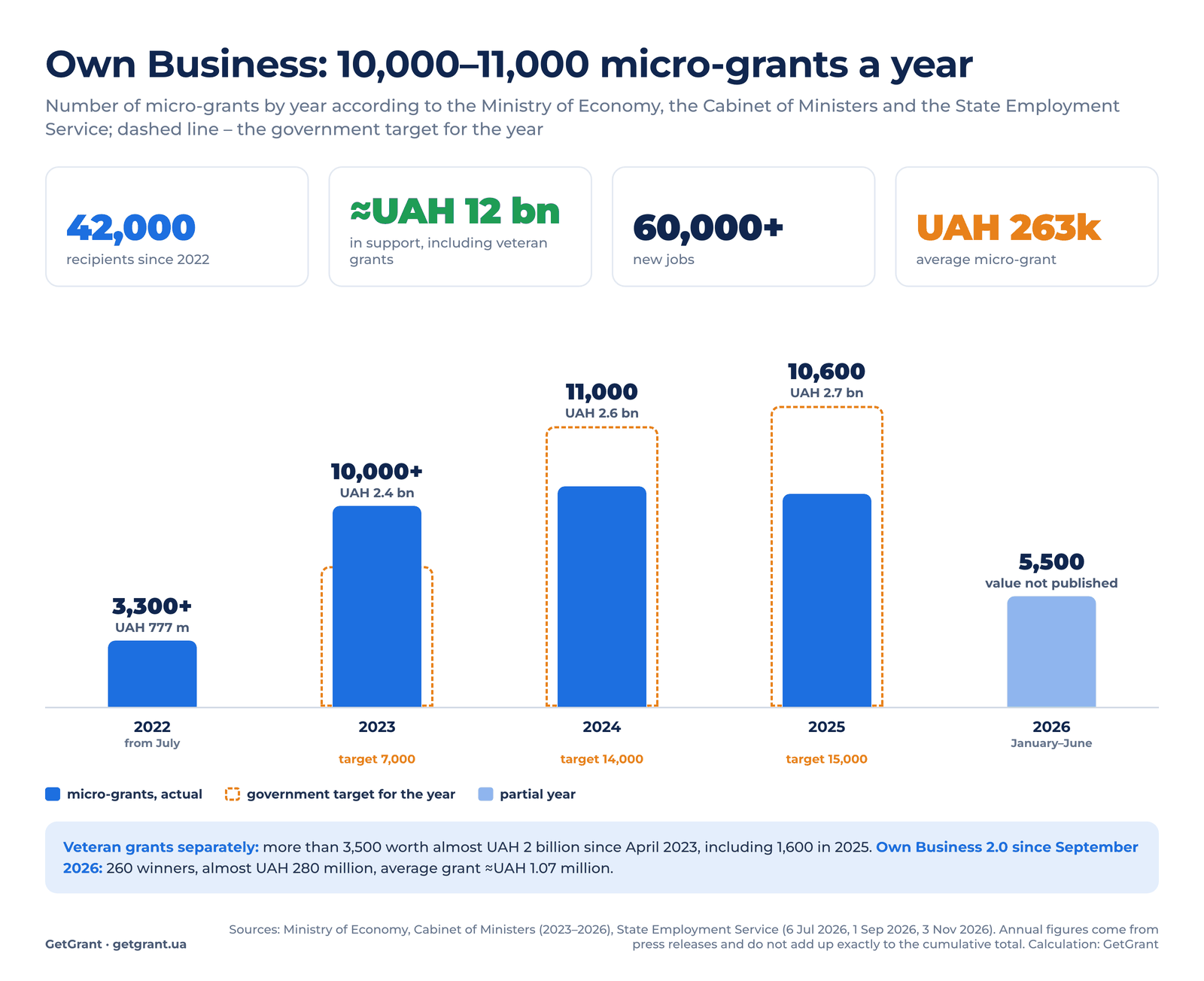
The programme started in summer 2022 with micro-grants of UAH 50,000 to 250,000. In the first six months more than 3,300 applicants received grants worth UAH 777 million. In 2023 the state awarded more than 10,000 micro-grants worth UAH 2.4 billion, although at the start of the year it planned “more than 7,000”. From April 2023 a separate strand opened for veterans, their family members and people disabled as a result of the war, with grants of UAH 250,000 to 1 million.
Then growth stopped. For 2024 the Ministry announced doubled funding of UAH 3.5 billion and 14,000 grants; by the end of the year there were 11,000 winners and UAH 2.6 billion. For 2025 more than UAH 3 billion and about 15,000 recipients were planned; in fact 10,600 entrepreneurs received micro-grants worth UAH 2.7 billion, plus 1,600 veteran grants worth UAH 766 million. In the first half of 2026, 5,500 micro-grants and 685 veteran grants were awarded.
The cumulative total as of 1 September 2026: 42,000 recipients, almost UAH 12 billion and more than 60,000 new jobs. The average micro-grant over the whole period is UAH 263,000.
The programme’s size is set by the budget of the Compulsory State Social Unemployment Insurance Fund that finances it, and in 2024–2025 the target number of grants was met by 70–79% (GetGrant calculation). In the new model the average grant is four times larger, so the same budget produces fewer winners per wave. In the first three waves of Own Business 2.0 (applications from 16 September), 260 entrepreneurs received almost UAH 280 million, 65% of them for scaling up.
Who receives grants: sectors, regions, recipient profile
Over the programme’s lifetime, according to the State Employment Service as of 1 September 2026, the largest shares of grants went to wholesale and retail trade and car repair (33%), accommodation and food service (14%), manufacturing (13%), health and social work (6%), and professional, scientific and technical activities (6%). The leading regions are Lviv region (13%), Kyiv city (8%), and Ivano-Frankivsk, Kyiv and Rivne regions (7% each).
Recipient profile: women 61%, men 39%; sole proprietors 68% of recipients; the most active age group among individuals and sole proprietors is 35–50 (almost 45%). Special strands: 4,016 micro-grants worth almost UAH 1.7 billion for frontline regions, 1,113 youth grants for entrepreneurs aged 18–25, 535 in the creative industries, and 163 in preschool education.
The veteran strand (April 2023 to July 2026) gave grant funding to more than 3,500 defenders and their family members, worth almost UAH 2 billion. 54% of recipients are combat veterans, 45% family members, and 1% people disabled as a result of the war; 77% chose a grant of up to UAH 500,000. Since 1 August 2026 the separate veteran procedure no longer accepts applications: veterans apply under the general Own Business 2.0 terms with a 20% bonus and a 1.25 coefficient on bank points.
The new rules are already changing the profile. In the wave announced on 3 November 2026 (178 winners, UAH 191 million), 65% of projects are in priority sectors, 18% in frontline territories, and 15% of recipients are VAT payers. Trade remained first by number of grants (24%), but manufacturing received more money: UAH 43 million against UAH 33 million.
How many are rejected: what open data shows
Official figures are scarcest here. The Ministry of Economy published an “applications vs recipients” pair only for 2022: more than 16,000 applications and more than 3,300 recipients. That means roughly one applicant in five received a grant (about 21%, GetGrant calculation). In September 2022 the Ministry cited 9,000 applications and 1,038 successful ones, but part of the applications was still under review at the time, so that ratio is not a rejection rate.
For 2023–2026 only wave winners and the cumulative number of applications were published (more than 20,000 micro-grant applications as of April 2023). The government has not published rejection rates by year, their breakdown by reason or average bank scores, so claims like “the bank screens out 80% of applications” have no official basis.
One thing is certain: in the new model an application passes three successive filters (business reputation, 99 bank points, 130 total points), and when more applications pass than there is money for, the grants go to those with the highest scores.
The 2026 rules at a glance: what Resolution No. 616 changed
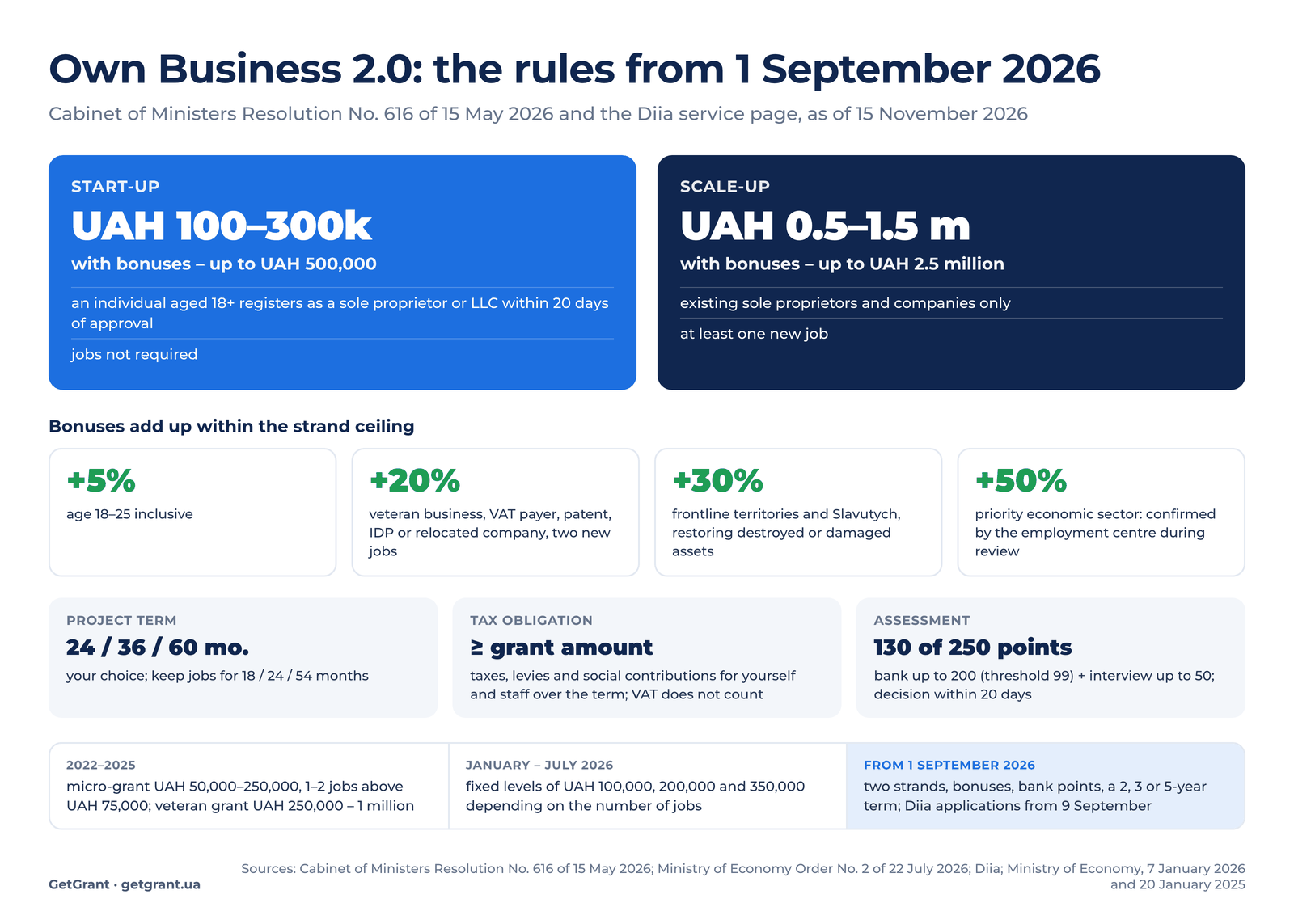
The programme has gone through three models. In 2022–2025 a micro-grant was UAH 50,000 to 250,000 with 1–2 jobs for amounts above UAH 75,000, and a veteran grant was UAH 250,000 to 1 million with 30% co-financing. From 1 January 2026 fixed levels applied: UAH 100,000, 200,000 and 350,000 depending on the number of jobs. Resolution No. 616 of 15 May 2026 stopped applications under the old procedures from 1 August and introduced the new model from 1 September; Diia has accepted applications since 9 September.
The essentials of Own Business 2.0:
- Two strands. Start-up: a base of UAH 100,000 to 300,000, up to 500,000 with bonuses, jobs not required. Scale-up: only for existing sole proprietors and companies, a base of UAH 0.5 to 1.5 million, up to 2.5 million with bonuses, at least one new job.
- Bonuses add up within the strand’s ceiling: +5% for ages 18–25; +20% for veteran businesses, VAT payers, patent holders, internally displaced persons with more than 6 months of business experience or relocated companies, and for two new jobs; +30% for frontline territories and restoring damaged assets; +50% for priority sectors, which the employment centre confirms during review.
- The project term is your choice: 24, 36 or 60 months. Jobs created must be kept for 18, 24 or 54 months respectively.
- Tax obligation. Over the project term the recipient must pay taxes, levies and social contributions for themselves and employees at least equal to the grant. VAT does not count. Otherwise the difference must be repaid.
- Own contribution is not required, but own funds above 50% of the project cost earn 20 of the 200 bank points. More on co-financing logic in our review of own contributions in grants.
- You choose the bank in the application: as of late October 2026, Sense Bank or Oschadbank. The decision is made within 20 calendar days after the application window closes.
The tax obligation is the most underestimated part. An illustrative example: a sole proprietor on the group 3 single tax (5% plus 1% military levy) with no employees takes a UAH 300,000 grant for 36 months. Their own social contribution over that time comes to about UAH 68,500; the remaining UAH 231,500 must come from the turnover tax, which means about UAH 3.9 million in revenue, or UAH 107,000 a month. Over 24 months it is about UAH 177,000 a month, over 60 months about UAH 52,000 (GetGrant calculation at 2026 rates). Taxes on employees’ salaries also count.
Bank points: 200 possible, 99 to pass
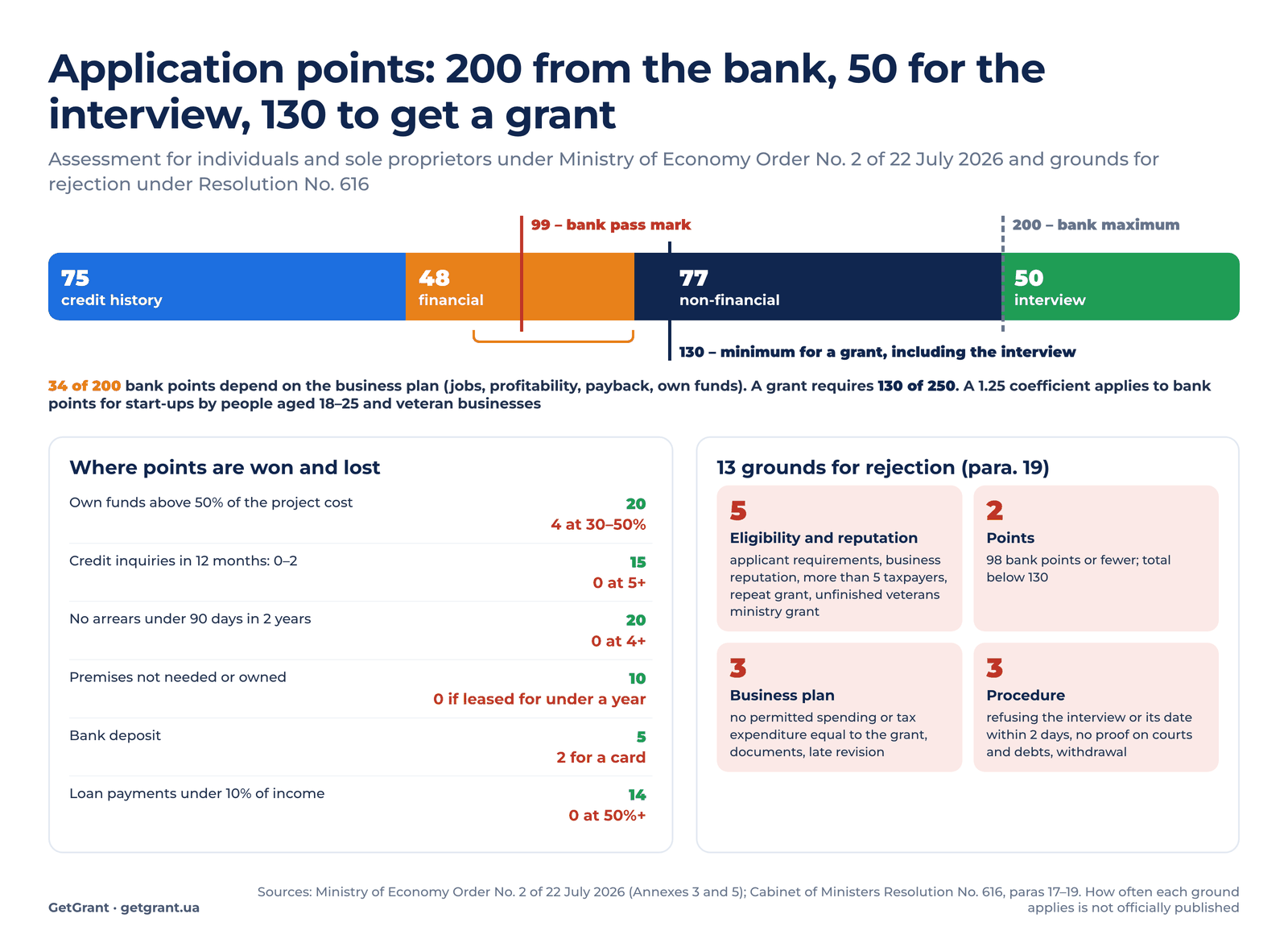
Assessment has two stages. First the authorised bank checks business reputation (no points here: one negative criterion and the application stops) and awards up to 200 points. The table for individuals and sole proprietors has three groups: credit history 75 points (37.5% weight), financial factors 48 (24%), non-financial factors 77 (38.5%). Applications with 99 points or more go to an interview at the regional employment centre, where five criteria add up to 50 points. A grant requires at least 130 out of 250.
The key takeaway: of the 200 bank points, only 34 depend on the business plan: jobs (up to 4), profitability (up to 6), payback (up to 4) and the share of own funds (up to 20). The rest is credit history, property, family, age, education and place of residence, and a perfect plan will not offset overdue loans in your credit history.
The biggest jump in the whole table is own funds: a share of 30–50% of the project cost earns 4 points, above 50% earns 20. The share is calculated from the sum of own funds and the grant, so it can also be raised by asking for a smaller grant.
For young people aged 18–25 without an established business reputation who apply for a start-up, and for veteran businesses, bank points are multiplied by 1.25. Young entrepreneurs with a certificate from the state mentoring programme skip the interview and receive the maximum score for it.
Why applications are rejected: 13 grounds in paragraph 19 of the Procedure
Paragraph 19 of the Procedure lists 13 grounds for rejection. They fall into four groups.
Eligibility and business reputation. The applicant does not meet the requirements (age, status, a prohibited activity code); negative business reputation on at least one criterion (tax debt, overdue loans, enforcement proceedings, seized assets, sanctions); the manager or founder holds such roles in more than five taxpayers, excluding charities and NGOs; a repeat application from someone who has already received a grant under this Procedure; a veteran who has not completed a project funded by a Ministry of Veterans Affairs budget grant.
Points. 98 bank points or fewer; a total score below 130.
Business plan and documents. The plan lacks permitted spending lines or expenditure on salaries, taxes and social contributions equal to the grant; the documents do not meet legal requirements; a revised plan was not submitted on time.
Procedure. Refusing the interview or not confirming its date within two days; failing to provide documentary proof of no court cases, enforcement proceedings, seized assets or tax debt; withdrawing the application before the decision.
The State Employment Service does not publish which grounds are triggered most often. But the structure of the assessment shows where there is least time to fix things: credit history (75 points) and business reputation take months to build, while a business plan can be rewritten in a week. So preparation should start with your credit history, not with the text of the plan.
How to prepare an application that passes the bank scoring
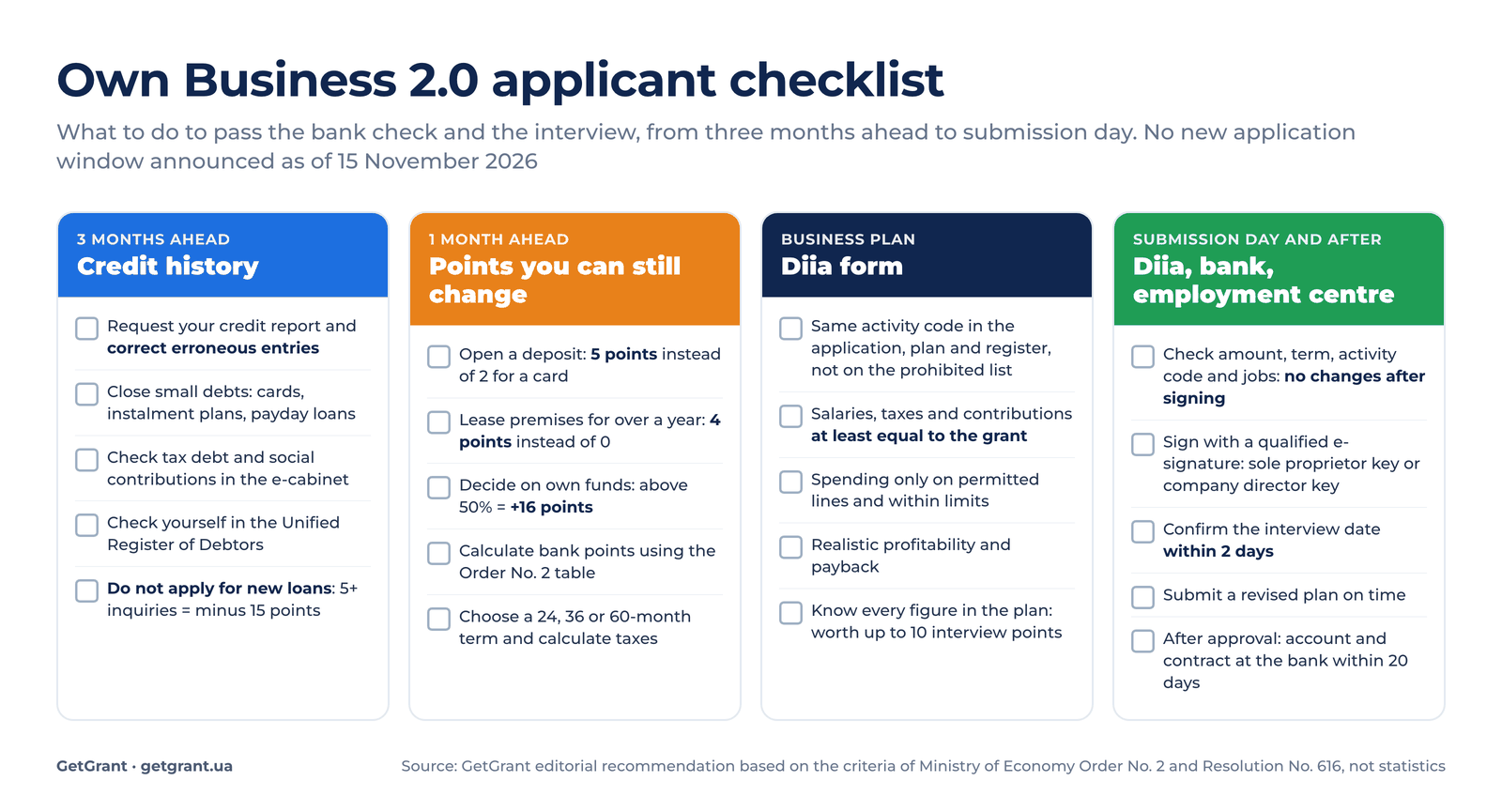
As of 15 November 2026 no new application window has been announced: the previous one on Diia ran until 27 October. This is the time to change the things that cannot be changed in a week.
Three months before submission. Request your credit report from a credit bureau and check it for erroneous entries: correcting them takes weeks. Close small debts on cards, instalment plans and payday loans; check for tax debts and social contribution arrears in the taxpayer’s e-cabinet, and check yourself in the Unified Register of Debtors. Do not apply for new loans: every credit inquiry in the last 12 months counts, and five or more inquiries cost you all 15 points for that criterion.
One month before. A deposit earns 5 points for bank services against 2 for a card account. Renting premises for more than a year earns 4 points, for up to a year 0; if the business does not need premises, say so – that is 10 points. Decide on your share of own funds: crossing 50% of the project cost adds 16 points. Calculate your bank points using the order’s table and the tax obligation for your chosen term.
While preparing the business plan. The activity code must match in the application, the business plan and the register, and must not be on the prohibited list (including 47.11, 68.20 and group 77). Show salaries, taxes and social contributions in the plan at least equal to the grant. Do not inflate profitability and payback: a payback of under a year earns just one point more than 1–3 years, while unrealistic figures cost more at the interview.
On submission day and after. Check the amount, term, activity code and number of jobs: once signed, the application cannot be changed. Watch your Diia account and email: the interview date must be confirmed within two days, and a revised plan must be submitted on time.
If you want a ready-made business plan on the official Diia form with a financial plan and obligation calculation, the next step is the Own Business 2.0 application generator (in Ukrainian, from UAH 4,900 per application).
Conclusion
In four years Own Business has awarded 42,000 grants worth almost UAH 12 billion and become Ukraine’s largest state support programme for small businesses. But its size is capped by the budget: the target has been missed every year since 2024, and with grants of up to UAH 2.5 million there are fewer winners per wave than before. Open data on rejections is almost non-existent: officially we only know that in 2022 roughly one applicant in five received a grant.
The new model is more transparent: all criteria are published in Order No. 2, so you can calculate your points before applying. Most of them do not depend on the business plan, so preparation should start several months before the application window, and the grant amount should be chosen based on how much tax you will realistically pay over the project term.
The GetGrant team helps calculate bank points and the tax obligation, prepare a business plan on the Diia form and find other programmes for businesses. Current calls are collected in the GetGrant catalogue, and programmes with assistance are on the grant support page.
Sources
- Cabinet of Ministers of Ukraine: Resolution No. 616 of 15 May 2026 amending Resolutions No. 738 and No. 1527
- Ministry of Economy: Order No. 2 of 22 July 2026 on application assessment (registered with the Ministry of Justice under No. 1185/46579)
- Diia: service “Starting and scaling up your own business”
- Cabinet of Ministers of Ukraine: Own Business 2.0, grants of up to UAH 2.5 million under new rules, 9 September 2026
- State Employment Service: Own Business, 4 years of support for Ukrainian business, 1 September 2026
- State Employment Service: UAH 191 million, results of the latest Own Business 2.0 wave, 3 November 2026
- State Employment Service: Own Business 2.0, almost UAH 86 million already, 21 October 2026
- State Employment Service: Oschadbank joins the programme, 30 October 2026
- State Employment Service: Own Business 2.0 questions and answers, 22 September 2026
- State Employment Service: 6,100 grants in six months of 2026, 6 July 2026
- Ministry of Economy: Own Business in 2025, 7 January 2026
- Cabinet of Ministers of Ukraine: Own Business, 15,000 Ukrainians can receive grants in 2025, 24 January 2025
- Ministry of Economy: Own Business, more Ukrainians can receive grants in 2025, 20 January 2025
- Cabinet of Ministers of Ukraine: more than 10,000 Ukrainians received grants in 2023, 22 January 2024
- Ministry of Economy: the government will double micro-grant funding in 2024, 9 October 2023
- Ministry of Economy: eRobota, more than 700 micro-grant applications since 1 February (2022 results), 13 February 2023
- Cabinet of Ministers of Ukraine: eRobota grant programmes, 1,115 Ukrainians to receive funding, 5 September 2022
- Diia: list of activity codes not eligible for eRobota grants
Open eRobota calls
- 7 programmes for Ukrainian businesses and veterans
- Veteran business in Khmelnytskyi: the city reimburses 50% of the own contribution to an eRobota grant
- eRobota: Own Business – Starting a Business up to UAH 500,000
- Veteran Business Grants in Ukraine 2026: The Complete Guide

Book a consultation or leave your application idea
Tell us in a few words about your project: we will say which grants it fits and can take the application itself off your hands. We reply within one business day.