Learn how to avoid the typical mistakes in preparing a Horizon Europe proposal and secure funding for your project.
Horizon Europe is the largest grant programme of the European Union, supporting innovation and creative research by talented and capable researchers from EU Member States and associated countries. Information on the programme’s open calls across its various areas can be found on the dedicated Funding and Tenders Opportunities portal. There you can also review the call requirements, the list of expected outcomes a project must deliver to receive funding, and the document templates that need to be prepared before submitting a proposal. The programme’s budget for 2021–2027 is EUR 95.5 billion. This amount makes it possible to allocate grant funding rationally and objectively, on a competitive basis, among the most deserving research and innovation projects and newly formed consortia.
A grant is non-repayable financial assistance awarded to applicants (grantees) on a competitive basis for a defined period in order to carry out predefined tasks described in a project proposal (project) submitted to the relevant funder (the party providing the money) in accordance with the established funding rules.
For most EU countries that have national public funding for research and technology projects, securing additional grant funding under Horizon Europe is regarded as a prestigious achievement. Universities and research institutions in particular invest considerable effort in attracting grant funding, as it gives them new opportunities to build consortia, find partners and master new research and analytical technologies.
To win a call and obtain funding from the European Commission, you need to convince the experts who will assess your proposal that, out of all the projects submitted to the call, yours is the one that deserves support. When preparing your proposal, keep in mind that the evaluators reviewing it may not be narrow specialists in your field. There is therefore no need to overload your project with terminology and references to specialised literature: this makes the content harder to understand and, in turn, lowers your chances of success. By contrast, graphics and diagrams that visually explain the key ideas and innovative approaches to be used in the project are an important feature of a winning proposal.
Having prepared more than 30 proposals and advised more than 100 people on various Horizon Europe calls, we can identify several of the most typical mistakes applicants make when they start preparing a proposal for the programme’s calls. Drawing on our experience in project work, we also offer some recommendations on how to avoid them.
Mistake 1. Choosing the wrong call
The title of a call does not always tell you whether it really suits you, so you should study the call requirements, which describe the challenges the call is designed to address. For example, if a call is titled “Development of 2D materials to improve the efficiency of photonic devices”, the title alone may suggest that it will fund projects creating any materials that improve the efficiency of photonic devices. However, if you read the scope and the expected outcomes that submitted projects must target in detail, you will see that the materials must be graphene-based and that the photonic devices have a defined range of applications with clear limitations. Accordingly, if you propose a project that may be innovative in concept but does not meet the stated requirements, it may simply be left unconsidered or receive low scores as not matching the objectives of the call.
Another important point that can be overlooked when choosing a call is the required Technology Readiness Level (TRL) that the project must reach by its end. As is well known, there are 9 technology readiness levels (see Fig. 1): TRL1 – basic principles observed, TRL2 – technology concept formulated, TRL3 – experimental proof of concept, TRL4 – technology validated in the lab, TRL5 – technology validated in a relevant environment, TRL6 – technology demonstrated in a relevant environment, TRL7 – system prototype demonstrated in an operational environment, TRL8 – system complete and qualified, TRL9 – actual system proven in an operational environment.
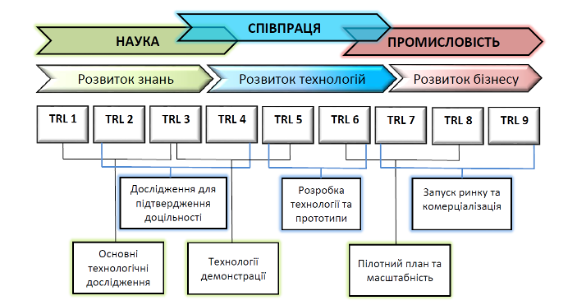
Fig. 1. Relationship between different interpretations of the Technology Readiness Level (TRL)
Increasingly, Horizon Europe calls require projects to end at TRL5. So if you submit a project focused on testing hypotheses and verifying results (fundamental research), it will be rejected however innovative it is, because the final output of the project must be a developed and manufactured laboratory prototype, not merely verification of an algorithm or method, as at the early TRLs.
Accordingly, before you start working on a proposal, check whether your area of activity and the project objectives match those expected of projects eligible for funding under the programme, and whether the TRL of your development corresponds to the level set out in the call requirements.
Mistake 2. Reading the call conditions carelessly
Another very common mistake is reading the submission conditions carelessly or, to be more precise, ignoring the clear submission conditions and the tasks the project is expected to carry out. Let us consider two approaches to designing a project that addresses the challenges set out in the call conditions: Bottom-Up and Top-Down. The Bottom-Up approach assumes that the planned tasks carried out by the project participants will lead to a new innovative solution with an important impact on modern science and technology, although the outcome of such a discovery cannot be predicted in advance. The Top-Down approach, by contrast, assumes that specific targets for improvement have already been defined and that we must devise an approach to achieve them. The Bottom-Up approach is used more in MSCA and CSA projects, while the Top-Down approach underpins RIA / IA projects.
Very often in RIA projects, for example, you need to demonstrate a 17% increase in the efficiency of laser diodes of a given class and range (a specific improvement target must be met). In its proposal, a group of researchers puts forward a set of tasks for developing a new laser with higher efficiency (new tasks that might plausibly lead to a similar improvement). However, regardless of how innovative the proposed project and its tasks are, such a project will not be funded, because the call conditions clearly state which conditions must be met and which challenges the funded project must address.
Accordingly, to submit a project that can actually be funded, you do not need to convince yourself or the funder that your idea is more interesting or more innovative. You need to follow the call requirements strictly, or find another call whose conditions allow your project to be funded and whose results will have the greatest impact on the scientific and technical community and on society as a whole.
Mistake 3. Vague and unclear formulation of the project objectives and tasks
Every researcher carrying out innovative research is, by nature, a brilliant innovator. And as we know, geniuses and their deeds are often misunderstood by most people, and their inventions are not appreciated in time. So for your contemporaries to grasp the full potential of the ideas in your new project, you need to express them rationally and concretely. Very often, with an idea for a project in mind, a researcher tries to describe everything that comes to mind for solving a particular problem, and in such a way that it is hard to identify the main idea of the project or even the secondary objectives it is supposed to achieve. One argument researchers often make is that the essence of the project and its objectives can be understood anyway from the text, with its heavy terminology and possibly formulas.
Accordingly, to make the evaluator’s job easier, formulate the project objectives and tasks as clearly as possible, highlight them separately in the proposal where you can, and describe the essence of the work as concisely as possible, without unnecessary analogies. Remember that during the evaluation each evaluator has a few hours to read the proposal, give scores and write a comment for each score. Evidently, they will not have time to dig very deeply into the project, follow links or imagine what else might be interesting there. Instead, they will rely on the key points that you yourself present in a structured way in the proposal, giving the evaluator a clear picture of how the project will be implemented. If you manage to do this, you will be one step closer to success.
Mistake 4. Insufficient description of the project participants
The ideal model for preparing a proposal is when like-minded experts on the project topic from different countries (partners) come together and jointly design the tasks, taking into account each participant’s strengths and weaknesses, allocate person-months of involvement according to the staff each partner provides, and plan the distribution of tasks in line with the description of each part of the proposal. However, such ideal models of cooperation are extremely rare. Quite often, writing the proposal falls on the shoulders of one person, usually the coordinator. As a result, without information on a partner’s activities and achievements, the proposal will lack a detailed description of the partner and its competences, or that description will be very limited. Evaluators may treat this as a weakness of the project and lower the scores.
To avoid losing points, contact your partners in advance and ask them to provide the necessary information about themselves and their organisation. If a partner does not provide it, we recommend finding the information yourself in open online sources in order to show each partner’s contribution and outline the capacity to implement the project. You can assign this to a member of your research group or to someone else involved in preparing the proposal.
Mistake 5. Too many tasks assigned to one project participant
In practice, the project coordinator very often tries to take on most of the tasks, as the one who fully understands how the project is to be implemented and who potentially has enough people and equipment to carry it out. However, most Horizon Europe projects require a consortium of participants who carry out the project tasks jointly. In addition, under the requirements of most calls, no single participant may account for more than 40% of the project budget.
The European Commission closely monitors the allocation of resources and the time spent on the project. Accordingly, evaluators quite often comment that one organisation carries out most of the project tasks and that the proposed consortium may look fictitious if the participants are not substantially involved in implementing the project.
To avoid losing points, it is important to correctly identify your partners’ strengths and describe them in the project, and to delegate to them tasks that match their professional profile. And remember to keep a proper distribution of person-months across all consortium members.
Mistake 6. A short and formal description of the dissemination of project results
For most academic staff involved in preparing Horizon Europe proposals, dissemination of their project results is limited to publishing articles in journals with a good impact factor, filing a patent, presenting at conferences and perhaps holding 1-2 workshops for project participants. The European Commission, however, takes a different view: the application form even devotes a whole section, Impact, to this. There you must give a detailed description of how the results will be disseminated and how the proposed dissemination plan will raise the target audiences’ awareness of the project’s results, both scientific and societal.
Accordingly, to avoid losing points in this part of the proposal, your dissemination plan must clearly identify which project result we expect to obtain, what we will do for this, who our target audience is and what the expected outcome of these activities is (quantitative indicators). Similarly, you need to set out a plan for communication activities, describing the actions to disseminate project results to the general public (producing and distributing handouts, videos about the project and its participants, setting up and running social media channels, etc.). And of course, do not forget the scientific, societal and economic impact of implementing your project, which must also be described in detail, with concrete facts and areas of application, rather than formally.
Mistake 7. No description of open science practices and the FAIR principles
Since 2021, open science practices have been actively introduced in Horizon Europe programmes. They mean that anyone interested can access information on project results and published data free of charge. For this purpose the European Commission allows separate cost items to be included in the project, and a detailed plan for such measures makes it possible to disseminate the main results to a wide audience as effectively as possible. However, researchers by their nature tend not to share such data early and mostly limit themselves to publishing a journal article, which is clearly not enough to provide maximum access to the data and results obtained in the project.
For your proposal to be scored well, it must include a detailed description of the open science practices for your project (a data management plan (DMP), clearly defined data types that are the same for all participants, the way they will be exchanged and disseminated, repositories for preprints of research papers (Zenodo, OpenAIRE) and for software code (GitHub), and access to open data and project results). In addition, you need to describe how the FAIR principles will be followed in the project: identify the types and formats of data, where they will be stored, the conditions under which they will be accessed and who will be responsible for this (during the project and after its end), how the data can be verified, who will pay for hosting the data, and what guarantees there are for data preservation and reliability.
Mistake 8. An incorrectly prepared project budget
We work long and hard on a proposal to attract funding, but when it comes to drawing up the project budget, applicants very often make various mistakes that lower their scores or even lead to the proposal being disqualified at the evaluation stage. The most typical mistakes are the lack of a description of how the money will be used (for example, EUR 30 thousand is allocated for measurement materials, but there is no detail on what these materials are), or a final project budget, filled in online in the system at submission, that does not match the detailed explanations provided for each participant of what the money is to be spent on. This often happens when the budget goes through several iterations of changes and the latest corrections are forgotten, or when different cost categories are added up incorrectly.
To keep your proposal from being rejected at the technical check, verify the declared project budget against the tasks described in the proposal and check that it complies with the call requirements. For example, if the maximum amount for equipment purchases is EUR 500 thousand and you have entered EUR 720 thousand, the budget is incorrect and is grounds for disqualifying the proposal. You should also check that the final project budget equals the sum of the detailed budgets of each participant.
Mistake 9. Grammatical errors in the application form
It is hard to overstate how important it is to be able to express your thoughts correctly. And it is even harder to judge how much the quality of your writing can affect the final score given by evaluators. All proposals submitted to Horizon Europe calls are written in English, which for most applicants is not their native language. As a result, applicants quite often try to use Google Translate as the only tool on the way to the desired success. However, it can mistranslate the meaning of words in a sentence and, as a result, change the meaning of the sentence itself.
To avoid evaluators commenting on a poor level of English, we recommend bringing a professional translator with expertise in your field onto the team to translate and proofread the proposal. We also recommend involving partners or colleagues from other institutions who have a high level of English and can reread the proposal and make corrections where needed. And use Grammarly, which helps you check spelling, the use of articles and correct sentence structure.
Conclusions
To sum up, I would like to quote the Chinese philosopher Lao Tzu: “A journey of a thousand miles begins with a single step.” I believe you have already begun your journey into the world of grant writing and are confidently moving towards your first Horizon Europe grant. Preparing a proposal and winning a Horizon Europe call at the first attempt is quite a challenging task. Our team won its first grant, back under Horizon 2020, in 2017, after applying to the same call three years in a row, taking the experts’ comments into account and resubmitting the updated project. After that it became easier, and new wins, including under Horizon Europe, were expected, but the most memorable is the first project to receive grant funding. Taking the mistakes described above into account when preparing your proposal will save you some time and help you reach your first Horizon Europe-funded project much faster.
Want to be the first to hear about new grants?
Subscribe to our newsletter – learn about new opportunities as soon as they are published!
Leave your email in the form below and we will send you only what matters most.
Open Horizon Europe calls
- European Prize for Women Innovators 2027: up to €100,000 for women founders of innovative companies, up to €50,000 for those under 35, Ukraine eligible, apply by 1 Decemberuntil 01.12.2026
- Horizon Europe: EUR 4.5m for geothermal assessmentuntil 01.12.2026
- Prize of up to €50,000 for young female founders of innovative companiesuntil 01.12.2026
- WoodStock Grants: up to €50,000 for SMEs, start-ups and non-profits from the EU and Horizon Europe associated countries for zero-waste timber construction, apply by 15 Decemberuntil 15.12.2026

Book a consultation or leave your application idea
Tell us in a few words about your project: we will say which grants it fits and can take the application itself off your hands. We reply within one business day.