An analytical map of funding for veterans, their families and veteran organisations in Ukraine: Ukrainian Veterans Fund results, the Own Business 2.0 bonus, IREX calls and the 2027 budget.
In 2026, funding for veterans stopped being a collection of one-off “opportunities”. The law on veteran entrepreneurship entered into force, a separate legal status for veteran businesses appeared, and the state and donors rebuilt their programmes around it. As a result, general advice along the lines of “veterans get grants” is of little use any more: who exactly applies and with what status now determines the amount, the list of available programmes and even whether two forms of support can be combined.
In this article we do not repeat the general list of eligibility requirements. Instead, we look at the figures: how many applications were submitted and how many won in the Ukrainian Veterans Fund competitions, how the veteran bonus works in Own Business 2.0, how often and for what amounts IREX announces calls for civil society organisations, what the draft 2027 budget provides and where You should apply. All conditions have been checked against primary sources as of 23 October 2026.
Short answer
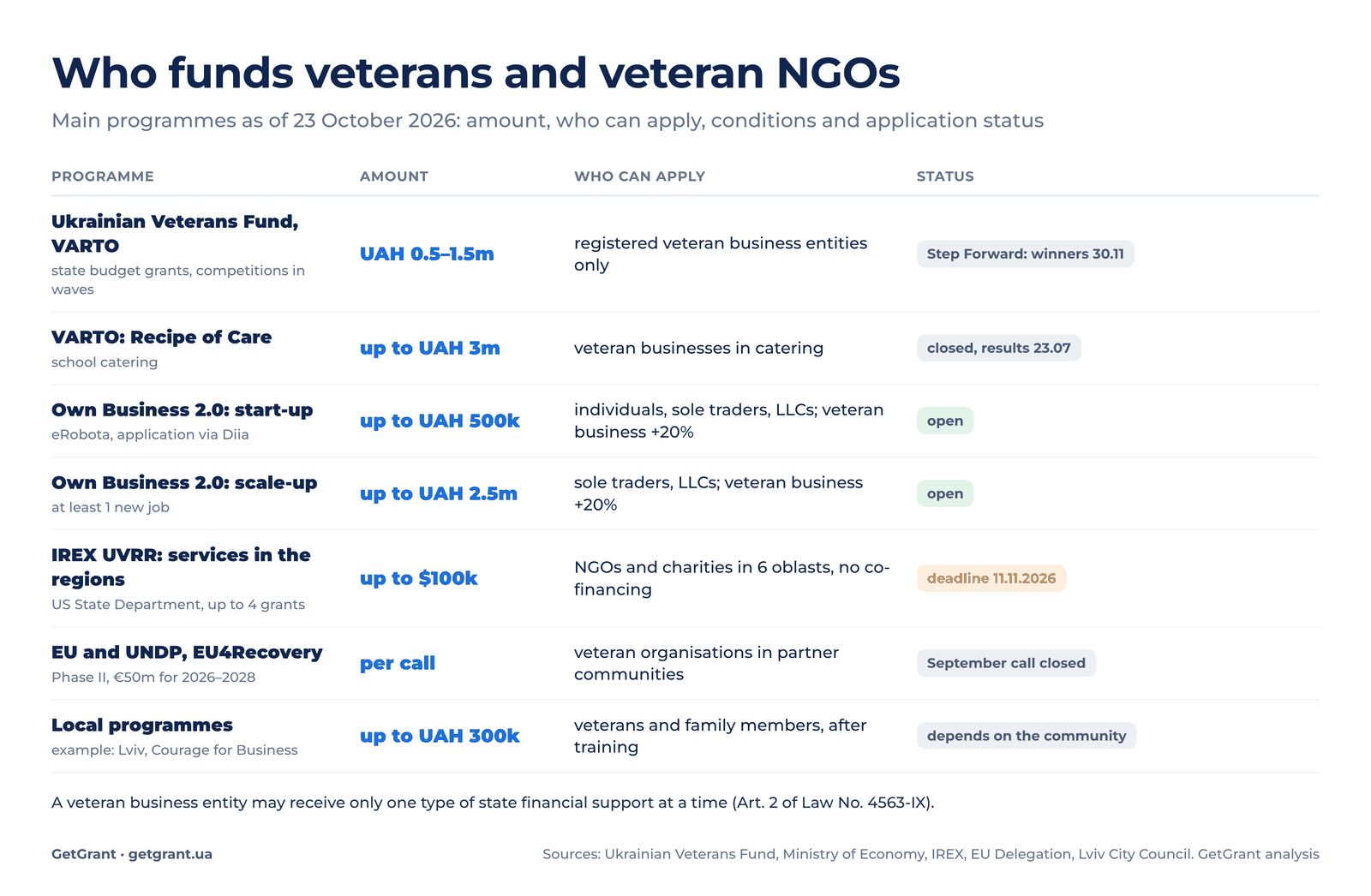
- In 2026 the largest sums for veteran businesses came from the Ukrainian Veterans Fund of the Ministry of Veterans Affairs: in two completed VARTO competitions, 301 winners will receive over UAH 426 million, with grants of UAH 500,000 to 1.5 million and up to UAH 3 million in a specialised competition. Since May, only registered veteran business entities may apply.
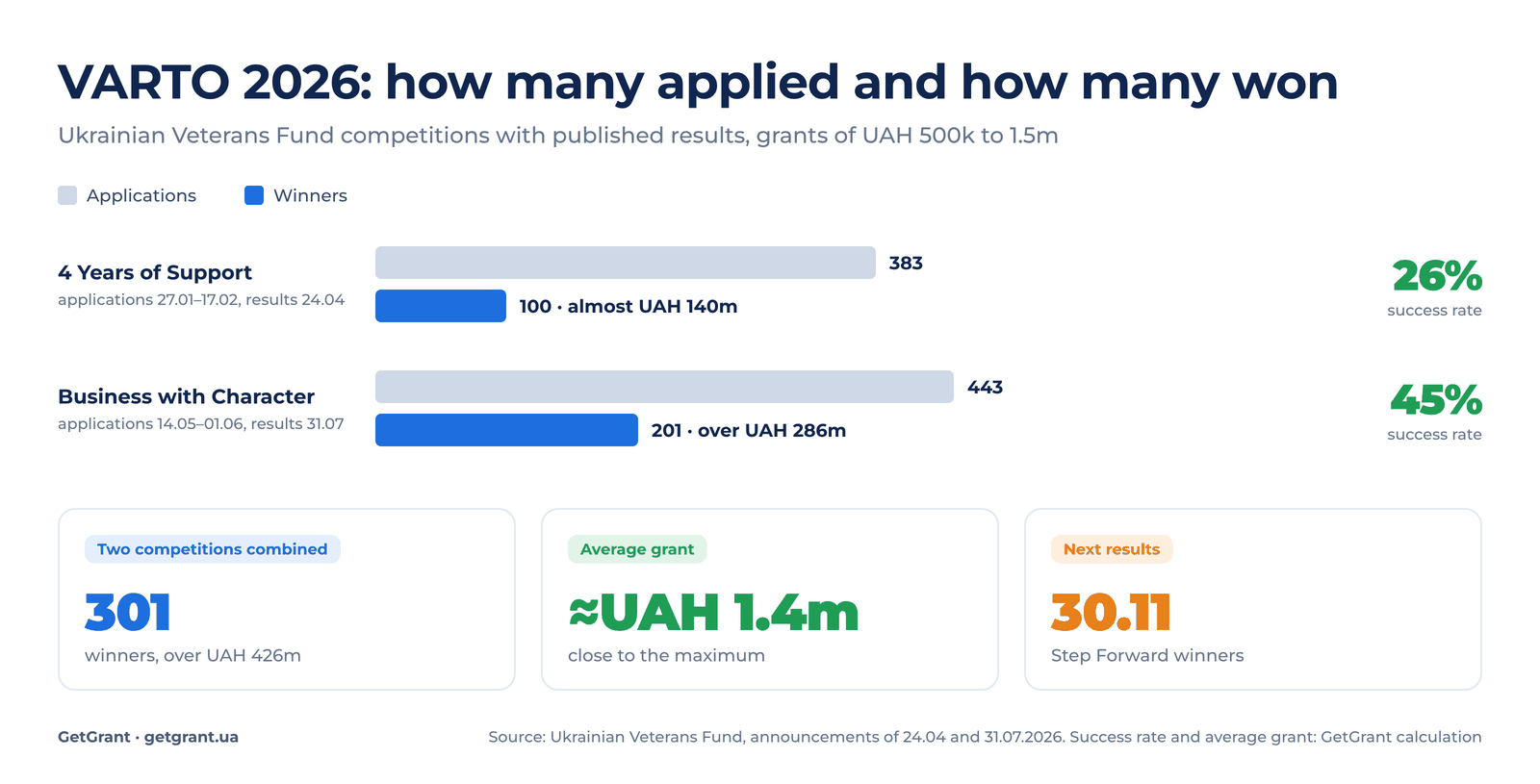
- The chances in the Fund’s competitions are real: in VARTO: 4 Years of Support one application in four won (100 of 383), and in VARTO: Business with Character almost one in two (201 of 443).
- Own Business 2.0 gives veteran businesses a +20% bonus on the base amount. The ceiling is UAH 500,000 for a start-up and UAH 2.5 million for scaling up. Applications have been accepted since 9 September 2026.
- For civil society organisations the main donor is the UVRR programme, funded by the US Department of State and implemented by IREX. In ten months it announced ten calls of USD 70,000 to 520,000, but the application window is usually about four weeks. One call is open now: up to USD 100,000 for NGOs in six oblasts, deadline 11 November 2026.
- The law allows a veteran business entity to receive only one type of state financial support at a time. A Fund grant and an Own Business grant have to be planned one after the other, not in parallel.
- The draft 2027 budget provides UAH 20.5 billion for veteran policy, UAH 3 billion more than in 2026. The final figures depend on the Verkhovna Rada.
What changed in 2026
The key event of the year is the Law of Ukraine “On Veteran Entrepreneurship” No. 4563-IX, which entered into force on 26 February 2026. It introduced the status of a veteran business entity. It can be obtained by war veterans registered as sole traders or self-employed persons, and by legal entities whose founders and beneficial owners are exclusively veterans. The status is granted for five years and is obtained online on the Diia portal with a qualified electronic signature.
Three provisions of the law matter for funding:
- business support funds at national, regional and local level must direct at least 10% of the budgets of their financial support programmes to veteran businesses;
- up to 5% of the relevant budget procurement programmes may be reserved for veteran businesses;
- a veteran business entity may receive only one type of state financial support at a time.
The second change concerns the programmes themselves. On 1 August 2026 the acceptance of applications under the old micro-grant rules ended, including the separate terms for combatants and their family members, and on 9 September Own Business 2.0 was launched, in which veteran support became a bonus on the grant amount. At the same time, the Ukrainian Veterans Fund moved to a status requirement: in the VARTO competitions announced since May 2026, only a veteran business entity may apply.
Ukrainian Veterans Fund: the largest amounts and real chances
The Ukrainian Veterans Fund is a state budget institution under the Ministry of Veterans Affairs. It runs its competition programmes under the common name VARTO. According to the Fund, as of April 2026 total funding under these programmes had reached about UAH 1 billion.
In 2026 the Fund announced four competitions:
- VARTO: 4 Years of Support, in partnership with Kernel. Applications from 27 January to 17 February, grants of UAH 500,000 to 1.5 million. 383 applications were submitted, 100 winners were selected on 24 April, and total support amounts to almost UAH 140 million.
- VARTO: Business with Character, also with Kernel. Applications from 14 May to 1 June, grants of UAH 500,000 to 1.5 million. 443 applications were submitted, 201 winners were selected on 31 July, and total support exceeds UAH 286 million.
- VARTO: Recipe of Care, together with the School Meals Reform Team and supported by the MHP-Hromadi charitable foundation. Grants of UAH 500,000 to 3 million for veteran businesses that provide school catering. Applications ran from 2 to 24 June, and the winners were announced on 23 July.
- VARTO: Step Forward. Applications from 7 to 29 September 2026, grants of UAH 500,000 to 1.5 million. Public project pitches are scheduled for 17–24 November, and the winners will be announced on 30 November 2026.
Three practical conclusions follow from these data.
First. Competition at the Fund is lower than applicants usually expect: the success rate was 26% and 45%. At the same time, the number of applications per competition is measured in hundreds rather than thousands, which means the status and documentation requirements screen out a significant share of potential applicants before they apply.
Second. The average grant is well above the minimum: in both competitions it was about UAH 1.4 million. In other words, winners mostly requested an amount close to the maximum and justified it with a cost estimate.
Third. The Fund works in waves with a predictable cycle: three weeks for applications, technical screening, expert assessment, a public pitch and a decision two to three months after the call closes. Anyone who missed the September competition should start preparing a cost estimate for the first waves of 2027 now.
An important restriction: in VARTO competitions announced after the law entered into force, only war veterans as defined by the law on veteran entrepreneurship may apply, that is, the categories set out in paragraphs 19–25 of part one of Article 6 of the Law “On the Status of War Veterans and Guarantees of Their Social Protection”. Persons who obtained war veteran status on other grounds cannot acquire veteran business status. Family members of veterans and of fallen defenders are not admitted to these competitions as separate applicants, although the Fund supports them through other services.
“The employment of veterans is one of the key challenges the state is working on today.”
Yuliia Kirillova, Deputy Minister of Veterans Affairs of Ukraine, at the presentation of a study by the Ukrainian Veterans Fund and robota.ua, 6 October 2026. Translated from Ukrainian.
Own Business 2.0: a veteran bonus instead of a separate programme
Until August 2026 the eRobota programme had a separate “Grants for veterans” strand with fixed amounts depending on the number of jobs created. The new model has no separate strand. Instead, a veteran business entity receives a +20% bonus on the base grant amount.
The programme has two strands:
- start-up: a base amount of UAH 100,000–300,000, up to UAH 500,000 with bonuses, with no obligation to create jobs. After approval, the applicant must register as a sole trader or LLC within 20 calendar days, and a veteran must obtain veteran business entity status specifically to receive the bonus;
- scale-up: a base amount of UAH 0.5–1.5 million, up to UAH 2.5 million with bonuses, with at least one new job.
The veteran bonus adds up with others: +20% for a VAT payer, a patent, internally displaced status with business experience or two new jobs, +30% for operating in a frontline region or restoring damaged assets, and +50% for a priority sector. For example, a veteran business with a base amount of UAH 1 million operating in a priority sector and in a frontline oblast would in theory gain +100%, that is UAH 2 million. The total cannot exceed the ceiling of the strand.
The main obligation is the same for everyone: over the project period, pay taxes and the single social contribution of no less than the grant received. The project period can be chosen: 2, 3 or 5 years. We analysed the mechanics of bonuses and the tax burden in detail in eRobota in 2026–2027: what changed in Ukraine’s state business grants.
What this means for families. In 2026, before the switch to the new model, the government separately introduced grants of up to UAH 1 million for family members of fallen and missing Defenders, conditional on job creation. The Ministry of Economy states that the new model retains dedicated support for the families of the fallen, but the announcement does not set out a specific mechanism. The +20% bonus is tied to veteran business status, which a family member cannot obtain. So for the wife or father of a fallen defender, Own Business 2.0 works on general terms with the other bonuses, in particular for region and sector.
Veteran NGOs: how IREX works and why it pays to watch the announcements
For civil society organisations and charitable foundations providing services to veterans, the key source in 2026 remains the Ukraine Veteran Rehabilitation and Reintegration programme (UVRR). It is funded by the US Department of State and implemented by the International Research and Exchanges Board (IREX). We analysed all the calls for organisations that the programme announced between December 2025 and October 2026.
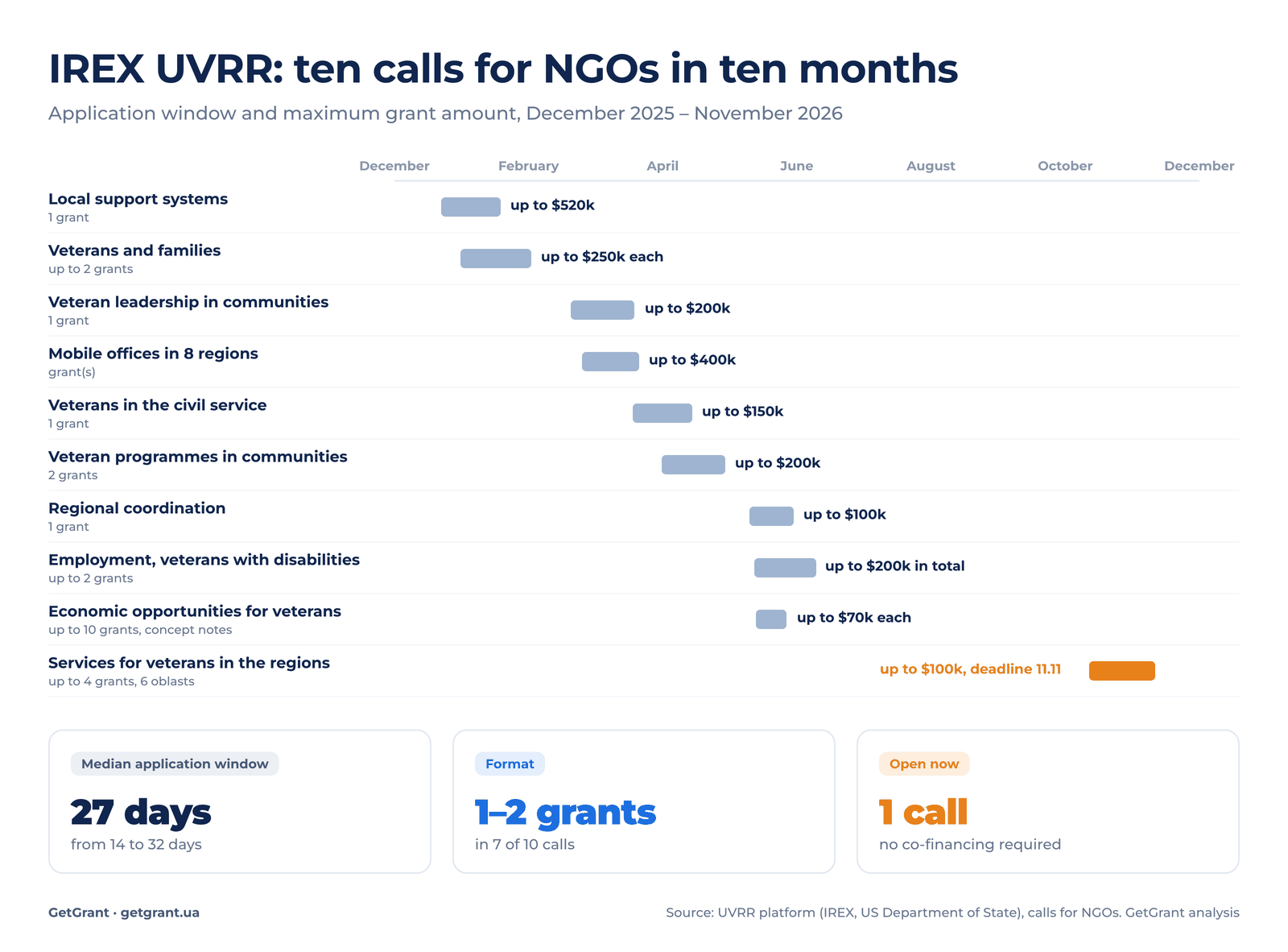
The picture is as follows:
- ten calls in ten months, that is one a month on average;
- an application window of 14 to 32 days, with a median of about 27 days;
- mostly one or two large grants per call: up to USD 520,000 to strengthen local support systems, up to USD 400,000 for mobile offices in eight regions, up to USD 250,000 to support veterans and their families, up to USD 200,000 for veteran leadership and for employment models for veterans with disabilities;
- only one call was designed for a wider range of small organisations: up to 10 grants of up to USD 70,000 to strengthen veterans’ economic opportunities, with a first stage in the form of concept notes.
The current call, “Comprehensive services for veterans in the regions”, was announced on 12 October 2026. IREX plans up to four subgrants of up to USD 100,000 each for projects lasting up to 10 months from December 2026. Geography: Volyn, Zakarpattia, Zaporizhzhia, Poltava, Cherkasy and Chernivtsi oblasts outside the oblast centres, with priority for rural and hard-to-reach communities. Services: social support, mental health and psychosocial support, employment counselling and legal aid. No co-financing is required.
The analytical conclusion for NGOs is simple: the programme does not accept applications “at any time”, and small organisations rarely manage to assemble a package with a budget, letters of support from the authorities and procurement policies from scratch within four weeks. Basic documents should therefore be kept ready in advance, and memoranda with local authorities should be signed before a call is announced. It is also worth bearing in mind that IREX explicitly expects winners to plan how services will continue after the project without depending on US funding.
Other donors are also strengthening their veteran focus. In May 2026 the EU and UNDP launched the second phase of the EU4Recovery programme, worth €50 million for 2026–2028, with a particular focus on veterans, youth and people returning to their homes. In September a call for veteran organisations was announced under it, and applications have already closed. Future calls are worth following in the programme’s partner communities, primarily in Dnipropetrovsk, Zaporizhzhia, Mykolaiv, Sumy, Kharkiv, Kherson and Chernihiv oblasts.
Local programmes and compensation for employers
Because of the legal requirement to direct 10% of business support fund budgets to veteran businesses, oblast and city programmes are becoming a noticeable source of start-up capital. One example is the Lviv city programme Courage for Business, which combines training with a grant of up to UAH 300,000 for veterans and their family members. The terms of such programmes depend on the community, so check them on the website of Your city council or oblast military administration.
If Your company is not looking for a grant but is hiring veterans, a different mechanism applies: the state compensates part of the salary of a veteran hired on referral from an employment centre. We analysed the conditions and calculations in our article on compensation for employers in 2026.
Budget 2027: what is known
The government approved the draft State Budget for 2027 in September 2026. It allocates UAH 20.5 billion to veteran policy, UAH 3 billion more than in 2026. The Ministry of Veterans Affairs does not give a breakdown by individual programmes in its announcement, including for Ukrainian Veterans Fund grants. The draft is still being considered by the Verkhovna Rada, so planning around specific 2027 amounts is only possible once the budget law is adopted.
It is also worth knowing that the Ministry of Veterans Affairs has already announced that the October stage of the Veteran Sport programme will not start this year because the funds have run out. The programme’s 2026 budget was UAH 600 million, while payments exceeded UAH 1.2 billion. The format and scale of the programme in 2027 will depend on the budget. This is a telling signal: state programmes operate within annual limits, and the end of the year often means a pause for them.
Who You are and where to apply
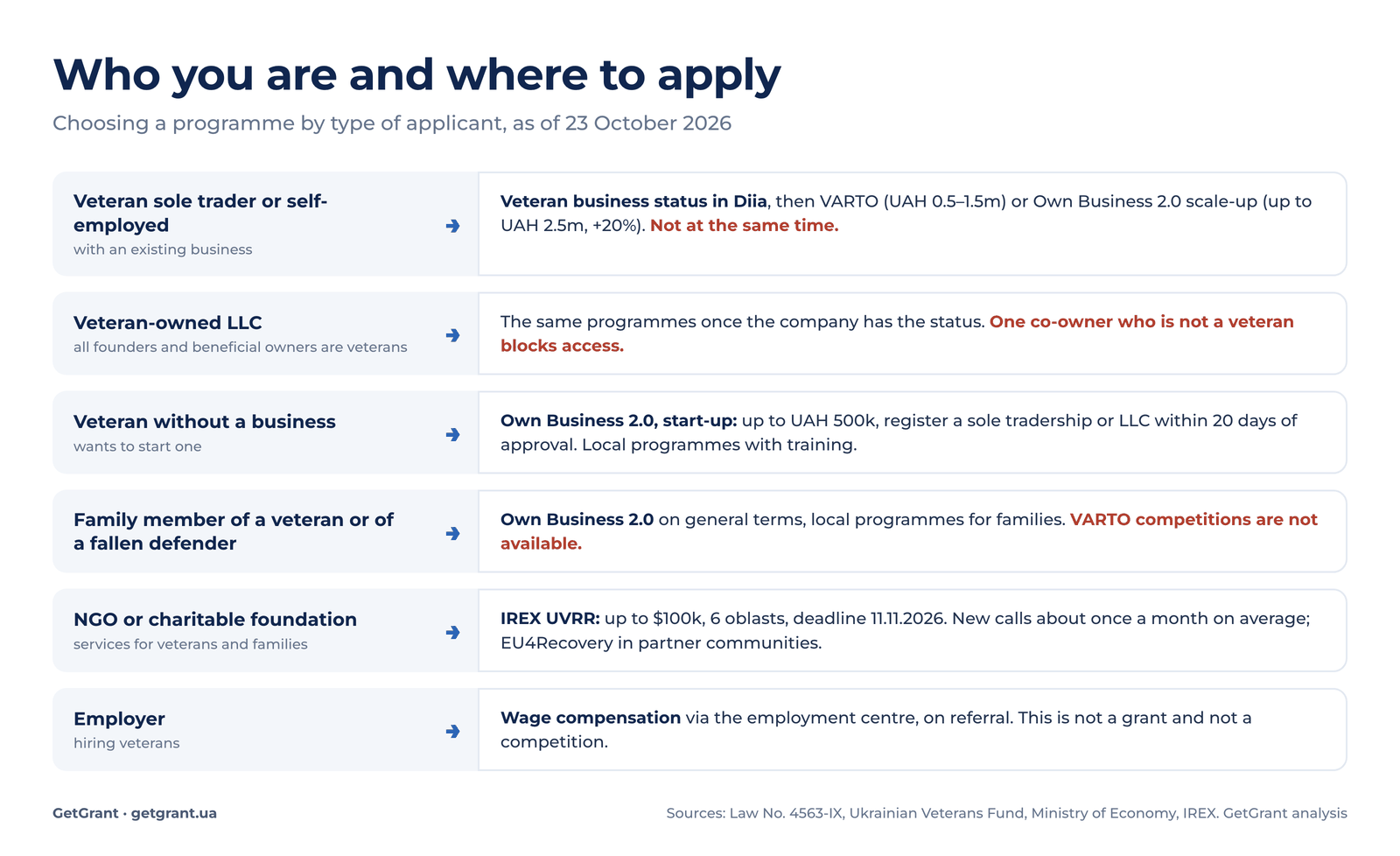
- Veteran sole trader or self-employed person with an existing business. First obtain veteran business entity status. Then there are two routes: the Fund’s next VARTO competition (up to UAH 1.5 million, up to UAH 3 million in specialised competitions) or Own Business 2.0 for scaling up with a +20% bonus. The two cannot be combined at the same time, so choose according to the size of Your need and Your readiness to meet the tax obligations.
- An LLC whose founders and beneficial owners are all veterans. The same programmes once the status has been obtained for the legal entity.
- Veteran without a business. Own Business 2.0 for a start-up, up to UAH 500,000 with bonuses, and local programmes with training.
- Family member of a veteran or of a fallen defender. Own Business 2.0 on general terms and local programmes that explicitly include family members. VARTO competitions are closed to this category.
- NGO or charitable foundation working with veterans. IREX UVRR calls, currently up to USD 100,000 until 11 November in six oblasts, as well as EU and UNDP programmes in EU4Recovery partner communities.
- Employer hiring veterans. Compensation via the employment centre rather than grant competitions.
Typical reasons for rejection
- No veteran business entity status at the time of application. For VARTO competitions this is a ground for rejection; in Own Business 2.0 the +20% bonus is lost.
- An ownership structure that does not meet the law. A legal entity obtains the status only if all its founders and beneficial owners are war veterans. A single co-owner without such status blocks access.
- War veteran status obtained on grounds other than those defined in the law on veteran entrepreneurship. Such an applicant cannot obtain veteran business status, although they have other benefits.
- Receiving other state financial support in parallel. The Fund requires a letter of guarantee that the applicant is not receiving it.
- Outdated or incorrect data in the registers. Diia will not confirm the status if the data in the Unified State Register of War Veterans or the business register do not match.
- Formal errors in an IREX application: links to Google Drive or Dropbox instead of attached files, an incorrect email subject line, no letters of support from the authorities. Late or incomplete applications may not be considered.
- A cost estimate unrelated to the business model. At the Fund, cost estimates are reviewed by the finance department, which issues recommendations on prohibited costs, and winners usually request an amount close to the maximum but justified in detail.
Conclusion
In 2026 the money available to veteran businesses became larger and, at the same time, more formalised. In two completed competitions the Ukrainian Veterans Fund supported 301 businesses with over UAH 426 million, Own Business 2.0 allows a veteran business to apply for UAH 2.5 million, and IREX announces calls for veteran organisations every month. But access to most of this money now runs through veteran business entity status, the one-state-support rule and short application windows. The winners are those who obtain the status and prepare a cost estimate before a call is announced, not after.
The GetGrant team helps veterans, their families and veteran organisations choose a programme that fits their situation, draw up a cost estimate and prepare applications to the Ukrainian Veterans Fund, Own Business and donor competitions. Current calls are collected in the GetGrant catalogue, and a tailored selection can be ordered on the services page.
Sources
- Verkhovna Rada of Ukraine: Law “On Veteran Entrepreneurship” No. 4563-IX (in Ukrainian)
- Ministry of Veterans Affairs: veteran business status on the Diia portal (in Ukrainian)
- Ukrainian Veterans Fund: 100 winners of VARTO: 4 Years of Support, 24.04.2026 (in Ukrainian)
- Ukrainian Veterans Fund: winners of VARTO: Business with Character, 31.07.2026 (in Ukrainian)
- Ukrainian Veterans Fund: winners of VARTO: Recipe of Care, 23.07.2026 (in Ukrainian)
- Ukrainian Veterans Fund: terms and timetable of VARTO: Step Forward (in Ukrainian)
- Ukrainian Veterans Fund: presentation of the study with robota.ua, 08.10.2026 (in Ukrainian)
- Ministry of Economy: Own Business updated, new model from 1 September 2026 (in Ukrainian)
- Cabinet of Ministers: applications open for the updated Own Business and Grants for veterans in 2026, 04.02.2026 (in Ukrainian)
- IREX UVRR: grant call for NGOs on services for veterans in the regions (in Ukrainian)
- IREX UVRR: all calls for civil society organisations (in Ukrainian)
- Ministry of Veterans Affairs: grants of up to USD 100,000 for NGOs to strengthen services for veterans in communities (in Ukrainian)
- EU Delegation to Ukraine: launch of the €50 million EU4Recovery Phase II, 06.05.2026
- Cabinet of Ministers: government approves the 2027 state budget, UAH 20.5 billion for veteran policy (in Ukrainian)
- Ministry of Veterans Affairs: the October stage of Veteran Sport will not start (in Ukrainian)
- Lviv City Council: veterans and family members received grants of up to UAH 300,000 under Courage for Business (in Ukrainian)

Book a consultation or leave your application idea
Tell us in a few words about your project: we will say which grants it fits and can take the application itself off your hands. We reply within one business day.