
We break down the new Vlasna Sprava model with its UAH 2.5 million ceiling: how bonuses are calculated, how much tax must be paid for the grant depending on the term, the 30 October deadline for processing grants and what the draft 2027 budget really sets aside for business.
For four years Vlasna Sprava (“Own Business”) worked as a one-size micro-grant: UAH 200,000 or 350,000, one or two jobs, three years of reporting. In 2026 that model was taken apart and rebuilt. Since 9 September, Vlasna Sprava 2.0 has been running with a ceiling of UAH 2.5 million, a bonus system and a choice of project term. In parallel, the processing grants close this year’s intake on 30 October, and by December the Verkhovna Rada must pass the budget that decides how much money the programmes receive in 2027.
This article explains what exactly changed, how the grant amount is now calculated, what tax obligation the recipient takes on, and what the draft 2027 budget actually promises business. All terms were checked against primary sources as of 10 October 2026.
Short answer
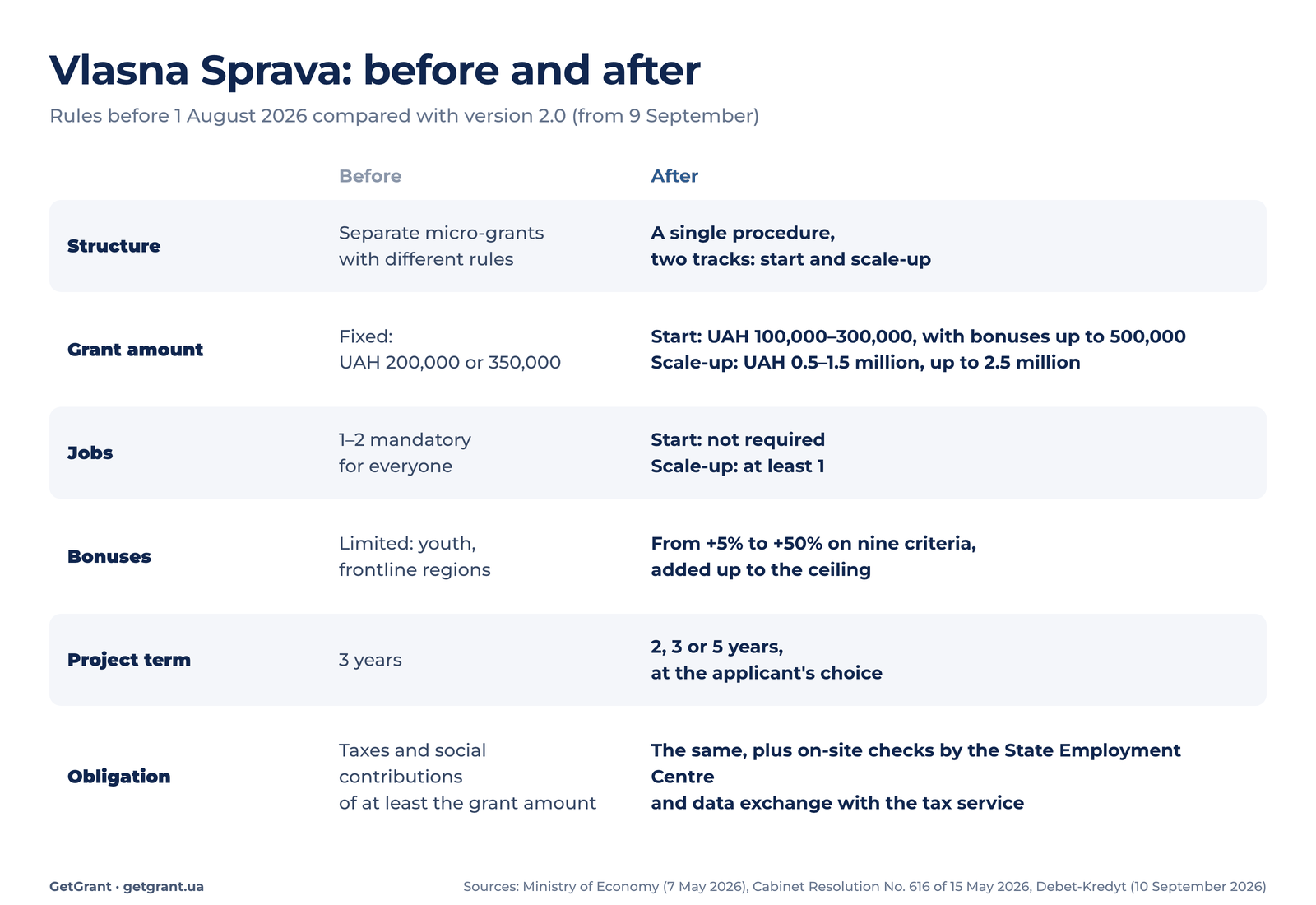
- Vlasna Sprava now has two tracks. Business start: UAH 100,000–300,000, with bonuses up to 500,000, no jobs required. Scale-up: UAH 0.5–1.5 million, with bonuses up to 2.5 million, at least one new job.
- Bonuses from +5% to +50% are added together. The largest, +50%, goes to work in a priority sector, so the choice of activity code and the wording of the project now directly affect the amount.
- The main obligation is unchanged: over the project term, pay taxes and social contributions of at least the grant amount. But the term can now be chosen: 2, 3 or 5 years. For a UAH 2.5 million grant that is the difference between 104,000 and 42,000 hryvnias of tax a month.
- Processing grants of up to UAH 8 million and grants of up to UAH 16 million for restoring damaged production facilities are accepted until 30 October inclusive. The next intake opens only in 2027.
- The draft 2027 budget almost doubles the “Support for the economy and business” section, to UAH 96 billion. However, 61% of the increase goes to the eOselia mortgage programme, not to business.
What changed in 2026: a timeline
The rules of the eRobota programmes were rebuilt throughout the year, so overviews written in winter or spring no longer reflect reality.
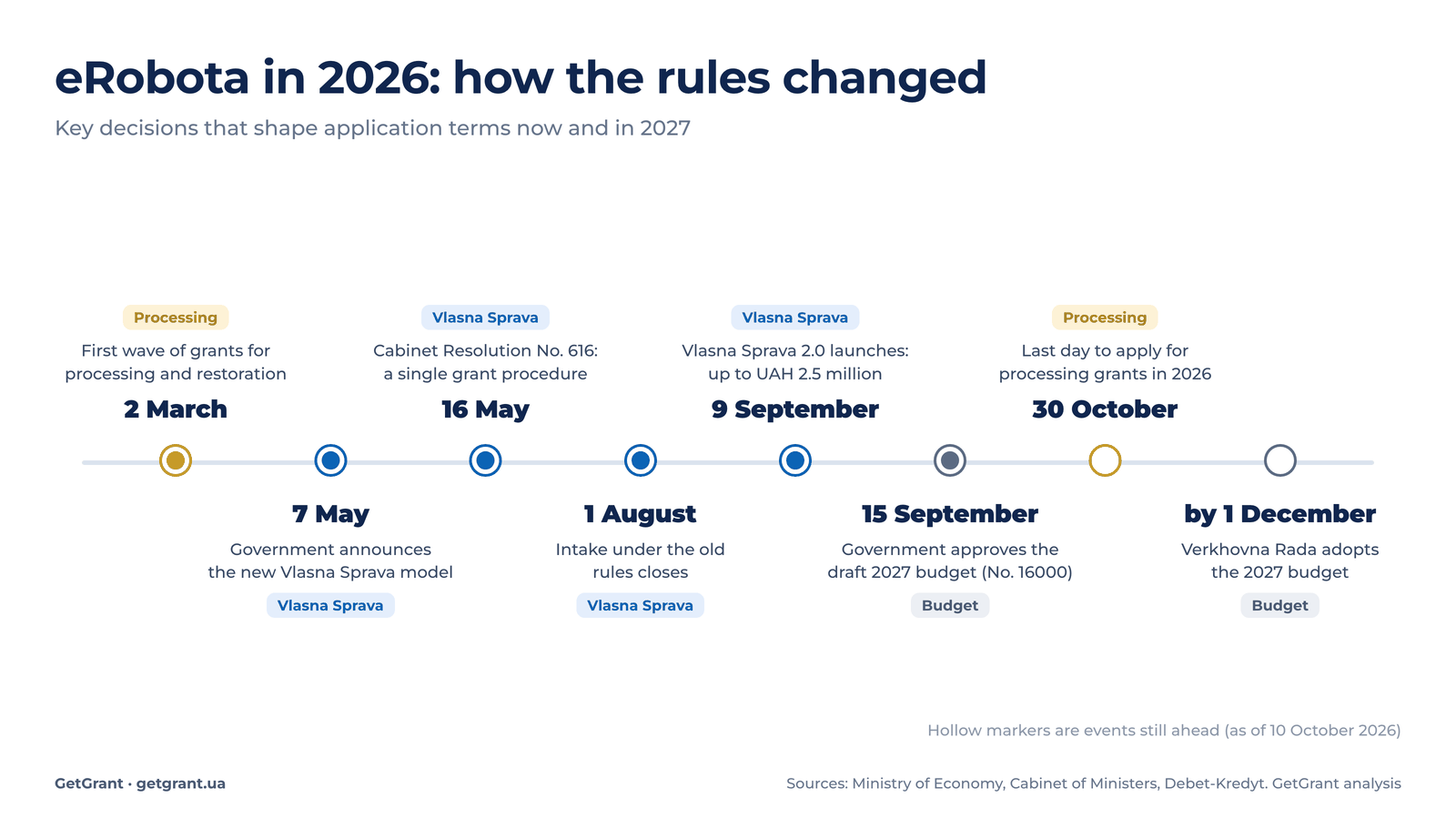
- 2 March. The Ministry of Economy opened the first 2026 wave of applications for grants to processing enterprises and for restoring production after shelling. Intake runs in two-week waves.
- 7 May. The government announced a new Vlasna Sprava model with two tracks and flexible amounts.
- 16 May. Cabinet of Ministers Resolution No. 616 of 15 May 2026 came into force. It replaced several separate micro-grant procedures with a single Procedure for providing grants to start or grow a business.
- 1 August. Intake under the old rules closed, including the separate procedure for combat veterans and their family members. August became a pause.
- 9 September. Vlasna Sprava 2.0 launched. Sense Bank was the first to accept applications, with Oschadbank and PrivatBank joining later.
- 15 September. The government approved the draft State Budget for 2027, bill No. 16000.
- 30 October. Last day to apply for processing and restoration grants in 2026.
- By 1 December. The Verkhovna Rada must adopt the 2027 budget under its rules of procedure.
Vlasna Sprava 2.0: what exactly is different
The most visible change is that the programme stopped being the same for a newcomer and for a company with a track record. Previously both received roughly the same amount. Now start and scale-up have separate scales, and in scale-up the maximum is seven times the former UAH 350,000.
The programme is run by three bodies: the Ministry of Economy, the Ministry of Digital Transformation and the State Employment Service. An application is submitted via Diia, then checked by an authorised bank, scored on a points system and, where needed, followed by an interview at an employment centre. The final decision is made by the State Employment Centre.
Applicants can be individuals aged 18 and over, sole proprietors and private-law legal entities. For a start there is one condition: register a sole proprietorship or a limited liability company within 20 calendar days of approval. For scale-up, the agreement and the documents to open an account must be signed within 10 working days.
“A more precise, flexible and convenient tool for supporting entrepreneurs.”
That is how Oleksandr Kravchenko, Minister of Economy and Environment of Ukraine, described the updated programme. According to him, Vlasna Sprava has supported more than 42,000 entrepreneurs in four years.
A detailed table of terms by track is in our separate review of the programme: Vlasna Sprava is updated from 1 September 2026.
How the amount is now calculated: bonuses
The base amount depends on the application score, the number of jobs, the region, the sector and the applicant category. Bonuses are added on top:
- +5% for applicants aged 18–25;
- +20% for each of the following: veteran-owned business; VAT payer; a valid patent for an invention or utility model related to the project; an internally displaced person with more than 6 months of business experience, or a relocated business; a commitment to create two jobs;
- +30% for operating in a frontline region or for using the grant to restore assets destroyed or damaged by the aggression;
- +50% for a project in a priority sector of the economy.
For the purposes of the programme, the frontline regions are Dnipropetrovsk, Donetsk, Zaporizhzhia, Mykolaiv, Odesa, Sumy, Kharkiv, Kherson and Chernihiv oblasts and the Slavutych community of Kyiv oblast.
The priority sectors include industry, in particular food; energy and utilities; transport and logistics; agriculture and processing; the defence industry and cybersecurity; dual-use production; construction and building materials; IT and digital products; the circular economy; the care economy; creative industries with high added value; preschool and extracurricular education; sport and local entertainment projects. Hotels, restaurants and food outlets make the list only if they use local produce and run social inclusion activities.
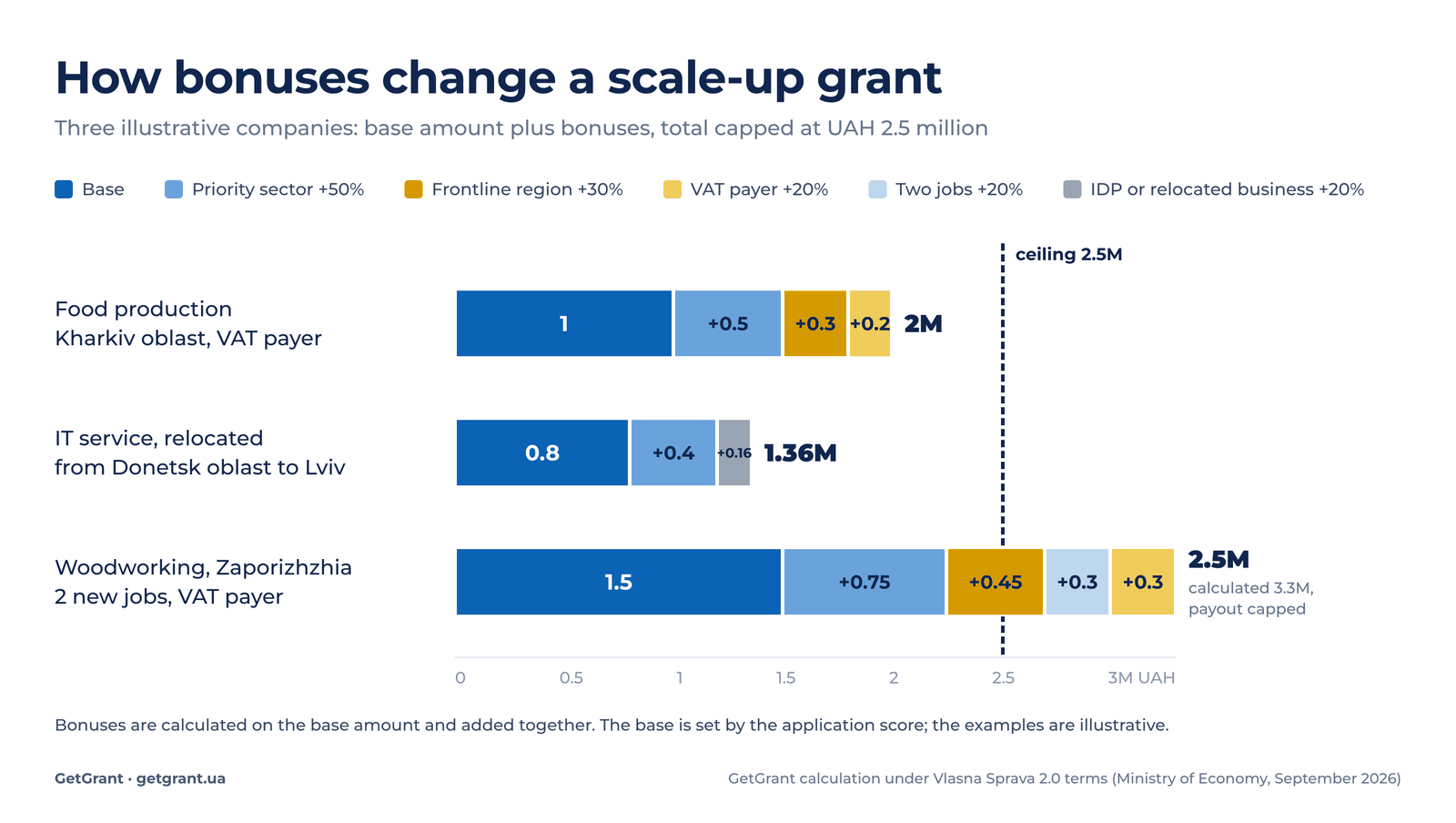
Bonuses add up, but the total cannot exceed the track ceiling: UAH 500,000 for a start and UAH 2.5 million for scale-up. Here is how it looks in three illustrative examples.
What follows from this in practice.
First. The priority-sector bonus equals the sum of the two other large bonuses. A food manufacturer in Kharkiv and the same company running a coffee shop without local produce will receive different money on otherwise identical terms. So the project description and the activity code need to be aligned with the sector list before applying.
Second. For strong applications the ceiling kicks in before the bonuses run out. The woodworking company in the third example would get UAH 3.3 million by calculation but will receive 2.5 million. If your calculation hits the ceiling, there is no point taking on obligations that earn a bonus, such as creating a second job.
Third. For a start, bonuses give less room. A 23-year-old founder opening a service business in Lviv with a base amount of UAH 250,000 gets only +5% for age, that is UAH 262,500. If her project belongs to a priority sector, for example a children’s education space, the amount rises to UAH 387,500.
What the grant can be spent on
The Procedure sets maximum shares by spending category:
- equipment, production assets and vehicles: up to 100% of the grant;
- rent of premises and land: up to 25%, equipment rental: up to 10%;
- software: up to 25%, websites and automation: up to 10%, technical set-up: up to 20%;
- advertising: up to 10%, packaging design and content: up to 50%;
- trademark registration and patenting: up to 20%.
The Procedure also allows spending on staff training and upskilling and on expanding the headcount. The practical conclusion is simple: the grant remains first and foremost an investment grant. A project in which most of the budget goes to marketing or rent will not pass on cost structure.
Obligations: the taxes that must be paid back
The grant is non-repayable, but it comes with a condition that is often underestimated. Over the project term the recipient must pay taxes and the unified social contribution, for themselves and for employees, of at least the grant amount. If jobs were promised in the application, people must be hired within three months of receiving the funds and kept on for 18 to 54 months depending on the project length.
The new version of the programme for the first time lets you choose the project term: 2, 3 or 5 years. This is not a formality. The monthly burden differs several times over.
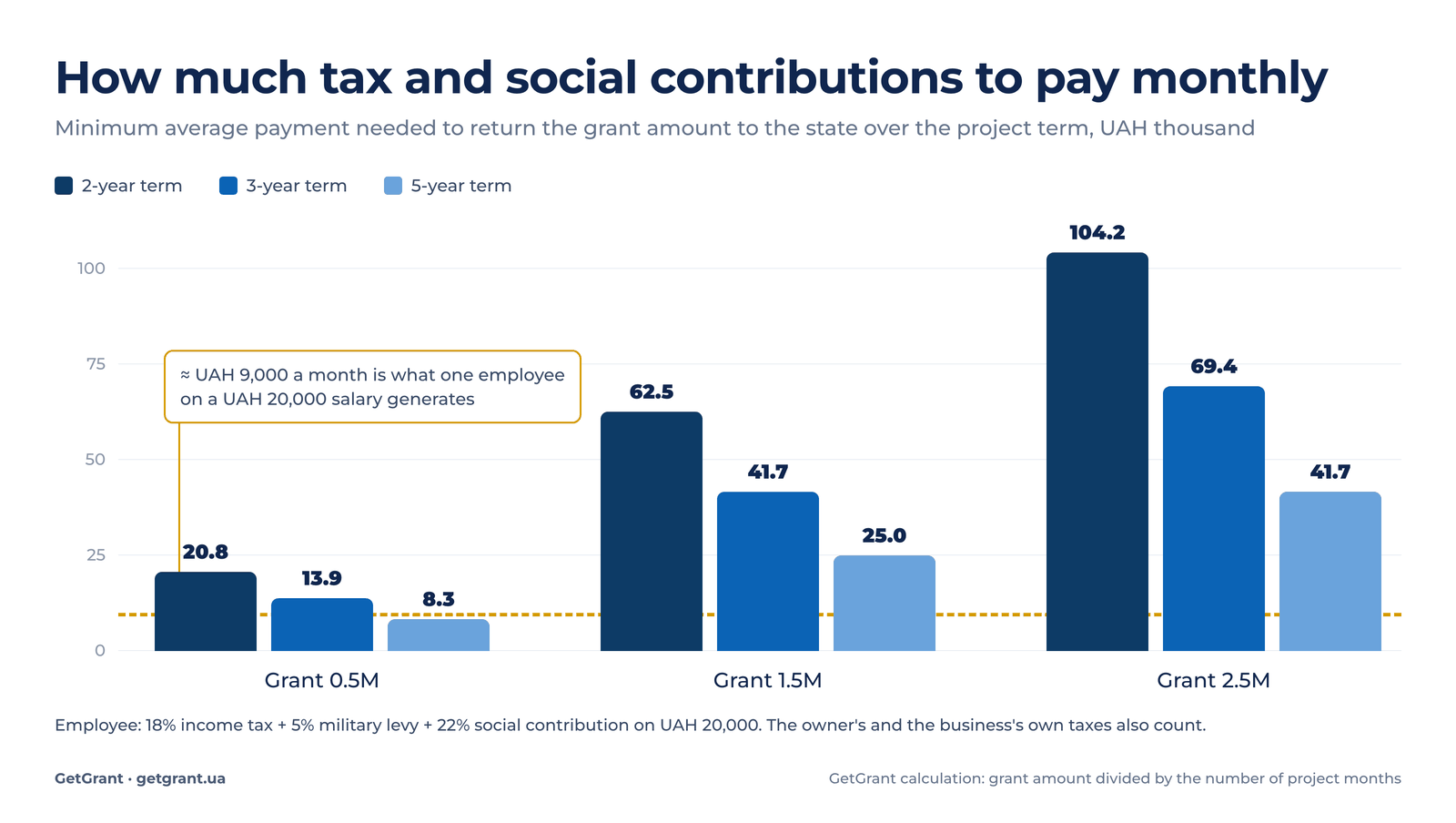
One employee with a salary of UAH 20,000 generates roughly UAH 9,000 in payments a month: 18% personal income tax, 5% military levy and 22% unified social contribution. So a UAH 2.5 million grant over three years requires about UAH 69,000 of tax a month, which corresponds to the payroll of roughly seven or eight such employees. Part of the burden is covered by the owner’s and the business’s own taxes, but for a small company choosing the five-year term can be the difference between meeting the conditions and repaying the money.
Control has also been tightened. The bank is responsible for the targeted use of funds, while the State Employment Centre checks actual activity, including on-site inspections, and verifies tax payments through data exchange with the State Tax Service. At the same time, two important rules work in the recipient’s favour. If property bought with the grant is destroyed as a result of the aggression, the money does not have to be returned and a new application can be submitted. After completing a previous grant project, you can receive a new one.
Processing grants: deadline 30 October
Separately from Vlasna Sprava, the programme for processing enterprises continues. It offers up to UAH 8 million to create or develop production and up to UAH 16 million to restore capacity damaged by the armed aggression. The funds go to purchasing, delivering and commissioning equipment.
In 2026 applications are accepted until 30 October inclusive; the next intake starts in 2027. Assessment takes up to 20 working days, and after a positive decision the company has 10 working days to contribute its own share of financing. In other words, it only makes sense to apply when the own contribution is already in the account or is guaranteed to arrive within a month.
How the programme itself works and what the job requirements are, we covered in the New Level grant for processing enterprises (in Ukrainian). For farmers, grants for orchards and greenhouses are also relevant; see our overview of 2026 farm programmes.
Budget 2027: what is set aside for business
The draft budget for 2027 allocates UAH 96 billion to the “Support for the economy and business” section, UAH 45.7 billion more than the 2026 plan. At first glance this is a doubling. Let us break the figure down.
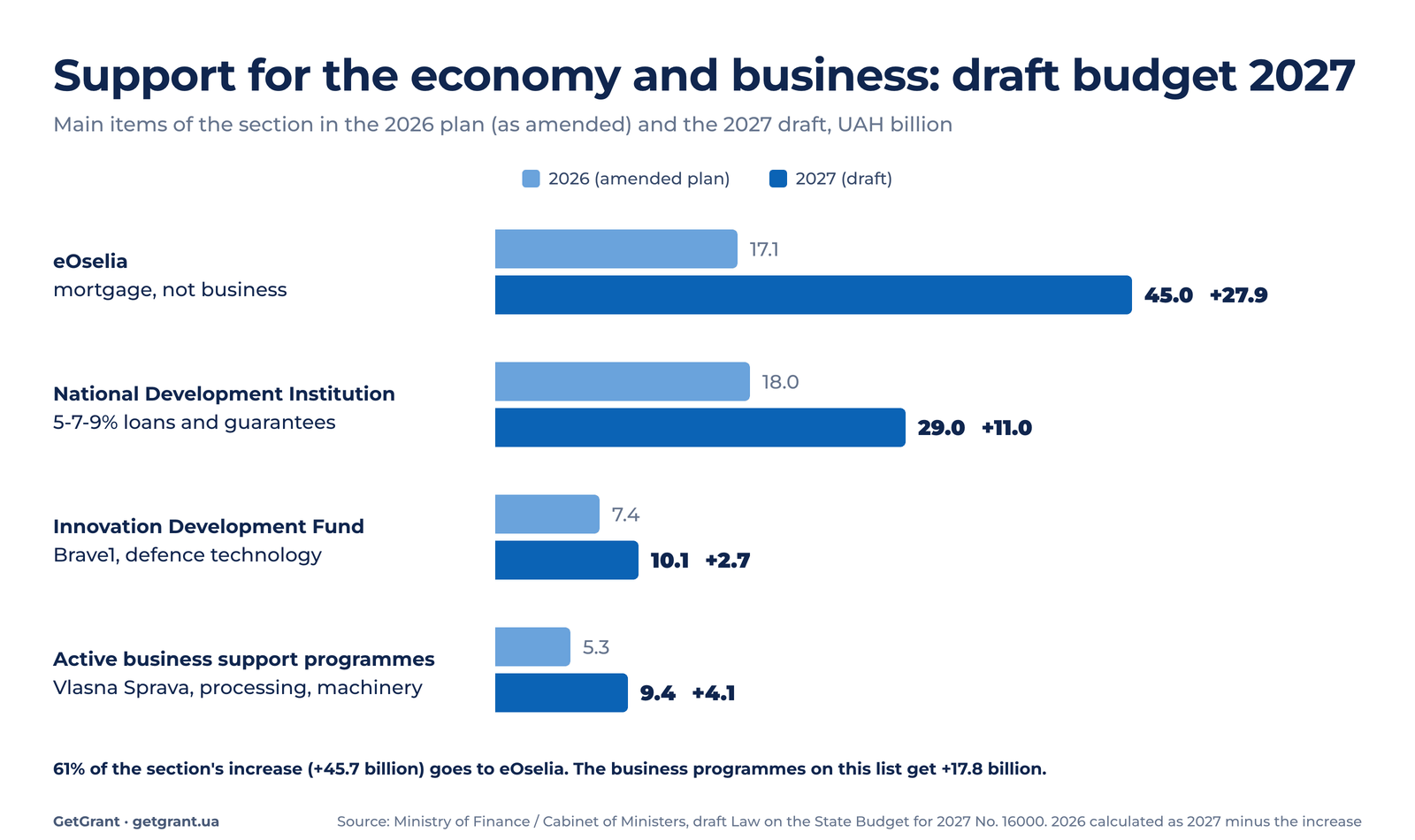
- UAH 45 billion goes to eOselia, up 27.9 billion. The programme matters, but it is a mortgage scheme for citizens, not business support. It accounts for 61% of the entire increase.
- UAH 29 billion goes to the National Development Institution for Affordable Loans 5-7-9% and guarantees, up 11 billion.
- UAH 10.1 billion goes to the Innovation Development Fund for Brave1 and defence technology, up 2.7 billion.
- UAH 9.4 billion is earmarked for active business support programmes, up 4.1 billion. This is where Vlasna Sprava, the processing and restoration grants, the compensation for Ukrainian-made machinery and support for industrial parks sit.
Separately, the draft contains a resource of UAH 58.7 billion for insuring business against war risks and other financial support. But its source is named as a possible increase in the base VAT rate from 20% to 21%, which still requires a separate law. So it is not worth counting on this money until that decision is adopted.
The UAH 9.4 billion figure for active programmes also needs clarification. The Ministry of Finance shows it as a 4.1 billion increase, but Dmytro Kysylevskyi, deputy chair of the Verkhovna Rada Committee on Economic Development, points out that the line has merged programmes previously funded under separate items or from other sources.
“Spending is broadly at the 2026 level.”
Dmytro Kysylevskyi, member of parliament, deputy chair of the Verkhovna Rada Committee on Economic Development, on the “Support for production and entrepreneurship” item in the draft 2027 budget.
So for Vlasna Sprava and processing, 2027 will most likely be similar in volume to 2026, not twice as generous. The figures may still change before the second reading of the budget; in particular, MPs have announced amendments on export support and the “100 Workshops” programme.
What business should do before the end of the year
- If you plan to modernise a processing facility, apply by 30 October and make sure the own contribution is available within 10 working days of the decision.
- If you are considering Vlasna Sprava for scale-up, calculate the amount with bonuses before applying. Check whether the project falls into a priority sector and whether the calculation hits the UAH 2.5 million ceiling.
- Choose the project term based on your real payroll, not on the wish to close the obligation faster. For a grant above UAH 1.5 million, a three-year term already requires more than UAH 40,000 of tax a month.
- Do not postpone a Vlasna Sprava application until the 2027 budget. Intake is open now, and next year’s funding is unlikely to grow substantially.
- If the grant share is small relative to the investment, compare it with a 5-7-9 loan. Calculations for typical scenarios are in our article Grant or a 5-7-9 loan for business in 2026.
Why applications are rejected: typical mistakes
- The project does not match the track. An operating business applies for a start, or a newcomer for scale-up, and the application loses points at the first check.
- The cost structure breaches the maximum shares. Most often this is inflated rent, marketing or software.
- Bonuses are claimed without evidence. For example, VAT payer status, a patent or veteran-owned business status is not formalised at the time of application.
- The business plan does not explain how the company will pay taxes equal to the grant amount. The bank and the State Employment Centre look precisely at this, because it is the main condition of the agreement.
- For processing, the own contribution is missing, or there is no confirmation that the equipment can be commissioned before the end of the term.
The GetGrant team supports the preparation of applications for Vlasna Sprava and processing grants: from choosing the track and calculating bonuses to the business plan and preparing for the employment centre interview. Current state and donor programmes for business are collected in the GetGrant catalogue, and a selection for a specific company can be ordered on the services page.
Sources
- Ministry of Economy: Vlasna Sprava updated, 7 May 2026 (in Ukrainian)
- Debet-Kredyt: Vlasna Sprava 2.0, new rules from 9 September 2026 (in Ukrainian)
- Debet-Kredyt: single grant procedure from 16 May 2026, Cabinet Resolution No. 616 (in Ukrainian)
- FinClub: processing grant applications accepted until 30 October (in Ukrainian)
- Cabinet of Ministers: government approves draft State Budget 2027 (in Ukrainian)
- NV Business: Dmytro Kysylevskyi on support for producers in the draft 2027 budget (in Ukrainian)
- NV Business: which support programmes are in the draft 2027 budget (in Ukrainian)