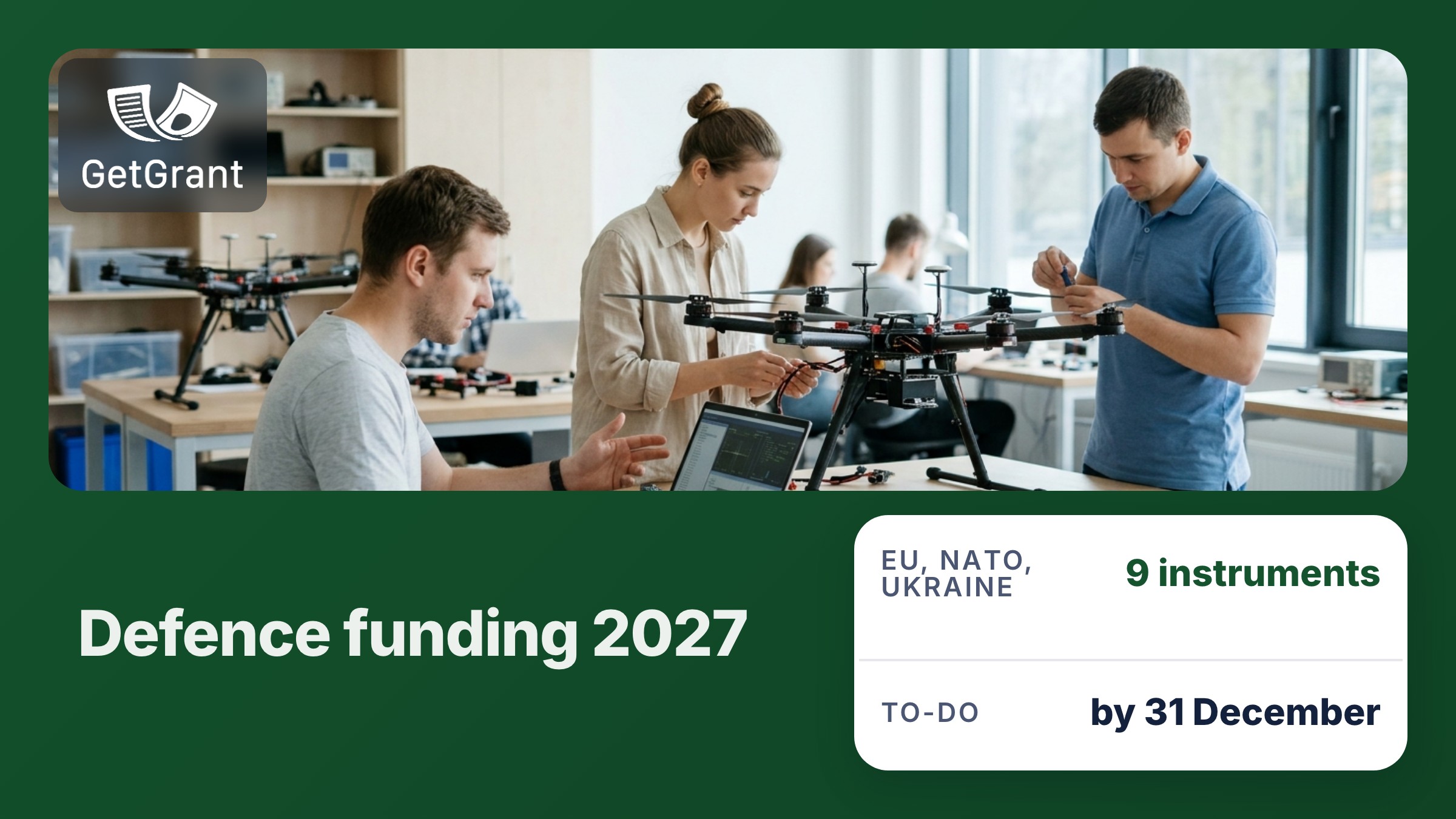
GetGrant analysis: 9 EU, NATO and Ukrainian defence funding instruments for 2027, checked against official sources on 15 November 2026: who can apply from Ukraine, amounts and consortia, a quarterly calendar (Ukraine Support Instrument on 16 February, EIC STEP Defence on 1 June) and a checklist to 31 December.
2027 is the last year of the EU’s 2021–2027 budget period, and for defence money it has already begun. The Ukraine Support Instrument call for unmanned and counter-unmanned systems closes on 16 February 2027, the European Innovation Council’s new investment call for defence companies opens on 1 December 2026, and the European Defence Fund’s 2027 work programme is expected in December, going by last year’s schedule. Anyone who starts preparing in January will only make the summer deadlines.
This is not a news round-up but a readiness analysis. We have gathered 9 instruments through which a Ukrainian defence or dual-use company can obtain money in 2027 and answered four questions for each: can a Ukrainian legal entity apply on its own, who does it need in a consortium, which security and ownership conditions will be checked, and when is the next date. Separately, there is a quarterly calendar for 2027 and a checklist of what is worth getting done by 31 December 2026.
Short answer
- The nearest large call where a Ukrainian participant is mandatory is the Ukraine Support Instrument under EDIP: €82 million for unmanned systems and countering them, €2 million to €10 million per project at 100% funding, deadline 16 February 2027 at 17:00 Brussels time.
- A new instrument for defence is EIC STEP Scale Up Defence: €100 million in equity investments, €10 million to €30 million per company, with Ukraine among the eligible countries. It opens on 1 December 2026 and closes on 1 June 2027, but requires an investor pre-commitment for at least 20% of the round.
- The European Defence Fund (EDF) opened its calls to Ukrainians for the first time in 2026: 612 proposals for €1.006 billion. As of 15 November 2026 no 2027 work programme had been published; last year it was adopted on 17 December and the calls opened on 11 February.
- For start-ups the shortest way in is EUDIS: a €120,000 voucher in the accelerator with no equity taken (call until 20 November 2026, next one in April–June 2027) and DefTech Forges challenges with a €120,000 prize (call from 23 November 2026 to 8 January 2027).
- NATO DIANA and the main EDIP calls are closed to a Ukrainian company applying directly, and SAFE is not a grant but loans to EU states, from which a Ukrainian manufacturer can win orders.
- As of 15 November 2026 the GetGrant catalogue lists 19 open calls with a defence or dual-use topic; a Ukrainian company can be the applicant without an intermediary in only 4 of them.
- By 31 December it is worth closing five items without which no European application passes the checks: a PIC and legal entity validation, an ownership chart down to the ultimate beneficial owners, a component origin table, documents on design authority and a decision on classified information.
Methodology
The list of instruments and their conditions comes from data GetGrant’s editors verified on 13 November 2026 for the defence programme support pages and rechecked on 15 November 2026 against official sources: topic pages and call documents on the Funding & Tenders Portal and the pages of DG DEFIS, EUDIS, NATO DIANA, Ukraine’s Ministry of Defence and the Cabinet of Ministers. Where an official source does not confirm a date, we write “expected” and state what the expectation rests on (usually last year’s schedule). The count of open calls was made on the GetGrant database as of 15 November 2026: 2,224 records, from which we selected calls with a deadline from 15 November 2026 or no fixed date whose title, funder or field mentions a defence, security or dual-use topic, and then manually removed irrelevant ones (generator subsidies from military administrations, veteran micro-grants and the like).
Comparison table: 9 instruments on one sheet
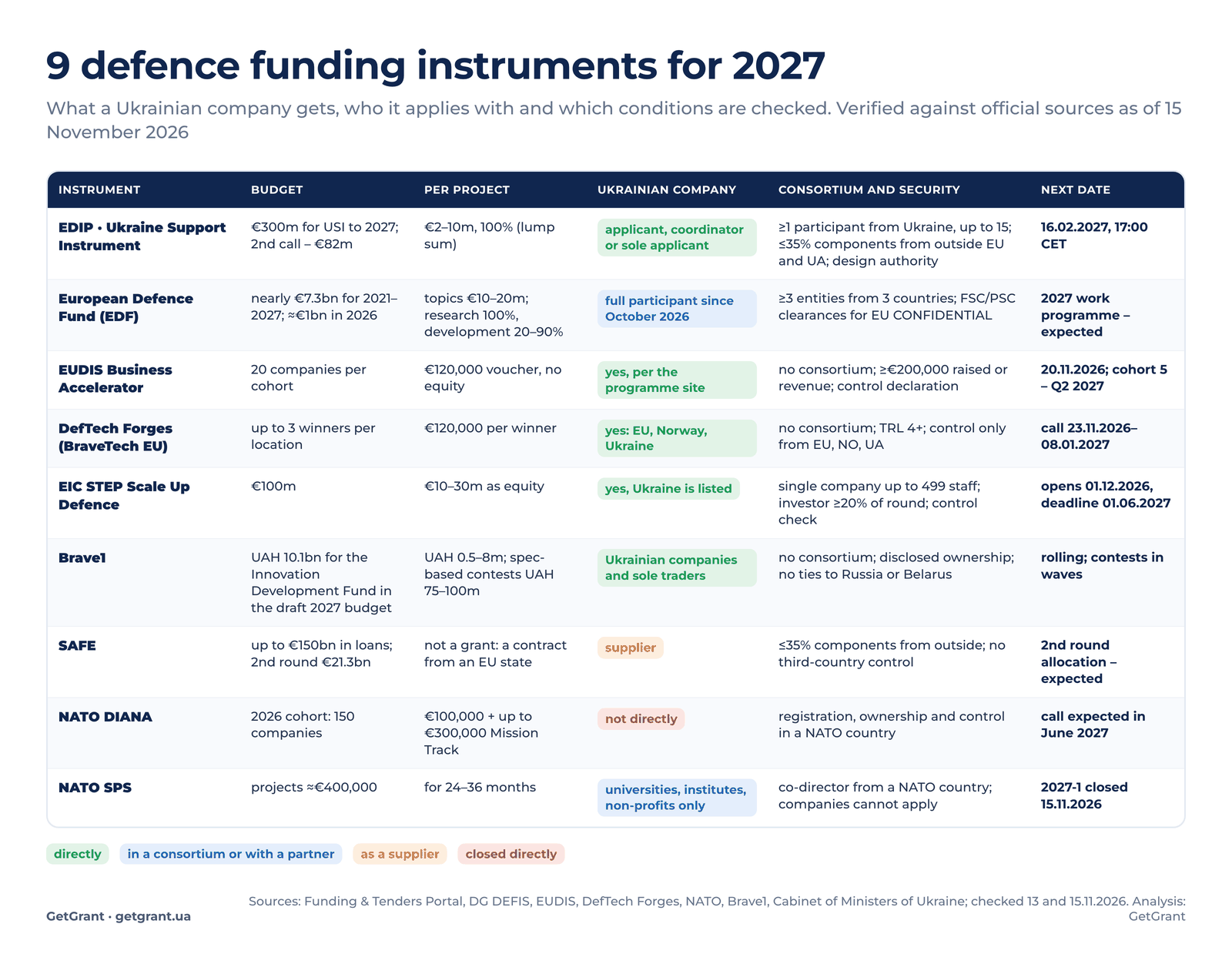
The main takeaway from the table is that money is unevenly spread across stages. At early stages there are Brave1 (UAH 0.5 million to 8 million depending on readiness), DefTech Forges and the EUDIS accelerator (€120,000 each). At the development stage in a consortium there is the European Defence Fund, where 2026 topics had budgets of €10 million to €20 million and research is funded at 100%. At the production stage there is the Ukraine Support Instrument with grants of €2 million to €10 million. For companies already raising investment, EIC STEP Scale Up Defence has appeared. According to Ukraine’s Ministry of Defence, Brave1 has issued more than 1,000 grants worth UAH 6.2 billion since 2023, and the draft 2027 state budget earmarks UAH 10.1 billion for the Innovation Development Fund through which it operates, UAH 2.7 billion more than in 2026.
The second pattern: the larger the amount, the stricter the access conditions. Brave1 checks a disclosed ownership structure and the absence of ties to Russia and Belarus. EUDIS adds an ownership and control declaration. The EDF and the Ukraine Support Instrument add third-country control, component origin, design authority and, where needed, clearances for classified information.
Who can actually apply
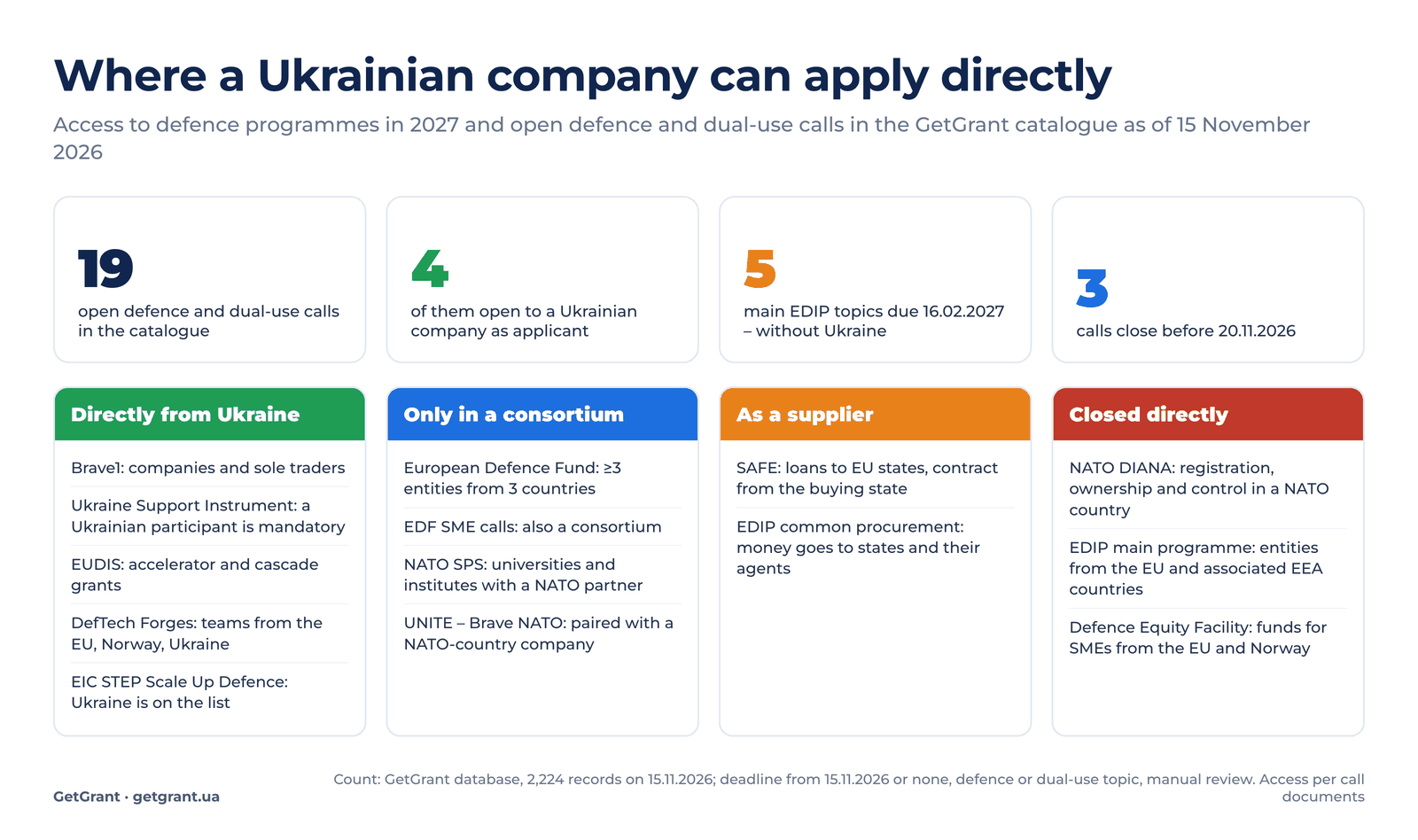
As of 15 November 2026 the GetGrant catalogue contained 19 open calls with a defence or dual-use topic. A Ukrainian company can be the applicant without an intermediary in only four of them: the EUDIS accelerator, the BattleVerse cascade call, the second Ukraine Support Instrument call and EIC STEP Scale Up Defence. Two of these four close before or on the day this article is published: BattleVerse on 16 November and the EUDIS accelerator on 20 November.
The rest are either calls not meant for Ukraine or open only through other roles. For example, the same database holds five topics of the “main” EDIP programme with a 16 February 2027 deadline: key electronic components, air and missile defence, C5ISR and space, ground and naval platforms, and support for Structures for European Armament Programmes. The budgets are large (the industrial reinforcement call alone has €275 million), but a Ukrainian company cannot be a beneficiary here: the industrial reinforcement call accepts legal entities from EU Member States and EEA countries associated to EDIP, and common procurement money goes to states and their procurement agents. The direct route to EDIP money for a Ukrainian company is the Ukraine Support Instrument. Other calls in the database are national (United Kingdom, Luxembourg) or for researchers (fellowships at the EPFL Cyber-Defence Campus).
An important detail on NATO DIANA. The memorandum between DIANA and Ukraine signed on 29 October 2026 covers testing, NATO requirements and access to expertise, but names no amounts and no change to challenge eligibility. A DIANA applicant must still be registered in a NATO country, with a majority of ownership and control held by nationals of those countries. Universities and research institutions have another NATO programme open to them, Science for Peace and Security (SPS), but commercial companies cannot apply there.
What the 2026 figures show
Three figures from this autumn show how much competition has grown. The 2026 EDF calls received 612 proposals, 49% more than a year earlier, against a budget of €1.006 billion; results are expected by March 2027. The first Ukraine Support Instrument call for missiles, ammunition and bombs (€184.5 million) closed on 10 November 2026 with 58 proposals from participants in 17 EU Member States and Ukraine, and 59% of them came from joint EU–Ukraine consortia. Results are due in March 2027.
A practical rule follows: the strongest proposals in the second Ukraine Support Instrument call will come from joint Ukrainian–European consortia. The call document of 3 November 2026 reinforces this: if funds from the Strategic Defence Industrial Partnership become available, projects by EU–Ukraine consortia that ramp up capacity by the end of 2027 may receive up to €30 million instead of €10 million. The pass mark is 39 points out of 60, and the implementation criterion carries the highest weight.
SAFE has changed too. On 29 October 2026 the Commission opened a second round of requests from states worth €21.3 billion and encourages them to include joint procurement with Ukraine. For a Ukrainian manufacturer this is not an application but a question of whether it gets onto the buying state’s supplier list. The conditions for a contractor are similar to USI: establishment and executive management in the EU, EEA-EFTA or Ukraine, no control by other third countries, and no more than 35% of component value from outside those countries.
The 2027 calendar by quarter
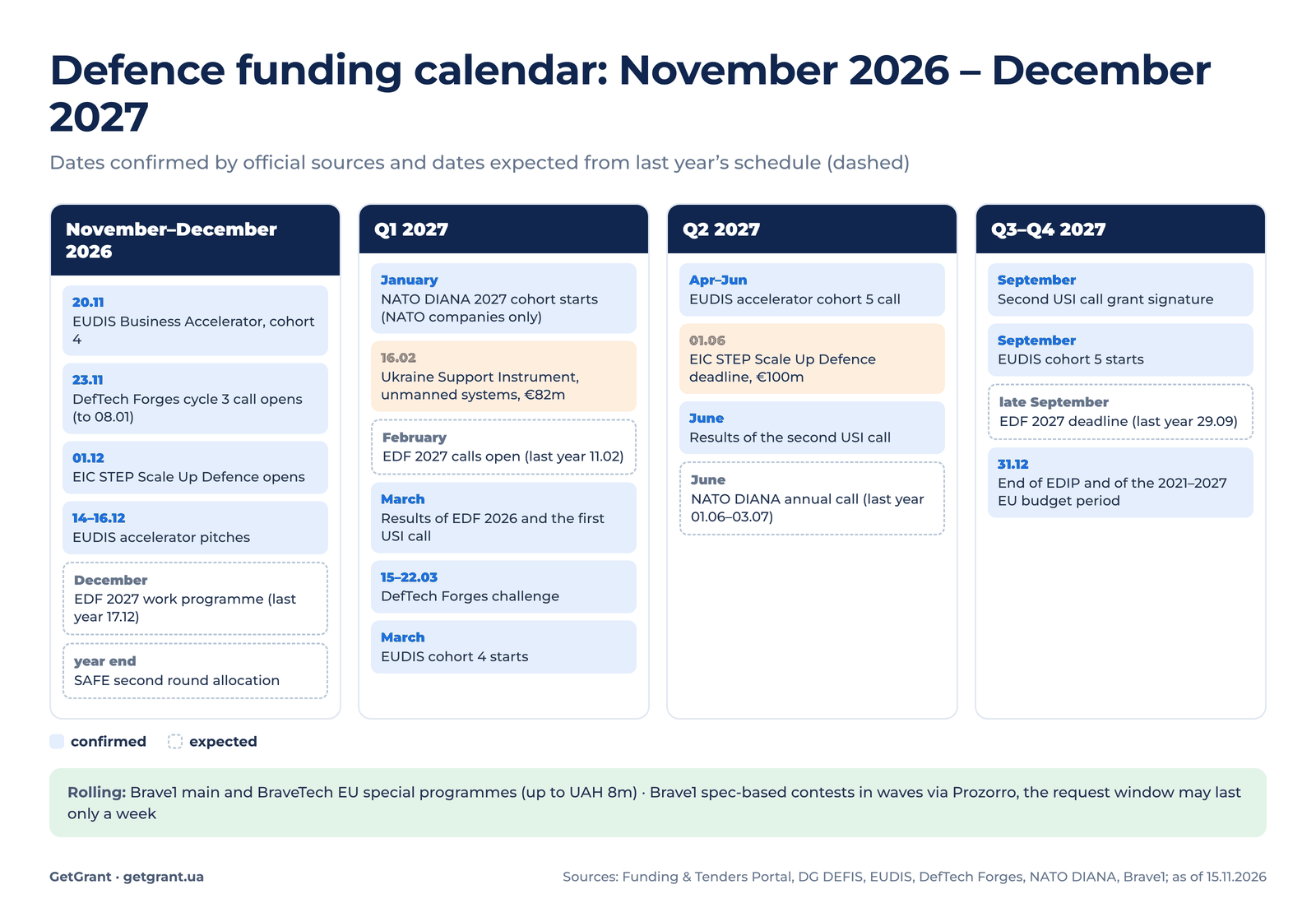
November–December 2026. The EUDIS accelerator accepts applications until 20 November, pitches are on 14–16 December and the cohort starts in March 2027. From 23 November to 8 January the participant call for the third DefTech Forges cycle runs. EIC STEP Scale Up Defence opens on 1 December. In December, if the Commission repeats last year’s schedule, the EDF 2027 work programme will appear: it will show the topics and budgets of the next calls.
Q1 2027. The key date is 16 February, the Ukraine Support Instrument deadline. March brings the results of the 2026 EDF calls and of the first USI call, as well as the DefTech Forges challenge itself on 15–22 March. By analogy with 2026, the EDF 2027 calls may open in February, but this is an expectation, not an announced date.
Q2. The call for the fifth cohort of the EUDIS accelerator is planned for April–June, with a September start. 1 June is the EIC STEP Scale Up Defence deadline. June brings the results of the second USI call and, going by last year, NATO DIANA’s annual call (in 2026 it ran from 1 June to 3 July; it is not open directly to Ukrainian companies).
Q3–Q4. September sees grant signature for the second USI call. The EDF 2027 deadline, if the schedule repeats, will fall at the end of September. On 31 December 2027 the EDIP period ends, along with the budget period in which the EDF operates. Brave1 accepts applications to its main and special programmes on a rolling basis and announces spec-based contests in waves through Prozorro with a short request window: in contests No. 10 and No. 11 it lasted seven days.
Security and ownership control: where proposals drop out before evaluation
European defence instruments check not only the idea but also who owns the company. In the EDF, EDIP and SAFE a participant may not be controlled by a non-associated third country or an entity from one, and exceptions are possible only with guarantees approved by the state where the participant is established. Every participant submits an ownership and control declaration, and its absence makes the participant ineligible. For companies with an investor from outside the EU and Ukraine, this is worth working through with a lawyer before looking for partners, not after.
The second filter is component origin. Under the Ukraine Support Instrument, components from outside the EU and Ukraine may account for no more than 35% of value across the action, and a component origin report is a mandatory project deliverable. The third is design authority: it must remain with the participants, so a licence without the right to modify or a design owned by a third-party design bureau can become a problem.
The fourth is classified information. The USI call document explicitly forbids uploading classified data to the portal; it is exchanged under the EU–Ukraine agreement on the security of information. In the EDF, work at EU CONFIDENTIAL level and above requires facility and personnel security clearances, and the grant will not be signed until at least one beneficiary holds a facility clearance. In Ukraine, access to state secrets is arranged by the Security Service (SBU): a special permit for the company and personal clearances in forms 1, 2 and 3, with vetting taking up to a month. If technical documentation on a military item has to be passed to partners abroad for the project, this may require a state export control permit: the general review times are 45 days for military goods, 30 for dual-use goods and up to 90 days with interagency approval. Materials marked “for official use only” are best left out of the proposal altogether, describing the solution at a level sufficient for evaluation.
What to do by 31 December 2026
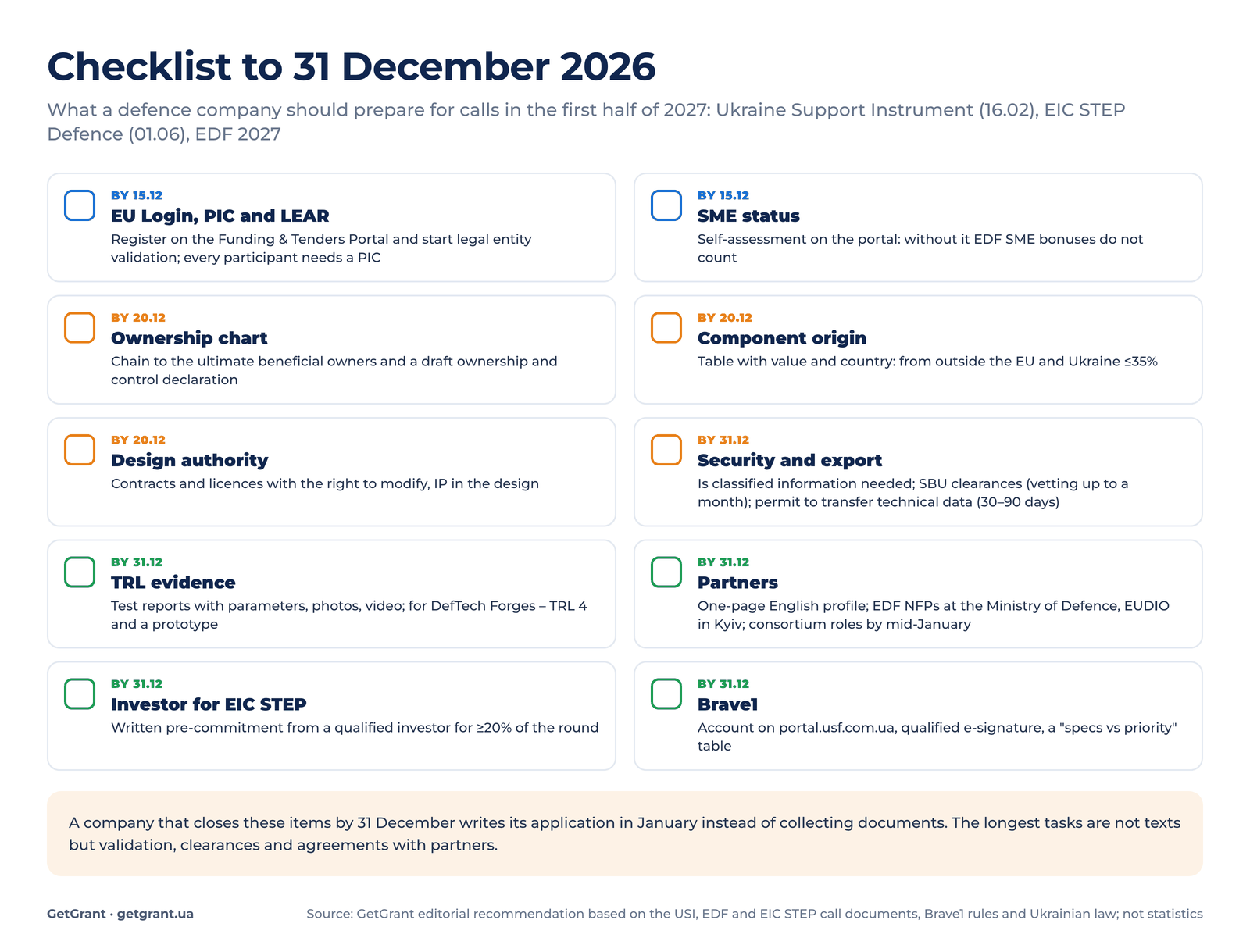
The list below is a GetGrant editorial recommendation built from the requirements in the call documents. It is designed for a company planning to apply to the Ukraine Support Instrument on 16 February or to the EDF 2027 calls.
- EU Login and PIC. Register the company in the Funding & Tenders Portal participant register, appoint a LEAR and start legal entity validation. Without a PIC for each participant a proposal cannot be submitted, and validation does not happen in a day.
- SME status. Complete the self-assessment on the portal: EDF bonuses for SMEs and mid-caps count only for participants with a PIC and a positive self-assessment.
- Ownership chart. Map the ownership chain to the ultimate beneficial owners with supporting documents and draft the ownership and control declaration.
- Component origin. Build a table of the product’s components with value and country of origin; the share from outside the EU and Ukraine must not exceed 35%.
- Design authority. Collect the contracts and licences proving that the design belongs to the company or that it has the right to modify it.
- Security and export. Decide whether the project needs classified information and, if so, start the clearance process; assess whether a permit to transfer technical data to partners will be needed.
- Evidence of readiness. Test reports with parameters and conditions, photos and video. DefTech Forges requires TRL 4 and a working prototype; in Brave1 the amount depends directly on confirmed readiness.
- Partners. A one-page English company profile: technology, TRL, testing, who you are looking for. Contacts: the EDF National Focal Points at Ukraine’s Ministry of Defence and the EU Defence Innovation Office in Kyiv. For the 16 February call, agree consortium roles by mid-January.
- Investor for EIC STEP. If you are planning a round, obtain a written pre-commitment from a qualified investor for at least 20% of the target round: without it an EIC STEP Scale Up Defence proposal will not be accepted.
- Brave1. An account on portal.usf.com.ua and the director’s qualified e-signature; a “product specs vs priority figures” table so you do not get stuck at compliance.
If you are unsure whether your company will pass the ownership and control check or which instrument to go for first, this can be worked through in a GetGrant expert consultation before you spend months on a proposal.
Conclusion
There is more defence money for Ukrainian companies in 2027 than ever before, but it is open in different ways. Directly from Ukraine one can apply to Brave1, the Ukraine Support Instrument, the EUDIS accelerator, DefTech Forges and EIC STEP Scale Up Defence; to the European Defence Fund only in a consortium; to SAFE as a supplier; and to NATO DIANA not at all while the company is registered in Ukraine. The first half of the year is dense: the Ukraine Support Instrument on 16 February, EIC STEP Defence on 1 June and, most likely, the EDF 2027 calls opening in between. What decides the outcome is not the proposal text but preparation that can be done now: a PIC, an ownership chart, component origin, design authority and a decision on classified information. A company that closes these five items by 31 December will be writing its proposal in January rather than collecting documents.
The GetGrant team helps assess a company’s eligibility for defence programmes, find a place in a consortium and prepare the proposal in English. Open calls are collected in the GetGrant catalogue, and individual programmes are analysed on the application support pages.
Sources
- Funding & Tenders Portal: topic EDF-EDIP-USI-2027-LS-IRA-CUXS, unmanned systems and counter-unmanned systems
- Call document for the second Ukraine Support Instrument call, version 1.1 of 03.11.2026
- Call document EDF-EDIP-P-2027-LS-IRA, main EDIP programme
- DG DEFIS: first USI call attracts 58 proposals (11.11.2026)
- DG DEFIS: European Defence Fund
- DG DEFIS: 612 proposals under the 2026 EDF calls (02.10.2026)
- DG DEFIS: Ukraine’s association to the EDF and the EDIP agreement enter into force (16.10.2026)
- Funding & Tenders Portal: topic HORIZON-EIC-2027-DEFENCE-01, EIC STEP Scale Up Defence
- EUDIS: official website
- EUDIS Business Accelerator
- DefTech Forges: Edition 3 timeline and conditions
- NATO: DIANA and Ukraine strengthen cooperation on defence innovation (29.10.2026)
- NATO DIANA: challenges and selection criteria
- DG DEFIS: SAFE – Security Action for Europe
- European Commission: SAFE state of play and second round of requests (29.10.2026)
- Brave1 grant programmes
- Ministry of Defence of Ukraine: Brave1 has issued more than 1,000 grants (14.09.2026)
- Cabinet of Ministers of Ukraine: draft 2027 state budget approved (16.09.2026)
- Law of Ukraine on State Secrets
- National Security and Defence Council of Ukraine: state export control
- Network of European Defence Fund National Focal Points
- GetGrant grants catalogue
Open calls: Defence
- EUDIS Business Accelerator Cohort 4: €120,000 non-dilutive funding for defence and dual-use start-ups, Ukrainian companies eligible, apply by 20 November 2026until 20.11.2026
- Unmanned systems and counter-unmanned systems (EDIP Ukraine Support Instrument)until 16.02.2027
- Brave Students: Pitch Drive by mono – Call for Student Defence and Dual-Use Startupsuntil 14.03.2027
- Innovative Prosthetics: Ukrainian Startup Fund and Brave1 offer up to UAH 8 million to developers of prostheses and components

Book a consultation or leave your application idea
Tell us in a few words about your project: we will say which grants it fits and can take the application itself off your hands. We reply within one business day.