The Erasmus+ Programme Guide 2027 was published on 18 November 2026: deadlines, the six actions where a Ukrainian organisation can be an applicant, changes from 2026, the odds of winning based on the 2026 call results and practical recommendations.
On 18 November 2026 the European Commission published the Erasmus+ Programme Guide 2027 (version 1, 466 pages) and announced the calls for proposals for 2027. These are the last calls of the 2021–2027 programme: the next ones will follow the rules of the 2028–2034 programme. Submission on the Funding & Tenders Portal is not open yet: the calls are listed there as forthcoming and will open gradually. The deadlines, however, are already known, and the first ones are eleven weeks away: Jean Monnet actions on 3 February and Capacity Building in Higher Education (CBHE) on 9 February 2027.
We analysed the Guide in detail, compared it with the 2026 version and compiled the results of the 2026 call from the data of the EU Delegation to Ukraine and the National Erasmus+ Office. This article covers where a Ukrainian organisation can be an applicant, what the deadlines and amounts are, how realistic it is to win and what to do in the coming weeks. We covered the programme budget for 2027 separately in our analysis of the Erasmus+ 2027 work programme.
Short answer
- The Erasmus+ calls for 2027 were announced on 18 November 2026. The conditions of participation, amounts and deadlines are set by the Programme Guide 2027; the call notice was published in the Official Journal of the EU (C/2026/6148). On the Funding & Tenders Portal they are still listed as forthcoming: submission opens later, for example Erasmus Mundus on 19 November and CB Sport on 17 December.
- Ukraine remains a third country not associated to the Programme (Region 2, Neighbourhood East). A Ukrainian organisation can apply on its own in six actions: CBHE, Jean Monnet Modules, Chairs and Centres of Excellence, the Jean Monnet Network “EU-Ukraine-Moldova”, Erasmus Mundus Joint Masters, CB Youth and CB Sport.
- The nearest deadlines for applicants from Ukraine: Jean Monnet on 3 February, CBHE on 9 February, Erasmus Mundus on 16 February, CB Youth on 2 March and CB Sport on 9 March 2027, all at 17:00 Brussels time.
- The restriction “no more than two applications per coordinator”, which applied in 2026, has disappeared from the CBHE section. In CB Youth the restriction remains: one application per coordinator.
- The new Jean Monnet Network “EU-Ukraine-Moldova”: up to €1.2 million, a consortium of at least 10 applicants, at least 5 of them from Ukraine, and a Ukrainian higher education institution can be the coordinator.
- The odds based on the 2026 call: CBHE – 11% of applications involving Ukraine, CB Youth – 12%, CB VET – 9.5%, Jean Monnet – only 5.4% (40 projects out of 747 applications) against a call average of 14.7%.
- The Guide now contains a provision on countries that are formally negotiating association: their applicants will be treated as applicants from an associated country if the agreement applies at the time the grant agreement is signed.
What has been published and what it means
The Programme Guide is the main document for applicants. It is an integral part of the call and determines who can apply, what consortium composition is required, how much money can be obtained and by what date to submit. Version 1 for 2027 is dated 18 November 2026; the English version is the authoritative one. On the same day the National Erasmus+ Office in Ukraine announced that the 2027 calls had been launched and published the schedule of information days.
The action budgets are set out in another document, the annual work programme, which the Commission adopted on 15 October 2026: up to €6.21 billion for 2027. The Guide itself contains no action budgets and refers to the work programme and the Funding & Tenders portal. The Guide warns that the actions of the call may be changed by a corrigendum, and that implementation depends on the adoption of the EU budget for 2027.
What makes these calls special. First, they are the last ones of the 2021–2027 programme, and the Guide is already preparing the transition: the re-accreditation of organisations for 2028–2034 has been announced. Second, Switzerland and the United Kingdom have been added to the associated countries (subject to their association agreements), so the pool of European partners has widened. Third, the Guide is aligned with the Education and Skills Package of 5 November 2026: priority goes to basic skills, the teaching profession, artificial intelligence in education and vocational education and training.
Ukraine’s status: what remains and what is new
In the Guide 2027 Ukraine is a third country not associated to the Programme, in the group “Neighbourhood East (Region 2)” together with Armenia, Azerbaijan, Georgia, Moldova and Belarus. The associated countries listed are Iceland, Liechtenstein, Norway, North Macedonia, Serbia, Türkiye, Switzerland and the United Kingdom. In practice this means the same as last year: a Ukrainian organisation can be an applicant only in those actions where this is explicitly allowed for non-associated countries, and in most others it is a partner.
What is new is one sentence in the section on eligible countries that was not in the Guide 2026. Applicants from third countries that are formally negotiating association to Erasmus+ will be treated as applicants from an associated country if the association agreement applies at the time the grant agreement is signed. The Guide does not name the countries. Whether Ukraine falls under this provision depends on whether formal negotiations have been opened: the Interagency Working Group on preparing for association has been working since June 2026, and its goal is Ukraine’s participation in the programme from 2028. We found no public announcement that negotiations have started, so we recommend raising this question at the National Office’s information days on 24–27 November.
The priority of supporting Ukraine has been kept. In 2027 the programme continues to mitigate the consequences of Russia’s war against Ukraine, in particular through activities supporting organisations, pupils, students and staff in Ukraine. Cooperation Partnerships in higher education have a separate priority: cooperation of European higher education institutions with Ukrainian ones to rebuild Ukraine’s higher education system. In CB VET preference will be given to projects that contribute to the objectives of the Ukraine Facility.
Where you can be an applicant in 2027
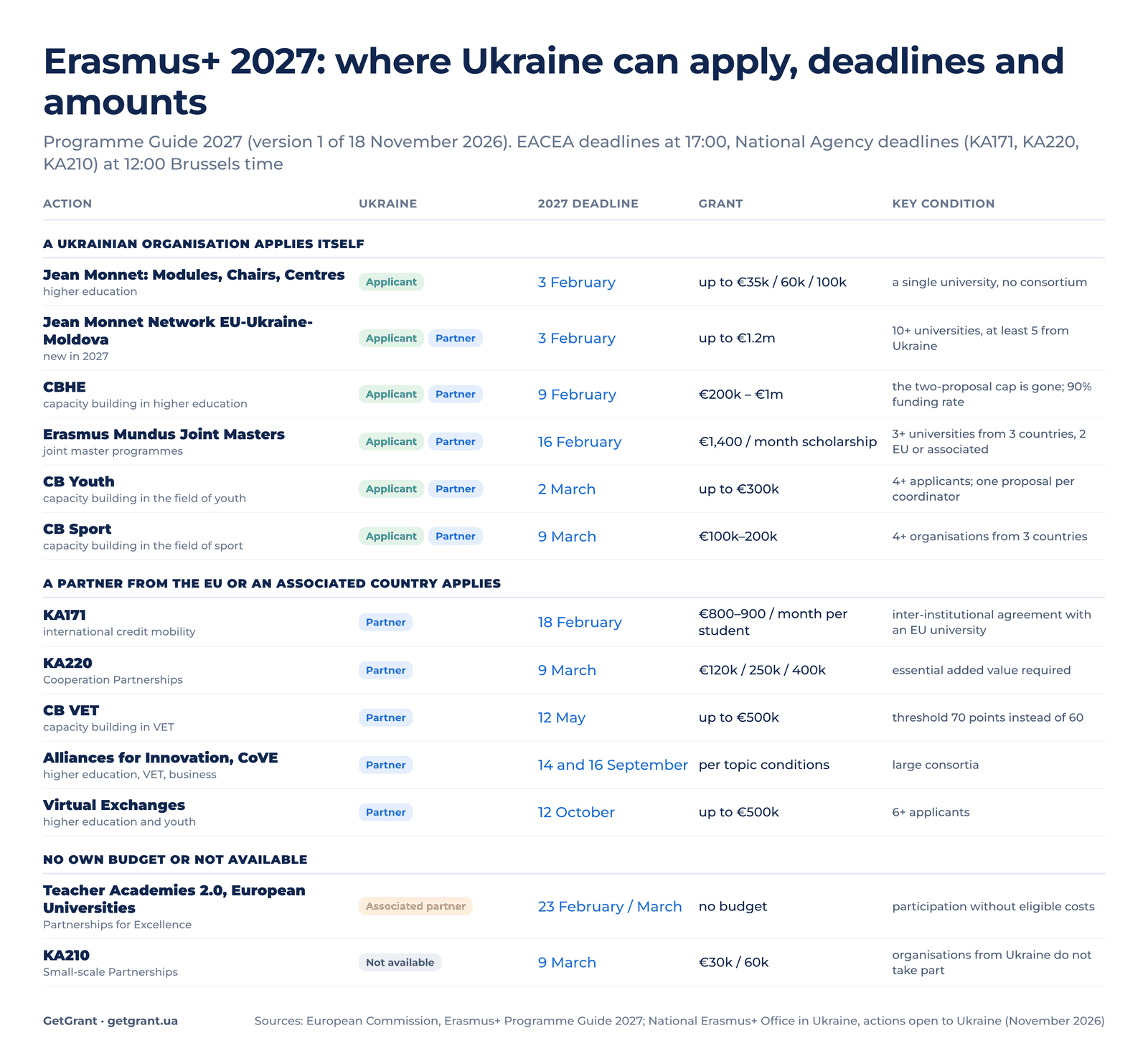
CBHE, Capacity Building in Higher Education. The deadline is 9 February 2027, 17:00. Only a higher education institution or an association of higher education institutions can be the coordinator; a Ukrainian institution must be recognised by the competent authority and award higher education degrees. There are three strands: Strand 1 “Fostering access to cooperation” for institutions with less experience (€200,000–400,000), Strand 2 “Partnerships for transformation” (€400,000–800,000) and Strand 3 “Structural reform” (€600,000 – €1 million, participation of the ministry is mandatory). The funding rate is 90%.
Jean Monnet in higher education. The deadline is 3 February 2027, 17:00. A Module (up to €35,000, at least 40 teaching hours per year), a Chair (up to €60,000, 90 hours per year) and a Centre of Excellence (up to €100,000) are applications by a single institution, without a consortium, for three years. The applicant can be a higher education institution from the EU, an associated country or a non-associated country, except Belarus and Russia.
Jean Monnet Network “EU-Ukraine-Moldova”. A new action in 2027, with the same deadline of 3 February. The consortium consists of at least 10 higher education institutions, at least 5 of them from Ukraine. The coordinator is a higher education institution from the EU, an associated country or Ukraine; Moldovan institutions take part but do not coordinate. The maximum grant is €1.2 million for three years. There will be only one network, so the realistic strategy for most Ukrainian universities is to join a strong consortium rather than build their own.
Erasmus Mundus Joint Masters. The deadline is 16 February 2027, 17:00. The applicant can be a higher education institution from an eligible non-associated country. The consortium consists of at least three institutions from three countries, at least two of which are EU Member States or associated countries. The student scholarship is €1,400 per month.
CB Youth, Capacity Building in the field of Youth. The deadline is 2 March 2027, 17:00. The coordinator is a civil society organisation working with young people or a public body at local, regional or national level. The consortium consists of at least four applicants: at least one from the EU or an associated country and at least two from two different non-associated countries of the same region. In other words, a Ukrainian organisation needs one more partner, for example from Moldova or Georgia. The grant is up to €300,000 and the funding rate is 80%.
CB Sport, Capacity Building in the field of Sport. The deadline is 9 March 2027, 17:00. The coordinator is a non-profit organisation; from Region 2 only organisations from Armenia and Azerbaijan cannot coordinate, so there is no restriction for Ukraine, and the National Office marks this action as “applicant/partner”. The consortium consists of at least four organisations from three countries: one or two from the EU or associated countries and at least two from Region 2. The grant is €100,000–200,000.
Where to find the calls on the Funding & Tenders Portal
Applications for actions managed by EACEA are submitted through the Funding & Tenders Portal. As of 18 November 2026 the 2027 calls are only starting to appear there and are marked as forthcoming: the conditions can already be read, and submission becomes possible from the opening date.
- Erasmus Mundus Joint Masters, ERASMUS-EDU-2027-PEX-EMJM-MOB – forthcoming, submission opens on 19 November 2026, deadline 16 February 2027.
- CB Sport, ERASMUS-SPORT-2027-CB – forthcoming, submission opens on 17 December 2026, deadline 9 March 2027.
- CBHE (ERASMUS-EDU-2027-CBHE, the topic for Ukraine is REGION 2), Jean Monnet (ERASMUS-JMO-2027-HEI-TCH-RSCH-MODULE, -CHAIR, -COE and the network ERASMUS-JMO-2027-NETWORKS-HEI-NON-EU-UKRAINE-MOLDOVA) and CB Youth (ERASMUS-YOUTH-2027-CB): these calls do not have pages on the Portal yet. They will appear in the list of Erasmus+ calls on the Funding & Tenders Portal; search for them by the identifiers from the Guide.
Opening dates on the Portal may change, so check them on the call page. The deadlines in this article are taken from the Programme Guide 2027.
Limits on the number of applications: what to check before submitting
This is the question we are asked most often, so we compared the text of the 2026 and 2027 Guides.
CBHE: there is no two-application limit in the Guide 2027. In 2026 the CBHE section contained an explicit rule: an organisation may not be the coordinator of more than two applications within the call. This sentence is absent from version 1 of the Guide 2027, and the section contains no other numerical restriction on applications by a coordinator or a partner. Our conclusion: formally, a Ukrainian higher education institution can coordinate more than two CBHE applications. However, we recommend confirming this in the topic conditions on the Funding & Tenders portal and at the information day on 24 November, because the conditions may be clarified in a corrigendum.
What applies in CBHE even without a limit on numbers:
- Very similar applications. Under the general rule for actions managed by EACEA, if several very similar projects are submitted, only one will be assessed; the others will have to be withdrawn or will be rejected.
- Composition of a national project (Ukraine only): at least two EU Member States or associated countries, each with at least one higher education institution, and at least two Ukrainian higher education institutions. The number of organisations from Ukraine must be no lower than the number of organisations from the EU and associated countries.
- Multi-country project: at least two non-associated countries, with two higher education institutions in each, and the same requirement on numbers.
- Equipment is capped at 35% of the grant and subcontracting at 10%; financial support to third parties is not allowed.
- Duration: 24 or 36 months for Strands 1 and 2, 36 or 48 months for Strand 3.
- The threshold is 60 points out of 100 and at least half of the points under each criterion. After the assessment, applications proposed for funding go through a consultation with the EU Delegation in the country.
- For Region 2, in Strands 1 and 2 preference is given to projects with institutions outside the capital, from rural or remote regions.
CB Youth: one application per coordinator. The same organisation may not submit more than one application as coordinator within the call. It can be a partner in several.
Jean Monnet, Erasmus Mundus, CB Sport. We found no numerical restrictions on applications from one organisation in the relevant sections of the Guide 2027. For Jean Monnet the general rule on very similar applications applies, and a Chair is held by one professor who is a permanent member of staff of the institution.
No double funding. One project can receive only one grant from the programme budget, and the same costs cannot be funded twice. All applications are automatically checked for double funding and plagiarism.
Where you are only a partner
In these actions the application is submitted by an organisation from the EU or an associated country, and the Ukrainian one joins the consortium.
- KA171, international credit mobility. European higher education institutions apply by 18 February 2027, 12:00. A Ukrainian institution needs an inter-institutional agreement with the partner by that date. A student from Ukraine in the EU receives €800–900 per month.
- KA220, Cooperation Partnerships. The deadline is 9 March 2027, 12:00, at the national agencies; a second round is possible on 5 October. Grants are €120,000, €250,000 or €400,000. A Ukrainian organisation can be included only if its participation brings essential added value; otherwise it will be excluded from the application.
- CB VET, Capacity Building in the field of vocational education and training. The deadline has moved from March to 12 May 2027. The grant is up to €500,000 and the funding rate is 80%. The threshold has been raised from 60 to 70 points. The number of organisations from non-associated countries must be no lower than from the EU, and the participants must include a vocational education and training provider at ISCED level 3.
- Virtual Exchanges. The deadline has moved from March to 12 October 2027. The consortium consists of at least six applicants, the grant is up to €500,000, with no more than €200 per participant.
- Youth exchanges, mobility of youth workers, youth participation activities. The first round is on 11 February and the second on 5 October 2027, 12:00.
- Alliances for Innovation and Centres of Vocational Excellence (CoVE). The deadlines are 14 and 16 September 2027.
In Erasmus+ Teacher Academies 2.0 (deadline 23 February) and European Universities alliances, Ukrainian institutions can be associated partners, that is, without a budget of their own. Organisations from Ukraine do not take part in Small-scale Partnerships (KA210).
The 2027 calendar: how much time is left
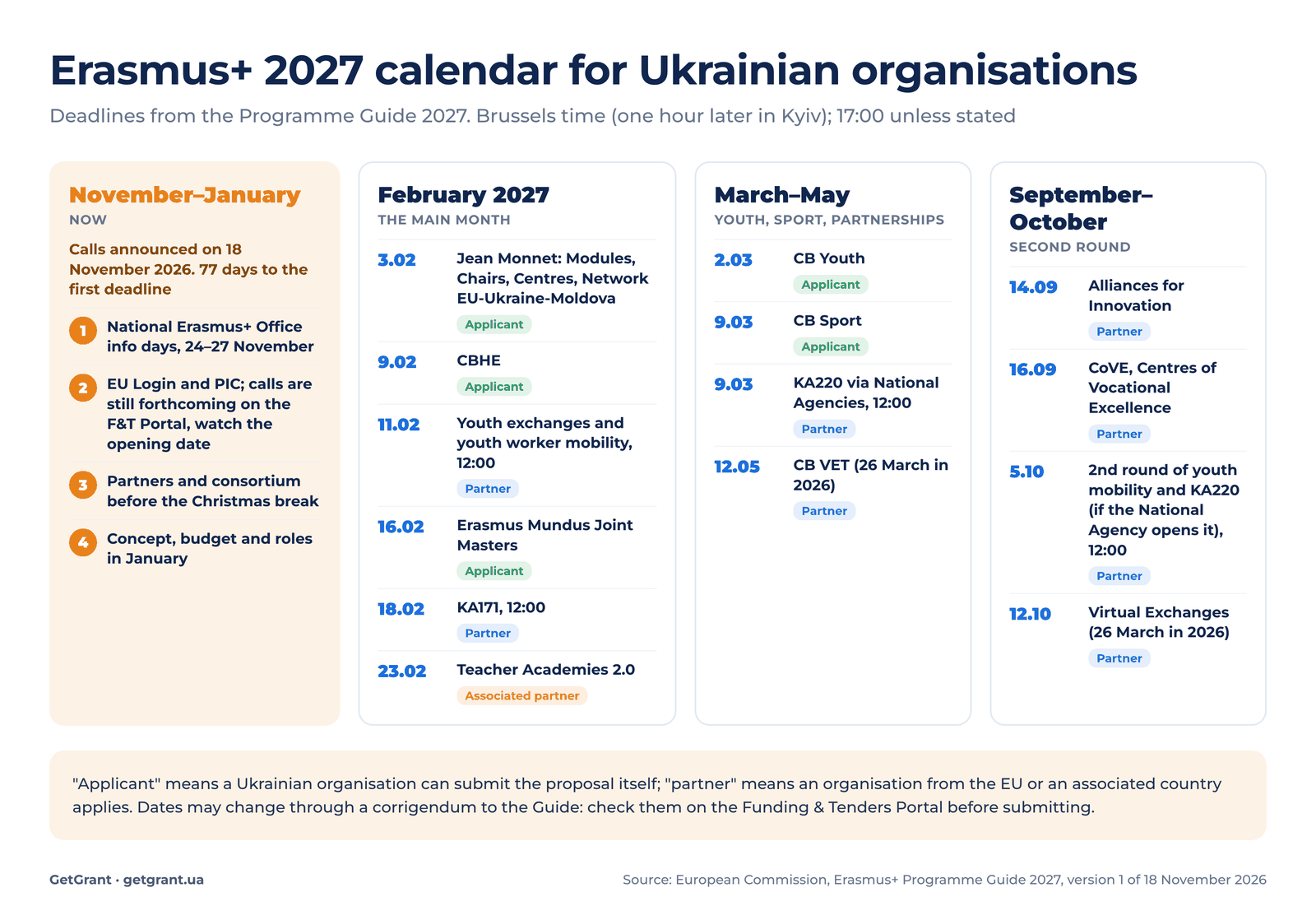
Compared with 2026, the dates have shifted unevenly. Jean Monnet stays on 3 February. CBHE is one day earlier (9 February instead of 10), and Erasmus Mundus four days later (16 February instead of 12). CB Youth has moved from 26 February to 2 March, CB Sport and KA220 from 5 to 9 March. The biggest changes are in two actions where Ukraine is a partner: CB VET (from 26 March to 12 May) and Virtual Exchanges (from 26 March to 12 October).
There are 77 days from the publication of the Guide to the first deadline; submission on the Portal does not open straight away, and these weeks include the Christmas holidays of the European partners. Subtracting two weeks of holidays and a week for internal approval leaves about eight working weeks to prepare a Jean Monnet application and nine for a CBHE consortium.
The odds of winning: what the 2026 call showed
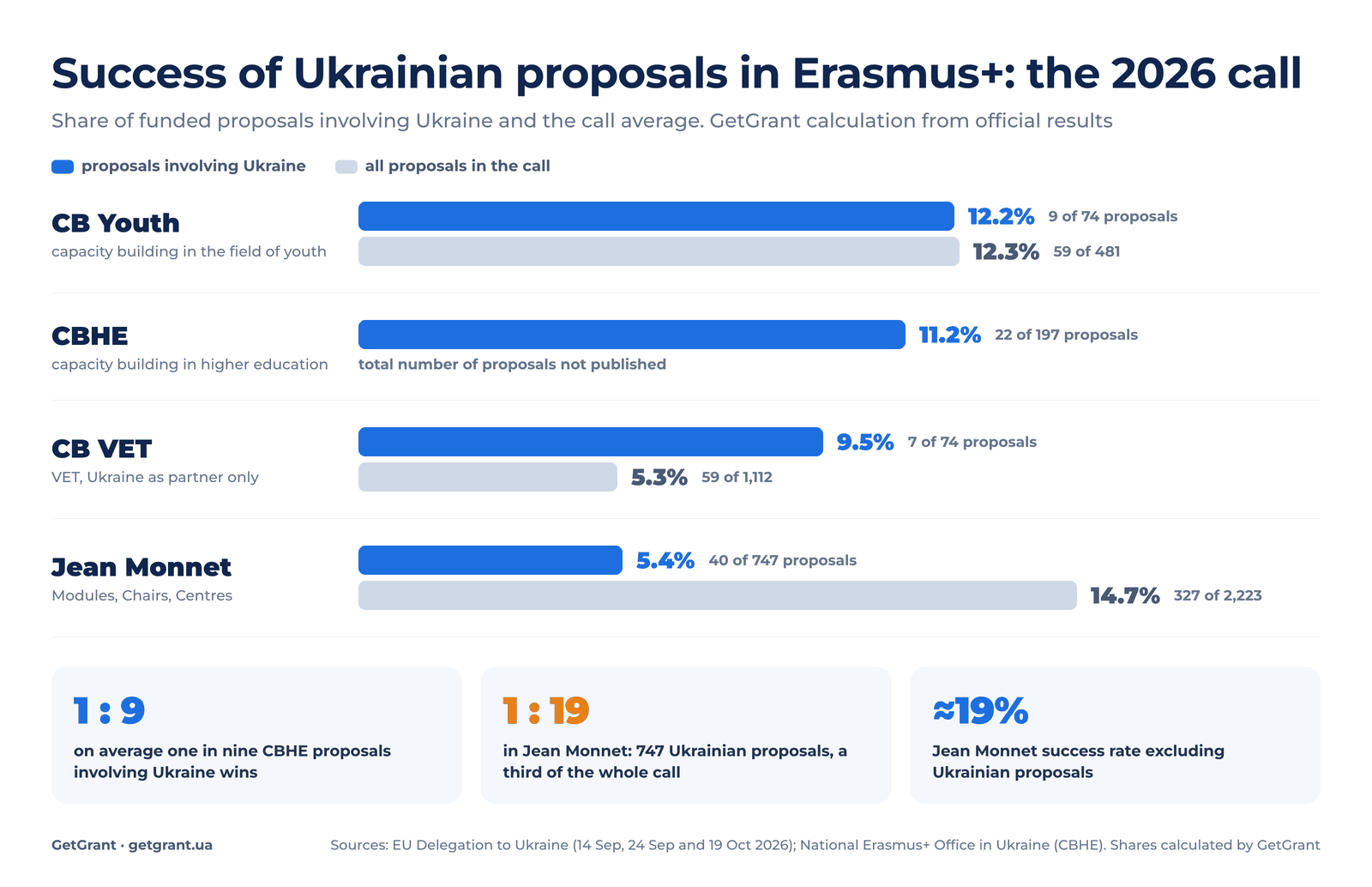
The Guide gives no official statistics on the “odds”, but they can be calculated from the announcements of the EU Delegation to Ukraine on the results of the 2026 call. All the rates below are our calculation.
Jean Monnet: the widest gap. The 2026 call received 2,223 applications and 327 were funded, that is, 14.7%. Applications involving Ukrainian higher education institutions numbered 747, a third of the whole call, and 40 were funded: 38 Modules and 2 Chairs. That is 5.4%. Without the Ukrainian applications, the rest of the world stands at about 19%. Ukraine ranks first among non-associated countries by number of projects (followed by Albania with 18 and the USA with 10), but pays for this with the lowest efficiency: there are almost 19 applications submitted for every project won. In previous years the number of projects was 93 (2022), 89 (2023), 34 (2024) and 20 (2025), so competition among the Ukrainian applications themselves has only grown.
CBHE: 11%. According to the National Office, in the 2026 call 22 of the 197 applications involving Ukraine were funded (in 2022 it was 13 of 73, that is, 18%). Ukrainian higher education institutions coordinate half of them. The action’s budget for 2027, according to the work programme, is 6.2% lower (€106.1 million), so an increase in the rate should not be expected.
CB Youth: 12%. Of 481 applications, 59 were funded (12.3%), and of the 74 applications involving Ukraine, 9 (12.2%). Ukrainian organisations compete here on a par with the average, but only one of the nine projects is coordinated by an organisation from Ukraine.
CB VET: 9.5%. Of 1,112 applications, 59 were funded, that is, 5.3%; of the 74 applications involving Ukraine, 7. This is the most competitive of the capacity building actions, and from 2027 it also has a higher threshold.
CB Sport. We found no data on the number of applications in 2026; according to the National Office’s overview, 7, 5 and 3 projects involving Ukraine were funded in 2024–2026.
What follows from this. In Erasmus+ a Ukrainian application has, on average, a one-in-nine chance, and in Jean Monnet one in nineteen. The number of applications does not in itself improve the odds: the winners are those whose topic does not duplicate dozens of neighbouring ones and whose consortium is convincing to the evaluator.
Recommendations: how to improve your chances
1. Choose one or two actions and do not spread yourself thin. The lifting of the limit in CBHE is no reason to submit five applications. A team that prepares one application for nine weeks writes it better than a team that splits the same time across three.
2. In Jean Monnet, move away from the typical Module. Behind the 5.4% success rate are a hundred similar “European Studies for…” Modules. Applications are in a stronger position when they come from faculties that are not obvious for European studies (engineering, medicine, agricultural sciences, IT), with a specific audience outside the institution and measurable results. Consider a Chair: only two were won in 2026, not because the odds are lower but because hardly anyone applies for them.
3. For the “EU-Ukraine-Moldova” network, look for a consortium this week. There will be only one network, with at least five Ukrainian higher education institutions in it. There will be several real consortia, and the places in them will be allocated before the Christmas holidays.
4. In CBHE, use the regional advantage. If your institution is not in Kyiv, this is a direct advantage in Strands 1 and 2. A university in the capital should invite a regional institution as a full partner, not just to make up the numbers. For newcomers it makes more sense to start with Strand 1: it was designed precisely for institutions with less experience.
5. Link the project to EU policy on Ukraine. The “Relevance” criterion carries 30 points out of 100, and an application that does not score half of the points under it cannot be funded. In CBHE this means the priorities of the region (the Green Deal, digital transformation, integration of migrants, governance and security, sustainable growth and jobs) and the plan for Ukraine’s recovery; in CB VET, the Ukraine Facility.
6. Keep in mind the consultation with the EU Delegation. In CBHE, applications proposed for funding are checked by the EU Delegation to Ukraine. A project that contradicts national reforms or duplicates one already funded may fail even with a high score.
7. Plan the budget around the funding rate. CBHE covers 90%, CB Youth and CB VET 80%. The consortium covers the rest with its own contribution, and this must be agreed with the partners before submission. Equipment in CBHE is capped at 35% of the grant.
8. Artificial intelligence: with caution. The Guide warns explicitly: if you use generative AI to prepare an application, responsibility for originality, accuracy and respect for intellectual property rights lies with the applicant. All applications undergo an automatic check for plagiarism and similarity to projects already funded. Separately, the Guide warns that engaging external contractors who write applications for several applicants increases the risk of rejection for lack of originality.
9. Register now. For EACEA actions you need an EU Login and a PIC on the Funding & Tenders portal; a PIC from Horizon Europe is suitable. For national agency actions, where you are a partner, you need an OID. Registration is done only once, but the validation of data takes more than a day.
10. Attend the information days. The National Office is holding online days on 24–27 November 2026: 24 November – higher education and Jean Monnet, 25 November – vocational education and training and adult education, 26 November – school education, 27 November – youth and sport. This is the best opportunity to clarify disputed points, in particular the CBHE application limit and the provision on association negotiations.
Common mistakes
- Applying as coordinator where Ukraine can only be a partner. In CB VET, KA220, KA171, CoVE and Virtual Exchanges such an application will fail the eligibility check.
- Putting together an “EU plus Ukraine” pair in CB Youth. At least four applicants are needed, as well as a second non-associated country from the same region.
- Upsetting the balance in CBHE. The number of organisations from Ukraine must be no lower than from the EU and associated countries, and a national project needs at least two Ukrainian higher education institutions.
- Submitting two almost identical applications. One will be assessed, and in national agency actions both may be rejected.
- Failing to justify added value in KA220. Without it the Ukrainian partner will be excluded from the application.
- Mixing up the time. EACEA deadlines are at 17:00 and national agency deadlines at 12:00, both Brussels time; in Kyiv that is one hour later.
Who you are and where to apply
Universities. Your actions as an applicant: Jean Monnet (3 February), CBHE (9 February), Erasmus Mundus (16 February). Update your inter-institutional agreements for KA171 by 18 February.
Vocational schools, colleges and schools. You cannot be an applicant. The realistic route is partnership in CB VET (12 May), KA220 (9 March), CoVE (16 September) and eTwinning.
Civil society and youth organisations. Coordinate CB Youth (2 March, one application) or become a partner in youth exchanges (11 February) and KA220 in the field of youth.
Sport organisations. CB Sport (9 March), as coordinator or partner, as well as Cooperation Partnerships in sport.
Students, teaching staff and youth workers. KA171 mobility through your university, Erasmus Mundus scholarships (€1,400 per month; admissions are announced by the programmes themselves) and youth exchanges through partner organisations.
Conclusion
The Erasmus+ calls for 2027 have been announced, and the rules for Ukraine are known: six actions where a Ukrainian organisation applies on its own, and the first deadlines as early as 3 and 9 February. Compared with 2026, the conditions have become somewhat looser (the two-application limit in CBHE has gone, and a Jean Monnet Network with the mandatory participation of five Ukrainian higher education institutions has appeared), but competition is higher than ever: in CBHE one in nine applications involving Ukraine wins, in Jean Monnet one in nineteen. Two questions remain uncertain: whether EACEA will confirm the absence of an application limit and whether Ukraine will obtain the status of an associated country before the grant agreements are signed. It is worth getting an answer to both at the information days on 24–27 November, and not putting off partners and registration until January.
The GetGrant team helps universities, colleges, schools, civil society and sport organisations choose an Erasmus+ action that fits their profile, find European partners and prepare an application. Current calls are collected in the GetGrant catalogue, and individual support can be ordered on the services page.
Sources
- European Commission: Erasmus+ Programme Guide 2027, version 1 of 18.11.2026
- Official Journal of the EU: Erasmus+ 2027 call for proposals, C/2026/6148
- European Commission: Erasmus+ Programme Guide 2026, version 1
- Publications Office of the EU: Erasmus+ 2027 annual work programme, C(2026) 7171 of 15.10.2026
- National Erasmus+ Office in Ukraine: the Programme Guide has been published, the 2027 calls have been announced, 18.11.2026 (in Ukrainian)
- National Erasmus+ Office in Ukraine: overview of Ukraine’s participation in Erasmus+ 2021–2026 and the list of actions open to Ukraine, November 2026
- EU Delegation to Ukraine: 40 new Jean Monnet projects, 14.09.2026
- EU Delegation to Ukraine: nine new projects for youth organisations, 24.09.2026
- EU Delegation to Ukraine: seven new projects in vocational education and training, 19.10.2026
- EU Delegation to Ukraine: 22 new CBHE projects with 105 organisations from Ukraine, 2026
- Ministry of Education and Science of Ukraine: inaugural meeting of the Interagency Working Group on preparing Ukraine’s association to the Erasmus+ programme (in Ukrainian)
Open Erasmus+ calls
- European Cultural Foundation: a €10,000 creative research fellowship to work with the ERASMUS archives for the programme’s 40th anniversary, Ukraine eligible, apply by 1 Decemberuntil 01.12.2026
- Erasmus Mundus NOHA master’s in humanitarian action: €1,400 a month for up to 24 months, study at two European universities, scholarship applications by 15 Decemberuntil 15.12.2026
- Erasmus Mundus GLOCAL master’s at seven universities in Europe, Asia and Latin America: free tuition and €1,400 a month, scholarship applications by 14 Januaryuntil 14.01.2027

Book a consultation or leave your application idea
Tell us in a few words about your project: we will say which grants it fits and can take the application itself off your hands. We reply within one business day.