Funding rates of 18 programmes for Ukrainian applicants according to 2026 documents: from 100% in Horizon Europe to 50% in Digital Europe and eRobota processing. What co-financing is, how to cover it, what donors do not accept and a checklist before submission.
Co-financing is one of the conditions that stop a good idea from reaching submission. An applicant finds a call, writes a concept and, at the budget stage, discovers that the grant covers only 60 or 70% of costs, while the rest has to come from other sources and be documented. For a civil society organisation without reserves, a sole trader in a frontline community or a university department living on the state budget, that 30–40% often weighs more than the grant itself.
We collected the funding rates of 18 programmes available to Ukrainian applicants from official 2026 documents: EU regulations and work programmes, call documents, donor pages and Cabinet of Ministers resolutions. Below is what exactly donors call co-financing, how much each programme requires, how it can be covered and what a donor will not accept, and where budgets most often go wrong. Figures were checked as of 9 November 2026.
Short answer
- In EU research and innovation the grant covers up to 100% of costs: research and innovation actions (RIA) and coordination and support actions (CSA) in Horizon Europe are fully funded, innovation actions (IA) at 70% for profit-making companies. Indirect costs are a flat 25% of direct costs.
- EIC Accelerator covers 70% of costs with the grant (below €2.5 million), Digital Europe 50% (75% for SMEs), LIFE standard projects 60% (75% for priority habitats and species).
- Programmes for NGOs, municipalities and SMEs are more generous: Interreg NEXT, CERV and the Single Market Programme up to 90%, Creative Europe 80% for small and 70% for medium cooperation projects.
- The International Visegrad Fund, the Swedish Institute, the Ukrainian Cultural Foundation, the Ukrainian Veterans Fund and Own Business 2.0 require no mandatory own contribution. But at the Ukrainian Cultural Foundation, on equal scores, a project with at least 5% co-financing wins, and under Own Business 2.0 taxes and social contributions paid during the project must at least equal the grant.
- The largest contribution is required by state programmes for production: 30% for orchards and greenhouses, 50% for processing (intake suspended), and 35 to 50% for a company commissioning research from a state university.
- In-kind contributions and volunteer work are not accepted everywhere: in EU grants volunteer work may make up to 50% of co-financing, Erasmus+ does not count third-party in-kind contributions, and the Ukrainian Cultural Foundation accepts only cash.
What co-financing is and what it is not
Co-financing (in the US, cost sharing or matching) is the part of a project’s eligible costs covered not by the donor but by the applicant, partners or third parties. The EU Financial Regulation states the principle directly: grants involve co-financing, and its sources may be the beneficiary’s own resources, income generated by the action, and financial or in-kind contributions from third parties (Art. 193 of Regulation 2024/2509).
The size of co-financing is set by the funding rate, the maximum share of eligible costs the donor will reimburse. If the rate is 80% and eligible costs are €100,000, the grant will be no more than €80,000, and €20,000 is your contribution. Three clarifications matter here.
First, the rate applies to eligible costs, not to everything you spend. Recoverable VAT, exchange losses or loan interest are not part of the project budget and are paid on top of co-financing.
Second, indirect costs are not co-financing. In Horizon Europe 25% is automatically added to direct costs for rent, accounting and communications, and this amount is covered at the same rate as the rest of the budget.
Third, leveraged funds are a broader concept. These are investments, municipal decisions or follow-up grants that the project attracts to its topic. They strengthen an application, but they become co-financing only when they cover the costs of this particular project and appear in its budget.
Lump sums and unit costs are a special case. In Erasmus+ the donor does not require reporting of actual costs, so compliance with co-financing is “generally assumed”. But for cooperation partnerships the Programme Guide separately requires the estimated cost of the project to be higher than the fixed lump sum the grant provides.
EU programmes: from 50 to 100%
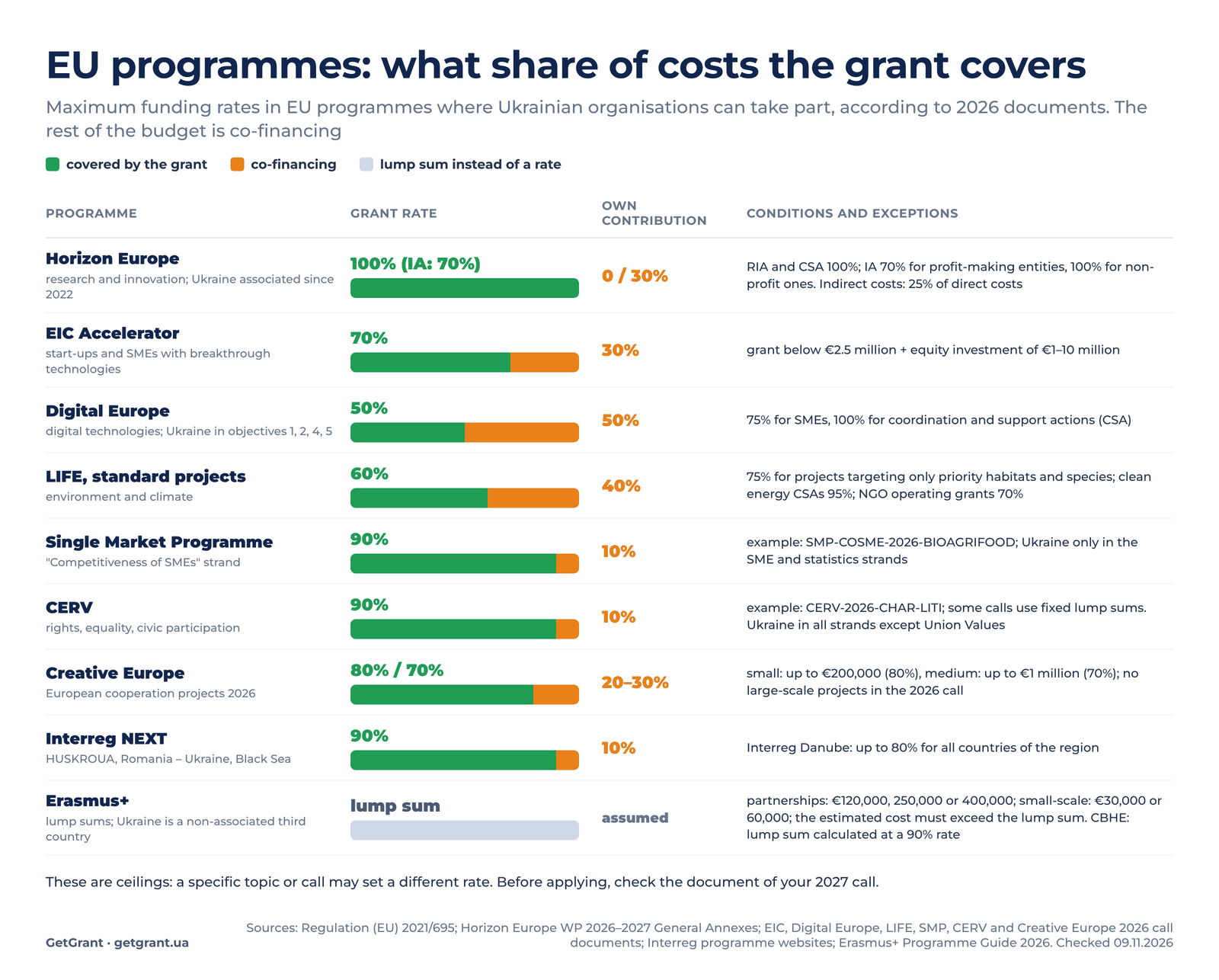
The EU logic is simple: the closer a project is to the market, the larger the share the applicant puts in. That is why Horizon Europe research actions are funded at 100%, innovation actions at 70% for companies, and EIC Accelerator, which effectively invests in a start-up, at 70% through the grant plus an equity investment of €1 to 10 million. A non-profit organisation in the same Horizon Europe innovation project receives 100%, so a university in a consortium with a company makes no own contribution.
Digital Europe, in which Ukraine takes part in objectives 1, 2, 4 and 5 (without cybersecurity), is the most demanding programme: a simple grant covers 50% of costs, SME support 75%, and only coordination actions receive 100%. LIFE in the 2026 calls offers 60% for standard environment and climate projects, 75% for projects targeting exclusively priority habitats and species, 95% for clean energy transition coordination actions and 70% for NGO operating grants.
Rates are higher for civil society, culture and municipalities. CERV, which Ukraine joined in all strands except Union Values, reimburses 90% in a typical 2026 call. Creative Europe in the 2026 cooperation projects call gave 80% to small projects (up to €200,000) and 70% to medium ones (up to €1 million); large-scale projects at 60% were not announced this time. Interreg NEXT programmes involving Ukraine (Hungary – Slovakia – Romania – Ukraine, Romania – Ukraine, Black Sea Basin) fund up to 90%, and Interreg Danube up to 80%. How to find a place in such consortia is covered in our review of Interreg NEXT for communities and universities.
All these rates are ceilings. A specific call topic may set a different one, so before applying, check the document of your own 2027 call.
Bilateral donors and Ukrainian programmes: often no mandatory contribution
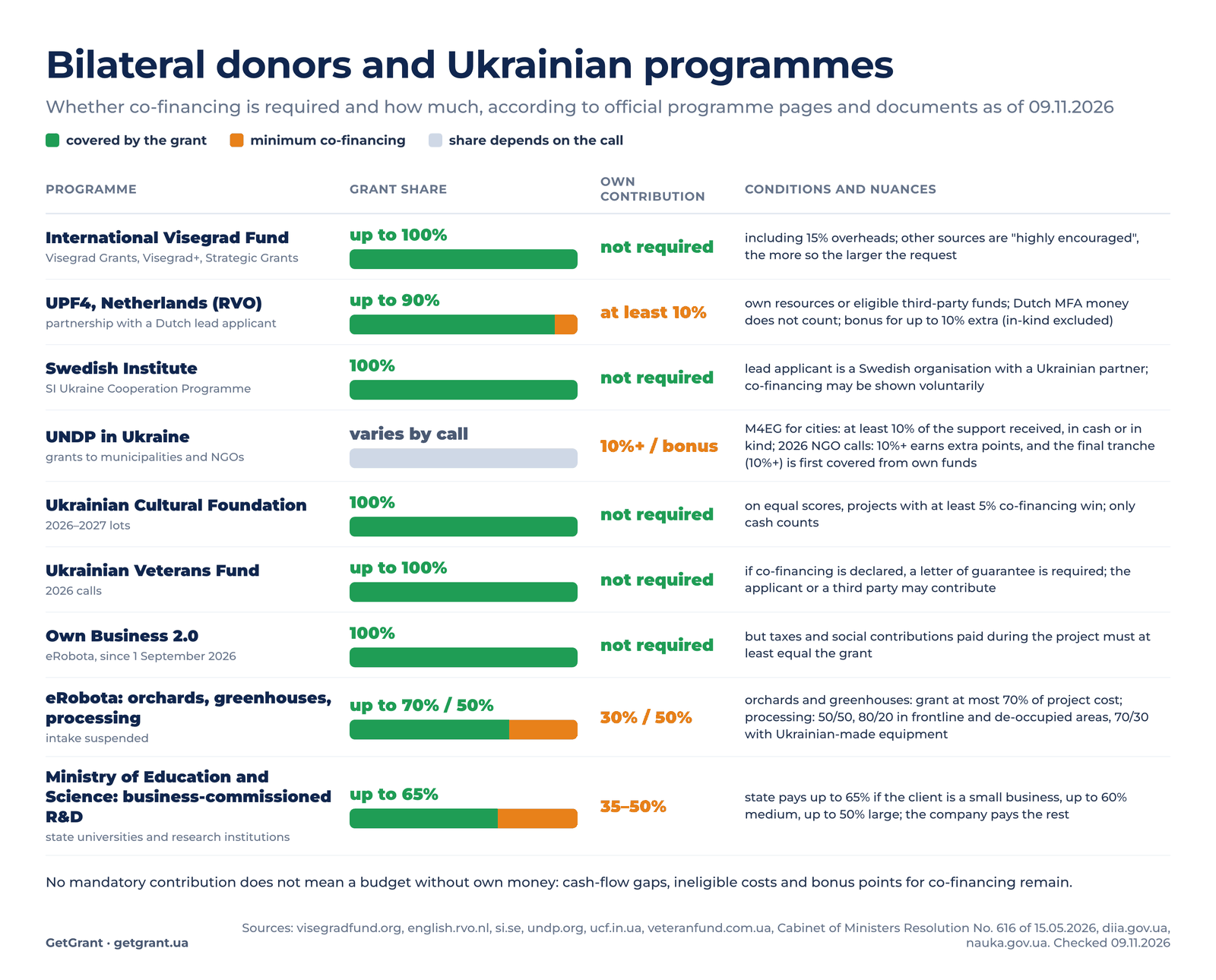
The International Visegrad Fund covers up to 100% of costs, including 15% overheads, in Visegrad Grants, Visegrad+ and Strategic Grants. Its guidelines, however, explicitly encourage other sources: the larger the amount you request, the more it expects to see funds from other partners. The Swedish Institute requires no co-financing at all in the SI Ukraine Cooperation Programme, although the lead applicant here must be a Swedish organisation with a Ukrainian partner.
The Dutch UPF4 is an example of the classic “90 to 10” model: a grant of up to 90% of eligible costs, with at least 10% contributed by the partnership from its own resources or eligible third-party funds. Money from the Dutch Ministry of Foreign Affairs does not count towards this 10%, and bonus points for a further contribution of up to 10% for projects in ten designated eastern, southern and northern oblasts cannot be earned in kind.
UNDP in Ukraine combines both approaches. In the M4EG call for cities a municipality must show co-financing of at least 10% of the support received, in cash or in kind. In 2026 NGO calls a contribution of 10% of the budget is not mandatory but gives an extra advantage. More important is something else: the final tranche, at least 10% of the grant, is first covered by the organisation from its own funds and reimbursed by UNDP after the financial report is approved. Formally there is no co-financing, but there is a cash-flow gap.
The Ukrainian Cultural Foundation does not require co-financing in its 2026–2027 lots, but on equal scores a project with at least 5% co-financing has priority, and only cash counts. The Ukrainian Veterans Fund does not require a contribution either, and if you declare one, a letter of guarantee from the applicant or a third party is needed. Own Business 2.0, in force since 1 September 2026 under Resolution No. 616, requires no own contribution; instead, taxes and social contributions paid during the project must be no less than the grant amount.
Among Ukrainian programmes the highest own contribution is in the production lines of eRobota. For orchards and greenhouses the grant is at most 70% of project cost, and for processing 50%, with preferential 80/20 for frontline and de-occupied communities and 70/30 if Ukrainian-made equipment is bought. Both lines are currently marked as suspended on Diia. Official sources diverge on orchards and greenhouses: in May 2026 the Ministry of Economy mentioned both 50/50 and 70% rising to 80% for frontline territories, so check the current version of Resolution No. 738 before intake resumes. What else changed in the programme is covered in eRobota in 2026–2027: what changed.
In science, a telling example is the Ministry of Education and Science call for business-commissioned research: the state covers up to 65% of a university project’s cost if the client is a small business, up to 60% for a medium one and up to 50% for a large one, and the company pays the rest and confirms it with a certificate.
What a rate means in money
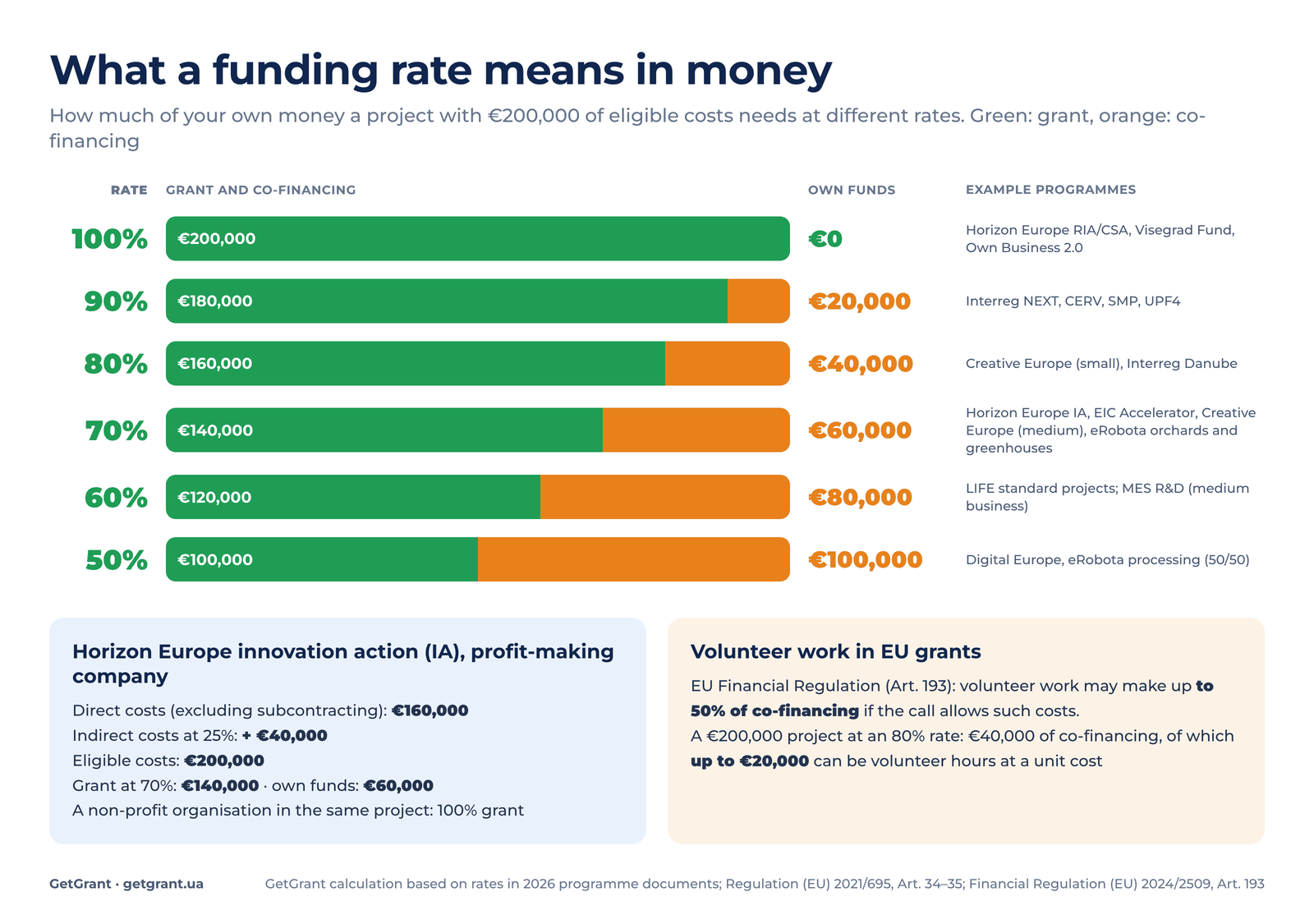
The difference between 90 and 70% becomes tangible in money. For a project with €200,000 of eligible costs, a 90% rate means €20,000 of own funds, 70% already €60,000, and 50% €100,000. For a company in a Horizon Europe innovation action the calculation looks like this: direct costs excluding subcontracting of €160,000, plus 25% indirect costs, giving €200,000 of eligible costs, of which the grant is €140,000 and the company covers €60,000 itself.
Co-financing is calculated on eligible costs, not on the grant amount. If a call says “grant up to €60,000, rate 80%”, then to receive the full amount eligible costs must be at least €75,000, and €15,000 of them are yours.
How to cover co-financing
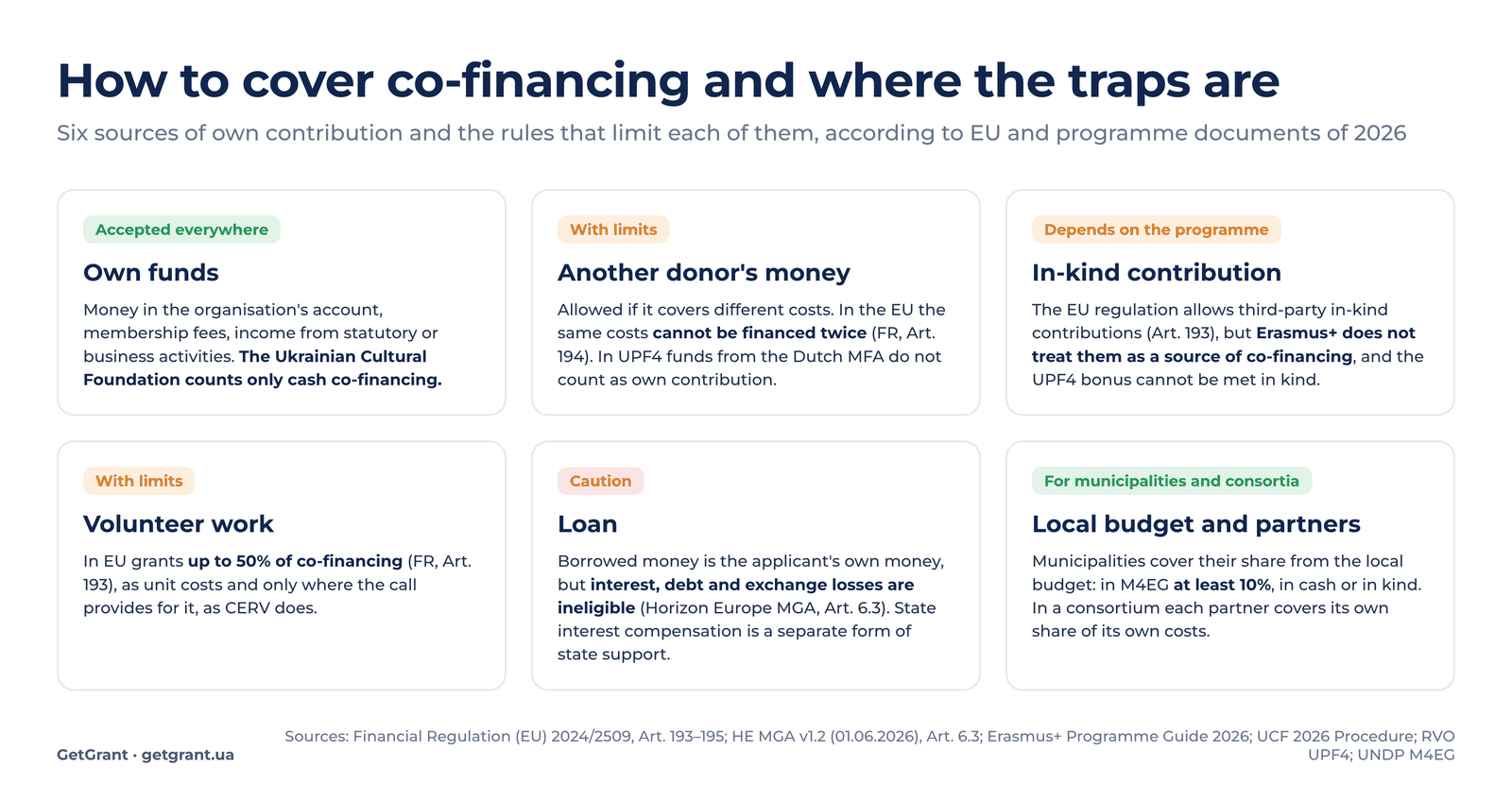
Own funds. Money in the account, membership fees, income from statutory or business activities. All donors accept them, and at the Ukrainian Cultural Foundation there is no other option.
Another donor’s money. Grants can be combined, but only for different costs. The EU Financial Regulation prohibits financing the same costs twice (Art. 194), and the Horizon Europe model grant agreement explicitly treats costs already declared under another EU grant as ineligible. Some donors narrow the circle further: in UPF4 funds from the Dutch Ministry of Foreign Affairs do not count as own contribution, and Sida does not accept money from other public sources as own funds.
In-kind contribution. Premises, equipment or services a partner provides free of charge. The EU regulation allows third-party in-kind contributions, but individual programmes restrict them: Erasmus+ does not treat them as a source of co-financing, the extra bonus contribution in UPF4 cannot be made in kind, and the Ukrainian Cultural Foundation does not count in-kind contributions at all.
Volunteer work. In EU grants it may make up to 50% of co-financing (Art. 193 of the Regulation) and is declared at a unit cost, as in CERV, where volunteer work allows reimbursement to reach up to 100% of normal costs. But only where the call explicitly provides for this cost category.
Loan. Borrowed money is your own money, so formally it can cover the contribution. But interest, debt service and exchange losses are ineligible costs and have to be paid on top of the budget. If the loan is subsidised, for example under the 5-7-9 programme, the state interest compensation is itself state support, and combining it with a state grant should be checked against the terms of both programmes. Grants and loans are compared in Grant or 5-7-9 loan for energy independence.
Municipal budget and partners. Municipalities cover their contribution from the local budget: at least 10% in M4EG. Under the State Regional Development Fund’s Procedure No. 196, co-financing from local budgets was 10%, but since 10 July 2026 the new Procedure No. 883 applies, so check the threshold against it. Housing associations in the Energodim programme are reimbursed 40–70% of costs and cover the rest themselves. In an EU consortium each partner is responsible for co-financing its own part of the budget, and this should be agreed before submission.
Co-financing by applicant type
NGOs and charitable foundations. The most comfortable options for you are the International Visegrad Fund, the Ukrainian Cultural Foundation, the Ukrainian Veterans Fund and UNDP calls, but keep a reserve for the final tranche and exchange differences. In the EU, CERV and Interreg NEXT with rates of up to 90% are the best fit, and volunteer work genuinely helps to cover the contribution here.
Businesses, sole traders and SMEs. Prepare for the largest share: from 30% in EIC Accelerator and Horizon Europe innovation actions to 50% in Digital Europe and eRobota processing. Own Business 2.0 requires no contribution, but a tax obligation equal to the grant is also a contribution, spread over time.
Universities and researchers. In Horizon Europe non-profit institutions receive 100% even in innovation actions. Co-financing usually falls on the business partner, as in the Ministry of Education and Science call, where the company pays 35 to 50% of the research cost.
Cultural organisations. Creative Europe requires 20–30%, and for Ukrainian organisations this is often the most tangible barrier. The Ukrainian Cultural Foundation and ZMINA:Resilience give more room, and at the Foundation even a 5% cash contribution can decide a project’s fate on equal scores.
Municipalities and local authorities. Interreg NEXT and M4EG work with a contribution of at least 10%, and for the State Regional Development Fund the threshold should be checked against the new Procedure No. 883. The contribution should be built into next year’s local budget before the call is announced.
Common mistakes and risks
- Double funding. The same cost in two grants is the most serious breach and leads to repayment. Keep separate accounts of costs for each project.
- Ineligible costs in co-financing. VAT you can recover is ineligible in EU grants, as are interest, debt and bank charges for transfers from the donor. They cannot be shown as a contribution.
- Exchange differences. In Horizon Europe costs in hryvnia are converted into euros at the average rate for the reporting period, and exchange losses are ineligible. If the hryvnia strengthens, the grant in hryvnia shrinks, and you cover the difference.
- Equipment. By default Horizon Europe reimburses only depreciation over the project period, not the full price. The rest of the cost is in effect borne by the applicant.
- Cash-flow gap. Even without formal co-financing, a donor may pay in instalments and reimburse the final tranche only after the report.
Checklist: co-financing before submission
- Find the funding rate and the grant type in the call document: actual costs or a lump sum.
- Calculate the contribution on eligible, not total, costs, and separately the ineligible costs you will have to pay anyway.
- Check which sources the donor accepts: cash, in kind, volunteer work.
- Obtain letters of guarantee from partners and third parties before submission, not after.
- Make sure no cost is covered by another grant.
- Set aside a reserve of 5–10% for exchange differences and the cash-flow gap between tranches.
- If a contribution is not mandatory but earns points, decide whether to show it.
Conclusion
Co-financing in 2026–2027 is not one figure but a range from 0 to 50%. The closer a project is to the market, the bigger the contribution: research in Horizon Europe is fully funded, company innovation at 70%, Digital Europe projects at 50%. For civil society, municipalities and culture the EU provides 80–90%, and some bilateral donors and Ukrainian funds do without a mandatory contribution. Even then, own money is needed: for ineligible costs, exchange differences, the cash-flow gap and bonus points. That is why co-financing should be planned together with choosing a call, not after the application is written.
The GetGrant team helps you choose a call with a co-financing share that is realistic for you, build a budget under the donor’s rules and prepare partners’ letters of guarantee. Current calls are collected in the GetGrant catalogue, and individual matching can be ordered on the services page.
Sources
- Regulation (EU) 2021/695 establishing Horizon Europe, Art. 34–35
- Horizon Europe Work Programme 2026–2027: General Annexes
- Horizon Europe Model Grant Agreement v1.2, 01.06.2026
- European Commission: Ukraine’s association agreement to Horizon Europe enters into force
- Financial Regulation (EU, Euratom) 2024/2509, Art. 189, 193–195
- EIC Accelerator: Guide for Applicants, WP 2026
- Digital Europe: DIGITAL-2026-BESTUSE-RSF-10
- Digital Europe: third-country participation
- LIFE 2026: Standard Action Projects, Nature and Biodiversity
- LIFE 2026: Clean Energy Transition
- LIFE 2026: NGO operating grants
- Single Market Programme: SMP-COSME-2026-BIOAGRIFOOD
- Single Market Programme: third-country participation
- CERV: CERV-2026-CHAR-LITI
- CERV: third-country participation
- Creative Europe: CREA-CULT-2026-COOP
- Erasmus+ Programme Guide 2026: financial conditions
- Erasmus+ Programme Guide 2026: cooperation partnerships
- Erasmus+ Programme Guide 2026: capacity building in higher education
- Interreg NEXT Hungary – Slovakia – Romania – Ukraine: call conditions
- Interreg NEXT Black Sea Basin
- Interreg Danube Region: How to apply
- International Visegrad Fund: Visegrad Grants
- International Visegrad Fund: Visegrad+
- RVO: Ukraine Partnership Facility
- Swedish Institute: SI Ukraine Cooperation Programme 2026, application instructions
- Sida: guidelines for partner organisations within the CSO strategy
- UNDP and EU: Innovative Finance Challenge for cities
- UNDP Ukraine: grant for creative resilience solutions in partner communities
- Ukrainian Cultural Foundation: 2026–2027 lots
- Ukrainian Veterans Fund: calls
- Cabinet of Ministers of Ukraine: Own Business 2.0, grants of up to UAH 2.5 million under new rules
- Diia: orchard grant
- Diia: greenhouse grant
- Diia: processing enterprise grant
- Ministry of Economy of Ukraine: greenhouse grants, 25.05.2026
- Ministry of Education and Science: 2026 call for business-commissioned research
- Cabinet of Ministers of Ukraine: new procedure for the State Regional Development Fund
- Energy Efficiency Fund: Energodim
- eCFR: 2 CFR 200.306, Cost sharing or matching

Book a consultation or leave your application idea
Tell us in a few words about your project: we will say which grants it fits and can take the application itself off your hands. We reply within one business day.