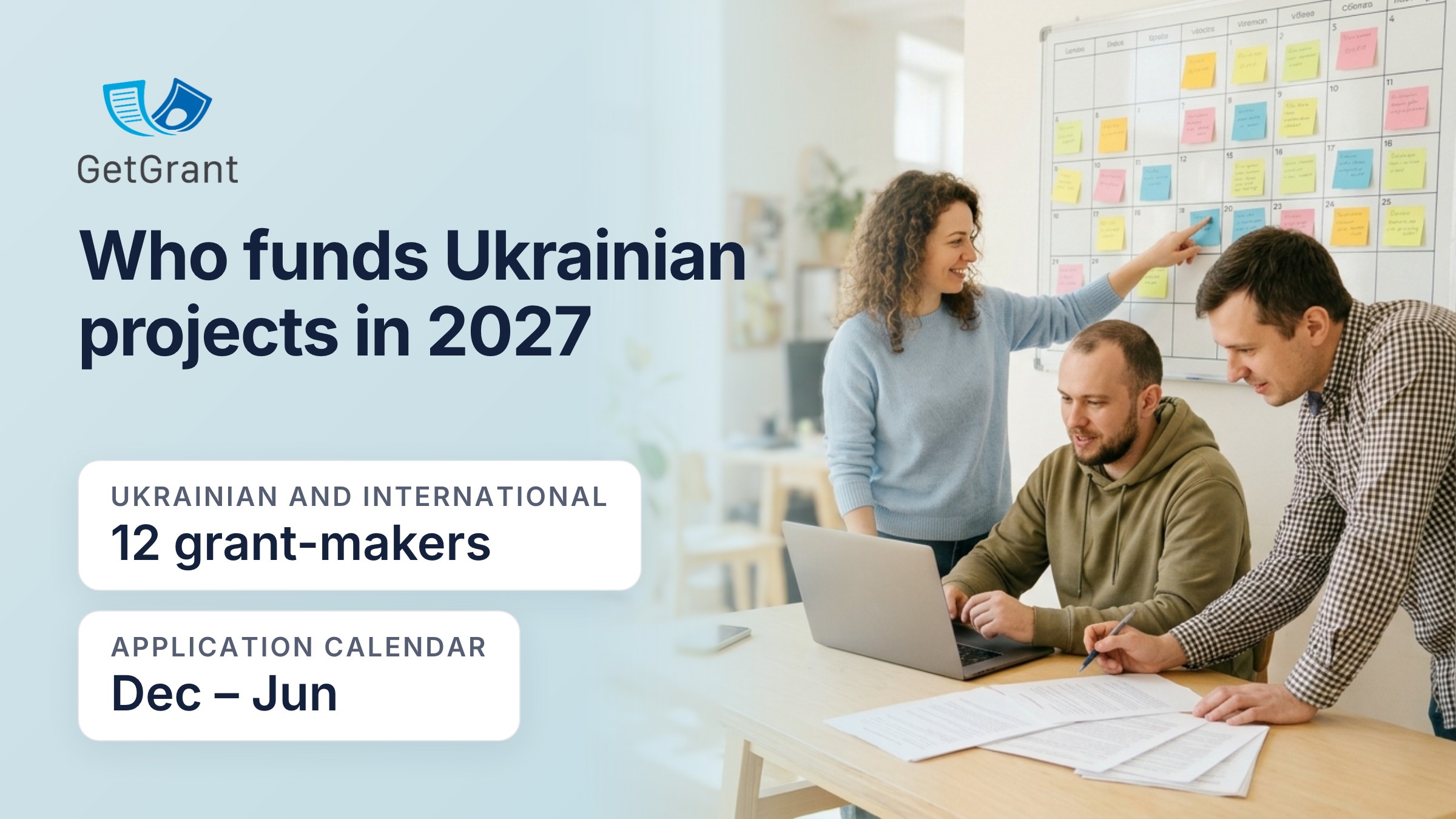
GetGrant analysis: 6 Ukrainian and 6 international grant-makers open to Ukrainian organisations in 2027 – who they fund, typical amounts, application cycles, what is open now and what to expect from December 2026 to spring 2027, with a monthly calendar and an applicant checklist.
The 2027 grant year for Ukrainian organisations starts in December 2026. Some international calls are open now and close in January–February, while Ukrainian funds that work on an annual cycle announce their programmes right at the turn of the year. Those who miss the winter window will wait until spring or autumn for the next chance in many programmes.
We have collected 12 grant-makers that most often fund projects from Ukraine: six Ukrainian and six international. For each one we describe who they fund, typical grant sizes, how the application cycle works, what is open now and what to expect from December 2026 to spring 2027, plus one practical tip. The article ends with a month-by-month calendar and a preparation checklist. Data were checked as of 24 November 2026.
Short answer
- The nearest firm deadlines where a Ukrainian organisation can be the applicant: Creative Europe literary translation – 27 January 2027; NED – 27 January; International Visegrad Fund, Visegrad+ – 1 February (under the Fund’s standing schedule); Erasmus+ Jean Monnet actions and CBHE – 3 and 9 February.
- The Ukrainian Cultural Foundation was the first to open 2027: since 20 November it has been accepting applications for UCF Scholarships (UAH 100,000–250,000 for artists and culture professionals, deadline 5 January 2027, 18:00). A full UCF season announcement, as well as new calls from the Ukrainian Veterans Fund and Own Business 2.0, had not appeared as of 24 November; their dates in this article are marked as “expected”, with an explanation of what the expectation is based on.
- The largest amounts per project among Ukrainian sources are offered by the National Research Foundation (up to UAH 8 million over three years in the Advanced Fundamental Science call) and Own Business 2.0 (up to UAH 2.5 million with bonuses). The typical budget of an NGO project in 2026 calls was UAH 1–1.5 million at the International Renaissance Foundation and in Unity for Community, and up to UAH 2.5 million in institutional support via ISAR Ednannia.
- Without foreign partners, a Ukrainian organisation can apply to NED, Black Sea Trust, Erasmus+ Jean Monnet actions and Creative Europe literary translation. Creative Europe cooperation projects, most Erasmus+ actions, the Visegrad Fund and the Swedish Institute require a consortium or a foreign lead applicant.
- Black Sea Trust accepts applications on a rolling basis ($5,000 to $60,000, $25,000 on average), NED three times a year (27 January and 28 June 2027), the Visegrad Fund three times a year (1 February, 1 June, 1 October).
- The main risk in 2027 is transition: it is the last year of the EU’s 2021–2027 budget period and of Sweden’s 2023–2027 cooperation strategy with Ukraine, while the budgets of Ukrainian state funds depend on the 2027 state budget.
Methodology
Selection. The list includes grant-makers that in 2025–2026 regularly announced open calls for Ukrainian applicants or with mandatory Ukrainian participation and published conditions with amounts and dates. We deliberately excluded loan programmes, state subsidies without competitive selection and programmes where Ukraine is only a partner with no budget of its own.
Sources. Conditions and dates come from the grant-makers’ official websites, call documents (PDF), European Commission documents on the Funding & Tenders Portal and announcements by public authorities. The full list is in the Sources section.
Limitations. Most grant-makers do not publish an annual calendar in advance. Where a 2027 date has not been announced, we write “expected” and state what the expectation follows from: the fund’s standing schedule, the previous year’s cycle or the work programme plan. Amounts are given in the funder’s currency without conversion. Wherever we calculate something ourselves, it is marked as a GetGrant calculation.
12 grant-makers on one page
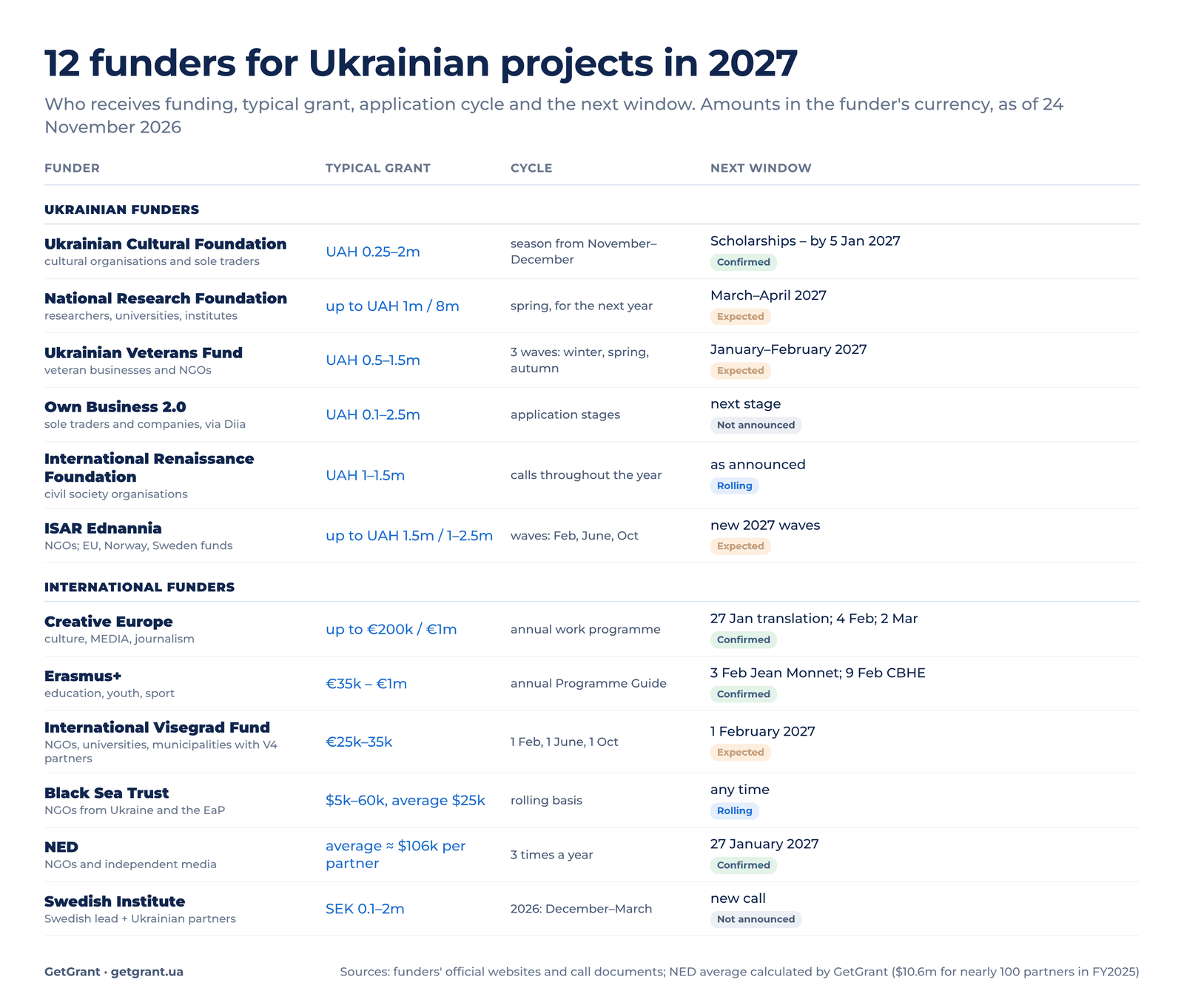
The table shows three patterns. The first is the cycle. Ukrainian state funds (UCF, NRFU, the Veterans Fund) work from the budget year: programmes are announced at the end of the previous year or in spring, and the money arrives in the implementation year. International funds keep a steady schedule (Visegrad on 1 February, 1 June and 1 October; NED three times a year ahead of board meetings) or accept applications on a rolling basis, as Black Sea Trust does.
The second is the applicant’s role. A Ukrainian organisation applies on its own to all six Ukrainian sources, to NED and Black Sea Trust, and in EU programmes to Jean Monnet actions and literary translation. In other Creative Europe and Erasmus+ calls it can be the coordinator, but a consortium is required; the Visegrad Fund requires two partners from different V4 countries; in the Swedish Institute programme the lead applicant must be Swedish.
The third is size. From $5,000 at Black Sea Trust to UAH 8 million at NRFU or €1 million for a medium-scale Creative Europe cooperation project, the range spans two orders of magnitude. This means a source should be chosen not by the funder’s name but by the scale of the project and the organisation’s capacity to report.
Ukrainian grant-makers
Ukrainian Cultural Foundation
Who it funds. A state institution that runs calls for organisations and sole traders in culture and the creative industries. The 2026 grant season included at least 10 programmes, among them Culture During War, Culture. Regions, Cultural Heritage and the new Contemporary Music Space, Art in Frame and Flagship Events.
Amounts. Set in the instructions for each lot. A 2026 example: Contemporary Music Space had a budget of UAH 20 million, with the Professional Stage lot at UAH 750,000 to 2 million and co-financing of at least 30%, and the New Voices lot at UAH 500,000 to 1 million. In the international Artistic Debuts call of the Cultural Horizons programme, grants ranged from UAH 250,000 to 715,000 with a total budget of UAH 18 million.
Cycle. UCF published the 2026 season announcement on 28 October 2025, and applications opened on 17 November 2025, programme by programme. Separately, the Cultural Horizons programme (UAH 35.3 million, Creative Europe funds) runs from June 2026 to August 2027; its calls require an EU partner.
2027. The first call of the season is already open: UCF Scholarships (Lot 1, co-funded by the Grand Duchy of Luxembourg) – UAH 100,000 to 250,000 for an individual creative project by Ukrainian citizens aged 18+ (not sole proprietors or legal entities), applied for via the UCF website with a qualified e-signature by 5 January 2027, 18:00; the number of scholarships is not stated. As of 24 November 2026 we found no full announcement of the 2027 season. The remaining programmes are expected to be announced in December 2026 – February 2027; this assumption is based on the 2026 cycle and depends on UCF’s allocation in the final 2027 state budget.
Tip. UCF’s requirements on the applicant’s track record can be strict: in the Artistic Debuts call, for example, an organisation or sole trader had to be registered at least a year before the announcement and have experience in culture, and all applications pass a technical screening before the expert assessment. Register your organisation in the UCF system and collect the statutory documents before the season is announced, not after.
National Research Foundation of Ukraine
Who it funds. Research projects by scientists and teams at universities and research institutions.
Amounts. Advanced Fundamental Science in Ukraine 2027–2029: a total of up to UAH 800 million (UAH 300 million in 2027), up to UAH 8 million per project if equipment worth at least UAH 200,000 is purchased and up to UAH 7 million without it. Individual Research Projects 2027–2028: up to UAH 1 million per project (up to UAH 500,000 a year), up to UAH 100 million in total; the principal investigator is the sole performer, and partners are not envisaged.
Cycle. NRFU announces calls for the next year in spring: in 2026 applications were accepted from 25 March to 24 April (Advanced Science) and from 1 April to 1 May (individual projects). Results of both calls are expected by around 15 December 2026, with funding from 2027.
2027. No calls for 2028 projects have been announced yet. They are expected to open in March–April 2027 by analogy with 2026.
Tip. NRFU rejects applications on formal grounds if the requested amount exceeds the limit of even one stage, and moving funds between stages is prohibited. Plan the budget by stage from day one rather than splitting the total at the end.
Ukrainian Veterans Fund of the Ministry of Veterans Affairs
Who it funds. Veteran businesses (sole traders, self-employed people and legal entities owned by veterans) and, under rules updated by the government in April 2026, civic associations with veterans or their family members in the leadership, registered at least a year earlier.
Amounts. In the three 2026 business calls, UAH 500,000 to 1.5 million depending on the budget.
Cycle. Three waves a year: Varto: 4 Years of Support (announced on 27 January, deadline 17 February, results 24 April), Varto: Business with Character (14 May – 1 June, results 31 July), Varto: Step Forward with Kernel (announced on 7 September, deadline 29 September). Selection consists of a technical check, expert assessment and a public pitch.
2027. The first wave is expected in January–February 2027, based on the 2026 schedule. There was no official announcement as of 24 November.
Tip. Each 2026 wave was open for about three weeks. Keep a ready budget and business plan so that you can apply within the first 10 days and attend the Fund’s webinars.
Own Business 2.0 (Ministry of Economy, State Employment Service, Diia)
Who it funds. Sole traders and companies starting or scaling up a business; applications are submitted in Diia.
Amounts. From 1 September 2026: start-up UAH 100,000–300,000 (up to 500,000 with bonuses), scale-up UAH 0.5–1.5 million (up to 2.5 million). A mandatory condition is paying taxes and social contributions over the project term at least equal to the grant.
Cycle. Applications in stages. The stage that started on 9 September ran in Diia until 27 October 2026.
2027. As of 24 November the next stage had not been announced. The programme is financed by the Compulsory State Social Unemployment Insurance Fund, so the 2027 volume will depend on its budget.
Tip. Bank points depend mostly on credit history rather than on the business plan. A detailed analysis of the rules, points and rejection statistics is in our Own Business grant in numbers review.
International Renaissance Foundation
Who it funds. Civil society organisations and their partnerships in democracy and governance, civic resilience, European integration and social capital. Over 36 years the Foundation has supported 21,000 projects worth $380 million, and since the start of the full-scale invasion more than 2,300 projects, including more than $80 million in support for civil society.
Amounts. Set in each call. In 2026 the optimal project budget in the Voice: Participation That Shapes Decisions call (participation of internally displaced persons) was UAH 1–1.3 million with a total budget of UAH 11.15 million, and in the small grants of the Impulse project UAH 1–1.5 million.
Cycle. Calls are announced throughout the year according to programme priorities; in 2026 deadlines fell on 3 April, 27 August and 9 October. The Foundation also considers socially significant projects outside calls. Applications are submitted electronically and in Ukrainian only.
2027. The Foundation does not publish a calendar in advance. The Impulse call completed its last, fifth wave on 27 August 2026 as scheduled, so new 2027 calls should be followed on the Foundation’s calls page.
Tip. The time between announcement and deadline at the Foundation is usually a few weeks, and results come one to one and a half months later. The best preparation is to have the problem, evidence base and community partners described in advance rather than waiting for the call topic.
ISAR Ednannia
Who it funds. Civic and charitable organisations. ISAR Ednannia is a Ukrainian operator that channels funding from the EU (the Unity for Community project, Unity4Community) and from Norway and Sweden (the Askold and Dir Fund).
Amounts. Unity for Community project grants of up to UAH 1.5 million for 6–12 months; Askold and Dir institutional support mostly from UAH 1 to 2.5 million for up to 12 months for organisations that have worked in their field for at least two years.
Cycle. In waves: in 2026 deadlines were 15 February (second Unity for Community wave), 17 June (institutional support) and 2 October (third wave, about 20 grants).
2027. New waves are expected, but the dates are unknown; the basis is the 2026 rhythm (winter, summer, autumn).
Tip. Winners go through a capacity verification (due diligence). Keep your reports, founding documents and financial policies in order: this is where organisations that passed the content assessment drop out.
International grant-makers
Creative Europe
Who it funds. Cultural and creative organisations (Culture strand), the audiovisual sector (MEDIA, which Ukraine joined in December 2024) and cross-sectoral projects, including journalism partnerships.
Amounts. Cooperation projects in 2026: small-scale – at least 3 partners from 3 countries, up to €200,000 with an EU co-funding rate of 80%; medium-scale – 5 partners from 5 countries, up to €1 million, 70%; large-scale – 10 partners from 10 countries. Literary translation in 2027: up to €100,000 for translating at least 5 works, up to €200,000 for 11 works, up to €300,000 for 21 works (consortium only), with a co-funding rate of up to 60%.
Cycle. The first 2027 calls were published on 30 September 2026 (the programme’s annual budget is €402 million). Open now: literary translation (€5 million, deadline 27 January 2027), journalism partnerships (€14 million, 4 February), MEDIA co-development (€12.5 million, 2 March).
2027. The Commission plans to launch the main cooperation projects call (€61 million) in the first quarter of 2027. In 2026 this call was published on 5 March with a deadline of 5 May, so the expected 2027 deadline is May. 2027 is the last year of the current programme; its successor will be AgoraEU.
Tip. In the translation call the Commission explicitly encourages translations from and into Ukrainian and books for displaced Ukrainians, and you can apply alone (up to €200,000) or as a consortium (up to €300,000). For a Ukrainian publisher this is a chance to be the applicant, not just a partner.
Erasmus+
Who it funds. Higher education and vocational institutions, youth and sport organisations.
Amounts and 2027 deadlines where a Ukrainian organisation can apply itself: Jean Monnet actions – 3 February; Capacity Building in Higher Education (CBHE, €200,000 – €1 million) – 9 February; Erasmus Mundus – 16 February; capacity building in the field of youth (up to €300,000) – 2 March; in the field of sport (€100,000–200,000) – 9 March. As a partner: KA220 – 9 March, vocational education CB VET (up to €500,000) – 12 May.
Tip. A detailed analysis of deadlines, amounts and the success of Ukrainian proposals in 2026 is in our article Erasmus+ 2027: calls announced.
International Visegrad Fund
Who it funds. Joint projects of organisations from the V4 countries (Poland, Czechia, Slovakia, Hungary) with partners from the Eastern Partnership and the Western Balkans under Visegrad+.
Amounts. A typical grant is €25,000–35,000, up to 100% of the project budget, overheads up to 15%, duration up to 18 months.
Cycle. Standing: registration opens on 1 January, 1 May and 1 September, with deadlines on 1 February, 1 June and 1 October. Results of the autumn 2026 round (deadline 1 October) will be announced on 22 December 2026.
2027. The next deadline is expected on 1 February 2027 under the Fund’s standing schedule; there is no separate 2027 announcement on the website yet.
Tip. A simplified formula applies to Ukraine “until further notice”: a Ukrainian organisation can apply with two partners from two different V4 countries, without a third Eastern Partnership country. The Fund offers up to two consultations per project idea, but no later than 14 days before the deadline, which for the February round means by 18 January.
Black Sea Trust (German Marshall Fund)
Who it funds. NGOs from Ukraine, Armenia, Azerbaijan, Georgia and Moldova, including recently founded ones.
Amounts. $5,000 to $60,000, $25,000 on average; 3 to 12 months. Co-funding is not required but encouraged.
Cycle. The Civic Participation and Regional Programs lines accept applications on a rolling basis; thematic calls have their own deadlines (as of 24 November 2026 no thematic calls are open).
Tip. Applications are accepted only in English, only on the Fund’s official forms and by email. Receipt is confirmed within a week; if you get no confirmation, check that your application arrived.
NED (National Endowment for Democracy)
Who it funds. Only non-governmental organisations: civic groups, associations, independent media. State institutions, including public universities, and individuals do not receive grants. In FY2025 NED supported nearly 100 partners in Ukraine with $10.6 million in direct assistance, about $106,000 per partner on average (GetGrant calculation).
Cycle. The board decides three times a year. Deadlines and meetings: 21 September 2026 – meeting on 22 January 2027; 27 January 2027 – meeting on 7 May; 28 June 2027 – meeting on 10 September. A proposal received after a deadline moves to the next meeting.
Tip. The proposal narrative can be submitted in Ukrainian and the budget in NED’s Excel template. Between deadline and decision there are 2.5 to 4 months, so a project meant to start in summer 2027 should be submitted by 27 January.
Swedish Institute (SI Ukraine Cooperation Programme)
Who it funds. Joint projects of Swedish organisations (companies, universities, authorities, NGOs) with Ukrainian partners in ten thematic areas, including innovation ecosystems, transparency and anti-corruption, and gender equality.
Amounts. Preparatory project – SEK 100,000–200,000 for 6–12 months; cooperation project – SEK 1–2 million for 12–24 months.
Cycle. The 2026 call was open from 5 December 2025 to 2 March 2026, with decisions in June and projects starting on 1 September 2026. Applications are now closed, and decisions under the 2026 call have been published.
2027. There is no announcement yet. The programme operates within Sweden’s 2023–2027 strategy for reconstruction and reform cooperation with Ukraine, so a new call, if there is one, is expected on the same rhythm (December–March), but this depends on the decision on the next strategy.
Tip. The lead applicant is a Swedish organisation, and the application is written in English together with Ukrainian partners. Look for a Swedish partner now: without one a Ukrainian organisation cannot apply.
Calendar: what and when from December 2026 to June 2027
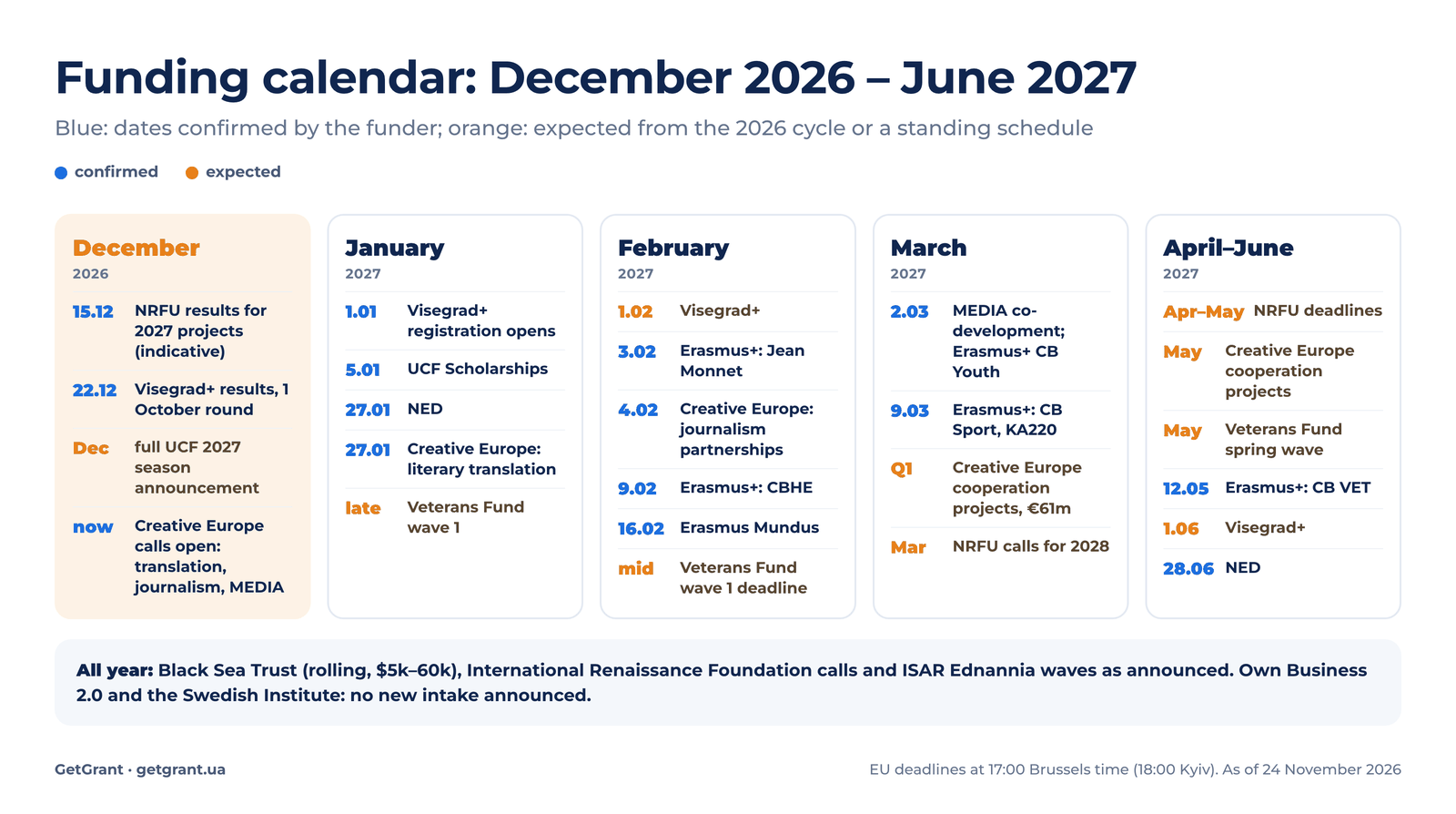
December 2026. Creative Europe calls are open (translation, journalism partnerships, MEDIA). 15 December is the indicative date for NRFU results for 2027 projects, 22 December the date for Visegrad autumn round results. UCF Scholarships accept applications until 5 January 2027; the full UCF 2027 season announcement is expected.
January 2027. Visegrad+ registration opens on 1 January. 27 January – NED and Creative Europe literary translation deadlines. The first Veterans Fund wave is expected (27 January in 2026).
February 2027. 1 February – Visegrad+; 3 February – Jean Monnet; 4 February – Creative Europe journalism partnerships; 9 February – CBHE; 16 February – Erasmus Mundus. The deadline of the first Veterans Fund wave is expected (17 February in 2026).
March 2027. 2 March – MEDIA co-development and capacity building in the field of youth; 9 March – sport and KA220. The Creative Europe cooperation projects call and NRFU calls for 2028 projects are expected.
April–June 2027. Expected: NRFU deadlines (24 April and 1 May in 2026), Creative Europe cooperation projects (5 May in 2026) and the Veterans Fund spring wave (14 May – 1 June in 2026). Confirmed: 12 May – CB VET, 1 June – Visegrad+, 28 June – NED.
All year. Black Sea Trust (rolling), International Renaissance Foundation calls and ISAR Ednannia waves as announced.
Checklist: what to do before the first deadline
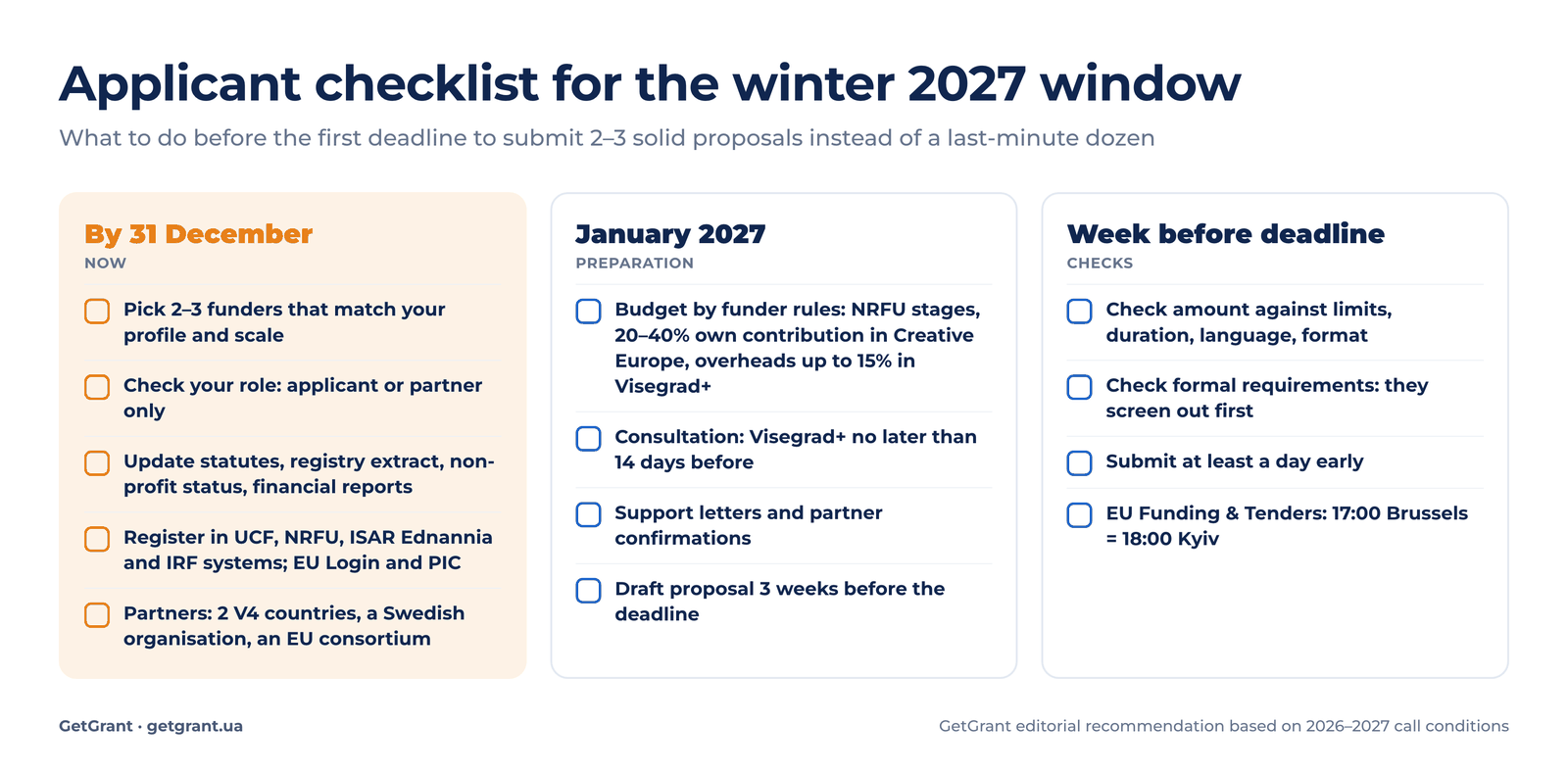
By 31 December 2026.
- Pick 2–3 grant-makers that match your organisation’s profile, scale and capacity to report, not all 12. Check whether you can be the applicant or only a partner.
- Update your core documents: statutes, registry extract, non-profit status, financial reports for recent years, organisational policies. Some calls require at least a year since registration (such as UCF’s Artistic Debuts or Veterans Fund support for civic associations), and institutional support via ISAR Ednannia requires two years of work in the field.
- Register in the submission systems: UCF, NRFU, ISAR Ednannia, the International Renaissance Foundation; for EU programmes, EU Login and a PIC.
- For international calls, agree on partners: two V4 countries for Visegrad+, a Swedish organisation for SI, a consortium for Creative Europe and Erasmus+.
In January 2027.
- Draw up the budget under the specific funder’s rules: NRFU stages without reallocation, an own contribution of 20 to 40% in Creative Europe, overheads of up to 15% at the Visegrad Fund.
- Get a consultation where one is offered: at the Visegrad Fund no later than 14 days before the deadline, for Creative Europe at the Creative Europe Desk Ukraine.
- Collect support letters and partner confirmations: they take the longest.
- Have a draft proposal three weeks before the deadline so that partners can read and add to it.
A week before the deadline.
- Check the amount against the limits, the implementation period, the language and the format. Formal errors screen a proposal out before its content is assessed, and they cannot be fixed after the deadline.
- Submit at least a day early: portals get overloaded in the final hours, and EU Funding & Tenders closes at 17:00 Brussels time, which is 18:00 in Kyiv.
Conclusion
The funding map for 2027 has two layers. The international layer is predictable: NED and Creative Europe have already set dates, the Visegrad Fund has a standing schedule, and the first deadlines arrive in nine weeks, on 27 January. The Ukrainian layer depends on the budget: UCF, the Veterans Fund and Own Business have not yet announced intakes, so their 2027 dates remain reasoned expectations based on the 2026 cycle.
The practical conclusion for an organisation is not to wait for announcements but to prepare what does not depend on a specific call: documents, registrations, partners and budget templates. Then the winter window of international funders and the spring window of Ukrainian funds can be handled with one plan rather than two last-minute rushes.
The GetGrant team helps match funders to an organisation’s profile, check eligibility and prepare applications. Open calls are collected in the GetGrant catalogue, and the geography of funders is on the funders map.
Sources
- Ukrainian Cultural Foundation: UCF Scholarships 2027, 23.11.2026
- Ukrainian Cultural Foundation: 2026 grant season announcement, 28 October 2025
- Ukrainian Cultural Foundation: Cultural Horizons programme 2026–2027
- Ministry of Culture of Ukraine: UCF accepts applications for the Artistic Debuts call, 21 September 2026
- Interfax-Ukraine: UCF received 80 applications for Contemporary Music Space, 18 February 2026
- NRFU: conditions of the Advanced Fundamental Science in Ukraine 2027–2029 call
- NRFU: conditions of the Individual Research Projects 2027–2028 call
- Cabinet of Ministers of Ukraine: government updates rules for grant support through the Ukrainian Veterans Fund, 24 April 2026
- Dnipropetrovsk Regional Military Administration: Varto: 4 Years of Support call, 27 January 2026
- Dnipropetrovsk Regional Military Administration: Business with Character call, 20 May 2026
- Dnipropetrovsk Regional Military Administration: 19th grant call Varto: Step Forward, 7 September 2026
- Ukrainian Veterans Fund: calls
- Cabinet of Ministers of Ukraine: Own Business 2.0, grants of up to UAH 2.5 million under new rules, 9 September 2026
- International Renaissance Foundation: calls
- International Renaissance Foundation: Voice: Participation That Shapes Decisions call
- International Renaissance Foundation: Impulse project small grants, fifth wave
- ISAR Ednannia: Unity for Community, second wave of project grants
- ISAR Ednannia: Unity for Community, third wave of project grants
- ISAR Ednannia: Askold and Dir Fund institutional support 2026
- European Commission: Creative Europe in 2027, 22 September 2026
- EACEA: launch of the 2027 Creative Europe work programme and calls, 30 September 2026
- European Commission: call document CREA-CULT-2027-LIT, circulation of European literary works
- European Commission: call document CREA-CROSS-2027-JOURPART, journalism partnerships
- European Commission: call document CREA-MEDIA-2027-CODEV, European co-development
- European Commission: 2026 Creative Europe call for European cooperation projects
- European Commission: European cooperation projects, partnership requirements
- DG Enlargement: Ukraine joins the MEDIA strand of Creative Europe, 12 December 2024
- International Visegrad Fund: Visegrad+ Grants
- German Marshall Fund: Black Sea Trust grantmaking
- German Marshall Fund: Black Sea Trust FAQ
- NED: apply for a grant, 2026–2027 deadlines
- NED: Europe, support for partners in Ukraine in FY2025
- Swedish Institute: SI Ukraine Cooperation Programme
- Swedish Institute: application instructions for the 2026 call, 12 December 2025
Calls with the nearest deadlines
- Walk of Water Photostory Contestuntil 30.11.2026
- Vital Impacts Environmental Photography Fellowshipuntil 30.11.2026
- Turmhaus Residency in Balzersuntil 30.11.2026
- Hvylia Programme of the Ukrainian Instituteuntil 30.11.2026

Book a consultation or leave your application idea
Tell us in a few words about your project: we will say which grants it fits and can take the application itself off your hands. We reply within one business day.