GetGrant analysis: 22 fellowships and scholarships for Ukrainian researchers for 2027, checked against funder websites, with 18 deadlines from December to April, programmes for PhD candidates, postdocs and experienced researchers, what you can do from Ukraine and how to prepare in 8 weeks.
The 2027 research fellowship cycle is being decided right now. Most programmes funding research stays from autumn 2027 accept applications in winter and announce results in spring. If you are planning a postdoc, a research visit or your own group for the next academic year, you have 6–10 weeks to secure a letter from a host institution, references and a research proposal.
We selected fellowships, scholarships and grants for individual researchers from the GetGrant catalogue with deadlines between 1 December 2026 and 30 April 2027 that are open to Ukrainian citizens, and checked each programme against the funder’s official page as of 9 November 2026. 22 programmes remained: 18 with a fixed submission date and 4 with no fixed deadline. We removed 12 other well-known programmes because their calls are closed or suspended, and we list 6 important programmes whose 2027 round has not yet been announced separately, with the 2026 cycle as a guide.
Short answer
- 22 programmes for Ukrainian researchers: 18 deadlines from 1 December 2026 to 23 April 2027 and 4 programmes with no fixed date (Humboldt Foundation, Gerda Henkel, SNSF Scholars at Risk, IIE Scholar Rescue Fund).
- 15 of the 18 deadlines fall in December and January: 8 in December and 7 in January. February has 2, March none and April one (JSPS in Japan).
- The largest amounts go to those building their own group: up to €2 million for 5 years in the ERC Consolidator Grant (deadline 12 January 2027), up to CHF 600,000 in the Branco Weiss Fellowship and $600,000 in Simons Fellows-to-Faculty.
- Among foreign programmes in the window, only one is designed specifically for Ukrainians: DAAD Future Ukraine, €992 to €2,300 a month for 1–6 months in Germany, applications until 10 December 2026.
- Without relocating you can apply for the ERC (the host institution can be in Ukraine), Gerda Henkel PhD scholarships, the National Academy of Sciences of Ukraine awards for young researchers (until 15 December) and, on the dates set by decree, Presidential grants for young researchers (until 1 March 2027).
- Most programmes require a letter from a host institution, and in several (Eiffel, JSPS, SNSF Scholars at Risk) the institution itself applies with its own internal deadline. Start with a letter to a potential supervisor, not with the proposal text.
Deadline calendar: 15 of 18 by the end of January
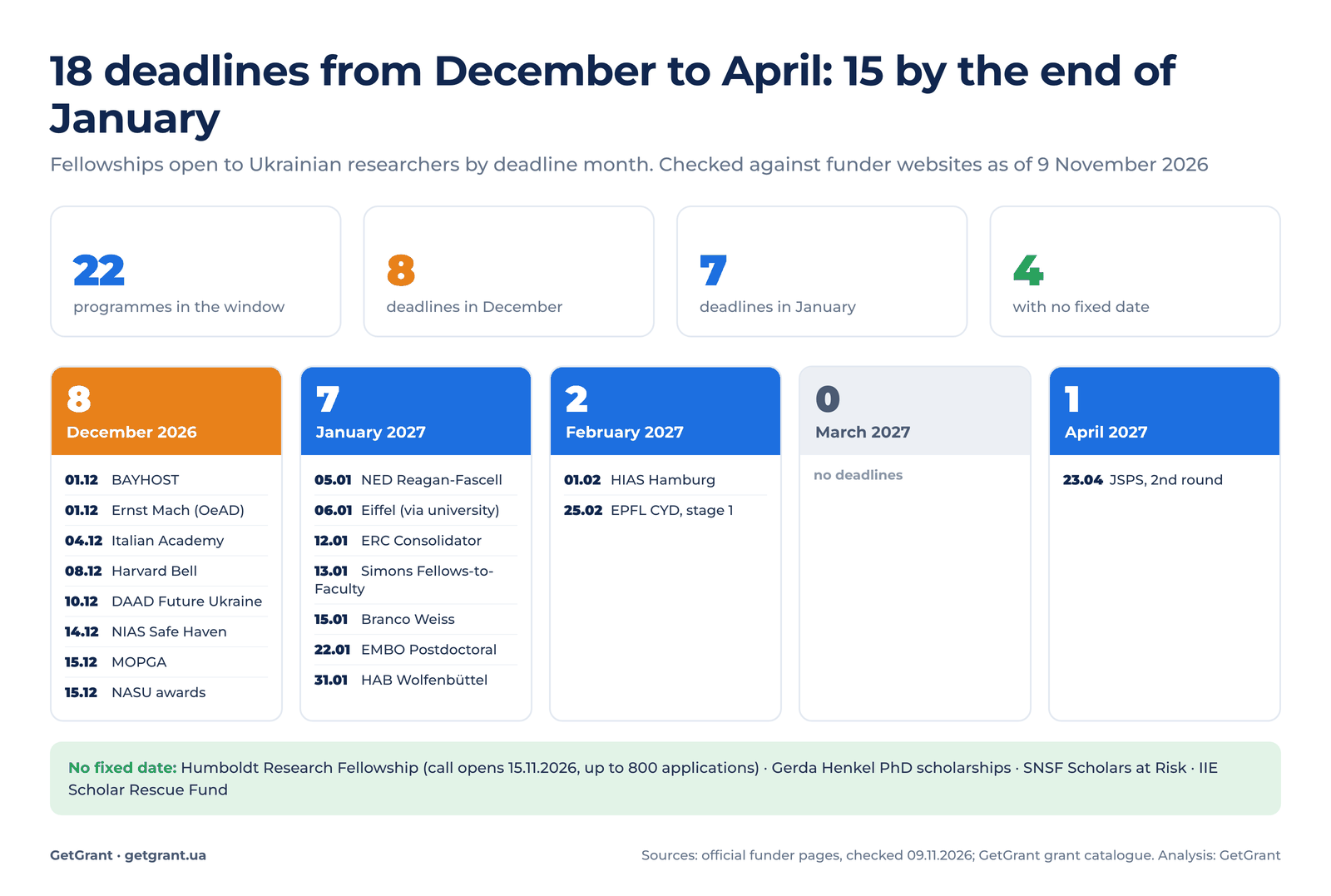
The busiest period is the first half of December: all 8 December deadlines fall between 1 and 15 December, from BAYHOST and the Austrian Ernst Mach Grant on 1 December to MOPGA on 15 December. The second wave runs from 5 to 31 January: NED, Eiffel, ERC Consolidator, Simons, Branco Weiss, EMBO and the Herzog August Library. After 1 February 2027 only HIAS, EPFL CYD and the second JSPS round remain in the window.
Mind the time zones. In winter Kyiv is on UTC+2, so “17:00 CET” means 18:00 Kyiv time, “12:00 ET” (Harvard, Simons) means 19:00, and “17:00 JST” (JSPS) means 10:00 in the morning of the same day. If no time is given, as with BAYHOST or DAAD, submit at least a day early.
Some programmes with deadlines just before the window are still open when this article is published: the Swiss Government Excellence Scholarships accept applications from Ukraine until 30 November 2026 (CHF 2,450 a month, for applicants born after 31 December 1991).
Where you are in your career
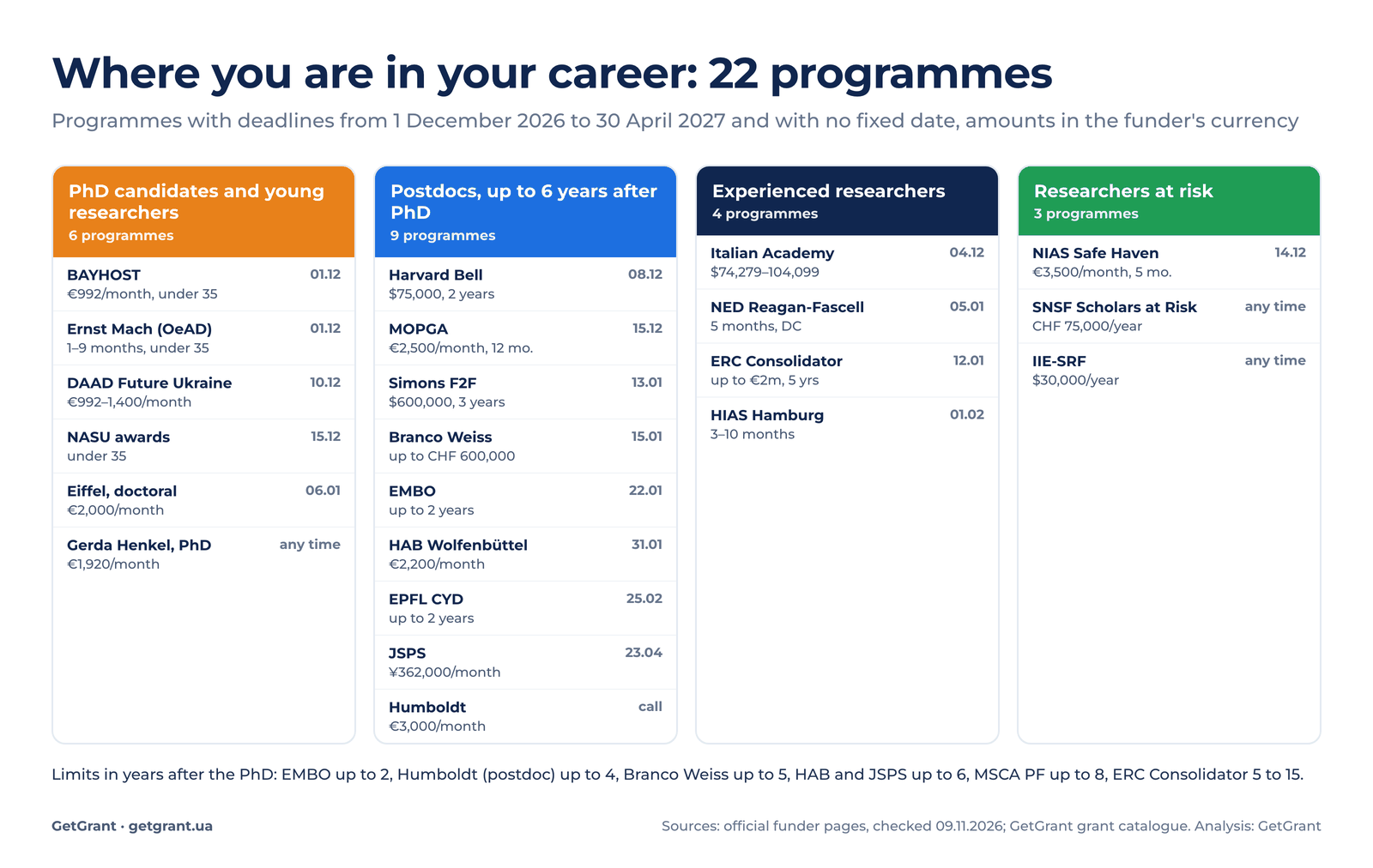
The main filter is not the topic but the date of your PhD defence: most programmes count years from the PhD to the deadline or to the start, and a few months decide whether you are eligible at all. Check your date against the conditions first, and only then read about the themes.
PhD candidates and young researchers
- BAYHOST (Bavaria): €992 a month for one year, renewable up to three, for a PhD at a Bavarian university or a one-year research project within a PhD in your home country. Under 35 on 1 October 2027, permanent residence in Ukraine at the time of application, confirmation from a supervisor in Bavaria. Deadline 1 December 2026; late applications are not considered.
- Ernst Mach Grant (OeAD, Austria): 1–9 months at an Austrian university for doctoral candidates at non-Austrian universities and young postdocs, under 35 at the start, letter from an Austrian supervisor. Deadline 1 December 2026, 23:59 CET. OeAD has not yet published the amount for 2027/28, and the separate Ukrainian line of the programme ended on 30 June 2026.
- DAAD Future Ukraine: 1–6 months in Germany between May 2027 and January 2028, €992 a month for master’s students, €1,400 for doctoral candidates, €2,000 for postdocs, €2,150 for experienced researchers and €2,300 for professors. Deadline 10 December 2026. The DAAD page also says that applying is “currently not possible”, so check whether the portal has opened.
- France Excellence Eiffel: €2,000 a month for new doctoral candidates at French universities (up to 36 months) or for 12–18 months of joint supervision, plus travel and insurance. Under 35. The French university submits the application by 6 January 2027, so its internal deadline will be earlier.
- Gerda Henkel PhD scholarships: €1,920 a month for up to two years for doctoral candidates in the historical humanities, applications at any time, decisions four times a year. The place of work is not restricted, so you can work from Ukraine.
Postdocs: up to 6 years after the PhD
- Harvard Bell Fellowship: a two-year postdoc in population sciences, a salary of $75,000, another $11,000 for research and up to $4,000 for relocation. The PhD must be awarded between 13 August 2024 and 13 August 2027. Deadline 8 December 2026, 12:00 ET, together with three reference letters.
- MOPGA 2027 (France): €2,500 a month for 12 months and €500 for settling in, for researchers in climate, Earth sciences, energy transition and One Health. PhD between December 2021 and December 2026, a French host laboratory is mandatory. Deadline 15 December 2026, 23:59 CET.
- Branco Weiss Fellowship (ETH Zurich): up to CHF 600,000 for 5 years for your own research programme, with no nationality restrictions. PhD no more than 5 years before 15 January 2027 and no previous independent PI position. Deadline 15 January 2027, 17:00 CET.
- EMBO Postdoctoral Fellowships (life sciences): up to two years, salary, relocation and parental support. PhD no more than two years before applying, a first-author paper and a mandatory change of country. Applications submitted by 22 January 2027, 14:00 CET, go into the current round; from the autumn 2027 round there is only one attempt and no resubmission.
- Herzog August Library (Wolfenbüttel): €2,200 a month for 6–10 months from 2028 for postdocs in historical disciplines (PhD no more than 6 years earlier), or €1,800 a month for a short visit of 1–3 months. Deadline 31 January 2027.
- EPFL CYD Distinguished Postdoctoral Fellowships: up to two years in Switzerland in cyber defence and data security, salary on the host institution’s scale plus up to CHF 5,000 a year for conferences. The call opens on 3 December, stage one closes on 25 February 2027, 17:00 CET.
- JSPS Postdoctoral Fellowship (Japan): ¥362,000 a month for 12–24 months, PhD no more than 6 years earlier. Ukraine is among the eligible countries. The Japanese host researcher applies; the second round closes on 23 April 2027, 17:00 JST.
- Simons Fellows-to-Faculty: $600,000 over 3 years for the transition from postdoc to a first independent position in autism and neuroscience research, with no citizenship requirements. Deadline 13 January 2027, 12:00 ET.
The Humboldt Foundation also accepts applications in this period, but without a fixed date: the Humboldt Research Fellowship call opens on 15 November 2026 and closes as soon as 800 applications have been received (€3,000 a month for postdocs up to 4 years after the PhD, €3,600 for experienced researchers up to 12 years).
Experienced researchers and professors
- ERC Consolidator Grant 2027: up to €2 million for 5 years plus up to €1 million for justified additional costs, for researchers who defended their PhD between 1 January 2012 and 31 December 2021. The call budget is €618.5 million, with about 296 grants expected. Deadline 12 January 2027. Ukraine is associated to Horizon Europe, so the host institution can be a Ukrainian university or research institute.
- Italian Academy for Advanced Studies (Columbia University): a salary on the university’s research officer scale of $74,279 to $104,099, for the autumn or spring semester or a full year in New York, any nationality, from postdocs to professors. Deadline 4 December 2026.
- NED Reagan-Fascell: 5 months in Washington for scholars with a PhD and practitioners working on democracy, a monthly stipend, insurance and travel. Applications until 5 January 2027, reference letters until 12 January.
- HIAS (Hamburg): 2028–2029 fellowships of 3–10 months for scholars with a PhD and artists, on a “no financial loss” principle for the fellow, residence in Hamburg required. Deadline 1 February 2027, 23:59 CET.
Researchers at risk
- NIAS Safe Haven Fellowship (Amsterdam): €3,500 a month and housing for 5 months from September 2027 for researchers endangered by war. A PhD and at least 3 years of postdoctoral experience are required, plus English at C1 level. Deadline 14 December 2026, 12:00 CET.
- SNSF Scholars at Risk: CHF 75,000 for 12 months at a Swiss university with a possible extension, applications at any time, but only through the Scholars at Risk coordinator of the host institution.
- IIE Scholar Rescue Fund: $30,000 a year, open-ended applications, decisions every quarter. Those who have been away from home for more than two years are usually not eligible, so for most people who left in 2022 this route is already closed.
Stay in Ukraine or move abroad
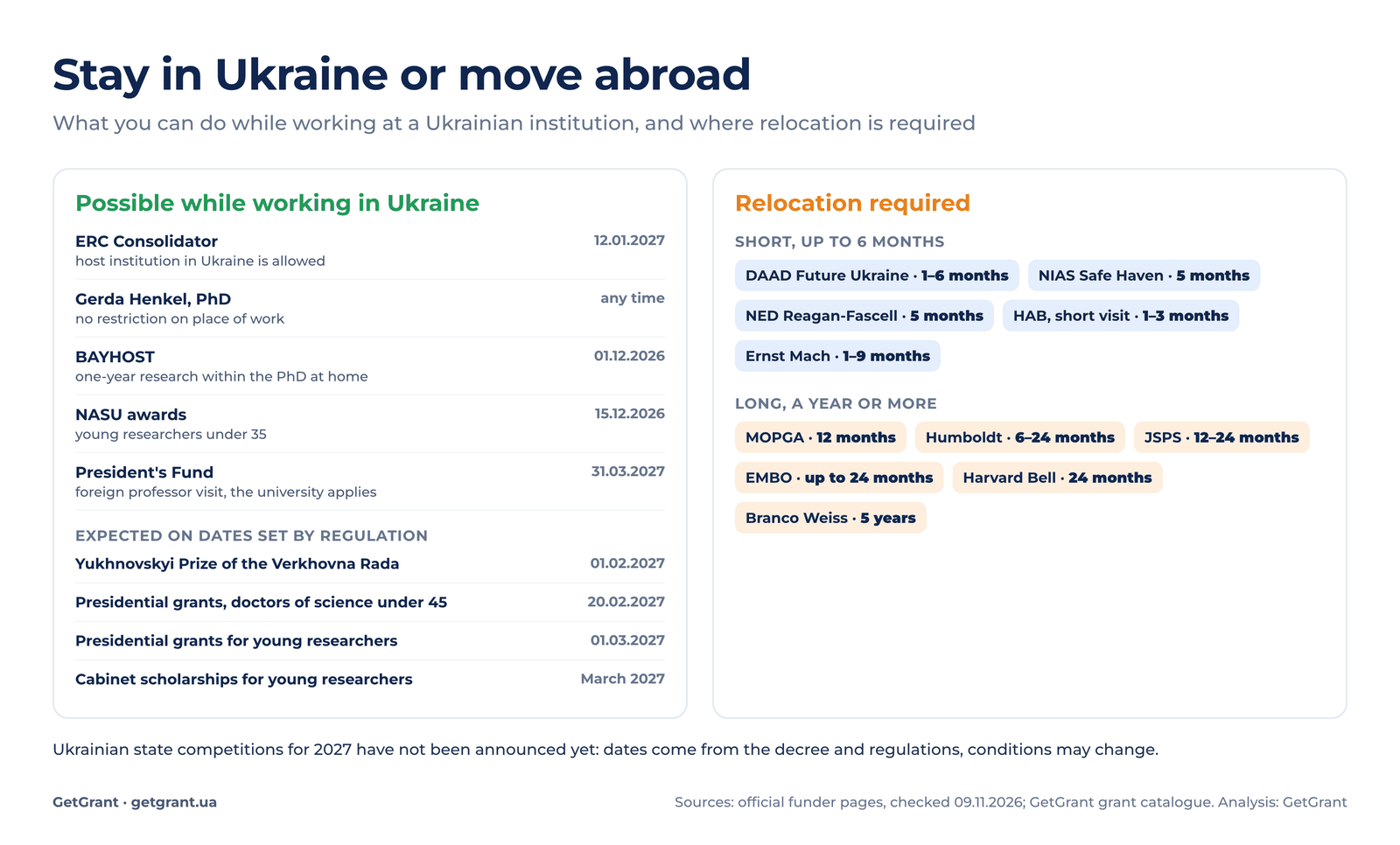
Of the 22 programmes, only a few can be carried out without leaving. The ERC Consolidator Grant offers the largest amount and allows a host institution in Ukraine, but it requires a mature track record and an independent research programme. Gerda Henkel PhD scholarships are not tied to a place of work. BAYHOST allows a one-year research project within the PhD in your home country.
Among Ukrainian programmes in the window are the awards of the National Academy of Sciences of Ukraine for young researchers and students: 14 awards for researchers and lecturers aged up to 35 inclusive, nominations until 15 December 2026 (the amount is not stated in the announcement). For universities and research institutions rather than individual applicants, the President’s Fund for the Support of Education, Science and Sport funds visits by foreign professors of up to UAH 300,000 per visit, with applications until 31 March 2027 or until the budget runs out.
The 2027 state competitions for young researchers have not been announced yet, but their dates are fixed in regulations:
- Presidential grants for doctors of science under 45, applications until 20 February 2027, and for young researchers, until 1 March 2027 (Decree No. 81/2026). In 2026 these were 50 grants of UAH 300,000 for PhD holders under 35, 20 of UAH 400,000 for doctoral researchers and 7 of UAH 500,000 for doctors of science under 40. The National Research Foundation of Ukraine has not yet published the 2027 conditions;
- the Ihor Yukhnovskyi Prize of the Verkhovna Rada: under its regulations, the work is submitted to the academic council no later than 1 February 2027, up to 50 prizes of 60 subsistence minimums each;
- Cabinet of Ministers scholarships for young researchers: the Ministry of Education and Science has announced the next selection for March 2027, with no dates yet.
Mobility brings higher rates and access to infrastructure, but it has a price. Almost all foreign programmes require a letter from a host researcher, and EMBO, Humboldt and MOPGA also limit time spent in the host country before applying. For those already living abroad, it works the other way round: BAYHOST requires permanent residence in Ukraine, and IIE-SRF usually does not consider those who have been away from home for more than two years.
Expected but not yet announced
These programmes matter to Ukrainian researchers, but as of 9 November 2026 they have no dates in the window. The previous cycle is a guide, not a promise from the funder:
- MSCA Postdoctoral Fellowships 2027: the Funding & Tenders portal lists an opening on 7 April and a deadline of 8 September 2027, about €388.6 million. Up to 8 years after the PhD, any nationality. Ukraine can be the country of the host institution.
- ERC Synergy (deadline 11 May 2027) and ERC Advanced (26 August 2027) have been announced, but fall outside the window.
- MSCA4Ukraine: the Humboldt Foundation does not plan new calls, and in 2025 the European Commission selected a new operator for the programme (that call closed on 16 September 2025). We did not find a call for researchers with dates on the official pages.
- HURI (Harvard Ukrainian Research Institute): the 2026 deadline was 15 January; the 2027–2028 cycle has not been confirmed on its page.
- NAWA Ulam (Poland): the 2026 call closed on 15 May, the 2027 call has not been announced. Ukrainians who have lived in Poland for more than 3 months in a row are not eligible under the programme rules.
- NATO SPS: call 2027-1 closed on 15 November 2026, the next one has not been announced. It is a project with two co-directors, not an individual fellowship.
After checking, we removed programmes that have closed or been suspended: Fulbright for Ukrainians (deadlines for the 2027–2028 academic year passed on 16 May and 15 October 2026), Kennan Institute fellowships (the Title VIII competition is suspended), British Academy Researchers at Risk, CRDF Global travel grants, the Mieroszewski Centre, the Visegrad Scholarship at OSA, NADIYA, the HIIG Impact AI Fellowship, the VUIAS call and Gerda Henkel research scholarships (both close in November), as well as the Max Planck Society and the Volkswagen Foundation, which currently have no separate open programmes for Ukraine.
How to prepare in 6–8 weeks
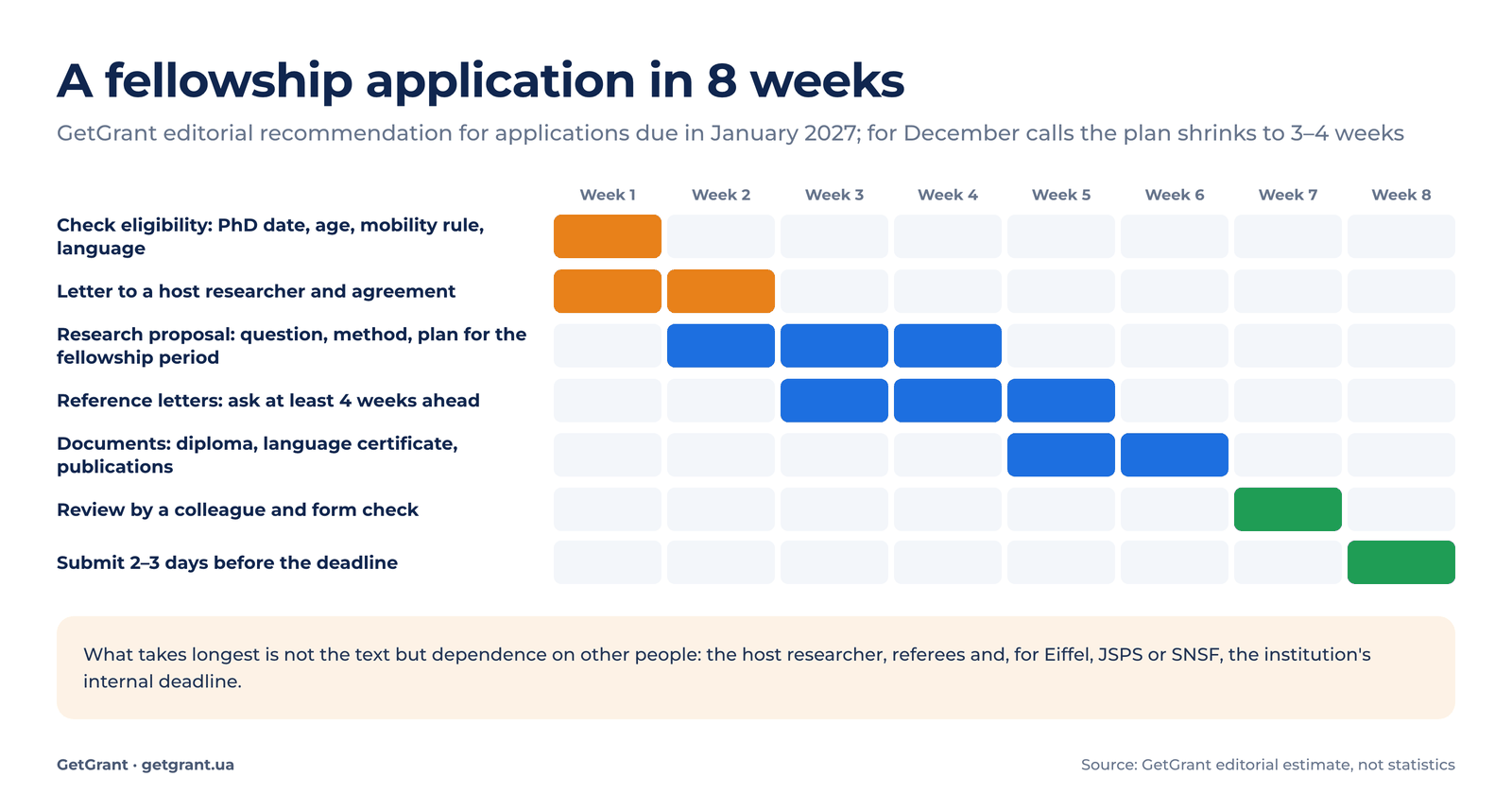
This is not statistics but an editorial recommendation for applications due in January. For December calls, compress the plan to 3–4 weeks.
- Week 1. Choose 2–3 programmes and check the formal conditions: PhD defence date, age on the relevant date, mobility rule, language requirements.
- Weeks 1–2. Write to a potential host researcher: 3–4 sentences about your project, why their group in particular, and your CV. Without a letter from a host institution, most programmes will not accept the application.
- Weeks 2–4. The research proposal: question, method, expected result and what exactly you will do during the fellowship period. Evaluators read whether the plan is realistic for 6, 12 or 24 months, not only whether the topic is important.
- Weeks 3–5. Reference letters. Ask your referees at least 4 weeks ahead and give them a short brief on the programme and your project. For Harvard Bell and NED, referees submit their letters themselves, and the application is incomplete without them.
- Weeks 5–6. Documents: diploma translation, proof of language (C1 for NIAS and BAYHOST), publication list in the funder’s format, scanned signatures.
- Week 7. Proofreading of the proposal by a colleague from another field and a check of every form field.
- Week 8. Submit 2–3 days before the deadline. Keep the last days as a buffer for technical problems: in most of these programmes the deadline is final, and BAYHOST explicitly calls it a cut-off.
Conclusion
For 2027, a Ukrainian researcher has 22 programmes with submissions in the next five months, but the real window is shorter than it looks: 15 of the 18 deadlines close by the end of January. For PhD candidates the most accessible are BAYHOST, DAAD Future Ukraine and Eiffel; for postdocs, MOPGA, Branco Weiss, EMBO and Humboldt; for experienced researchers, the ERC Consolidator Grant, NED and the Italian Academy. Those staying in Ukraine should look at the ERC with a Ukrainian host institution, Gerda Henkel PhD scholarships and the February–March state competitions. The decisive step is the same in every scenario: a letter to a host researcher this week, not ten days before the deadline.
The GetGrant team helps you choose a programme for your career stage and topic, check eligibility and prepare the research proposal and supporting documents. Open fellowships and grants are collected in the GetGrant catalogue, and a tailored selection can be ordered on the services page.
Sources
- GetGrant grants catalogue: fellowships for researchers
- BAYHOST: Bavarian scholarship programme for graduates from Central, Eastern and South-Eastern Europe (in German)
- OeAD: Ernst Mach Grant – worldwide, FAQ
- Italian Academy for Advanced Studies, Columbia University: Fellowship Program
- Harvard Center for Population and Development Studies: Bell Fellowship
- DAAD: Future Ukraine, Research Grants for Ukrainian Master’s students and researchers
- NIAS-KNAW: Safe Haven Fellowship
- Campus France: MOPGA 2027
- NRAT: competition for the NASU awards for young researchers and students (in Ukrainian)
- NED: Reagan-Fascell Democracy Fellows Program, applying for a fellowship
- Campus France: France Excellence Eiffel, programme rules for 2027
- ERC: Consolidator Grant
- Simons Foundation: Fellows-to-Faculty 2027
- Branco Weiss Fellowship: Application timelines
- EMBO: Postdoctoral Fellowships
- Herzog August Library: research fellowships (in German)
- HIAS: Open Call 2028–2029
- EPFL: CYD Distinguished Postdoctoral Fellowships
- JSPS: Postdoctoral Fellowship for Research in Japan (Standard), application guidelines
- Alexander von Humboldt Foundation: Humboldt Research Fellowship
- Gerda Henkel Foundation: PhD Scholarships
- SNSF: Scholars at Risk grants
- IIE Scholar Rescue Fund: eligibility criteria
- President’s Fund for the Support of Education, Science and Sport: academic visits of foreign professors (in Ukrainian)
- National Research Foundation of Ukraine: 2026 conditions of the Presidential grants for young researchers (in Ukrainian)
- National Research Foundation of Ukraine: conditions of the Verkhovna Rada Prize for young researchers (in Ukrainian)
- Cabinet of Ministers of Ukraine: National Researchers System and state scholarships (in Ukrainian)
- MSCA: Postdoctoral Fellowships
- List of participating countries in Horizon Europe and Euratom, version 4.2
- NAWA: Ulam NAWA 2026
- NATO SPS: Call for Proposals 2027-1

Book a consultation or leave your application idea
Tell us in a few words about your project: we will say which grants it fits and can take the application itself off your hands. We reply within one business day.