
The €96 million Digital Europe cybersecurity call is not available to Ukrainian companies, not even as subcontractors. We explain why and show where to apply instead, including the €71.8 million Horizon Europe call in 2027.
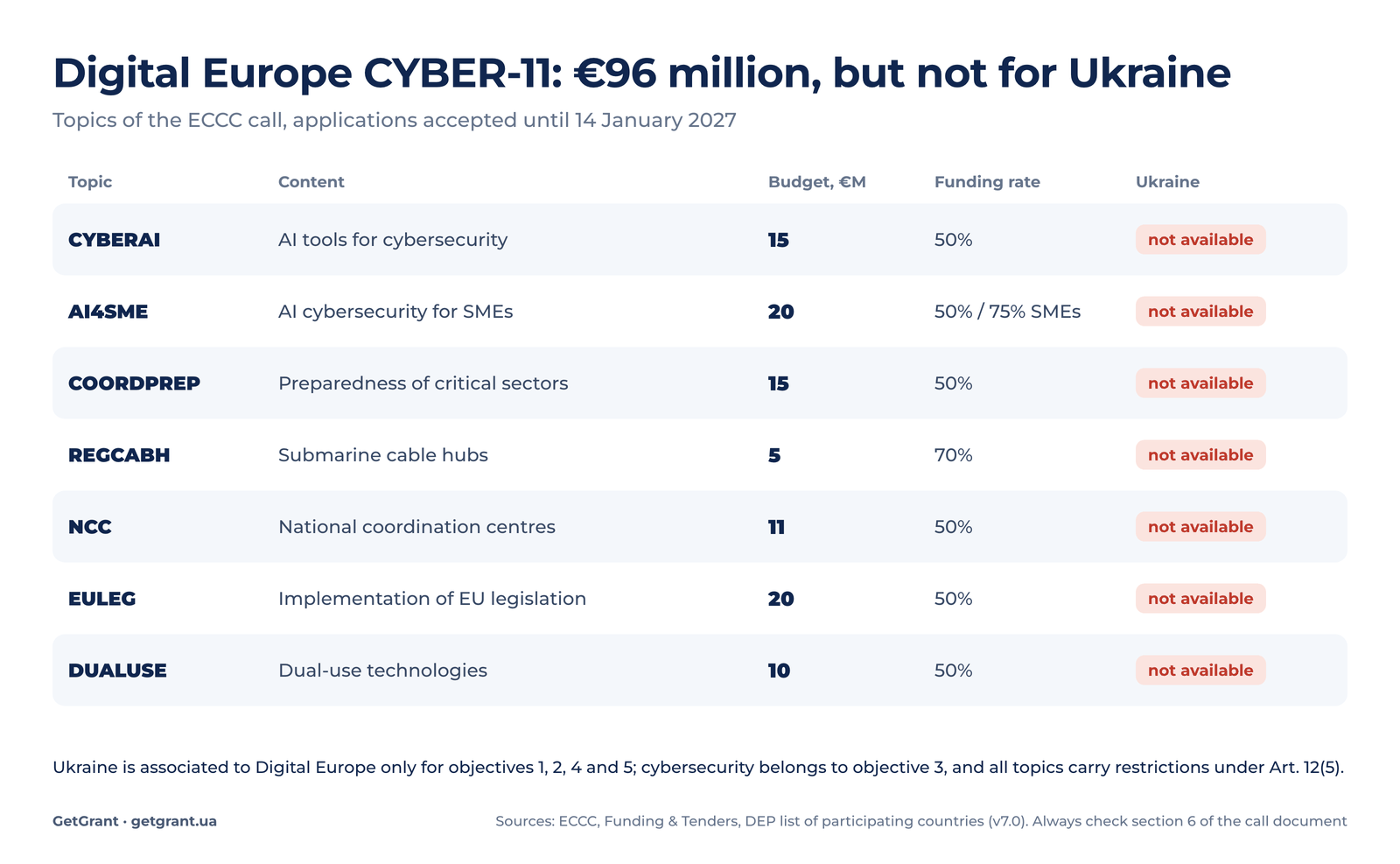
On 1 September 2026 the European Cybersecurity Competence Centre opened a €96 million call under the Digital Europe programme. The topics sound as if they were written for the Ukrainian market: AI tools for cybersecurity, solutions for SMEs, dual-use technologies. Ukraine has been associated to Digital Europe since 2022, so many companies have already started looking for partners.
The problem is that this call is closed to Ukrainian companies. Not because of the quality of applications, but because of the rules of the programme itself. In this article we explain why, look at where EU money for Ukrainian cybersecurity and AI really is in 2026–2027, and show how to prepare for the call that opens in March 2027. The data was checked against programme documents as of 10 October 2026.
Short answer
- The €96 million call DIGITAL-ECCC-2027-DEPLOY-CYBER-11, with a deadline of 14 January 2027, is not available to Ukrainian organisations either as participants or as subcontractors.
- The reason is that Ukraine is associated to Digital Europe only for specific objectives 1, 2, 4 and 5. Cybersecurity belongs to objective 3, and all of its topics carry security restrictions under Article 12(5) of the programme regulation.
- The real chance for cybersecurity companies is Horizon Europe. The €71.8 million Cluster 3 cybersecurity call opens on 2 March and closes on 15 September 2027, with grants of €3–5 million per project.
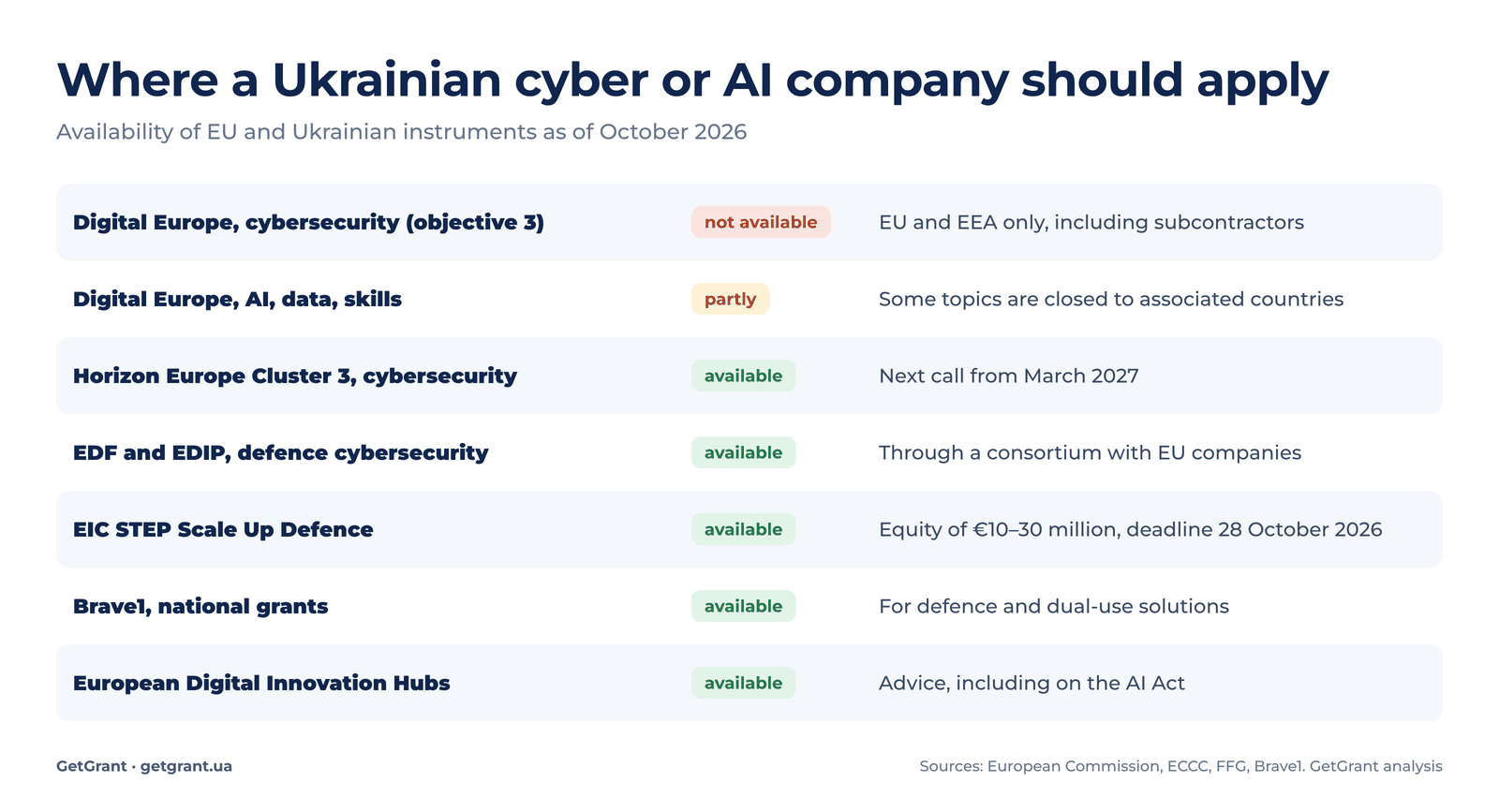
- For defence cybersecurity, EDF, EDIP and EIC STEP Scale Up Defence are available, as well as national Brave1 grants.
- Before spending time on any EU call, check the “Eligibility” section of the call document, not Ukraine’s general association status in the programme.
Why CYBER-11 is closed to Ukraine
Digital Europe consists of several specific objectives: supercomputers, artificial intelligence and data, cybersecurity, digital skills, deployment of digital technologies. Ukraine signed the association agreement in September 2022, but the association covers only objectives 1, 2, 4 and 5. Cybersecurity is objective 3 and is not on that list.
The second reason: all topics of the CYBER-11 call carry security restrictions under Article 12(5) of the programme regulation. The cybersecurity work programme limits participation to organisations established in EU Member States and controlled by them or by their nationals. The EEA countries, that is Norway, Iceland and Liechtenstein, have a status equivalent to Member States. In the previous call, CYBER-10, these rules applied to all participants, including subcontractors, and the work had to be carried out on the territory of eligible countries.
An important caveat: the final rules of each call are set by section 6 of its call document. We rely on the list of participating countries of the programme, the work programme, the document of the previous call and clarifications from national contact points. If your company is nevertheless considering participation, confirm this in writing with the European Cybersecurity Competence Centre.
We wrote in more detail about why the general status of an associated country does not guarantee the right to apply to a specific call in the article Who can apply: the status of Ukraine in EU programmes.
Where Ukraine does have access in Digital Europe
Under the objectives to which Ukraine is associated, participation is possible, although there are exceptions here too. In the AI call DIGITAL-2026-AI-09, which closed in March 2026, five of the seven topics were restricted to EU, EEA countries and Switzerland, meaning Ukraine was not admitted to them.
The results of previous years show that there is a chance. As of March 2025, Ukrainian organisations had 19 grant agreements, and 75 Ukrainian institutions took part in projects and received €7.2 million, of which €6.3 million went to SMEs. The success rate of applications with Ukrainian participation was 32%. For 2025 as a whole, the Ministry of Digital Transformation reported €7.7 million raised under the programme. Ukrainian organisations also joined the network of European Digital Innovation Hubs: six hubs received €4.5 million in EU funding.
The Digital Europe calls on skills and data with a deadline of 1 October 2026 have already closed, and no new ones have been announced for October. The next ones are worth tracking from the beginning of 2027.
The real chance: Horizon Europe, Cluster 3
For cybersecurity research and development, Ukraine, as a country associated to Horizon Europe, has much wider access. In the 2026 call, the SecureAI topic on protecting AI models was open to organisations from Member States and associated countries, including Ukraine, with the exception of territories not controlled by the government.
The next call, HORIZON-CL3-2027-02-CS-ECCC, has a budget of €71.8 million. It opens on 2 March and closes on 15 September 2027. A single grant is €3–5 million, and funding can reach 100%.
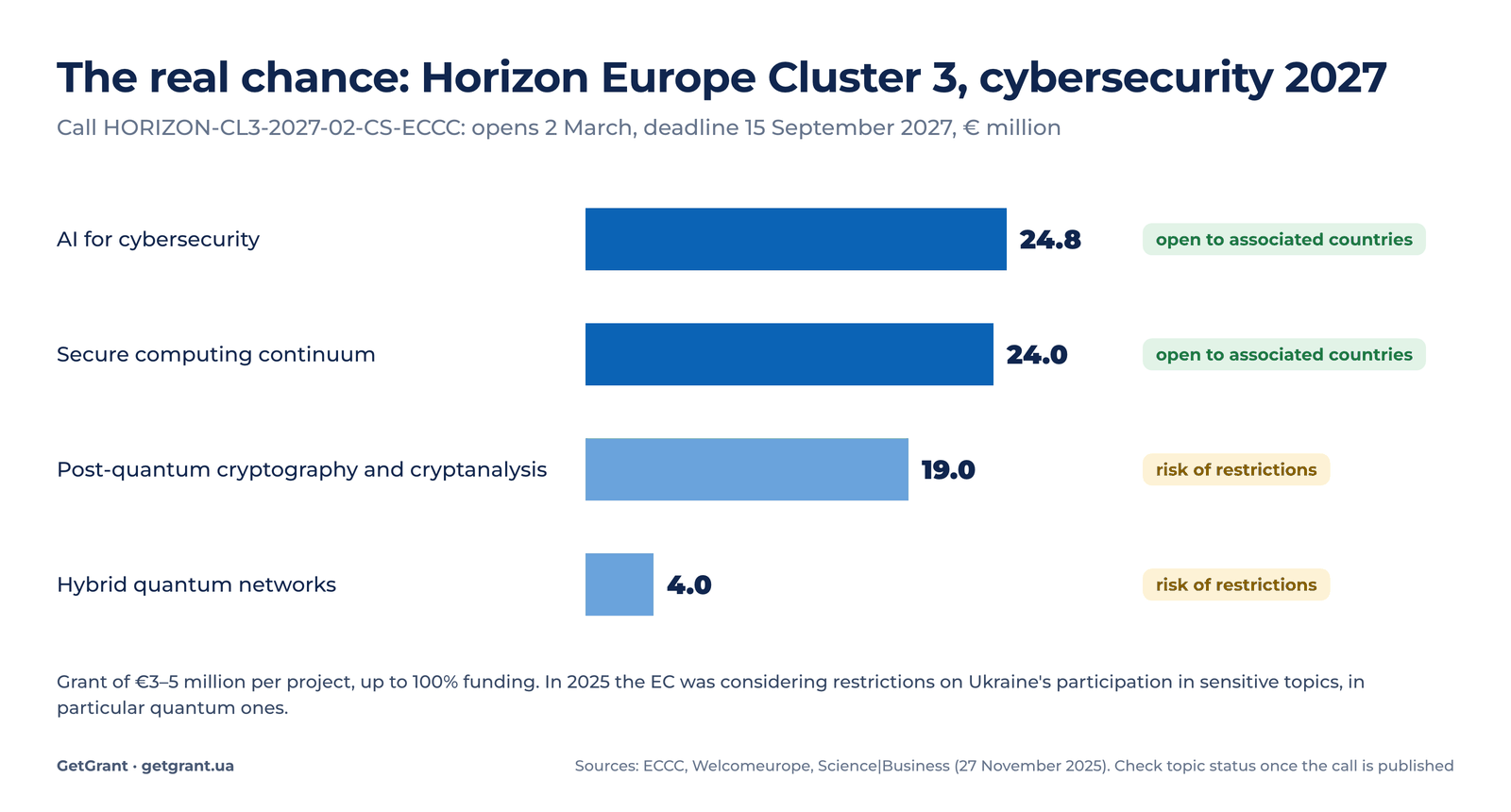
There is a risk here that is worth knowing about in advance. In November 2025 the European Commission was considering restricting Ukraine’s participation in sensitive Horizon Europe topics for 2026–2027, in particular in AI, quantum technologies, communication networks and space, because of insufficient security guarantees. The topics on post-quantum cryptography and quantum networks are most at risk. The final picture will only be visible once the call documents are published.
“By admitting Ukraine to the EU Cybersecurity Reserve, we are strengthening our common defence.”
Henna Virkkunen, Executive Vice-President of the European Commission, June 2026.
This step matters as a signal, but not as a source of grants. The EU Cybersecurity Reserve, to which Ukraine was admitted in June 2026, provides assistance in responding to large-scale cyberattacks; it does not fund company projects.
Defence cybersecurity: other doors
For companies whose solutions have defence applications, instruments are open that do not exist in civilian programmes:
- EDF and EDIP. Ukraine has signed an agreement on association to the European Defence Fund and an agreement on the Ukraine Support Instrument. Participation is possible as part of a consortium with EU companies.
- EIC STEP Scale Up Defence. Equity investments of €10 to €30 million in companies whose solutions are intended primarily for defence. The deadline is 28 October 2026.
- Brave1. National grants for defence and dual-use technologies, including cyber solutions and electronic warfare.
How to prepare for March 2027
The Horizon Europe cybersecurity call opens in five months, and putting together a consortium and an application for €3–5 million realistically takes three to four months. So it makes sense to start preparing now.
- Register a PIC code on the Funding & Tenders portal and prepare documents on ownership and control. In sensitive topics they are checked especially thoroughly.
- Define your unique value. Ukrainian companies have experience that European ones lack: protecting infrastructure during massive cyberattacks, working with real threats, testing in combat conditions. This is exactly what makes a Ukrainian partner needed by a consortium.
- Look for partners through national contact points and ECCC events. Info days and brokerage events take place in autumn and winter, and that is where consortia are formed.
- Have a plan B for sensitive topics. If the quantum networks or post-quantum cryptography topic is closed to Ukraine, the project can be refocused on AI for cybersecurity or on the secure computing continuum.
- Check the conditions of each topic separately. General association to a programme does not mean access to a specific call. This is the most common and most expensive mistake.
Conclusion
The biggest risk for a Ukrainian cybersecurity company today is not a weak application, but an application submitted where it cannot be accepted. The €96 million Digital Europe call is closed to Ukraine, whereas Horizon Europe will open a real €71.8 million opportunity in March 2027. A company that uses these five months for partnerships and documents will have a substantial advantage.
The GetGrant team helps technology companies check eligibility for specific EU calls, find partners and prepare applications to Horizon Europe, the EIC and defence programmes. Current calls are collected in the GetGrant catalogue, and an individual selection can be ordered on the services page.
Sources
- ECCC: new call under the Digital Europe programme, 1 September 2026
- List of participating countries in Digital Europe, v7.0
- ECCC cybersecurity work programme 2025–2027, Amendment 2
- Call document DIGITAL-ECCC-2026-DEPLOY-CYBER-10
- European Commission: questions and answers on Digital Europe
- FFG: CYBER-11 call
- Ukrinform: Ukraine received €7.2 million in Digital Europe, 14 March 2025 (in Ukrainian)
- European Commission: new digital innovation hubs in Ukraine, 30 January 2025
- ECCC: Horizon Europe cybersecurity call 2026
- Euro-Access: SecureAI topic
- Welcomeurope: HORIZON-CL3-2027-02-CS-ECCC
- Science|Business: risk of Ukraine’s exclusion from sensitive Horizon Europe topics, 27 November 2025
- European Commission: support for Ukraine from the EU Cybersecurity Reserve, 15 June 2026
- FFG: EIC STEP Scale Up Defence 2026

Book a consultation or leave your application idea
Tell us in a few words about your project: we will say which grants it fits and can take the application itself off your hands. We reply within one business day.