The labour shortage is breaking records, and the state pays extra for hiring veterans, internally displaced persons, young people and people with disabilities. We go through seven programmes, calculate what they give a company and explain the main mistake that costs employers their compensation.
For more than a year and a half, the shortage of workers has remained the main obstacle for Ukrainian business. In May 2026 a record 69% of industrial enterprises named it their main problem, and in June the figure was already 71%. Wages are rising, vacancies stay open for months, and some employers do not even know that the state is ready to pay part of the cost of hiring and training people.
This money is not like a grant: it does not have to be won in a competition, it requires no business plan, and it is paid almost automatically if the order of steps is followed. The problem is that the order is easy to break before the first working day. In this article we go through seven current programmes, calculate how much they really give a company, and explain what will change in 2027. Terms were checked against primary sources as of 10 October 2026.
Short answer
- The state reimburses three kinds of costs: wages of new employees from certain categories, adapting a workplace for a person with a disability, and vocational training of staff.
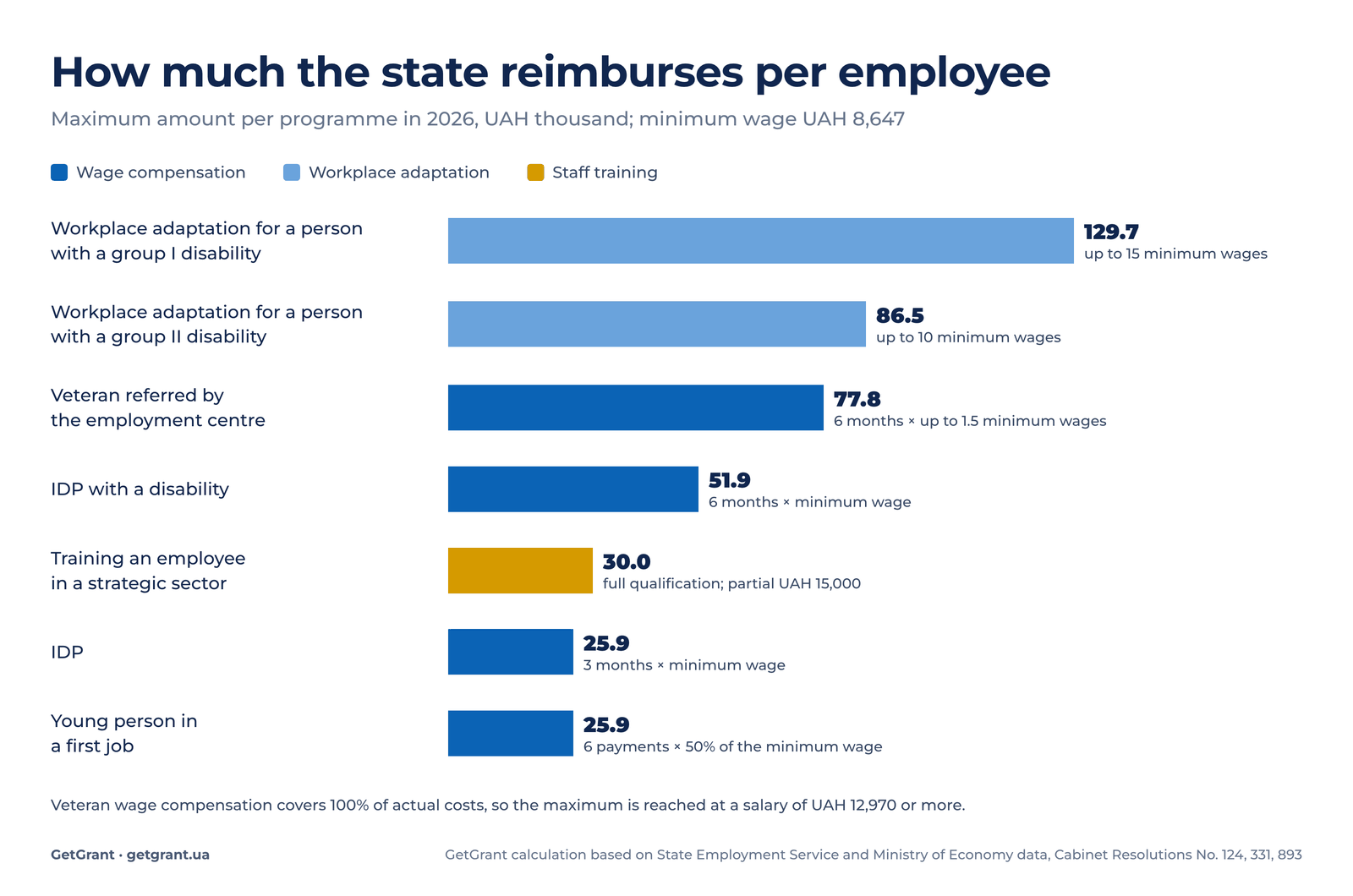
- The largest amounts come from workplace adaptation: up to UAH 129,700 for a person with a group I disability. Among wage compensations the leader is hiring a veteran: up to UAH 77,800 over six months.
- The main condition of most wage programmes: the candidate must be registered with the employment centre before being hired and come with a referral. Hiring “off the street” usually gives no right to compensation. Internally displaced persons are the exception.
- In an illustrative example of a manufacturer hiring four people, the programmes cover about 23% of the annual cost of their wages and social contributions.
- From 2027 the compensation for training an employee will rise to UAH 35,000, and the Ministry of Economy is launching four new or expanded programmes to bring people into the labour market.
The scale of the problem
The Institute for Economic Research and Policy Consulting surveys industrial enterprises every month about obstacles to business. Lack of labour has been in first place for more than a year and a half. In July the share of enterprises naming it the main obstacle fell for the first time since February, from 71% to 66%. But the search itself got harder: 54% of companies now find it difficult to hire skilled workers, against 46% a month earlier.
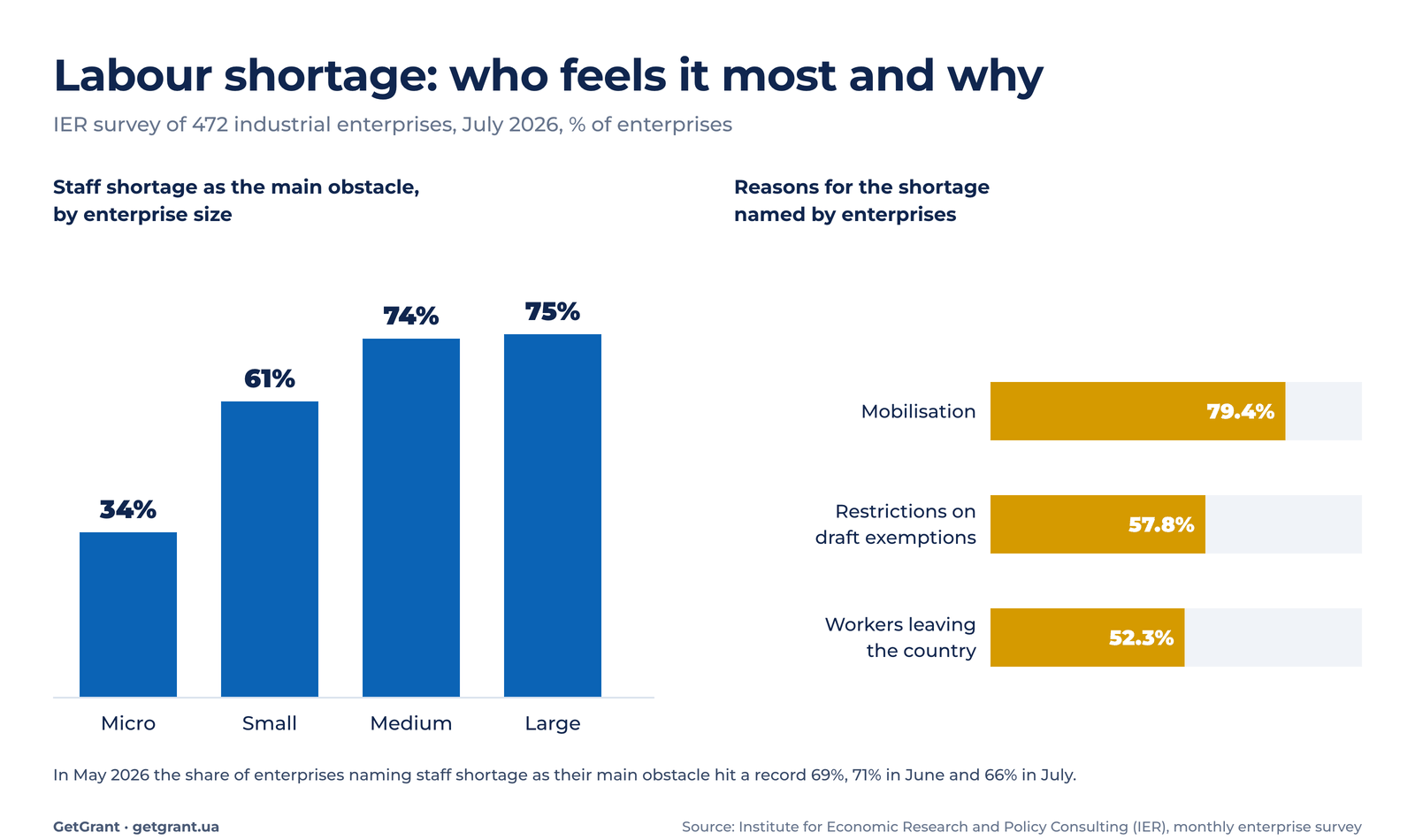
Two things in these data matter for planning. First: the shortage grows with company size. Micro-businesses cope with the owner and family, while medium and large enterprises feel the lack of people three times more often than micro ones. Second: the reasons are dominated by mobilisation, restrictions on draft exemptions and workers leaving the country. None of them will disappear soon, so competition for people will only intensify.
The state officially acknowledges the problem. On 1 October the Ministry of Economy presented a plan to bring people into the labour market; by the ministry’s estimate, almost 7 million Ukrainians are currently outside it.
“Our goal is to bring at least 2 million people into the labour market by 2030.”
Oleksandr Kravchenko, Minister of Economy and Environment of Ukraine, at a meeting of the Council on Barrier-Free Access, 1 October 2026.
For an employer this goal leads to a practical conclusion. The largest labour reserve today is people whom business has traditionally been reluctant to hire: veterans, internally displaced persons, people with disabilities, young people without experience, people of pre-retirement age. It is for hiring them that the state pays extra.
Seven programmes for employers
All amounts below are calculated from the 2026 minimum wage, which is UAH 8,647.
1. Hiring a veteran or combatant
If a veteran comes with a referral from the employment centre, the state reimburses 100% of the actual cost of their pay, but no more than 1.5 minimum wages, that is up to UAH 12,970.5 a month. The compensation runs for six months, so the maximum is UAH 77,800. The condition: employment during martial law for at least a year. Because actual costs are reimbursed, only an employer paying UAH 12,970 or more receives the full amount.
2. Hiring an internally displaced person
There are two options. Under the general programme the employer receives one minimum wage for each IDP hired for three months, and for six months for an IDP with a disability. No referral from the employment centre is needed: the application is filed via Diia or the State Employment Service portal no earlier than 5 calendar days after hiring. If the IDP is registered as unemployed and comes with a referral, actual pay of up to two minimum wages is reimbursed, that is up to UAH 17,294 a month.
3. A first job for young people
For hiring registered unemployed people from youth categories, in particular those under 25 with up to a year of service or under 35 in their first job, the employer receives 50% of the minimum wage, that is UAH 4,323.5. Payments are made for odd months of work, six payments in total, which gives about UAH 25,900 per employee.
4. People with disabilities and of pre-retirement age
For hiring registered unemployed people with a disability or those with up to five years left before retirement, 50% of the actual cost of pay is reimbursed, but no more than the minimum wage a month. The payment period depends on the programme and ranges from 6 to 12 months.
5. A new job in a small business
Small enterprises and sole proprietors with up to 50 employees and annual income of up to UAH 70 million can be reimbursed for the unified social contribution actually paid for a registered unemployed person hired to a new job. The legislation sets no cap: at a salary of UAH 20,000 this is UAH 4,400 a month. An important limitation: if the employee simply replaces someone who resigned voluntarily, the programme does not apply.
6. Adapting a workplace for a person with a disability
The state reimburses the actual cost of specialised furniture, technical aids, accessibility equipment, lifting platforms, Braille devices and other equipment. The limit is 15 minimum wages for an employee with a group I disability, that is UAH 129,705, and 10 minimum wages for group II, that is UAH 86,470. The application is filed within 180 calendar days via Diia or the employment centre.
7. Staff training and vouchers
Enterprises in strategic sectors can recover the cost of vocational training for their employees: up to UAH 30,000 for a full professional qualification and up to UAH 15,000 for a partial one. The programme covers the defence industry, mining and processing industry, construction, transport, energy, heat and water supply. Training lasts up to six months, the enterprise organises and pays for it itself, the employee is assessed and receives a certificate, and the application to the employment centre is filed within the 30-day period set by the programme.
A training voucher of up to UAH 33,280 works separately. It is received not by the enterprise but by the employee or candidate, in particular people aged 45 and over and demobilised veterans. An employer can offer a candidate retraining under a voucher for its vacancy.
The key condition: order of steps
Most refusals of compensation are linked not to the employee’s category but to the sequence of actions. An employer finds a veteran through acquaintances, puts them on the payroll and only then learns about the programme. By that point the person no longer has unemployed status, and compensation under the veterans’ programme is unavailable.
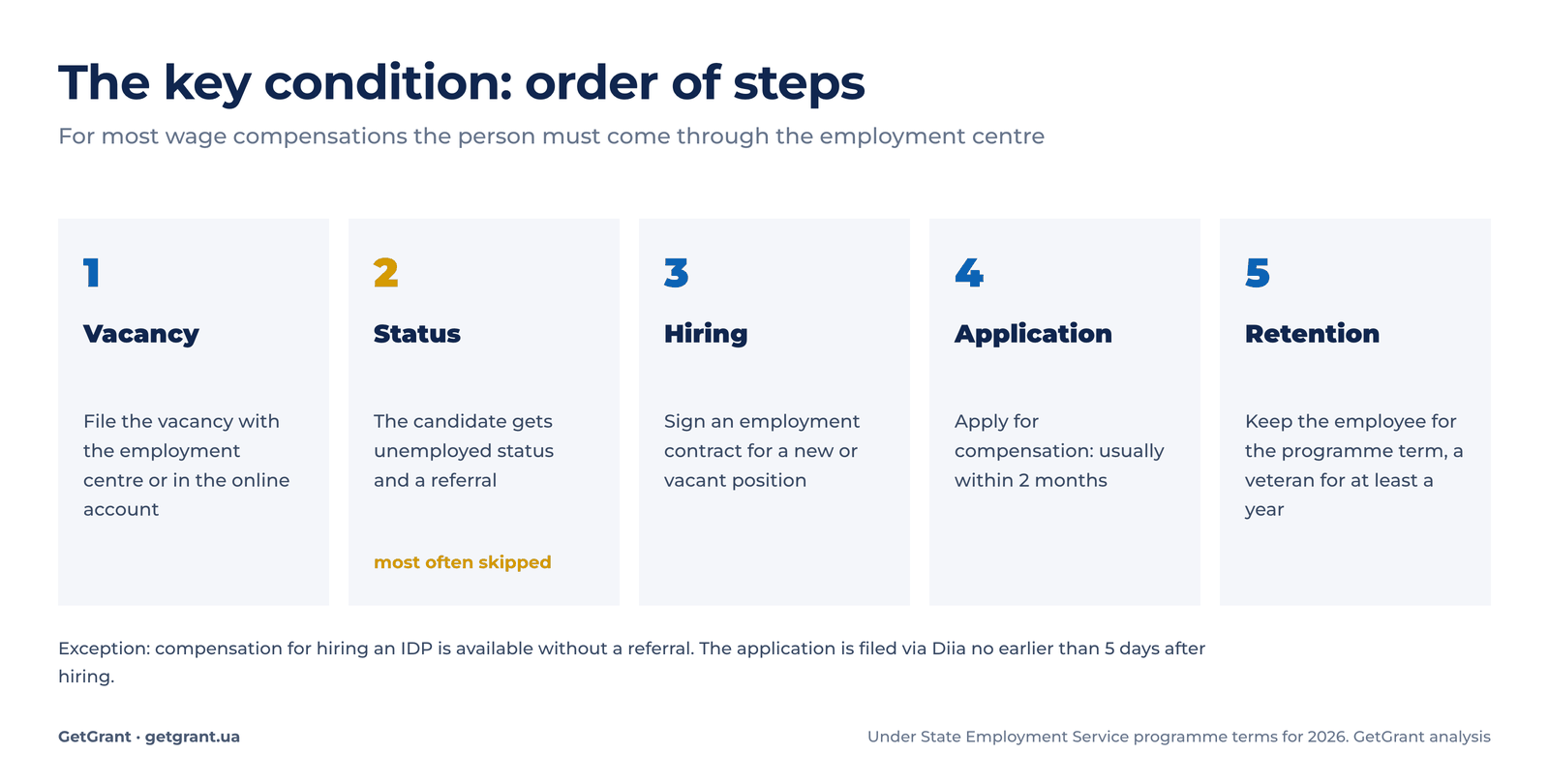
The correct sequence looks like this. First the vacancy is filed with the employment centre or in the employer’s online account. The candidate registers as unemployed and receives a referral. Only after that is the employment contract signed, and the employer applies for compensation, for most programmes within two months. If you have already found a person yourself, ask them to register with the employment centre before signing the contract. For veterans, support specialists can do this on their behalf with their consent.
What it gives a company: an example
Take an illustrative manufacturing company in Zhytomyr that hires four people in the autumn. A veteran as an operator on a salary of UAH 18,000; an IDP employee for the warehouse on UAH 16,000; a 22-year-old graduate as a technologist on UAH 15,000; an employee with a group II disability on UAH 15,000, for whom a workplace has to be adapted at a cost of UAH 60,000. All except the IDP employee are hired with a referral from the employment centre. In addition, as a processing-industry enterprise, the company trains one operator for a full qualification.
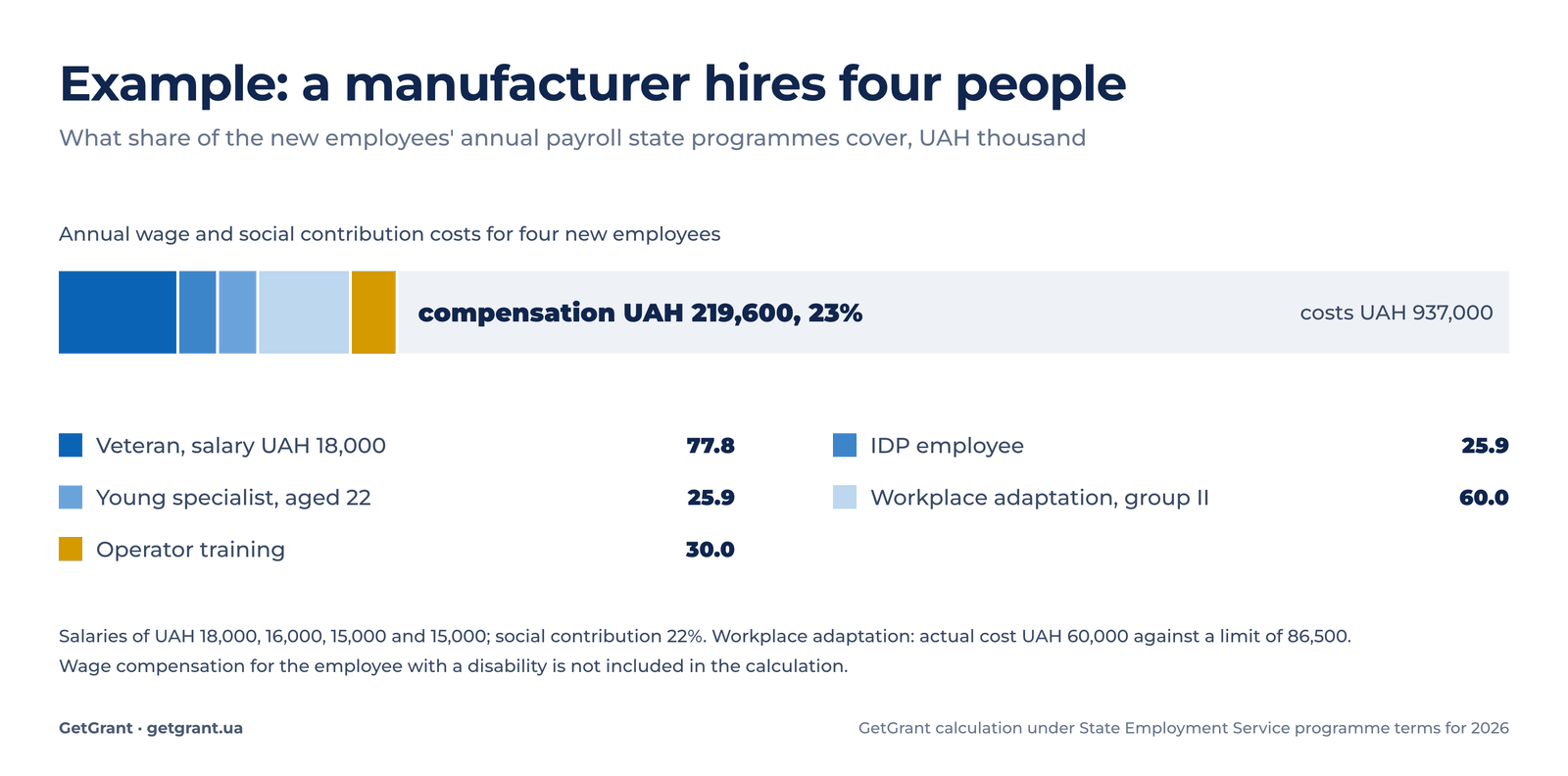
The annual cost of wages and social contributions for these four employees is about UAH 937,000. Compensation gives UAH 219,600, that is roughly a quarter. Half of that amount comes from the veteran, another quarter from workplace adaptation. We deliberately did not include wage compensation for the employee with a disability, because its duration depends on the specific programme. With it, the share would rise by a few more percentage points.
For a small company this amount is comparable to a small grant. The difference is that compensation does not have to be won: if the conditions are met, the payment is guaranteed.
What will change in 2027
The Ministry of Economy is expanding programmes around the same groups of people that business can hire. Four areas matter most for an employer:
- “Experience Matters”. Expanded support for people aged 50 and over. About 2,500 people have already been employed under the programme.
- “Combine and Grow”. A new project for young parents, primarily women returning to work after the birth of a child, from counselling to employment and follow-up support.
- “This Is My Business”. Training and mentoring for young people planning their own business. There are already more than a thousand participants.
- “Youth Guarantee”. Proactive career support for people aged 15–35 who have not yet decided on a profession.
From 2027 the compensation for training employees in strategic sectors will rise from UAH 30,000 to 35,000 for a full qualification and from UAH 15,000 to 20,000 for a partial one. In the draft budget for 2027, spending of the Fund of Compulsory State Social Insurance against Unemployment is set at UAH 31.6 billion, which is 5.3 billion more than in 2026. Another UAH 3.5 billion, 1.2 billion more, is earmarked for employment programmes for IDPs.
For more on what the draft 2027 budget means for Vlasna Sprava and processing grants, read our article eRobota in 2026–2027: what changed in Ukraine’s state business grants.
Typical employer mistakes
- Hiring before the candidate registers with the employment centre. The most common and irreparable mistake for programmes that require unemployed status.
- A missed application deadline. For most wage programmes this is two months; for IDPs the application cannot be filed earlier than 5 days after hiring; for workplace adaptation 180 days are given.
- Replacing an employee instead of creating a new job. The social contribution compensation programme for small business does not cover this situation.
- A salary that does not match the programme. Compensation for a veteran is calculated from actual costs, so at a minimum salary the company receives less than the maximum.
- Dismissal before the end of the term. If the programme sets a minimum period of work, such as a year for a veteran, early dismissal can become grounds for repaying the money. The conditions are worth checking in the agreement with the employment centre.
- Training without a certificate. Training costs are reimbursed only after the employee is assessed and receives a qualification certificate.
Staffing compensations combine well with grants in a company’s financial plan: a grant provides capital for equipment, and compensations reduce the cost of the people who will work on that equipment. The GetGrant team helps build such a model for a specific business and prepare applications for Vlasna Sprava grants, grants for processing enterprises and donor programmes. Current calls are collected in the GetGrant catalogue, and an individual selection can be ordered on the services page.
Sources
- 7eminar: 7 programmes for employers in 2026, 5 October 2026 (in Ukrainian)
- 7eminar: Ministry of Economy names 4 programmes to tackle the labour shortage, 1 October 2026 (in Ukrainian)
- LIGA.Business: hiring compensations for employers raised in 2026 (in Ukrainian)
- Debet-Kredyt: compensations to employers for hiring veterans (in Ukrainian)
- Forbes Ukraine: labour shortage hits a historic record, IER survey (in Ukrainian)
- Borg Expert: labour shortage, July wave of the IER survey (in Ukrainian)
- Cabinet of Ministers: government approves draft State Budget 2027 (in Ukrainian)

Book a consultation or leave your application idea
Tell us in a few words about your project: we will say which grants it fits and can take the application itself off your hands. We reply within one business day.