The €300 million Ukraine Support Instrument has made a Ukrainian participant mandatory in EU calls for joint production. We break down EDIP, BraveTech EU, EDF, EIC STEP Scale Up Defence and SAFE: amounts, deadlines and what to prepare right now.
A year ago a Ukrainian defence company could get into a European defence project only as a subcontractor, if at all. In summer 2026 the situation changed. In July Ukraine and the European Commission signed two agreements: one on association to the European Defence Fund and one on financing under the EDIP programme, which creates a separate Ukraine Support Instrument worth €300 million. In September the Verkhovna Rada ratified the EDIP agreement. Now, in some EU calls, a Ukrainian company is not merely allowed to take part but is a mandatory condition: without a Ukrainian participant the application will not be accepted.
In this article we look at which EU instruments are actually available to Ukrainian defence businesses, how much they provide, which deadlines are closest and what it takes to join a consortium. The terms were checked against call documents and European Commission announcements as of 10 October 2026.
Short answer
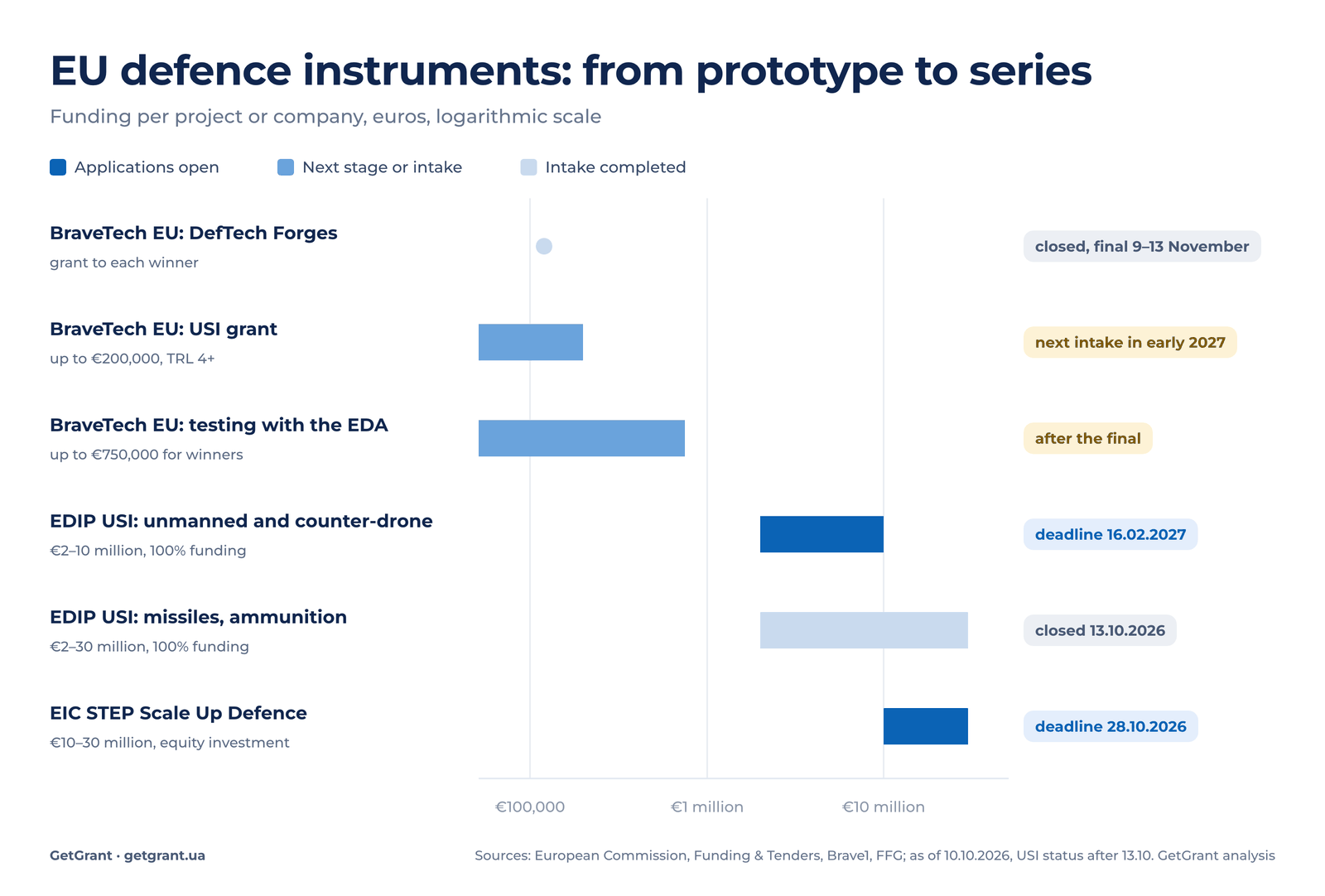
- The biggest money right now is in the Ukraine Support Instrument. There are two calls for joint EU–Ukraine production: missiles and ammunition, up to €30 million per project, and unmanned and counter-drone systems, up to €10 million. Funding is 100%, and every consortium must include a Ukrainian participant.
- The first call closed on 13 October 2026; the second accepts applications until 16 February 2027. It is an interesting opportunity that is worth preparing for now: for most companies the February deadline is the realistic target.
- For startups there is BraveTech EU: €120,000 for winners of technology challenges, then testing with the European Defence Agency worth up to €750,000. A new intake of grants of up to €200,000 is expected in early 2027.
- For companies that are already scaling, the EIC accepts applications for equity investment of €10 to €30 million until 28 October 2026.
- The European Defence Fund has already closed its 2026 call. The association agreement has been signed, but as of early October it had not yet entered into force. The next EDF calls are worth preparing for in 2027.
What changed in 2026
EDIP, the European Defence Industry Programme, is the first EU instrument that funds not research but the ramp-up of production. Its budget is €1.5 billion for 2025–2027. The regulation was given final approval by the Council of the EU in December 2025. It contains two decisions of principle for Ukraine. The first: a separate Ukraine Support Instrument worth €300 million. The second: components of Ukrainian origin count as European when the 35% limit on components from third countries is checked.
On 30 March 2026 the European Commission adopted the EDIP work programme for 2026. This is how the main amounts are allocated in it.
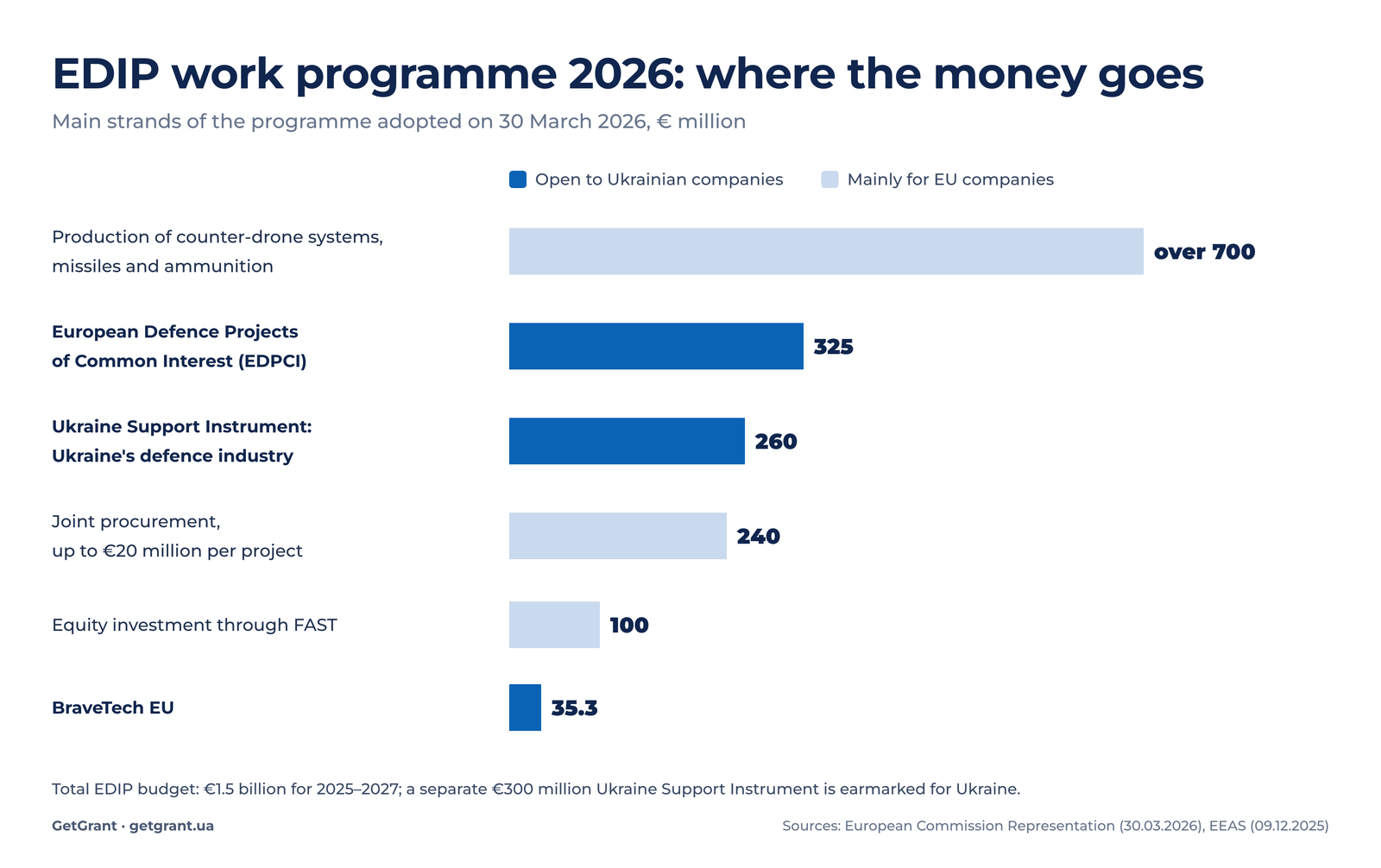
Three lines matter for Ukrainian business. €260 million from the Ukraine Support Instrument goes to rebuilding and modernising Ukraine’s defence industry. €35.3 million from the same instrument funds BraveTech EU. A further €325 million is directed to European Defence Projects of Common Interest, in which participation is also open to Norway and Ukraine.
The legal basis was laid by the agreements signed in Kyiv in July 2026 by Minister of Defence Mykhailo Fedorov and European Commissioner for Defence Andrius Kubilius. The EDIP agreement provides that support may cover up to 100% of the costs of Ukrainian participants. On 16 September the Verkhovna Rada ratified it.
“Ukraine is becoming part of the policies and instruments of the European Union. Integration continues!”
Andrius Kubilius, European Commissioner for Defence and Space, after the signing of the agreements with Ukraine, July 2026.
Ukraine Support Instrument: two calls and their rules
Both calls were published on 31 March, and submission opened on 17 June 2026. They share the same logic: the EU pays for projects that ramp up production in Ukraine and in EU countries at the same time.
Call 1. Missiles, ammunition and bombs. Budget €184.5 million. A single project receives from €2 million in total eligible costs up to €30 million in EU funding. Applications closed on 13 October 2026 at 17:00 Central European Time. Results are expected in February, and the signing of grant agreements in May 2027.
Call 2. Unmanned and counter-drone systems. Budget €80 million, from €2 million to €10 million per project. The aim: cross-border production of drones, interceptors, systems resistant to electronic warfare and counter-drone equipment. Deadline 16 February 2027. With the first call closed, this is the nearest opportunity under the USI, and it is worth preparing for well in advance: a consortium, ownership documents and a component-origin calculation take several months.
Key rules worth knowing before you look for partners:
- Organisations from EU countries and Ukraine can apply, except for territories not controlled by the Ukrainian government.
- If there is a single applicant, it must be a Ukrainian company. If there is a consortium, it must include at least one Ukrainian participant. The maximum is 15 participants.
- Funding is 100% in the form of a lump sum, and indirect costs are covered at a rate of 7%.
- No more than 35% of the value of components may originate from outside the EU and Ukraine, and the applicant must retain full rights to the design of the product.
- Project duration is from 36 to 60 months. A work package on protecting production can be claimed separately: up to €500,000 in the first call and up to €200,000 in the second.
The practical conclusion: a Ukrainian company with proven production capacity now has a negotiating position it did not have before. A European manufacturer cannot submit an application without a Ukrainian participant. So it is worth looking for a partner not as a “junior subcontractor” but as an equal participant responsible for part of the production chain in Ukraine.
BraveTech EU: the route for startups
BraveTech EU was created in close cooperation with Brave1. The programme has two phases. The first, DefTech Forges, consists of short technology challenges. The second, testing and evaluation, is run together with the European Defence Agency, for which the European Commission allocated €35 million in April 2026.
The second edition of DefTech Forges accepted applications from 10 August to 6 September 2026. The final will take place on 9–13 November simultaneously in Germany and Romania. Forty teams have been selected for the final, there will be six winners, and each will receive €120,000 to bring its solution to technology readiness level TRL 6–7. The themes of the second edition: ground sensors, autonomous strike drones and swarms, drone operation under electronic warfare, rapid adaptation on the battlefield, radio-frequency homing seekers.
Winners can move on to testing with the European Defence Agency with funding of up to €750,000. Separately, Brave1 is announcing a Ukraine Support Instrument grant strand: up to €200,000 for a six-month project for startups from the EU and Ukraine at TRL 4 and above, with field trials in Ukraine. On the programme portal the next intake is marked as early 2027. DefTech Forges challenges are planned to be held six times a year, so a missed intake is not a lost opportunity.
The official programme portal: eu.brave1.tech.
European Defence Fund: prepare for 2027
EDF is the EU’s largest defence instrument for research and development. Its 2026 call, worth €1.01 billion across 28 topics, closed on 29 September, and results are expected in the first half of 2027.
Ukraine’s status here is transitional. The association agreement was signed in July 2026, but on the European Commission portal it is marked as not yet in force. Until that moment Ukrainian organisations could apply as consortium members, and they will become fully fledged beneficiaries and subcontractors once the agreement enters into force. We did not find any EDF calls with a deadline at the end of 2026, and the 2027 calls have not yet been published.
One more change is in progress: the European Parliament has backed a proposal to make the costs of testing in Ukraine eligible for EDF funding. The Council of the EU has not yet formally adopted this decision. If the rule is approved, European projects will have a direct financial incentive to involve Ukrainian test ranges and Ukrainian partners.
EIC STEP Scale Up Defence: capital for those already growing
A separate instrument for companies at the scale-up stage has been launched by the European Innovation Council. EIC STEP Scale Up Defence invests from €10 to €30 million in a company’s equity and is designed for rounds 3–5 times larger than the investment itself. SMEs and small mid-caps with up to 499 employees whose solutions are intended primarily for defence can apply. Confirmation of interest from a qualified investor for at least 20% of the target round is required.
Companies controlled by Ukraine are not among those excluded from participation. Applications are accepted until 28 October 2026, 17:00. This is not a grant but a dilution of ownership, so the instrument suits companies that are already in talks with funds.
SAFE: loans to EU countries, orders for Ukrainian manufacturers
The €150 billion SAFE instrument lends not to companies but to EU Member States for joint defence procurement. But it contains an important rule for Ukrainian business: at least 65% of the value of components must originate from the EU, the EEA or Ukraine. Ukraine takes part in joint procurement on the same terms as Member States.
As of October 2026, 19 EU states had submitted plans, and the first advance payments had already been received by Cyprus, Lithuania, Greece and Estonia. A Ukrainian company does not receive SAFE funds directly, but it can become a supplier in a contract financed from these loans. We have not yet found specific SAFE contracts with Ukrainian manufacturers in public sources.
Calendar for the coming months
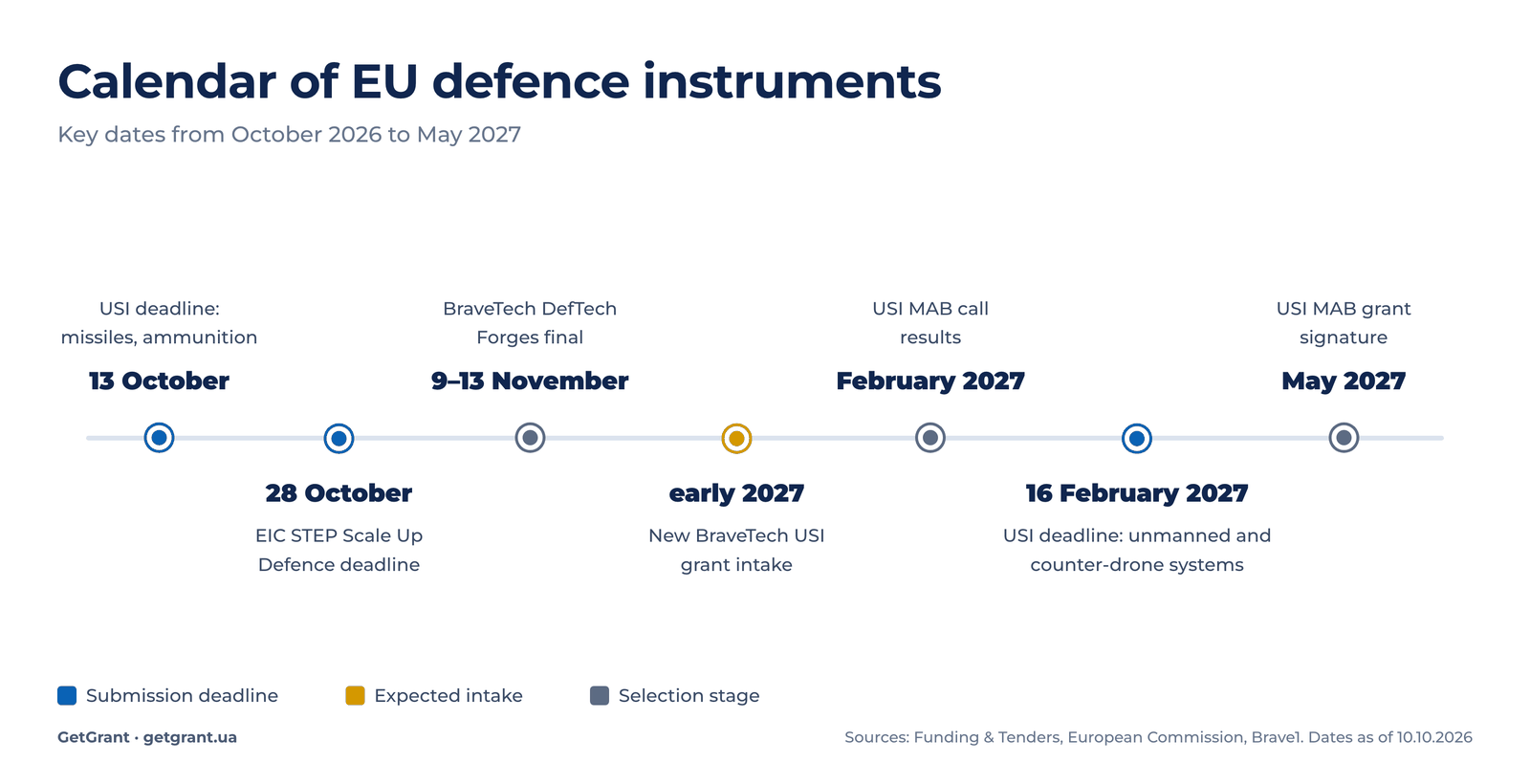
What to prepare right now
- Register your organisation on the Funding & Tenders portal and obtain a PIC code. Without it a company cannot become a consortium participant.
- Prepare an ownership and control package. EU defence calls check who actually controls the company and exclude entities linked to third countries.
- Calculate the origin of your components. The 35% limit applies to the whole product, so dependence on Asian components can knock a project out before evaluation even begins.
- Check your design rights. The applicant must retain full control over the design, so licensed solutions without the right to modify are not suitable.
- Look for partners now, not a month before the deadline. Four months remain until 16 February 2027, and a consortium of 3–5 participants from different countries takes at least two to three to form.
Conclusion
For Ukraine’s defence business, 2026 became the year of transition from the role of aid recipient to the role of participant in the European market. But EU money is tied to consortia, ownership procedures, the origin of components and long evaluation cycles. A company that starts preparing documents and partners now will have a real chance in February 2027 in an €80 million call where Ukrainian participation is a mandatory condition.
The GetGrant team helps defence and technology companies assess which EU instruments are worth pursuing and prepare documents for the Funding & Tenders portal and grant applications. Current calls are collected in the GetGrant catalogue, and a tailored selection can be ordered on the services page.
Want help with your application?
If you have an idea for joint production, a technology for BraveTech EU or a scale-up plan for EIC, write us a few words in the form below. We will look at which instrument it fits and what is realistic before the deadline, and we can take the application itself off your hands: partners, budget and the paperwork for the Funding & Tenders portal.
Sources
- European Commission Representation: €1.5 billion EDIP work programme, 30.03.2026
- EEAS: final approval of EDIP by the Council of the EU, 09.12.2025
- Ministry of Defence of Ukraine: access to EU programmes and a €300 million instrument, 15.07.2026
- Kyiv Post: ratification of the EDIP agreement, 16.09.2026 (in Ukrainian)
- Call document EDF-EDIP-USI-2026-LS-IRA
- European Commission: second edition of BraveTech EU DefTech Forges, 10.08.2026
- Ministry of Defence of Ukraine: grants of up to €120,000 in BraveTech EU, 12.08.2026
- European Commission: partnership with the European Defence Agency for BraveTech EU, 29.04.2026
- Interfax-Ukraine: statement by Andrius Kubilius, 14.07.2026
- FFG: EIC STEP Scale Up Defence 2026
- FFG: EDF call 2026
- The Defense Post: testing in Ukraine as eligible EDF costs, 21.09.2026
- European Commission: the SAFE instrument

Book a consultation or leave your application idea
Describe your idea, the instrument you are interested in and a rough budget. We reply within one business day.