Grants for veterans in 2026: an overview of grant types, eligibility requirements, documents and a submission checklist. How to find the right grant quickly.
More detail and current amounts: Grants for veterans 2026: a complete guide to programmes and applications – five funders, limits and reasons for rejection. Since September 2026, the Ministry of Economy’s veteran grant has been part of Vlasna Sprava (Own Business) 2.0 as a top-up.
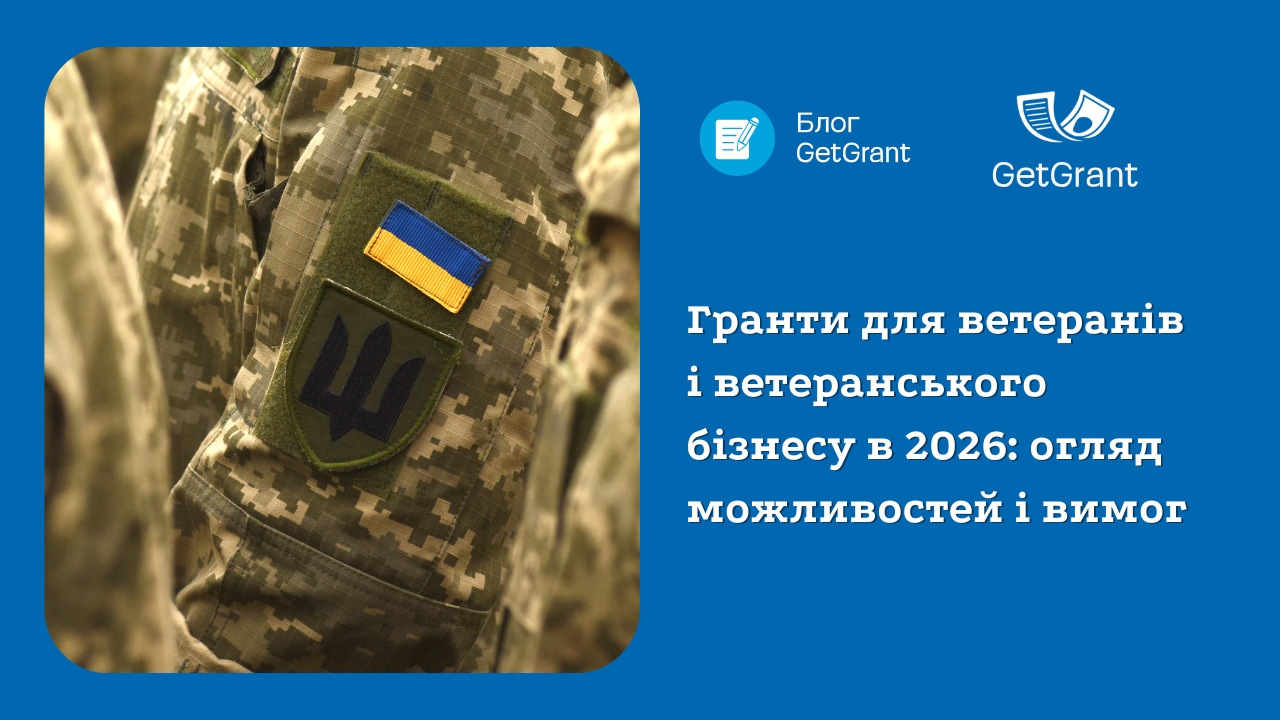
Grants for veterans in 2026 are a real opportunity to start or grow your own business after military service. In this article we look at the types of grants for veterans, their key differences and the eligibility requirements for applicants. You will learn how to check eligibility quickly and filter out irrelevant calls, which documents you will need for a grant, and you will get a grant application checklist. We will also walk through two case scenarios – a veteran starting from scratch and the owner of a veteran-led business – and offer tips for different situations. Finally, we will show how the GetGrant service helps you find the right grant and keep track of deadlines.

Types of grant programmes for veterans
In Ukraine, there are various types of grants for veterans and veteran-owned businesses. Each type has its own funding sources, conditions and target audience. Let us look at the main categories of grant programmes.
State support programmes (government grants)
State grants are funded from the budget and usually aim to encourage entrepreneurship and create jobs. For example, the “Grant for veterans and their family members” programme under eRobota lets you apply for funding to start or grow a veteran business through the Diia portal. Such funds can usually be spent on equipment, raw materials, premises rental, a franchise, marketing and so on.
A key requirement of many state programmes is the creation of new jobs. There are also other state instruments under eRobota, in particular the “Grant for your own business”.
This category also includes the calls of the Ukrainian Veterans Fund, which are published on its official website: Ukrainian Veterans Fund.
International and donor grants
International organisations, foundations and Ukraine’s partners also support veterans through grant programmes. Such calls often combine financial support with training or mentoring. Donor programmes are usually more flexible in their conditions, but they may have a clear focus on specific priorities: innovation, social impact, economic resilience, reintegration and so on.
Local initiatives and regional calls
Local grant programmes at the level of regions, cities or communities are often aimed at developing entrepreneurship in that particular area. The amounts may be smaller, but competition is often lower and the conditions are closer to the local context. If you are planning a business that will benefit your community, it is worth asking about support programmes at your local veteran support centre or business centre.
Corporate and charitable grants
Large companies and banks also launch programmes for veteran entrepreneurs as part of their corporate initiatives. One example is the educational and grant programme “Zhyty Nazustrich” (Living Forward) (veteran track: “Veteran Business”). Such programmes often combine training, mentoring and grant funding, and also give participants promotion and support after selection.

How to choose a grant: a quick eligibility check
There are many grant programmes, but spending time on every one of them is inefficient. It is important to learn how to filter out irrelevant calls quickly. Here is a step-by-step approach to choosing “your” grant without missing an opportunity.
– Define your profile and needs. Who are you and what are you looking for: are you a veteran just starting out, or do you already have a business? Do you need funds to launch or to scale up? What sector, and what kind of support would you prefer?
– Find available programmes. Check official sources and grant-matching platforms. For example, eRobota on Diia brings together several state grant services, including veteran grants and general business grants.
– Filter out irrelevant options using key criteria. First check the grant’s eligibility: who can apply, business status (sole proprietor (ФОП) / LLC or an individual with an idea), purpose of the grant, region, type of support, and basic requirements for documents and reporting. If a grant is clearly not for you, discard it without reading it in detail.
– Analyse the detailed conditions of the selected grants. For the 2–5 remaining programmes, read the conditions and the list of documents carefully, as well as the selection procedure and deadlines. For example, applying for the veteran grant through Diia usually requires a business plan in a prescribed format.
– Make your final choice and an action plan. Choose the programme that best matches your goals and resources. Then draw up a simple plan: what you need to collect, what you need to write and when you will apply. Keep 1–2 backup programmes as a plan B.
– Track new opportunities and deadlines on GetGrant. Set up monitoring and deadline reminders. You can sign up here
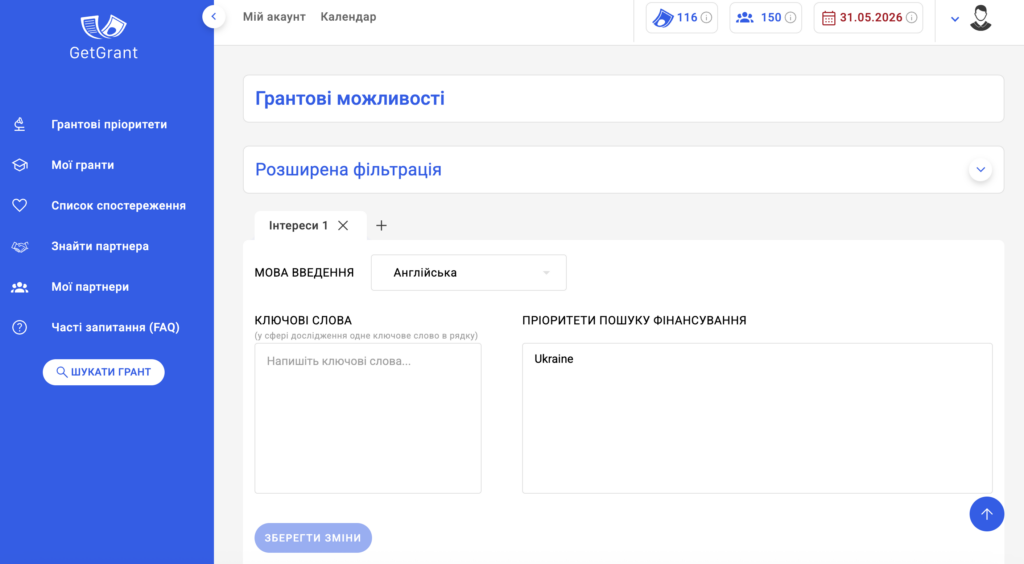 The home page of the GetGrant grant search engine – it is like Google, but for grants!
Criteria and red flags: what to check in grant conditions
Every programme has its own requirements. Below is a table for a quick eligibility check, along with possible red flags that signal that a grant is not right for you or carries risks in the area of “grants for veterans”.
| What to look at (criteria) | Red flag (risks) |
|---|---|
| Target audience of the grant – who can apply (veterans, family members, IDPs, etc.). | You do not belong to the specified category. Example: the grant is only for veterans with disabilities, but your status is different. |
| Business status – registration requirements (sole proprietor/LLC) or length of business activity. | You have no registered sole proprietorship where this is mandatory, or the business does not meet the requirements for length of activity. |
| Purpose of funding – what the money is given for (launch, growth, training). | Your needs do not match the purpose of the programme. Example: the programme funds only launches, but you need to scale up. |
| Sector focus – priority areas (agriculture, IT, manufacturing, etc.). | The project falls outside the topic of the call, and you are “stretching” your idea to fit the conditions. |
| Regional scope – geography of participants or project implementation. | You are not from the region the programme is intended for, or the project has to be implemented in a different location. |
| Grant size and own contribution – the amount and co-financing requirements. | The amount does not match your needs, or you cannot afford the co-financing. |
| Grantee obligations – jobs, reporting, use of funds for intended purposes. | You are not ready to fulfil the obligations or will not be able to support expenses with documents. |
| Deadlines and duration – application and implementation periods. | There is not enough time to prepare a quality application, or the implementation periods are unrealistic for your resources. |
| Reputation and source – who the organiser is, and whether there are official pages and rules. | There is no information about the organisers, they ask for a participation fee, or they promise “100% success”. |
Common mistakes when submitting grant applications (grants for veterans)
- Applying “just to give it a try” without reading the requirements. Check eligibility first so you do not waste time on an application that will not pass the technical screening.
- Using templates without personal input. It is better for the application to sound like you and reflect your motivation and a realistic plan.
- A vague business idea or a project with nothing unique about it. Explain what the value is and how you differ from others.
- Ignoring finances and implementation. Show where the money will go, what the stages are and what results you will achieve.
- Problems with documents. Check that files are up to date, in the right format and complete before submitting.
- Procrastination and missed deadlines. Apply in good time, not in the last few hours.
- No plan B. Keep 1–2 alternative programmes and analyse the feedback if you are not selected.
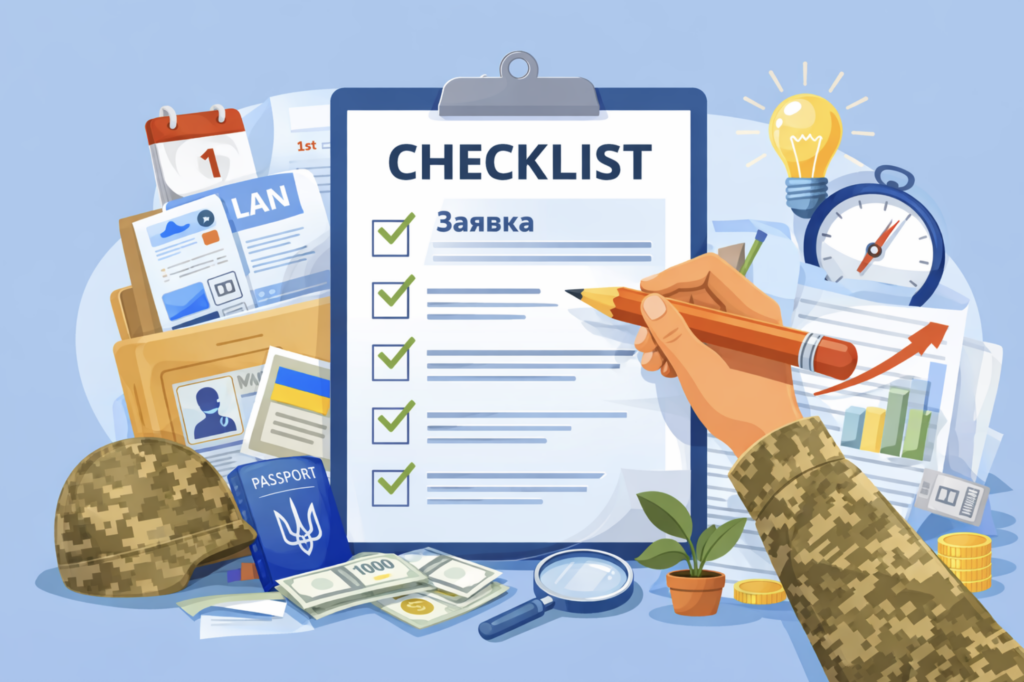
Checklist for a successful grant application
– Eligibility met: status, category, region, format, deadlines, criteria.
– Documents collected: passport, individual tax number (ІПН), proof of status, sole proprietor/LLC registration documents (if required).
– Business plan and budget: a clear description of where the money will go and what result you will achieve.
– No empty fields in the form, and correct files in the required format.
– A unique idea: how you differ and why your project in particular deserves support.
– A realistic implementation plan: stages, timelines, responsible persons, risks.
– Deadline under control: submitted in good time, confirmation received, copies saved.
– Ready for an interview or pitch: a short presentation and answers to questions.
– Plan B: other calls or reapplying in the next round.
– Monitoring opportunities: reminders and curated selections set up.
– Eligible costs: everything complies with the “eligible costs” rules.
– Co-financing confirmed, if required.
– Reporting: you understand how you will substantiate expenses and results.
– Proofreading: errors, logic, figures and consistency throughout the document.
– GetGrant: you are ready to use filters and modern grant search so that you do not miss new opportunities. Sign up now!
Conclusion. A systematic approach to finding and selecting grants in 2026 helps you quickly put together 3–5 realistic options and apply without stress. Save the checklist, check the conditions of each programme and use monitoring tools so that you do not miss deadlines – and win grants for veterans!
FAQ: frequently asked questions about grants for veterans
How can a veteran get a grant? Where to start?
What counts as a “veteran business”, and how can you check it?
Can I apply without a sole proprietorship or LLC if I only have an idea?
What should I do if co-financing is required?
Which costs are most often “rejected”?
Can I apply to several programmes at the same time?
How do I prepare a business plan if I have no experience?
What should I do after submitting?
Open calls for business
- EUDIS Business Accelerator Cohort 4: €120,000 non-dilutive funding for defence and dual-use start-ups, Ukrainian companies eligible, apply by 20 November 2026until 20.11.2026
- Ministry of Education and Science: call for applied research and development commissioned by business, with the state covering up to 65% of a university or research institution project, apply by 20 Novemberuntil 20.11.2026
- Founder Labs Cohort 5: a £25,000 Invest NI grant with no equity or repayment for tech start-ups in Belfast, apply by 20 November 2026until 20.11.2026
- Chernivtsi region reimburses businesses 30% of the cost of generators, batteries and solar panels: up to UAH 100,000 for companies and UAH 50,000 for sole proprietors, apply by 27 Novemberuntil 27.11.2026

Book a consultation or leave your application idea
Tell us in a few words about your project: we will say which grants it fits and can take the application itself off your hands. We reply within one business day.