
Horizon Europe, Erasmus+, the UCF and the NRFU score proposals on different scales, but points are lost in the same places. We break down thresholds, rankings, ten typical weaknesses and a self-evaluation sheet for checking Your proposal before submission.
Most proposals lose not because the idea is weak, but because the text gives the expert no grounds for a high score. The expert does not know Your team, cannot ask a clarifying question and is not allowed to assess what could have been in the proposal. They compare the submitted text with the criteria and the scale, and every gap turns into half a point or several points lost. In programmes where one proposal in seven to ten is funded, that half point is what separates a grant from the reserve list.
In this article we look at how evaluation works in the four systems Ukrainian applicants deal with most often: Horizon Europe, Erasmus+, the Ukrainian Cultural Foundation (UCF) and the National Research Foundation of Ukraine (NRFU). We then set out ten typical places where a proposal loses points, and a self-evaluation sheet You can use to check the text before submission. The rules were checked against primary sources as of 23 October 2026.
Short answer
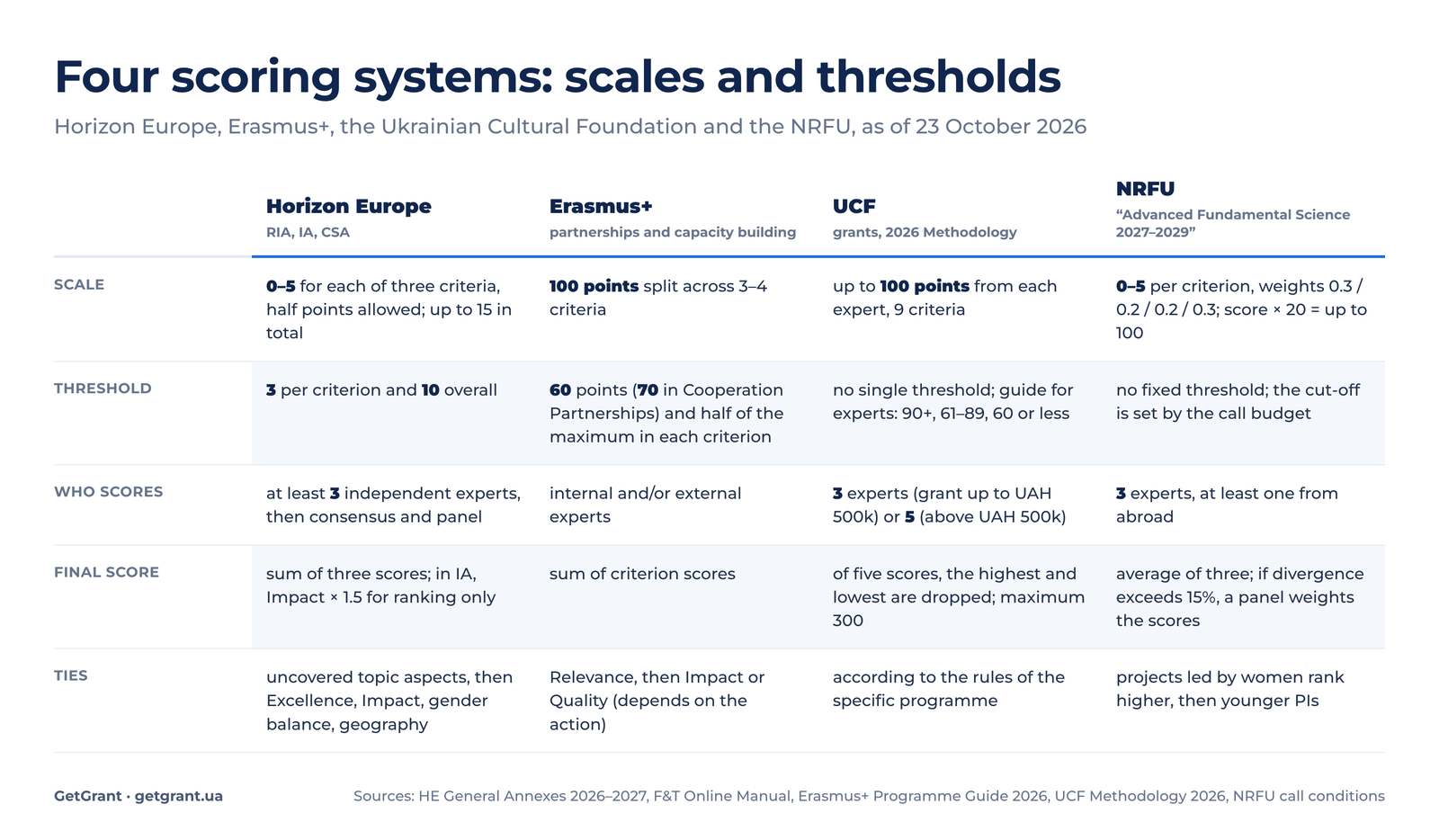
- In Horizon Europe each of the three criteria (Excellence, Impact, Quality and efficiency of the implementation) is scored from 0 to 5 in half-point steps. The threshold is 3 per criterion and 10 out of 15 overall.
- Passing the threshold does not mean getting a grant. According to the European Commission, 55% of eligible proposals pass the thresholds, but around 75% of these go unfunded. The overall success rate is 14%, and for calls that closed in 2025 only 10%.
- In Erasmus+ a proposal can score up to 100 points. For most actions the threshold is 60 points and at least half of the maximum in each criterion, but in Cooperation Partnerships the threshold is 70 points.
- At the UCF each expert awards up to 100 points across nine criteria. At the NRFU three experts, at least one of them from abroad, score the project on a 0–5 scale with weighting coefficients.
- Points are most often lost not on the scientific idea but on what surrounds it: a mismatch with the call text, objectives without indicators, an implausible pathway to impact, a budget unconnected to the work plan and generic risks.
How evaluation works: four systems
Horizon Europe: three criteria, five points, two thresholds
The General Annexes to the Horizon Europe Work Programme 2026–2027 set three criteria for Research and Innovation Actions (RIA), Innovation Actions (IA) and Coordination and Support Actions (CSA). Excellence covers the clarity and pertinence of the objectives, the extent to which the work goes beyond the state of the art, and the soundness of the methodology, including the gender dimension and open science practices. Impact assesses the credibility of the pathways to the expected outcomes and impacts specified in the work programme, and the quality of the dissemination and exploitation measures. Quality and efficiency of the implementation covers the work plan, risk assessment, resources and the role of each consortium member.
Scores are awarded for the criteria, not for individual aspects. The threshold for each criterion is 3 and the overall threshold is 10. For Innovation Actions the Impact score is weighted by 1.5, but only for ranking, not for checking thresholds. At the first stage of two-stage calls only Excellence and Impact are evaluated, the threshold for each is 4, and the overall threshold is normally set at 8 or 8.5.
According to the Funding & Tenders Online Manual, proposals are normally evaluated by at least three independent experts. Each prepares an individual report, the experts then agree on comments and scores in a consensus group, after which a panel checks the consistency of the scores and draws up the ranking. The applicant receives a result letter together with the Evaluation Summary Report, which contains the scores and comments.
“Applications must be evaluated as they were submitted, NOT on their potential.”
Standard Horizon Europe evaluation form for RIA and IA, version 4.0 of 12 November 2025.
The same form explicitly forbids experts to recommend changes to the consortium, budget or work packages: shortcomings must be reflected in a lower score. If a proposal is partly out of scope, this is also reflected in the score.
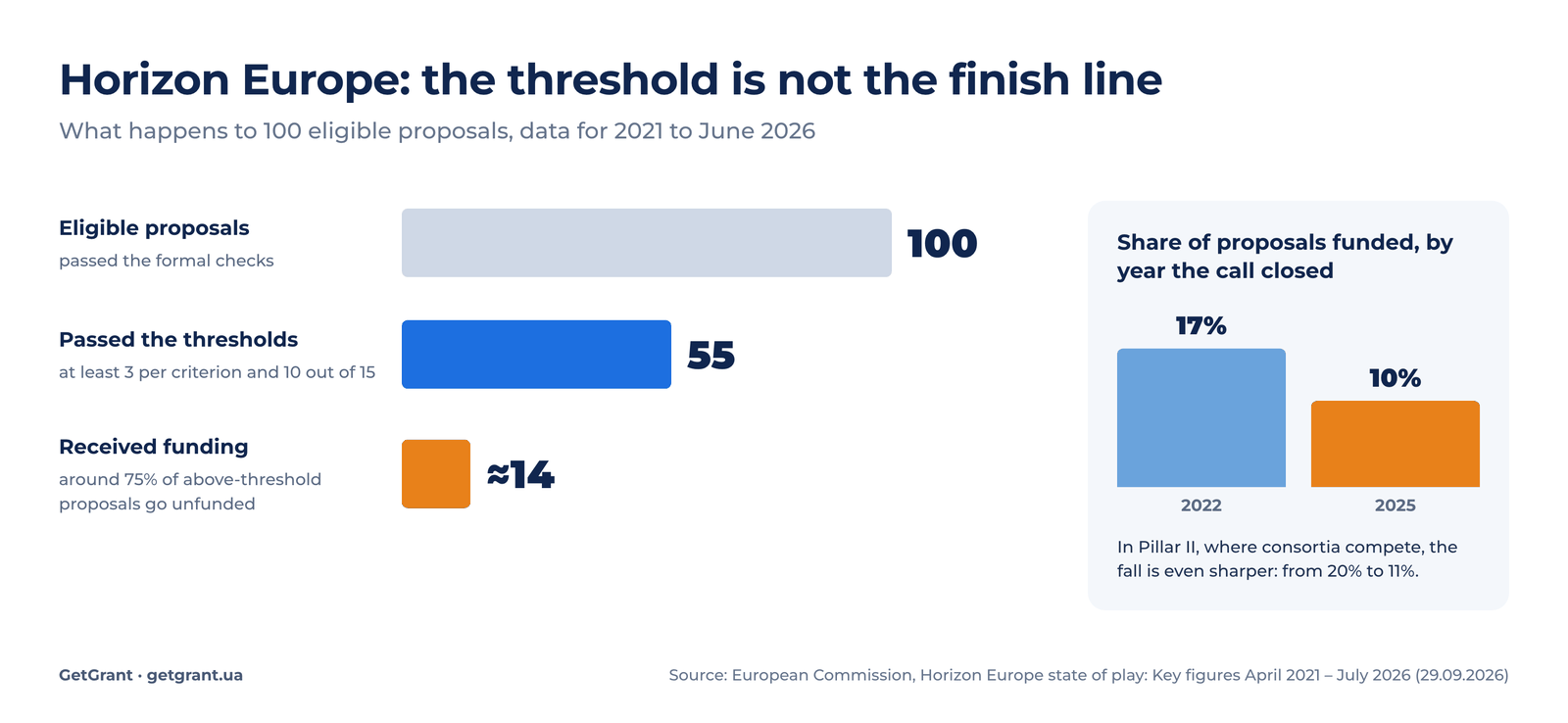
The Commission’s report “Horizon Europe state of play” of 29 September 2026 shows the scale of competition. From 2021 to June 2026 the programme received over 170,000 eligible proposals. The success rate fell from 17% for 2022 calls to 10% for 2025 calls, and in Pillar II, where consortia compete, from 20% to 11%. Funding every proposal that experts judged worthy of funding would require more than €150 billion extra.
Erasmus+: 100 points and thresholds that depend on the action
The Erasmus+ Programme Guide 2026 (version 1 of 12 November 2025) sets a separate set of criteria and maximum scores for each action. The general logic is the same: a proposal must reach a minimum total and at least half of the maximum in each criterion. The specific figures differ:
- Cooperation Partnerships: Relevance 25, Quality of the project design and implementation 30, Quality of the partnership and the cooperation arrangements 20, Impact 25. Threshold 70 points, with minimums of 13, 15, 10 and 13 points per criterion.
- Small-scale Partnerships: 30, 30, 20 and 20 points, threshold 60.
- Capacity Building in Higher Education: 30, 30, 20 and 20 points, threshold 60, minimums of 15, 15, 10 and 10.
In the event of a tie in Cooperation Partnerships, the proposal with the higher Relevance score ranks higher, followed by Impact. So before writing, open the section of the exact action You are applying to: carrying the 60-point threshold over to Cooperation Partnerships gives a false sense of margin.
Ukrainian Cultural Foundation: 100 points from each expert
The UCF Expert Evaluation Methodology, approved by order No. 119 of 1 December 2025, provides that a project with a maximum grant of up to UAH 500,000 is assessed by three experts, and one above UAH 500,000 by five. Each expert awards up to 100 points. Where there are five experts, the highest and lowest scores are dropped, so the maximum rating score is 300.
The heaviest block is “Aim, objectives, tasks, results and indicators of project implementation, work plan” (25 points), followed by the detailed project description (15) and the analysis of the budget (15). Communication support, long-term results and the team receive 10 points each; target audiences, sustainability, management and risks 5 each. The Methodology gives experts a guide: 90 points or more means a project worth supporting, 61–89 worth supporting but needing revision, 60 or less in need of significant revision. There is no single pass mark: the ranking is drawn up separately by programme, lot or sector. Each expert’s final comment must run to between 2,700 and 6,000 characters without spaces and becomes the feedback to the applicant.
NRFU: three experts, one of them from abroad
Under the conditions of the NRFU call “Advanced Fundamental Science in Ukraine 2027–2029”, each project is assessed by three experts, at least one of whom must be from abroad. The four criteria carry weighting coefficients: quality of the planned research 0.3, potential impact 0.2, quality and realism of the implementation plan 0.2, and the research record of the principal investigator and team 0.3. Each criterion and sub-criterion is scored on a 0–5 scale, the weighted average is multiplied by 20, so the maximum is 100 points.
If the divergence between the three experts’ scores exceeds 15%, panel members assess how well justified each score is, and the result is calculated as a weighted average. There is no fixed threshold: the lower limit of the list of winners is set by the funding available for the call. In the event of a tie, projects led by women rank higher, followed by those with younger principal investigators.
What this means for the proposal writer
Comparing the systems yields three practical conclusions.
First, thresholds are trickier than they look. In Horizon Europe three scores of 3 add up to 9, so a proposal that formally passed every criterion will be rejected. In Erasmus+ Cooperation Partnerships the criterion minimums add up to 51 points against a threshold of 70. A criterion minimum protects against failure but brings You no closer to funding.
Second, aim for the ranking, not the threshold. When three quarters of above-threshold proposals go unfunded, the competition takes place in a range where every weakness costs a place in the ranking. The Horizon Europe scale itself describes the difference between 4 and 5 as the difference between “a small number of shortcomings” and shortcomings that “are minor”.
Third, only the text is assessed. No system allows the expert to guess what the author meant. What is not on the page does not exist for the evaluator.
Ten places where a proposal loses points
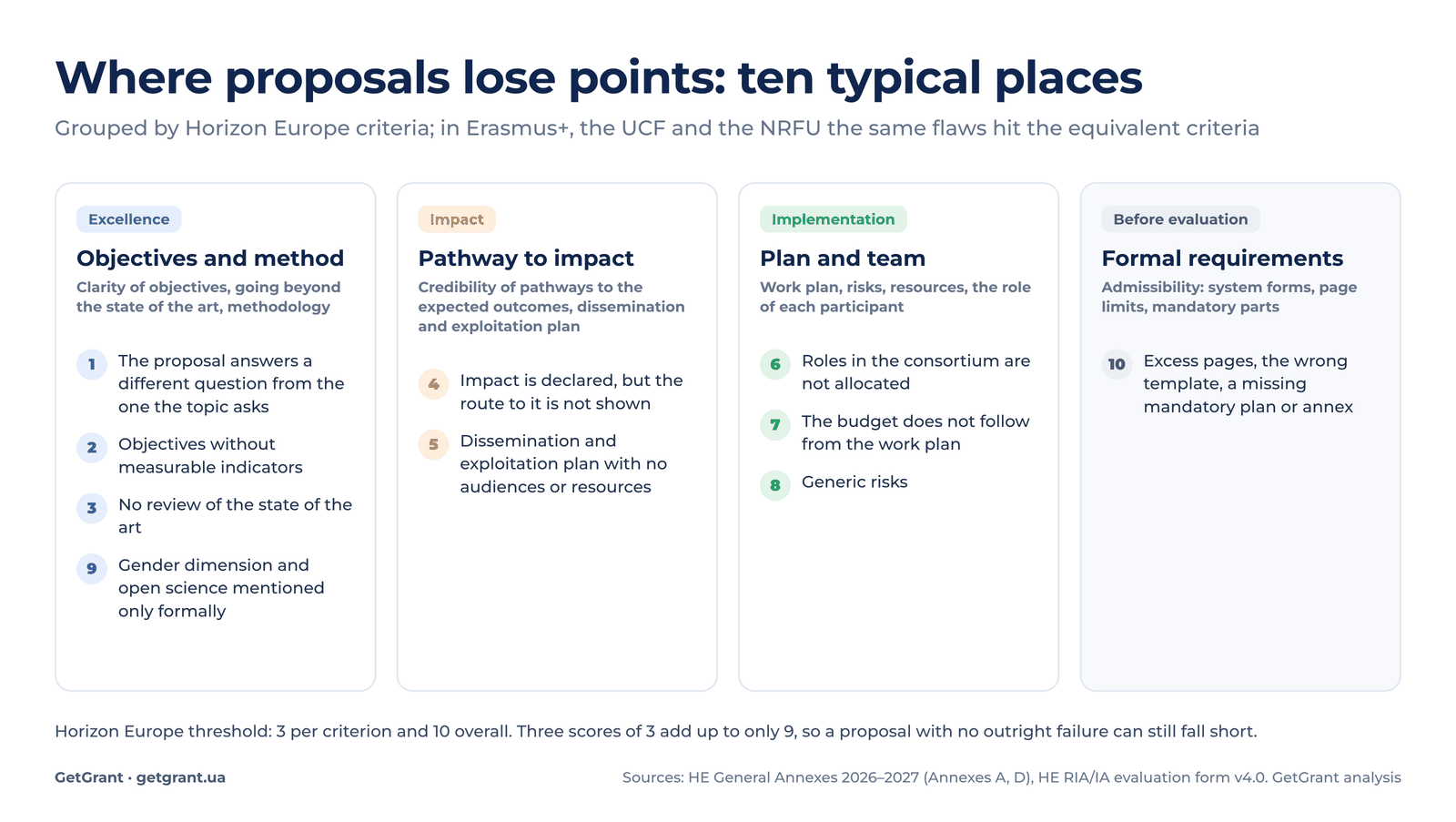
1. The proposal answers a different question from the one the call asks
Where it costs points: Excellence (pertinence of objectives), Impact (the topic’s expected outcomes); in Erasmus+ Relevance; at the UCF the sub-criterion on delivering the priorities of the programme or lot.
A typical case: the team adapts an existing project to a new call by changing the introduction. The expert, however, reads the proposal side by side with the topic text and looks for an answer to every point in the Expected Outcomes section. What to fix: list all the expected outcomes of the topic and, for each, name the section of the proposal that addresses it. Either close any point left without an answer or explain honestly why the project does not cover it.
2. Objectives without measurable indicators
Where it costs points: Excellence (clarity of objectives); at the UCF the sub-criterion “Objectives, tasks, results and indicators” is scored on a 10-point scale and requires quantitative indicators.
Wording such as “raise awareness” or “strengthen capacity” cannot be verified. What to fix: for each objective state the indicator, the baseline, the target value and the method of measurement. The logic is easiest to build through a logical framework matrix.
3. No review of the state of the art
Where it costs points: Excellence (going beyond the state of the art); at the NRFU the sub-criterion on the motivation and soundness of the scientific concept, where the absence of references means 0 points.
What to fix: show briefly what is already known, with references to recent publications, where exactly the gap lies and what specifically the project adds. A claim that “there are no analogues” without a review lowers the score rather than raising it.
4. Impact is declared, but the pathway to it is not shown
Where it costs points: Impact (credibility of the pathways to the expected outcomes and impacts).
The expert looks for a chain: the project result, who will use it, what will change and on what scale. What to fix: for each key result describe the target users, the barriers to uptake and what the project does to overcome them. Large impact figures without a calculation are better replaced with smaller but substantiated ones.
5. A box-ticking dissemination and exploitation plan
Where it costs points: Impact (dissemination, exploitation and communication measures); in Erasmus+ Impact; at the UCF communication support (10 points).
In Horizon Europe such a plan is an admissibility condition (except at the first stage of two-stage calls), and if exploitation involves a product or service, the plan must include a strategy for that exploitation. What to fix: name the audiences, channels, timing, responsible partners and the resources in the budget. A list of “website, social media, conferences” without addressees will be judged generic.
6. A consortium in which roles are not allocated
Where it costs points: Implementation (capacity and role of each participant); in Erasmus+ Quality of the partnership (20 points); at the NRFU the criterion on the team, weighted at 0.3.
What to fix: check that every partner has a task without which the project would not happen and that the distribution of person-months matches those tasks. A partner with one line in the work plan and a noticeable share of the budget raises questions.
7. A budget that does not follow from the work plan
Where it costs points: Implementation (appropriateness of the effort assigned to work packages and of the resources overall); at the UCF the budget analysis (15 points); at the NRFU the adequacy of equipment and material prices.
For lump sum grants, experts comment on the detailed budget table, and a proposal may be rejected in part for significant overestimation or underestimation of costs. What to fix: every large budget line should refer to a specific task or work package, and the person-months should match the volume of work.
8. Generic risks
Where it costs points: Implementation (risk assessment); at the UCF project management and risks; at the NRFU the implementation plan with risks and ways to prevent them.
“Delays”, “staff turnover” and “the war” without specifics do not show that the team has thought the project through. What to fix: describe the risks specific to Your methodology and context, with likelihood, consequence, mitigation and the work package they belong to.
9. Cross-cutting requirements mentioned only formally
Where it costs points: Excellence (gender dimension in research content, open science practices).
These aspects are written directly into the Excellence criterion for RIA and IA. Separately from evaluation there is an eligibility condition: public bodies, research organisations and higher education establishments from EU Member States and Associated Countries must have a gender equality plan at the moment of grant signature. What to fix: explain whether sex or gender affects the subject of the research, and how exactly the project will manage data, publications and citizen engagement. If the gender dimension is not relevant to the topic, justify that rather than skipping it.
10. Formalities: pages, template, mandatory parts
Where it costs points: before evaluation even starts.
In Horizon Europe the limit for a full application is 40 pages, 25 for CSA, 45 for lump sum RIA and IA, 28 for lump sum CSA and 10 for the first stage of a two-stage call, unless the topic conditions provide otherwise. After the deadline, pages above the limit automatically become invisible to the experts. Applications must be submitted using the forms in the submission system, not the templates on the topic page. What to fix: check the limit in the template for the specific topic and leave time for uploading before the deadline.
Score Your proposal like an expert: a self-evaluation sheet
The most effective way to find lost points before submission is to run an internal evaluation under the same rules the experts follow.
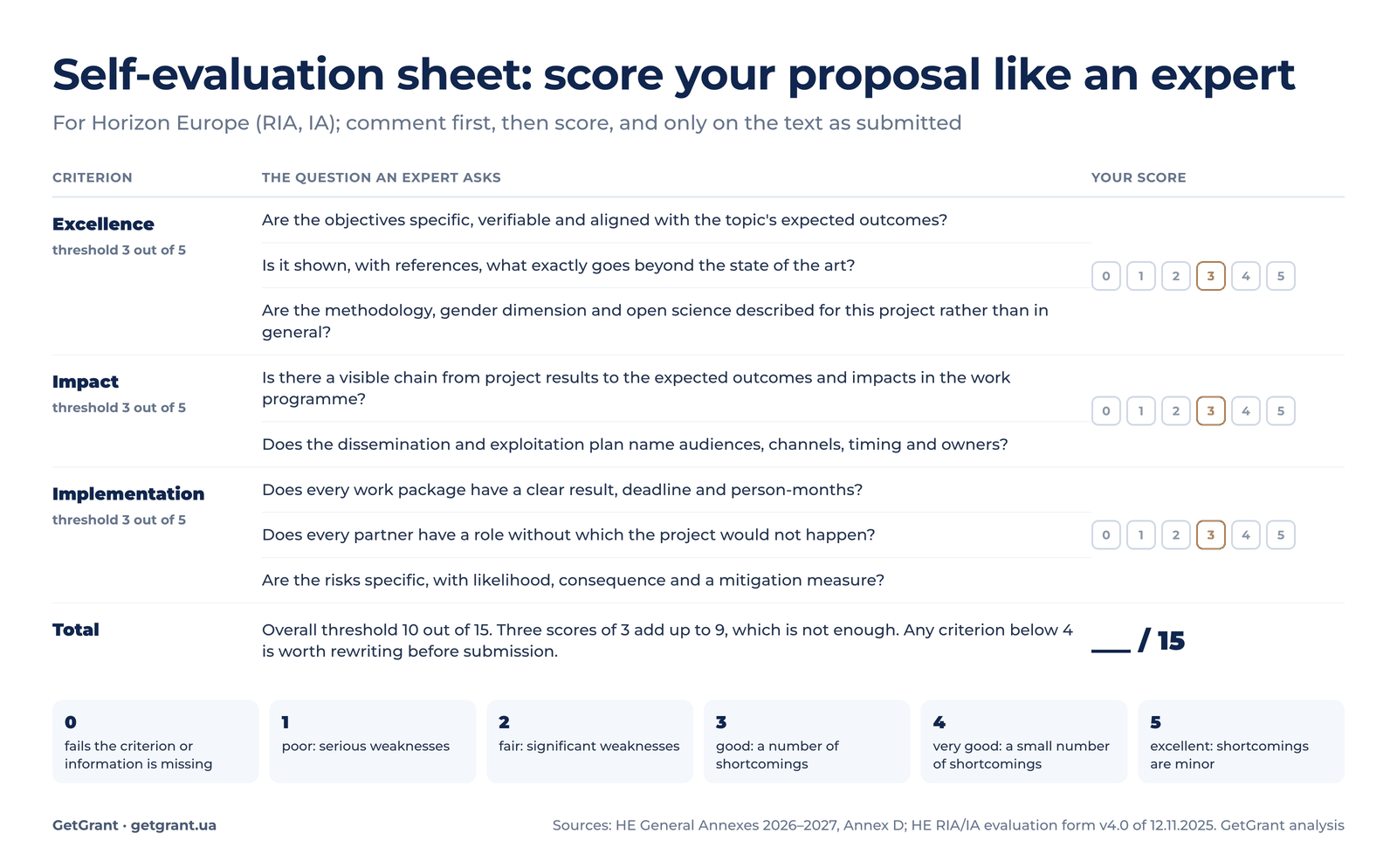
How to proceed:
- Give the proposal to a colleague who did not write the text, together with the topic text and the evaluation form. The author cannot judge what is missing from the page, because they know what they meant.
- Ask them to write a comment on each criterion first and only then give a score. The score should match the wording of the scale: “a number of shortcomings” means 3, “a small number of shortcomings” means 4.
- Assess only the submitted text. A phrase like “we will explain this at the interview” adds no points.
- Add up the total and check both thresholds. Any criterion below 4 is worth rewriting before submission.
- Check the formal requirements separately: template, page limit, mandatory annexes, the dissemination and exploitation plan, and whether the budget matches the work plan.
For Erasmus+, the UCF and the NRFU, substitute the criteria and maximum scores from the documents of the specific call, and for the budget see our separate guide to grant budgeting.
Conclusion
Evaluation in Horizon Europe, Erasmus+, the UCF and the NRFU is organised differently, but the logic is shared: the expert assesses only the submitted text against published criteria, and the ranking is decided by tenths of a point. With success rates of 10–14%, passing the threshold is merely the condition for entering the ranking. Most lost points can be recovered before submission if You read the proposal through the expert’s eyes, with the call text and the evaluation form beside it.
The GetGrant team helps researchers, universities, civil society organisations and businesses find suitable calls and prepare applications to Horizon Europe, Erasmus+ and Ukrainian funds. Current calls are collected in the GetGrant catalogue. A review of Your draft against the evaluation criteria or a consultation on Your application can be ordered on the services page.
Sources
- Horizon Europe Work Programme 2026–2027: 15. General Annexes
- EU Grants: Evaluation form (HE RIA and IA), V4.0, 12.11.2025
- Funding & Tenders Online Manual: Evaluation and evaluation results
- European Commission: Horizon Europe state of play. Key figures April 2021 – July 2026, 29.09.2026
- Erasmus+ Programme Guide 2026, version 1 of 12.11.2025
- Ukrainian Cultural Foundation: Expert Evaluation Methodology 2026, order No. 119 of 01.12.2025 (in Ukrainian)
- NRFU: conditions of the call “Advanced Fundamental Science in Ukraine 2027–2029” (in Ukrainian)
- Funding & Tenders: ERC Consolidator Grant 2027 (ERC-2027-COG)
- Funding & Tenders: ERA Chairs (HORIZON-WIDERA-2027-02-WIDENING-01)

Book a consultation or leave your application idea
Tell us in a few words about your project: we will say which grants it fits and can take the application itself off your hands. We reply within one business day.