
WoodStock Grants: up to €50,000 for SMEs, start-ups and non-profits from the EU and Horizon Europe associated countries for zero-waste timber construction, apply by 15 December
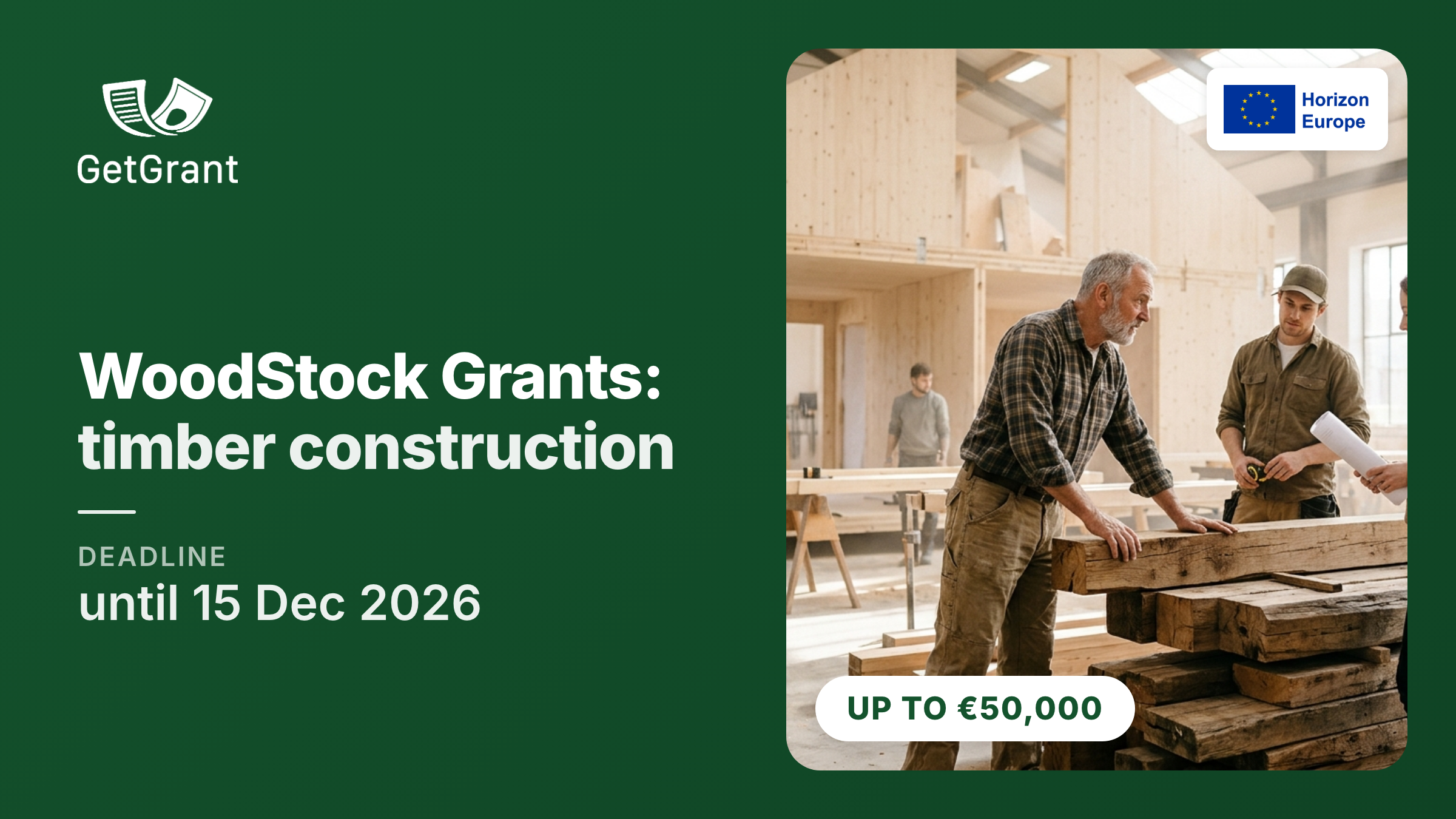
The WoodStock consortium, an initiative funded under the Horizon Europe programme and managed by Ghent University, has announced a competitive grant call to support climate-smart, zero-waste timber construction solutions. The programme aims to accelerate the adoption of underutilised wood resources and demonstrate sustainable, circular building practices across the European market.
A total of four projects will be selected, each eligible to receive up to €50,000 in direct financial support. The grant distribution follows a staged payment model, providing €30,000 immediately upon signing the grant agreement, with the remaining balance disbursed following the formal approval of the final project report.
The call is open to small and medium-sized enterprises, start-ups, non-profit organisations, and consortia led by these entities within eligible European and associated territories. Applications must be completed and submitted through the dedicated application platform by 15 December 2026 at 17:00 CET.
What is funded
The call provides financial support for one-year demonstration projects that advance climate-smart wood construction solutions beyond Technology Readiness Level (TRL) 5. Funded activities focus on testing, validating, and scaling zero-waste approaches in real-world operating environments while integrating circular design principles.
Eligible initiatives must concentrate on the practical application of underutilised timber resources. These sources include hardwoods, low-quality wood, damaged wood, post-consumer wood, and industrial residual wood. Projects are expected to embed the New European Bauhaus core values of sustainability, aesthetics, and inclusion into tangible construction solutions.
The selection committee intends to fund one project per specific underutilised wood source type. If a designated wood category lacks an application meeting the minimum score of 3 points across every evaluation criterion, the grant will be reallocated to the overall second-best proposal from another wood category.
Who can apply
Eligible applicants must be registered small or medium-sized enterprises (SMEs), start-ups, or non-profit organisations. Consortia are also eligible to participate, provided that the lead partner is an SME, a start-up, or a non-profit entity.
Applicants and consortium members must be legally established in an EU Member State or in a country associated with Horizon Europe (Pillar 2). Interdisciplinary collaboration is strongly encouraged, bringing together actors from architecture, engineering, design, forestry, manufacturing, and the green building sectors.
Geographic restrictions apply to final grant distribution to ensure broad territorial representation. A maximum of one grant will be awarded per EU Member State or Horizon Europe associated country, based exclusively on the country of origin of the lead applicant.
Conditions and requirements
Proposals must pass a two-step evaluation process, beginning with basic eligibility checks on geographic alignment and submission deadlines. Projects are required to demonstrate how they achieve at least ambition level I across all three New European Bauhaus dimensions using the NEB Compass framework.
Awardees must engage in co-creation activities involving local communities and industry stakeholders throughout the project lifecycle. Beneficiaries are also expected to contribute data and case studies to the WoodStock project, the WoodBook publication, and the European Wood Construction Observatory to support wider market adoption.
Practical tip. Review your raw material focus and lead applicant location strategically before submission. Because the evaluation assigns only one grant per underutilised wood category and caps awards at one per country, selecting an underexplored timber stream or leading from a less competitive jurisdiction can significantly improve your odds of selection.
How to apply
All applications must be prepared and submitted online through the Evalato portal, as proposals sent by email or through other channels will be rejected. New users must register on the platform to obtain an individual login link and PIN code, which can be used to edit draft submissions at any stage prior to the deadline.
Applicants must complete the standardised proposal form and provide supporting documentation, including the official budget spreadsheet in Excel format, relevant visual materials in PDF format, and letters of support in the case of consortia. Each file uploaded to the portal must not exceed a size limit of 20 MB.
Only one application per innovative solution may be entered into the competition. Once submitted, applicants will receive an automated confirmation email from the portal, which must be retained as evidence of compliance with the 15 December 2026 deadline.
Applications are submitted on the donor’s page: woodstockproject.eu.
| Parameter | Details |
|---|---|
| Donor | WoodStock consortium (Horizon Europe, managed by Ghent University) |
| Programme | WoodStock Grants (Cascade Funding) |
| Budget | Up to €50,000 per project (4 projects supported) |
| Deadline | 15 December 2026, 17:00 CET |
| Eligible applicants | SMEs, start-ups, non-profit organisations, or consortia led by them |
| Eligible geography | EU Member States and Horizon Europe associated countries (Pillar 2) |
| Type of support | Financial grant |
See which other calls fit your organisation
The GetGrant database lists EU programmes, bilateral donors and foundations by organisation profile, with verified deadlines.
Frequently asked questions
Short answers based on the facts of this call
