eRobota: a step-by-step guide to getting a business grant. Programme terms, the application process and practical tips for entrepreneurs.
Open right now
As of 18 November 2026, the GetGrant catalogue lists 54 open calls for businesses and SMEs, 17 of them with rolling applications.
Nearest deadlines
- EUDIS Business Accelerator Cohort 4: €120,000 non-dilutive funding for defence and dual-use start-ups, Ukrainian companies eligible, apply by 20 November 2026
- Ministry of Education and Science: call for applied research and development commissioned by business, with the state covering up to 65% of a university or research institution project, apply by 20 November
- Founder Labs Cohort 5: a £25,000 Invest NI grant with no equity or repayment for tech start-ups in Belfast, apply by 20 November 2026
- Horizon Europe Grants 2026: Open Calls
- Chernivtsi region reimburses businesses 30% of the cost of generators, batteries and solar panels: up to UAH 100,000 for companies and UAH 50,000 for sole proprietors, apply by 27 November
Programme status as of 17 November 2026. Since September 2026, microgrants and grants for veterans, young people and preschool education have been merged into a single procedure, “Vlasna Sprava 2.0”: up to UAH 500,000 to start a business and up to UAH 2.5 million to scale one, plus top-ups. The latest intake round in Diia ran until 27 October; the date of the next one has not yet been announced. Current terms for all strands: eRobota 2026: state grants for business, a full breakdown of Vlasna Sprava 2.0, and a short explainer in the wiki: what eRobota is. Below is a guide based on the terms of previous years; the amounts and strands it describes are out of date.
eRobota is a government programme of non-repayable grants launched in summer 2022 to stimulate entrepreneurship and job creation in Ukraine. The programme was announced by the Cabinet of Ministers of Ukraine on 1 July 2022, when applications for grants under six business support strands opened on the Diia portal. Its main goal is to give small and medium-sized businesses a financial boost so that Ukrainians can start their own business or expand an existing one, which in turn helps create new jobs and strengthens the country’s economic resilience. The grants are non-repayable (they do not have to be returned as long as the conditions are met), and the money the state spends is expected to flow back into the budget as taxes paid by newly created businesses and their employees. eRobota is a comprehensive programme: it brings together several grant strands for different sectors and categories of entrepreneurs, each of which we describe in detail below.
Overview of the eRobota grant strands
The state programme eRobota consists of six main business support grant strands. Each has its own specifics, target audience and funding conditions. Here is an overview of each grant:
Vlasna Sprava (Own Business) – microgrants for business
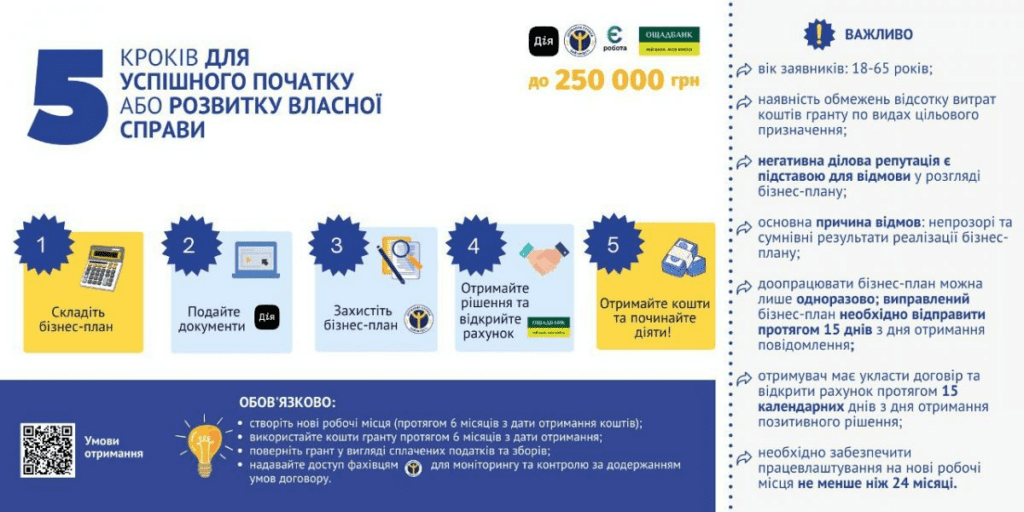
Vlasna Sprava is the most popular eRobota strand, providing microgrants from UAH 50,000 to UAH 250,000 to start or grow a small business. The grant is open both to individuals who plan to register as a sole proprietor (FOP) and to existing sole proprietors or small enterprises that meet the programme’s basic criteria. The money may be used to buy equipment or tools, purchase raw materials and supplies, partly cover premises rent (up to 25% of the grant), rent or lease equipment, pay for marketing and advertising services, and buy a franchise (commercial concession). The grant recipient must create at least 1 new job in the business and operate for at least 3 years. If the grant exceeds UAH 150,000, the requirement rises to 2 jobs.
Young entrepreneurs under 25 enjoy preferential terms: they can receive a grant of up to UAH 150,000 without having to hire staff – registering as a sole proprietor is enough. It is also worth noting that for businesses operating in frontline regions (Donetsk, Kharkiv, Kherson, Mykolaiv, Zaporizhzhia, Sumy, Dnipropetrovsk and Chernihiv oblasts), the maximum microgrant was raised to UAH 500,000. In that case, for a grant of up to UAH 300,000 it is enough to create 1 job, and for a grant of more than UAH 300,000 and up to UAH 500,000 – 2 jobs. This programme gives a wide range of Ukrainians the chance to obtain start-up capital for their own business – from opening a coffee shop or a hair salon to expanding a small manufacturing or service business.
Grants for veterans and their spouses
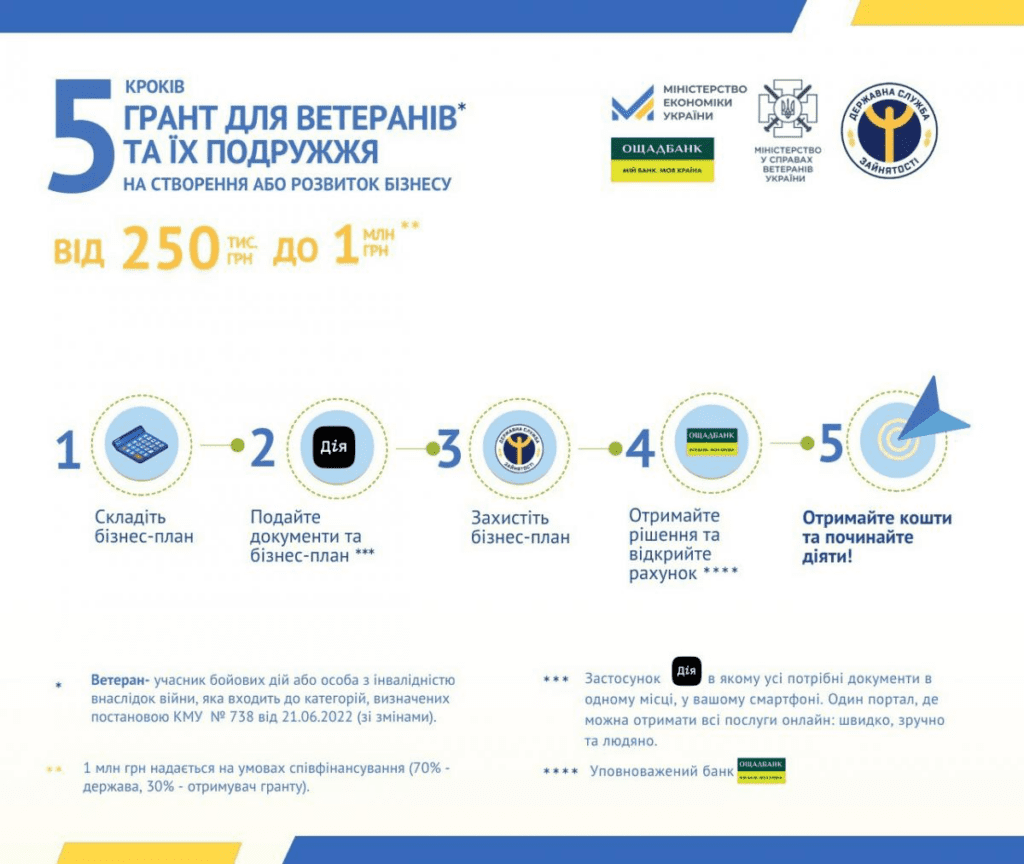
Grants for veterans and members of their families (also known as grants for veterans and their spouses) were introduced in 2023 as a separate component of eRobota aimed at war veterans, people with war-related disabilities and their husbands or wives. The aim of this eRobota strand is to help veterans start their own business or grow an existing one and to support their economic reintegration. The maximum grant is up to UAH 1,000,000, and the amount depends on the entrepreneur’s experience and plans: up to UAH 250,000 (with 1 job to be created), up to UAH 500,000 (2 jobs) or up to UAH 1,000,000 (4 jobs). Importantly, a grant of more than UAH 500,000 or UAH 1 million is available only to veterans with business experience: for the maximum amount, the applicant must have been registered as a sole proprietor for at least 1 year and must finance at least 30% of the project cost from their own funds.
The permitted uses of funds under this eRobota strand differ somewhat from the Vlasna Sprava microgrants: you may buy equipment, furniture and even vehicles for commercial use (up to 100% of the grant), licensed software (up to 50% of the grant), raw materials and supplies, as well as livestock or seedlings for farming (up to 50% of the grant). Marketing costs (up to 10%) and premises rent (up to 25%) are also allowed. A veteran grant recipient must register a business (if they have not done so yet), hire the required number of employees and operate for at least 3 years. A special feature: the new jobs must be created within 6 months of receiving the funds, with employment contracts signed for at least 2 years. This grant is funded from the unemployment social insurance fund and donor money, and is administered by the State Employment Service together with the Ministry of Economy.
The programme is already in high demand among veterans, as it gives them a chance to start their own business after service with substantial financial support from the state.
Svii Sad (Own Orchard) – grants for orchards
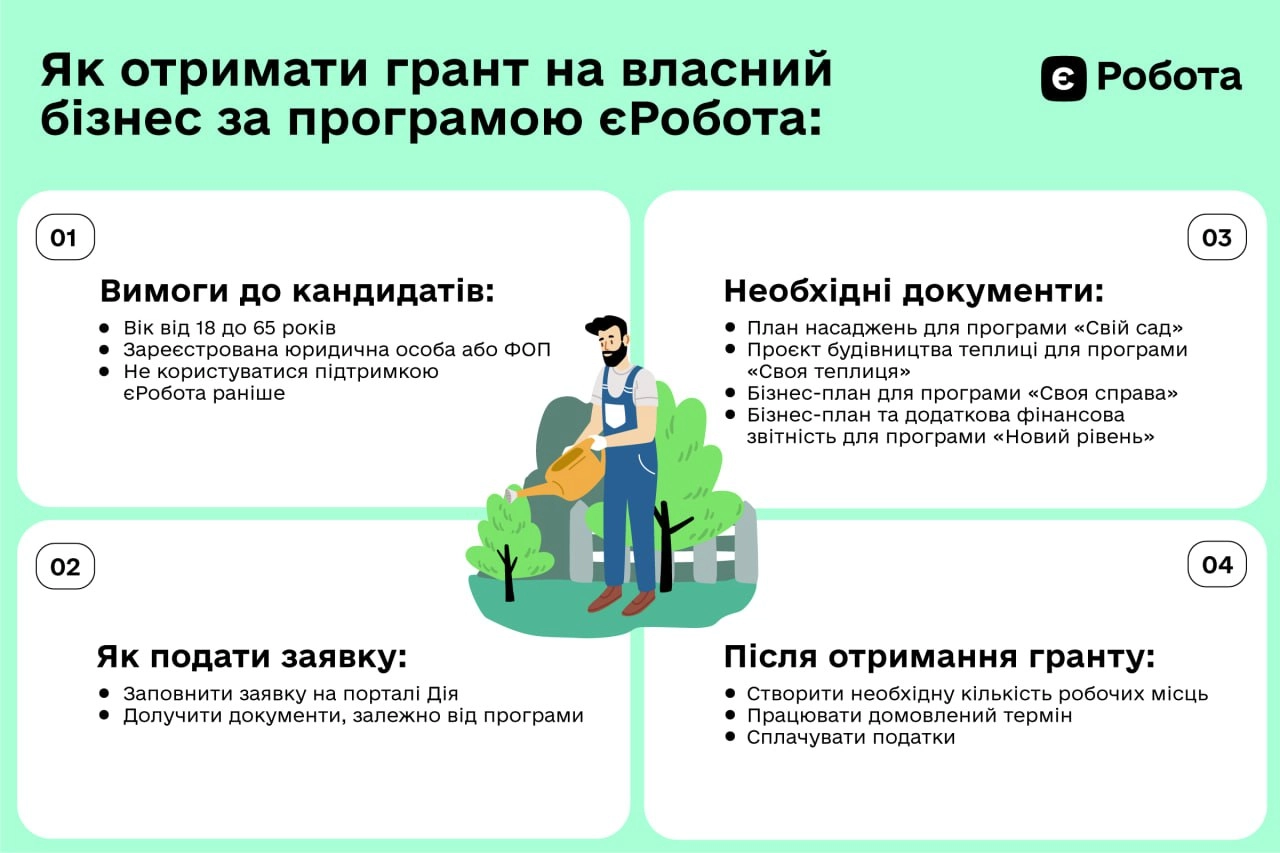
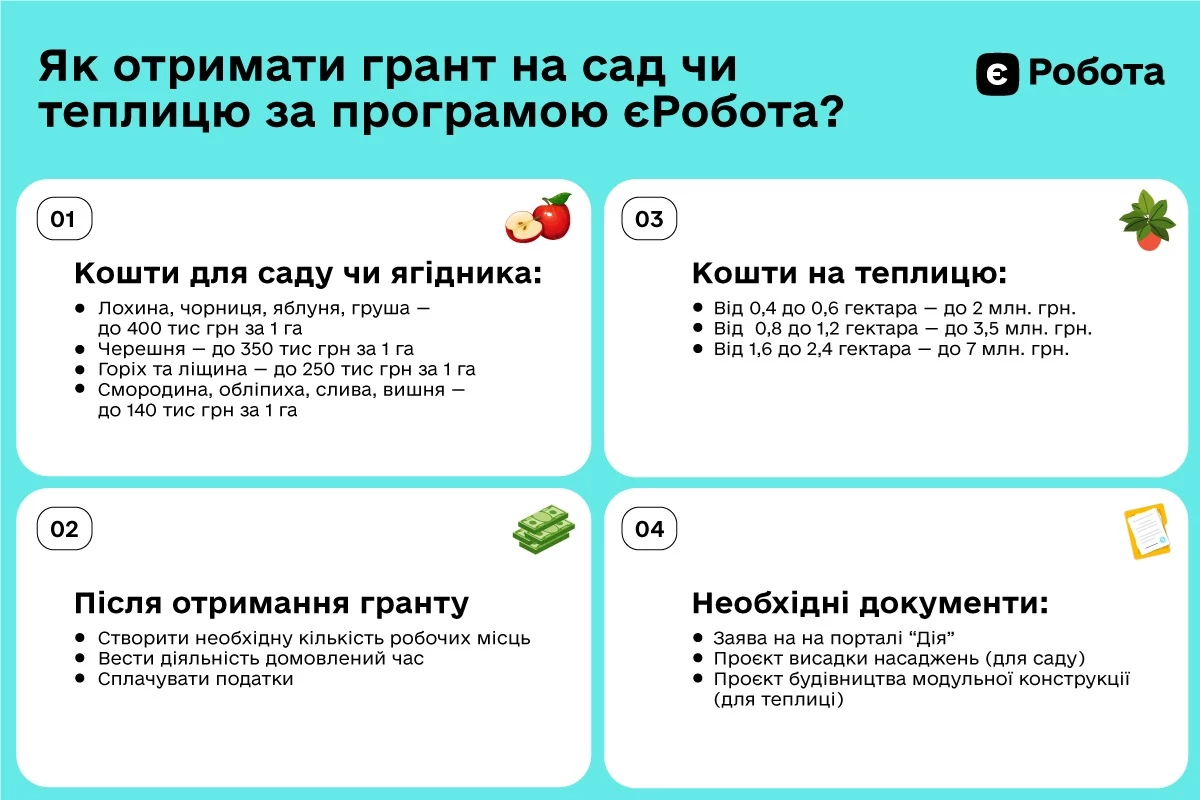
The eRobota strand Own Orchard supports the development of fruit growing, berry farming and viticulture. The grant is provided for planting and setting up a new orchard, berry plantation or vineyard covering 1 to 25 hectares. The state finances up to 50% of the project cost (in combat zones – about 80%) of establishing perennial plantings, but no more than UAH 400,000 per hectare of plantings. This means the maximum grant can reach UAH 10 million (if the plot is 25 ha and the project cost allows). The recipient may be an existing sole proprietor or a legal entity that does not operate in occupied or dangerous territories and meets the other general requirements (no sanctions, no debts, etc.). It is important to own or hold a long-term lease of agricultural land – for at least 7 years at the time of application. Funds under the eRobota “Own Orchard” grant are paid directly to the suppliers of materials and equipment listed in the cost estimate – they can cover seedlings, irrigation systems, specialised machinery, orchard equipment and so on.
Mandatory conditions: the grant money must be used to plant the orchard and install an irrigation system, after which the recipient must run the plantation as a business for at least 5 years. The grant recipient must also create a certain number of new jobs at the farm. Depending on the crop and planted area, the typical requirements are about 6–15 permanent employees and up to 125–425 seasonal workers (for the harvest period) for the project as a whole. In this way, the state supports fruit growing – a sector that requires large upfront investment and has a long payback cycle – and encourages the creation of new agricultural businesses and jobs in rural areas.
Svoia Teplytsia (Own Greenhouse) – grants for greenhouse farming
Own Greenhouse is the eRobota grant strand for building and developing modular greenhouses. It is designed for farmers who plan to build a modern greenhouse complex of 0.4 ha to 2.4 ha. The grant amount is fixed according to the area: UAH 2 million for greenhouses of 0.4–0.6 ha, UAH 3.5 million for 0.8–1.2 ha and UAH 7 million for the largest modules of 1.6–2.4 ha. Co-financing is a condition: the state covers up to 50% of the cost of a standard greenhouse project (in combat zones – about 80%), and the investor must contribute the rest. The eRobota grant can be spent on any costs related to building the greenhouse complex in line with the cost estimate – buying equipment (heating, irrigation, lighting systems, etc.), seeds and planting material, and paying contractors for construction and commissioning of the greenhouse.
Who can receive the eRobota “Own Greenhouse” grant: a sole proprietor or small enterprise that meets the general requirements (not in a combat zone, no debts, etc.) and owns or holds the right to use agricultural land (also for at least 7 years, as with orchards).
Project implementation period – up to 1 year: the modular greenhouse must be built within 12 months of receiving the grant. Once the business is up and running, the grant recipient must operate for at least 3 years and create new jobs. The typical requirements for greenhouse farming are specific: you must employ at least 4 permanent and 10 seasonal workers for every hectare of greenhouse area. So for a project of the maximum area of ~2 ha, around 8 permanent staff and 20 seasonal workers are expected. Failure to meet these conditions (for example, late construction or too few employees) means the grant funds must be returned.
The eRobota “Own Greenhouse” grant aims to stimulate growing vegetables and greens in modern greenhouses, which is especially relevant given the need for food security and import substitution. In 2023–2024 the programme was temporarily suspended because of war-related risks, but from 2025 applications from farmers have reopened with updated conditions and simplified project requirements.
Novyi Riven (New Level) – grants for processing
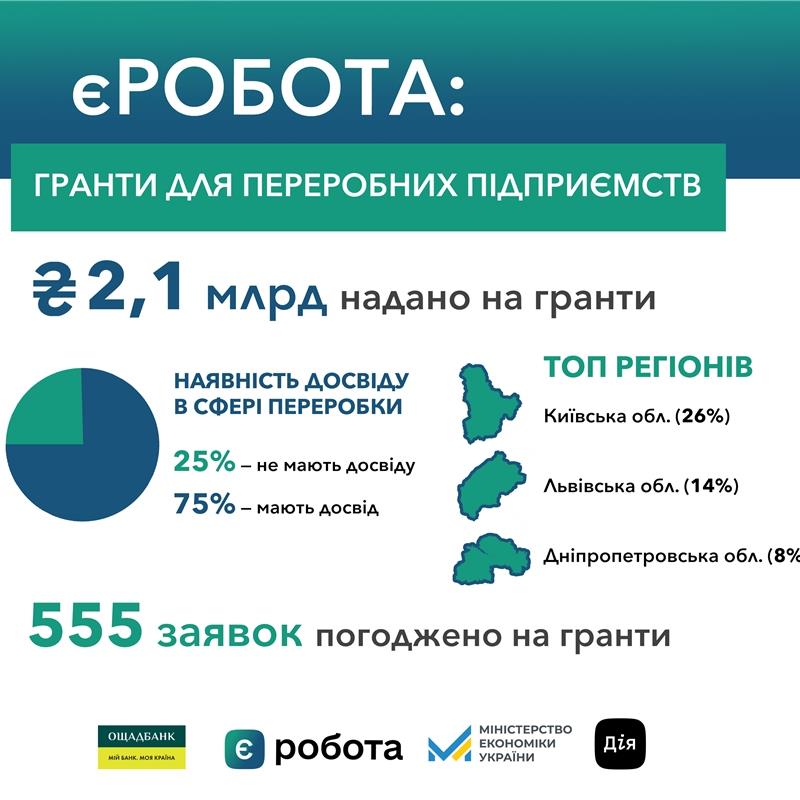
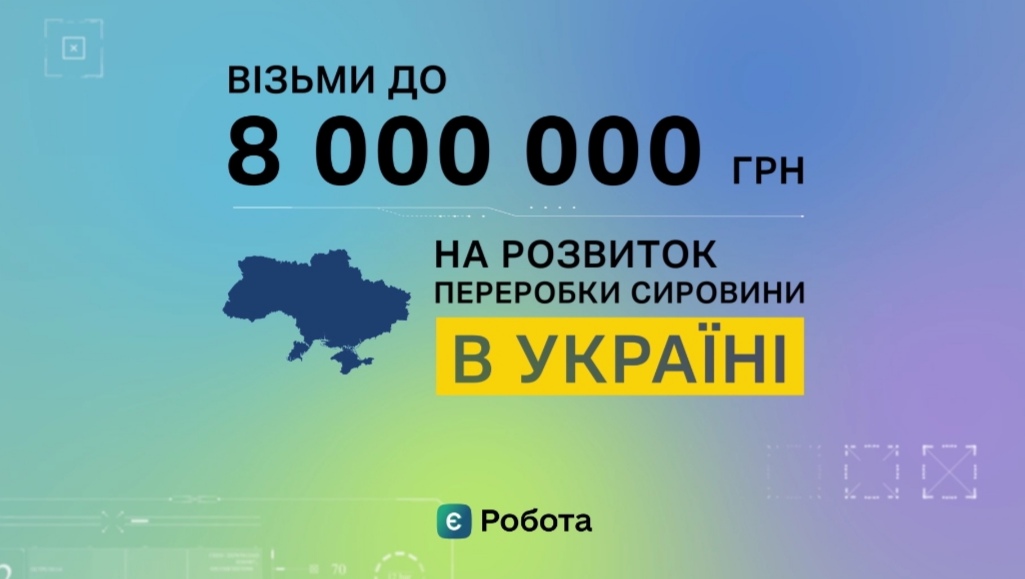
The New Level grant programme supports the creation or expansion of manufacturing (processing) enterprises. These are businesses that process raw materials into finished products – from food factories and furniture workshops to garment, woodworking, metallurgical and other plants. The maximum state support is up to UAH 8 million per project. The grant is mostly provided for purchasing production equipment: machine tools, production lines and machinery, as well as for delivering, installing and commissioning that equipment. Part of the funds may also go towards working capital (buying raw materials) – but only for enterprises in certain categories (for example, in mechanical engineering with NACE (KVED) code 30.30, in line with the terms).
Requirements for grant recipients: they must be entrepreneurs or companies that meet the general integrity criteria (not bankrupt, no tax debts, not under sanctions, etc.).
Priority is given to projects that can raise the technological level of production and increase exports of processed products.
A mandatory condition for receiving the grant is creating at least 5 new jobs, regardless of the amount requested. The employer must also pay decent wages: the single social contribution (ESV) paid for the new employees must amount to at least 20% of the grant per year. In practice, this means the grant recipient has to invest their own money in wages and operations on a par with the state. The grant is awarded on condition that the entrepreneur undertakes to carry out production activities for at least 3 years and pay all taxes; if these obligations are breached, the money will have to be returned.
The New Level programme is designed to stimulate the processing industries, since the share of processing in Ukraine’s economy has traditionally been low. The grants awarded are already being used to launch workshops producing furniture, building materials, garments and more. The state expects that supporting processing enterprises will increase the share of value-added products, including for export.
IT grants (startups and training)
A separate eRobota strand is IT grants, which include two sub-programmes: “IT Startups” (funding for technology business projects) and “Start in IT” (grants for training in IT professions). At present these instruments are in the final stage of development and have only been launched in test mode.
IT Startups is a grant to support Ukrainian technology startups at different stages of development. Funding ranges from UAH 750,000 for the earliest-stage startups to UAH 3.5 million for mature projects that need to scale. The money can go on costs typical of an IT business: team salaries, expert services (for example, mentors or lawyers), necessary equipment, research and development, and product marketing and promotion. The aim of this programme is to encourage the emergence of new IT companies, increase exports of high-tech services and products, and create new jobs in Ukraine’s digital economy. Depending on the amount and stage of the project, an IT grant recipient is expected to commit to creating at least 3–5 jobs in their startup at the outset. At the time of writing, the IT Startups programme had not yet been fully launched, but the government says it is ready to invest in promising Ukrainian startups even in wartime. Pilot competitions for IT projects may be announced soon, and while entrepreneurs prepare for them, the startup fund and the relevant agencies are working out the selection criteria.
Start in IT provides grants for training in IT professions. This programme is aimed at people who have no formal education or experience in IT but want to gain a new profession in the field. The state plans to fund training at certified IT schools or courses in programming, testing, web design and other areas most in demand on the labour market. In effect, the grant will cover the cost of the relevant training programmes (fully or partly) so that people who have lost their jobs or were forced to relocate because of the war can retrain as IT specialists. Priority will be given to unemployed applicants or those on furlough or unpaid leave. The Start in IT programme is also awaiting launch; detailed terms (the maximum amount per learner, the list of training providers, the course payment mechanism, etc.) will be published on the Diia portal once approved. It is known that this grant will be awarded to individuals (not businesses), so the selection procedure may include professional testing or an interview to assess the candidate’s motivation. Successfully completing the training and obtaining a certificate is mandatory – otherwise the money will have to be refunded to the state. Start in IT is an investment in human capital aimed at reducing unemployment and meeting the demand for IT specialists.
Comparison of eRobota grant programme terms
For convenience, here are the main terms of the six grant strands in table form:
Table 1. General terms of the grant programmes (microgrants, veteran, processing and IT startup grants)
| Programme | Maximum grant | Co-financing requirements | Mandatory jobs | Minimum operating period | Eligible uses of funds |
|---|---|---|---|---|---|
| Vlasna Sprava (microgrant) | UAH 250,000 (UAH 500,000 for frontline regions) | Not required (0% own contribution). | 1–2 new jobs (1 for a grant ≤UAH 150,000, 2 for >UAH 150,000, 0 jobs for young people aged ≤25 with a grant of up to UAH 150,000) | ≥ 3 years | Equipment, tools, raw materials; premises rent (≤25%); marketing; franchise; equipment rental (≤30%) |
| Grant for veterans and members of their families | UAH 1,000,000 (1 million) | 30% own funds for grants >UAH 500,000 | 1 new job (grant ≤UAH 250,000) 2 jobs (≤UAH 500,000) 4 jobs (≤UAH 1 million) | ≥ 3 years (5–7 years recommended) | Equipment, furniture, vehicles (up to 100%); software (≤50%); raw materials, supplies, livestock, seedlings (≤50%); marketing (≤10%); premises rent (≤25%); equipment rental (≤10%); franchise (≤100%) |
| New Level (processing industry) | UAH 8,000,000 (8 million) | Own contribution not fixed, but the payroll must generate ESV payments of ≥20% of the grant amount | ≥ 5 new employees (regardless of the grant amount) | ≥ 3 years | Purchase of production equipment and machine tools; installation and start-up of equipment; delivery of machinery; working capital (raw materials) – partly, under certain conditions |
| IT Startup | UAH 3,500,000 (3.5 million) | Details pending (co-financing possible at later startup stages). | 3 to 5 new jobs (depending on the amount requested and the project’s stage of development) | expected ≥ 3 years of company operation | Team salaries; consulting services (mentors); equipment; R&D (product development); marketing and market entry |
Notes: The Start in IT programme is not included in the table, as it provides grants to individuals for training rather than funding business projects – its terms differ substantially.
Table 2. Specialised agricultural grants (Own Orchard and Own Greenhouse)
| Parameter | Own Orchard (fruit growing) | Own Greenhouse (modular greenhouse) |
|---|---|---|
| Purpose | Planting a new orchard/berry plantation/vineyard of 1–25 ha (perennial crops) | Building a greenhouse complex of 0.4–2.4 ha for growing vegetables, greens, etc. |
| Maximum grant | Up to UAH 400,000 per 1 ha of plantings (but no more than 50% of the project cost). E.g. for 10 ha – up to UAH 4 million | UAH 2 million (for a 0.4–0.6 ha greenhouse) UAH 3.5 million (0.8–1.2 ha) UAH 7 million (1.6–2.4 ha), but no more than 50% of the project cost |
| Co-financing requirements | At least 50% own funds (the state provides ≤50%; in combat zones – about 80/20). | At least 50% own funds (the state provides ≤50%; in combat zones – about 80/20). |
| Project implementation period | Plant the orchard in season and install the irrigation system as planned; fruiting begins in 2–4 years. | Build the greenhouse within 12 months of receiving the grant |
| Mandatory jobs | 6–10 permanent employees + 125–425 seasonal workers (for the harvest period), depending on the crop and planted area | 4 permanent and 10 seasonal workers per 1 ha of greenhouse. For example, for 2 ha – 8 permanent + 20 seasonal. |
| Minimum operating period | At least 5 years after planting the orchard (the payback period for fruit growing) | At least 3 years after the greenhouse is launched |
| Eligible uses of funds | Planting material (seedlings), drip irrigation systems, orchard machinery, fertilisers, structures (trellises), storage/cooling equipment, etc. Payments to suppliers according to the cost estimate. | Turnkey design and construction of the greenhouse – building materials, structures, technological equipment (heating, irrigation, lighting systems), seeds and seedlings, commissioning of the facility. Payments go through contractors/suppliers according to the cost estimate. |
Note: In both programmes, the grant recipient must own or lease the (agricultural) land for ≥7 years, which guarantees the implementation of long-term agricultural projects
Applying through the Diia portal
To receive any eRobota grant, the applicant has to go through an established procedure that is largely the same for all strands. Applications are submitted online via the Diia portal – the only intake channel, whatever the type of grant. The applicant logs in to the portal, fills in the electronic application form and attaches the required documents, the main one being a business plan in the prescribed format. The application then goes through several stages of assessment: a check of the applicant’s business reputation by the authorised bank (Oschadbank), an assessment of the business plan against set criteria, and an interview with the candidate conducted by the regional employment centre. The State Employment Centre decides whether to award the grant based on all three components within ~15–20 working days after the application deadline (timeframes may vary by programme). Let us look in detail at the requirements and key aspects of each stage of the application.
Business plan requirements
The business plan is the main document, and the success of an eRobota application depends on its quality. The applicant prepares it using the form approved by the Ministry of Economy, which can be downloaded from the Diia portal (each strand has its own template). The business plan normally has two parts – a descriptive part and a financial part. The descriptive part should explain the business idea and how it will be implemented, namely:
- a description of the business and the business idea (what you plan to do, what your product/service is, what makes it unique);
- market and competition analysis (target audience, its needs and purchasing power; competitors on the market, their strengths and weaknesses);
- a marketing and sales plan (which channels you will sell through, how you intend to promote the product, planned sales volumes);
- an operational plan (resources needed, suppliers, production or service delivery process, business location, etc.);
- an organisational plan (how many employees and which positions are needed, whether the team has relevant experience, what roles the entrepreneur will play in the business);
- a financial plan (calculation of costs and revenues, the investment required, cash flow forecast, break-even point, etc.).
The financial part of the business plan contains a detailed project cost estimate and a forecast of financial indicators for several years ahead. It is in the cost estimate that you must set out what the grant money – and, where there is co-financing, the applicant’s own funds – will be spent on. It is important not to leave budget lines empty: employment centre experts note that having no planned spending at all under a given line can make the essence of the project unclear and hurt the score. In other words, the business plan must be proportionally balanced (for example, if the plan includes employees, their salaries and taxes must be accounted for; if production is to be scaled up, the corresponding marketing costs must be planned, and so on).
When writing the business plan, applicants are advised to set clear and achievable goals, ideally in SMART format (specific, measurable, achievable, relevant and time-bound). Examples of SMART goals: “Within 6 months of receiving the grant, open production and reach sales of 100 units of product per month”; “Within a year, increase the number of regular customers by at least 30% through active social media marketing”. Goals like these show the grantmaker that the entrepreneur has a concrete development plan and clear success criteria.
The style of the business plan should be businesslike but understandable to a broad audience – avoid bureaucratic jargon and overly general phrases. It is better to be specific: figures, facts, examples. For instance, instead of “I plan to advertise actively” write “I will launch Facebook and Google ads with a budget of UAH 15,000, which should bring in about 1,000 leads within 3 months”. Before submitting, be sure to reread your business plan through an investor’s eyes or give it to someone outside – is it clear what exactly you want to do and how you will make money? Remember that the business plan is an annex to the application in Diia and must be consistent with the answers in the application itself. Formally it is submitted as a PDF, so make sure the document displays correctly and is easy to read.
Eligibility criteria (who can get a grant)
Each programme has clearly defined eligibility criteria – requirements that the applicant and their business must meet. Most of these requirements are common to all eRobota grants:
– Registration and place of business in Ukraine. The applicant (or enterprise) must be registered in Ukraine. The business must operate on territory controlled by Ukraine, preferably not in an active combat zone. Participants who operate in temporarily occupied territories or cannot implement the project because of war-related risks are not eligible.
– No business in the Russian or Belarusian market. One of the criteria is having no operations in the aggressor states. The entrepreneur must not have an active business in Russia or Belarus; otherwise the eRobota grant will be refused.
– No sanctions, criminal records or bankruptcies. Applicants who are under sanctions or have been convicted of corruption offences are not eligible. An application will likewise be refused if bankruptcy proceedings have been opened against the company or it has been declared bankrupt. Business partners with a dubious reputation can also negatively affect the decision (the bank checks all beneficial owners).
– No tax debt. The enterprise or sole proprietor must have no arrears to the budget in taxes, levies, ESV and so on. A clean tax record is a mandatory condition.
– Unsupported types of activity. Applications are not considered from businesses that produce or sell weapons, alcohol or tobacco, or from financial institutions (banks, pawnshops, insurers, investment funds, etc.). In addition, eRobota grants are not given for currency exchange or other questionable operations. In other words, the project must belong to the legal SME (small or medium-sized enterprise) sector.
– Limits on support. One applicant can receive only one grant under Procedure No. 738. So if you have already won an eRobota grant before, a repeat application from you will not be considered. Nor can you apply to several strands at once – you will have to choose one.
Some strands have additional criteria: for example, only combatants, people with war-related disabilities or their spouses can apply for the veteran grant (supporting documents are required). For orchard or greenhouse grants, proof of land rights is required (a state title deed or a lease agreement for 7+ years). IT startups may need a product presentation or at least a prototype. All these requirements are set out in the procedures for awarding the respective grants (Cabinet of Ministers resolutions) and are checked at the application stage. A typical mistake is when applicants ignore the eligibility criteria. For example, they submit a business plan for a winery (which falls under the alcohol exclusion), or a person without veteran status tries to obtain a veteran grant – such applications are subsequently rejected automatically. So before applying, check carefully that you meet all the programme’s conditions.
Common applicant mistakes and reasons for rejection
Even a candidate who meets the formal criteria can be refused if the application is poorly prepared or if negative factors come to light during the assessment. Let us look at the most common reasons for rejection that experts point to:
– A superficial business plan. As already mentioned, an incomplete or poorly worked-out business plan is the applicant’s enemy. Entrepreneurs often fail to work through the financial section: they do not calculate costs properly, do not show the cost structure and do not plan for taxes. For example, one frequent reason for rejection is that the applicant did not include salaries and taxes for hired employees in the budget. The commission sees this as a sign of weak planning or an attempt to hide costs, which costs points. Another typical mistake is having no “other expenses”. If the cost estimate shows round figures for the main lines and zero reserve for unforeseen costs, experts become wary. Recommendation: include all possible costs, even small ones, to show that the plan is realistic.
– Not understanding your obligations. The assessment may reveal that the applicant does not understand the programme’s conditions – for example, does not know exactly how many employees they must officially hire and what taxes to pay for them. If at the interview the entrepreneur gets confused about basic requirements (say, “I don’t plan to hire anyone in the first year”, even though under the grant terms they must create jobs within 6 months), the chances of approval drop sharply. So study the programme rules thoroughly and plan clearly how you will meet all the conditions.
– An unsuitable or questionable business idea. The commission may deem a business plan risky if the expected results look unrealistic or non-transparent. Resolution No. 738 allows a refusal if the results look “non-transparent or questionable”. This is a subjective criterion, but what it means in practice is overly optimistic forecasts without justification, an unclear business model, and no information on where customers and revenue will come from. For example, a plan to “pay back in 3 months and reach UAH 1 million in profit in the first year” will raise questions. The commission is likely to rate a cautious, realistic forecast with gradual growth more highly.
– A negative business reputation. The results of the bank check can undo even a good business plan. The authorised bank analyses the applicant’s credit history, tax discipline, possible court cases and so on against a number of criteria and assigns a score. If the reputation score is ≤98 out of 100, the application is automatically rejected under the programme terms. So check in advance that you have no outstanding loans, tax debt or other “skeletons in the closet”. Additional open data is also taken into account – for example, if public information shows that the applicant provided false information or concealed a conflict of interest, the grant will not be awarded either.
– Haste and carelessness when applying. Applications are often refused because of the applicant’s technical errors: an electronic application filled in incorrectly or incompletely, form fields not matching the business plan, the wrong file attached, and so on. The Diia system is largely automated, but some information (such as the revenue forecast) has to be entered manually and must match the business plan. Any discrepancies are grounds for refusal. Another case is ignoring requests for corrections. Sometimes the employment centre likes a project but finds it “raw” – the commission may then give time to revise the business plan (15 days). If the applicant does not submit the revised plan on time, the application is rejected. That is why it is very important to check your Diia account regularly after applying for notifications that revisions are needed or that an interview has been scheduled.
In addition to the above, missing the interview without good reason guarantees a refusal. If you have been scheduled for an online interview and you twice fail to show up or do not agree on a time within 2 days, the employment centre will close your application as one that has declined the interview. This requirement is spelled out explicitly in the programmes – follow notifications carefully so as not to miss your chance.
The interview and project pitch
The interview is the final stage of the assessment, open to applicants who have passed the preliminary selection (the bank check and a business plan assessment with a sufficient score). It is conducted by a commission of the regional employment centre, often by video conference. Its purpose is to meet the entrepreneur in person, clarify any questionable points in the business plan and assess the applicant’s presentation skills and motivation. In effect, the interview is a pitch of your project to an “investor” (the state), so it needs to be taken seriously.
The interview is usually short – 15–20 minutes. During this time the applicant is asked to briefly present their business project and answer the commission’s questions.
How to prepare for the interview? Experts advise working on your oral presentation in advance: prepare a concise summary of the business idea (a so-called elevator pitch of 2–3 minutes) and rehearse it. You can hold a mock interview with friends or colleagues to practise answering questions. If the interview is online, be sure to prepare your workspace and equipment: check your internet connection, camera and microphone to avoid technical glitches.
At the very beginning, introduce yourself, briefly describe your experience and move on to the business idea: what it is, what need exists in the market and how your product/service will meet that need. Highlight the project’s strengths, for example: “I already have 5 years of experience in this field and know the production technology well”, or “there is no similar bakery in our town, so competition is minimal and there is demand”. The commission will definitely test your understanding of the finances: they may ask how much revenue do you expect in the first year? what is the expected profitability? – be ready to give the figures you stated in the plan.
A frequent question concerns risks and a plan B: what will you do if you fail to reach your planned sales? Here it is important to show that you have thought about this and have fallback options (for example, cutting costs, adding new services, looking for investment, etc.). Commission members also often ask whom exactly will you hire for the new jobs? – especially for veteran grants. Answer specifically: which specialists you plan to hire and whether they are available on the market (for example, “I will hire two seamstresses; our employment centre has unemployed people with exactly that experience”).
Remember that the interview is scored (a maximum of 50 points) and can be decisive for getting the grant. So show as much confidence, competence and enthusiasm for your project as you can. Speak clearly, stay on track and answer questions to the point. If you don’t know something, it is better to say honestly “I don’t know yet, I will look into it” than to make something up on the spot. The commission values honesty and knowledge of the subject. Interview points are awarded against various criteria (substance of the answers, justification, command of the information, realism, etc.). To get a high score, the applicant needs to prepare thoroughly and present their business plan well. If you pass the interview and your total score (reputation + business plan + interview) exceeds the threshold (usually 130 points out of a possible 230), you can expect a positive answer.
What to do if you are refused
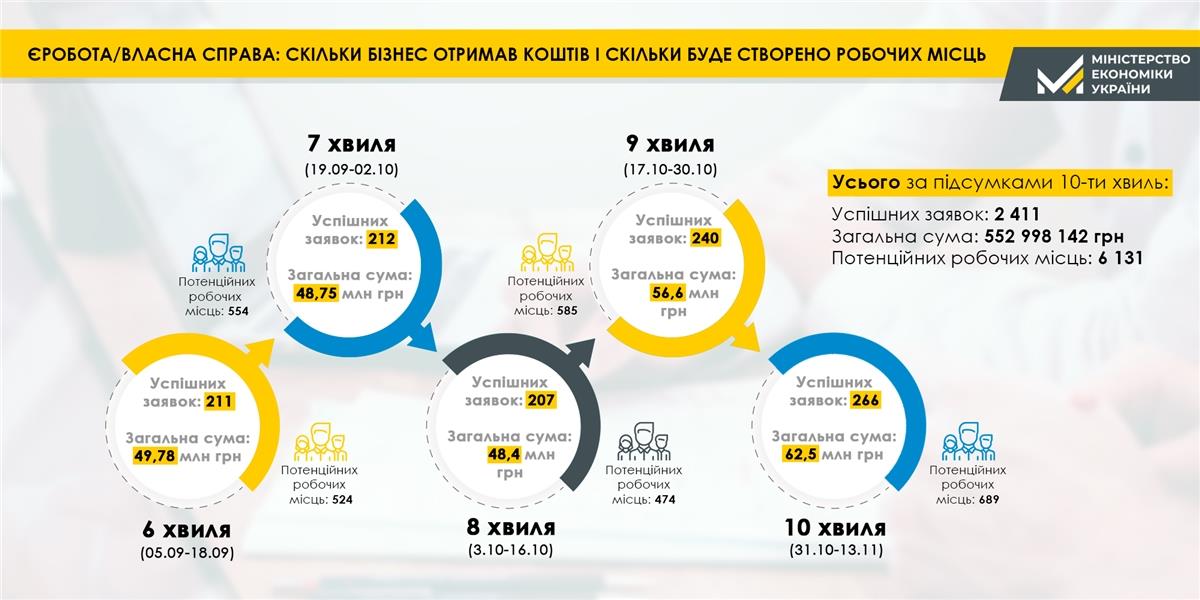
Not everyone manages to get a grant on the first attempt. As of autumn 2022, only about 1,400 of the 13,000 applications submitted were successful, so the competition and the screening are quite tough. If you receive a refusal, that is no reason to give up. Here is what to do:
Analyse the reasons for the refusal. You will receive a refusal notice in your Diia account that states the grounds on which the grant was not awarded. Read them carefully. These may be formal reasons (not meeting the criteria, a low bank score, an insufficient total score) or comments on the substance of the business plan. In the latter case, applicants are often offered the chance to revise the business plan within 15 days and resubmit. If you get that offer, be sure to take it. If not, still identify the weak points. You can ask the employment centre for clarification or analyse the application yourself: was your business plan convincing? Perhaps the problem was your reputation (for example, you had an ESV debt – in which case pay it off before reapplying). We have described the most common reasons above – compare them with your application. Once you have identified the mistakes, you can correct them. As a training manual puts it, eliminating the reasons for refusal is the key to success next time.
Apply again. The rules do not prohibit applying again to the same programme if the first attempt failed (the exception is if you have already received a grant – you will not get a second one). Each programme has its own frequency of selection rounds: microgrant rounds are held almost monthly, orchard/greenhouse grants usually once a quarter or when budget funds are available, and veteran grants also in rounds. In 2023–2024 there were sometimes pauses in accepting applications because funds ran out, but for 2025 the programme was extended with new funding. So keep an eye on announcements of upcoming rounds (information is published on the websites of the Ministry of Economy and the State Employment Centre, as well as on social media). Prepare an updated business plan, take all the previous comments into account and apply again through Diia. Many entrepreneurs won a grant on their second or third attempt – for example, by the end of 2022 there had already been 10 microgrant rounds, and some who did not get through in the 1st won in the 5th or 6th round. Participation in the programme is not limited to a single attempt – work on your mistakes and try again.
Alternative options. If for some reason your project still does not get through the state programme, don’t be discouraged – there are other sources of funding. In 2023–2025 there are numerous grant competitions from international organisations (USAID, the EBRD, grants for veterans from IREX, etc.). Some are simpler than eRobota, others more complex, but the experience of preparing a business plan and pitching gained in the state programme will be useful when approaching any donor. You can also consider the state preferential lending programme “5-7-9%” as an alternative or a complement to a grant – with a good business plan, a bank may issue a low-interest loan to start a business. The main thing is not to give up after the first failure. The state is interested in funding as many viable projects as possible, so keep improving and apply again.
Grant recipient obligations
Once the grant is approved, the entrepreneur signs a grant agreement with the State Employment Centre (this takes place at an Oschadbank branch). The money is then transferred to the grant recipient’s special bank account – usually as a targeted tranche or directly to suppliers (for agricultural programmes). From that moment on, the grant recipient must strictly comply with the programme conditions; otherwise the financial support will have to be returned. Here are the main obligations an eRobota grant recipient takes on:
Creating jobs. This is the key requirement: the number of new jobs is set by the terms of the specific grant. They must be created within 6 months of receiving the funds. Employees must be officially hired full-time and kept on for at least the specified period (2 years for most programmes). If the enterprise does not create the required jobs within the deadlines, it becomes liable to return the full grant amount in proportion to the jobs not created, or, as the committee decides, the difference between the grant amount and the taxes/ESV actually paid for the employees. In this way, the state protects itself against situations where a grant is taken but people are not hired or are quickly let go. If this does not happen (for example, if people are dismissed early), part of the money will have to be returned.
Using funds for their intended purpose. The grant must be spent only on its intended purpose in line with the business plan. It may not be spent on other purposes, even once the project has been funded. For example, if you bought equipment but now want to buy a different asset instead, or shift money from advertising to renovation, this has to be agreed with the committee. Importantly, you cannot change expenditure unilaterally: say you change your mind about buying one piece of equipment and want to replace it with another or redirect the money to other purposes – without written approval this will be treated as a violation. Only after receiving written approval can you adjust the cost estimate. Without approval, misuse of funds may be considered and classified as a violation (up to criminal liability, since these are public funds).
Operating for the specified period. After receiving an eRobota grant, the business must operate continuously for at least the stipulated time. For most grants this is 3 years from the start of the project. For orchards it is 5 years (since an orchard starts producing a full harvest in its 3rd–4th year), and for veterans 5–7 years is declared in some cases (as the business is meant to be a long-term source of income for the veteran). The resolution provides a mechanism: if within the 3-year period the grant recipient decides to stop operating, they must return the grant (in proportion to the months not worked). In other words, you can in effect “terminate the agreement” early, but you will have to compensate the state for the unfulfilled obligations.
Paying taxes and transparency. The state expects a business that has received an eRobota grant to operate legally and pay taxes on its activities. The grant funds as such are not taxed (you do not have to pay corporate income tax or other levies on the grant amount), but all tax obligations arising from business activities (personal income tax, ESV, VAT, etc.) must be met properly. Payment of payroll taxes is monitored particularly closely, since new jobs are the main goal of the programme. If an entrepreneur receives a grant and then evades taxes, this may be grounds for terminating the agreement and returning the funds. In addition, the grant recipient is obliged to report regularly on compliance with the conditions: entrepreneurs are usually required to submit monthly information on the people employed and the enterprise’s activities (for example, once a quarter or every six months – this is set out in the programme).
Special conditions for co-financing an eRobota grant. Most programmes include a mandatory co-financing requirement: the grant recipient must make their own contribution, and this too must be done within the set deadline. For example, veterans who received a grant of more than UAH 500,000 must transfer 30% of the project funds (their contribution) to a separate account within 30 days of signing the agreement. If the recipient does not make their contribution in full and on time, the grant instrument is cancelled. In the Own Orchard and greenhouse programmes, co-financing works in a similar way: first you pay your share of the costs, and then the state pays the rest. It is important not to break this mechanism, or you may lose the right to support.
Liability for breaching the grant conditions under eRobota is very high. The state has provided for various scenarios for returning funds if obligations are not met, some of which have been mentioned above. To sum up: if a grant recipient does not create the required jobs within the set period or does not keep them for 2 years, they return the money (in full or in part). If they stop operating early, they return the balance not offset by taxes. If they spend the money on something other than its intended purpose, they must also repay the amount. That is why those who have received a grant should strictly follow the business plan and the terms of the agreement. If the requirements are met in good faith, the grant remains non-repayable support. But it should be understood that failure to comply carries sanctions, up to recovery of the funds through the courts, as the agreement is legally binding.
Eligible and ineligible uses of grant funds
To avoid misunderstandings, it is worth outlining once again what grant money may and may not be spent on. Costs that are explicitly allowed under the eRobota programme include:
Purchase of fixed assets for the business. This can be production equipment, tools, mechanisms, machine tools, computers and office equipment, furniture for the premises – in short, the tangible assets needed to launch or expand business processes. Commercial vehicles may also be purchased (for example, a delivery van) – this item is set out separately in the veteran grants in particular. A personal vehicle cannot be bought with the grant, but if a car or other machine is built into the business plan as part of the production process, it is allowed. Please note: none of the equipment or vehicles may be disposed of – you are obliged to use these assets in the business, not resell them.
Purchase of raw materials, supplies and goods. Grant funds can be used to build up stock – for example, flour for a bakery, fabric for a tailoring studio, seeds and fertiliser for a farm, goods for resale in a shop, etc. The only restriction: some programmes cap the share of spending on raw materials. For microgrants, up to 70% of the grant may be spent on raw materials and goods. For veteran grants, up to 50% (because the amounts are larger and it is preferable for part to go on fixed assets). If the project involves raising animals or poultry, it is allowed to buy infrastructure for young stock and feed; beekeeping projects may buy hives and bees; fruit-growing projects – seedlings. All of this falls under the category of material resources for the business.
Rent of premises or land. An eRobota grant can cover the cost of renting an office, production workshop, retail outlet or land plot used in the business. The limit: no more than 25% of the grant may be spent on rent. This rule favours financing the purchase of a machine over renting it long term. Equipment rental may be funded, but with lower limits: up to 30% for microgrants and up to 10% of the grant for veteran grants. In other words, the state prefers to encourage investment in the asset itself rather than spending money on rent, and to have the money invested in development.
Marketing and advertising. Spending on promoting the business is also allowed within reason. The general limit is that up to 10% of the grant may be spent on marketing services. This means, for example, that out of a UAH 250,000 microgrant, a maximum of UAH 25,000 can go on website development, online advertising, printing business cards, flyers and so on. That is enough for basic marketing activities for a small business.
Licensed software. If the business needs special programs or software, the grant can cover their cost – but no more than 50% of the grant. This applies in particular to IT businesses (buying development software), designers (an Adobe licence), engineers (CAD systems) and so on. Licensed means official software, not “cracked” software. The 50% limit means that at least half of the money should be invested in something tangible or in creating jobs, not only in software. At the same time, these restrictions may be flexible for IT startups, which have different priorities – in their case salaries and R&D are the main costs, and the programme allows this.
Buying franchise rights. It is worth noting separately that microgrants allow you to buy a commercial concession (franchise) – that is, to pay the initial fee for the right to open a business under a well-known brand. This is quite a popular option: Ukrainians have used grant funds to open franchised cafés, bakeries and shops. The franchise limit is up to 100% (so, if needed, the entire grant can go on the lump-sum fee to the franchisor). The main thing is that the applicant justifies the profitability of this step in the business plan and can then cover the royalties and operating costs.
Ineligible costs under an eRobota grant are not explicitly listed in the programme (there is only a general statement about intended use), but they follow logically from the eligible ones. A grant may not be used for personal needs (renovating your own home, buying a personal car), repaying old debts or loans, speculative financial transactions, buying securities and so on. Nor may funds be spent on anything that was not planned in the business plan’s cost estimate – “first I’ll buy a machine, and if there’s a bit left over, I’ll use it for a holiday” is completely unacceptable. Every hryvnia must be reflected in the plan and go towards developing the business. As for salary costs: formally, microgrants and veteran grants do not cover the payroll (you are expected to pay employees from business revenue or your own funds). That is why the programme’s expenditure table has no “wages” line – the state funds only capital and operating costs, excluding direct payments to employees. At the same time, an exception has been made for IT startups – they may use part of the grant to pay the team, since in a technology business the main asset is people. But in the classic eRobota grants, no money is provided for salaries (instead, the entrepreneur is partly compensated for these costs because the payroll taxes count towards fulfilling the grant conditions).
To sum up: eligible costs are those related to building the material base of the business, launching production or service delivery, as well as marketing and rent to support operations. Ineligible costs are anything outside the business plan and unrelated to business activities (personal, financial or non-purpose spending). Follow this rule, and using your eRobota grant will go smoothly.
Key tips for applicants
eRobota has proven effective as a tool for supporting Ukrainian entrepreneurs during a difficult wartime period. It combines state support with accountability requirements, encouraging business development on mutually beneficial terms: the entrepreneur gets start-up capital, and the state gets new jobs and tax revenue. Grants are awarded across various sectors – from traditional small business to agriculture and IT – which makes it possible to support the diverse projects the economy needs. Since July 2022, thousands of Ukrainians have taken this opportunity, and many success stories confirm that it is possible to make your business idea a reality, even amid crisis and uncertainty. The state plans to keep funding eRobota, earmarking more than UAH 3 billion for new grants for 2025. That means there will be even more opportunities.
For those planning to apply, here are the key practical tips:
Assess your capacity and eligibility. Choose the grant strand that matches your profile (veteran, farmer, IT specialist or the universal microgrant). Make sure your type of business is not prohibited and that you are ready to meet all the conditions (hire people, operate for 3 years, etc.).
Prepare a strong business plan. Clearly set out what you will do, how much money you need and for what exactly, and what income you expect to earn. Add real evidence (market research, preliminary agreements with suppliers or customers). Avoid padding – every point should carry concrete information. Check the financial tables: they must be logically linked to each other and to the text.
Focus on creating jobs. One idea should run like a red thread through your entire application: “my business will give people work”. Ultimately, that is why the state awards the grant. So emphasise how many employees you will hire, in which specialities and how this will improve the situation (for example, “in our town there are X unemployed seamstresses, and my workshop will give them work”). Show that you understand your role as an employer.
Demonstrate your own investment and risk. Although the grant is free, it matters psychologically to the state to see that you also have “skin in the game”. If you have already invested or plan to invest your own money, be sure to say so. For example: “I have UAH 100,000 of my own, with which I bought equipment even before the grant” or “I plan to take out an additional loan for working capital”. This signals that you are serious and share the risks with the state.
Be proactive at the interview. Don’t just wait for questions – present your project yourself in a structured way, as if you were selling the idea. Take the initiative, but don’t interrupt the commission. Answer confidently and with enthusiasm, and keep eye contact (if it is a video call, look into the camera). Your energy may rub off on the people you are talking to.
Think ahead about implementing the project. Even before you get the result, it is worth laying the groundwork: looking for premises, checking equipment prices, talking to potential employees. Then, if you win, you will be able to meet the conditions and launch quickly. And if you don’t win, this groundwork will still come in handy if you decide to start the business by other means.
So eRobota grants are a real tool that works. It requires effort from the entrepreneur in preparation and discipline in implementation, but in return it gives a powerful start to your own business. The state effectively becomes your investor without demanding a stake in the business or interest – you have to agree, an opportunity like that is worth a try. If you have an idea and a plan of action – act! Become one of those who are developing the country’s economy, creating jobs and building their own successful future with the support of eRobota. We wish every success to all the bold entrepreneurs who dare to take this step – may your business plans become reality and benefit both you and Ukraine!
Individual help with grants
Have a business idea and looking for funding opportunities to make it happen? Need individual help or advice on preparing documents and submitting a grant application? Fill in the form below and our experts will give you personalised recommendations and support at every stage!

Book a consultation or leave your application idea
Tell us in a few words about your project: we will say which grants it fits and can take the application itself off your hands. We reply within one business day.