We compare the rules of ten funders on generative AI in applications: Horizon Europe, the ERC, Erasmus+, UKRI, Wellcome, NIH, NSF, the NRFU, Ukraine's MES and the UCF. What is allowed, what must be disclosed, what is prohibited, a safe-use protocol and a disclosure statement template.
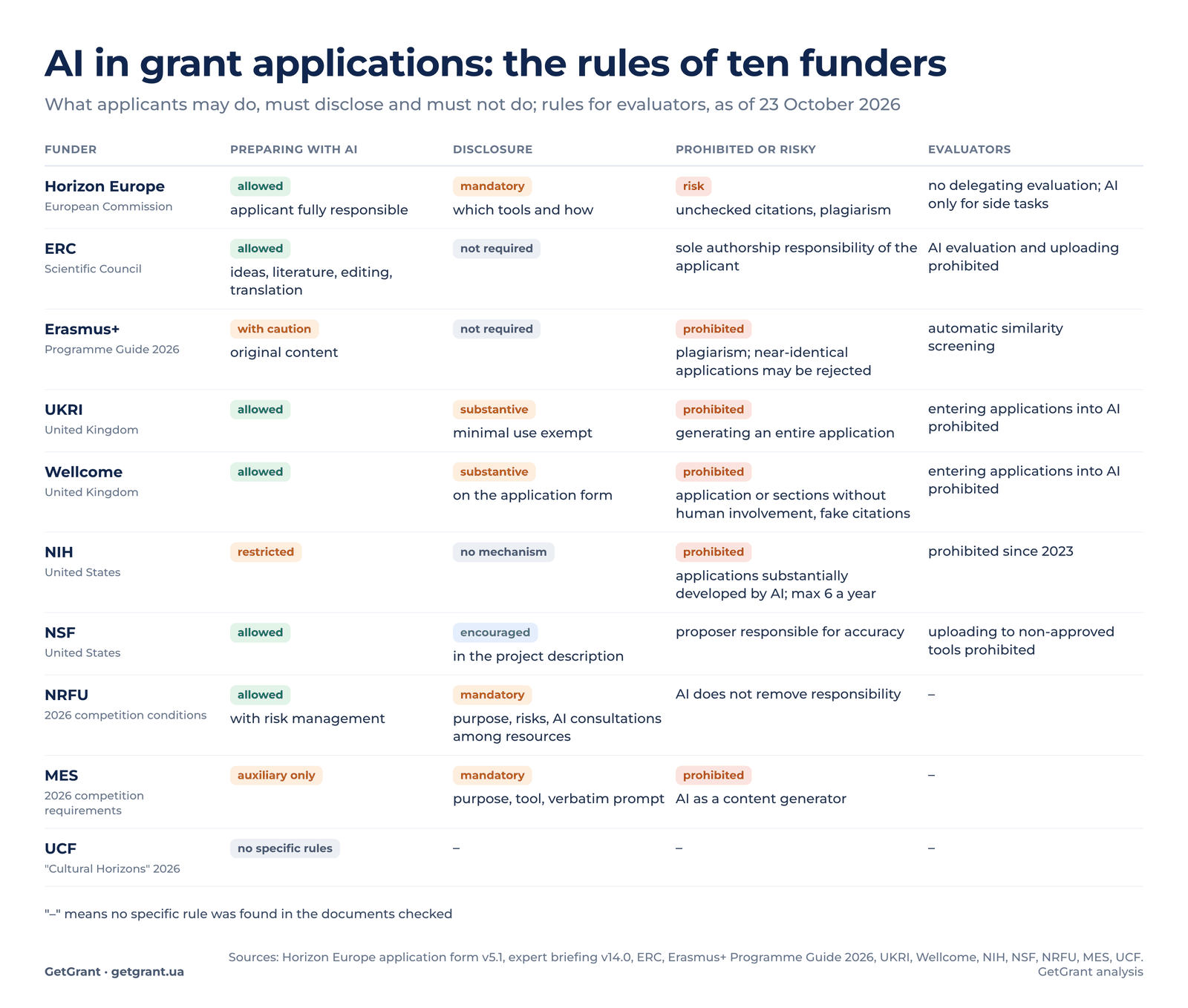
Generative AI has become a routine tool for preparing applications, but there is no single rule for all funders. The European Commission allows AI and requires applicants to disclose which tools they used. NIH does not consider applications substantially developed by AI to be original. Ukraine’s Ministry of Education and Science (MES) has explicitly classed generating project content with AI as a breach of academic integrity in its 2026 competition. The same practice can be neutral for one funder and grounds for rejection for another.
In this article we compare the current rules of ten funders and programmes: the European Commission and Horizon Europe, the ERC, Erasmus+, UKRI, Wellcome, NIH, NSF, the National Research Foundation of Ukraine (NRFU), the MES and the Ukrainian Cultural Foundation (UCF). We explain what is usually acceptable, what is risky and what is prohibited, how the rules apply to evaluators, and we offer a protocol for working with AI safely and a disclosure statement template. All provisions were checked against funders’ documents as of 23 October 2026.
Short answer
- None of the funders reviewed bans AI outright. Language editing, translation and reducing word count are allowed wherever rules exist at all.
- Disclosure is mandatory for Horizon Europe (which tools were used and how), for UKRI and Wellcome (for substantive use), for the MES (purpose, tool and the verbatim prompt) and for the NRFU (purpose, risks, AI consultations listed among the resources used). NSF only encourages disclosure.
- The strictest limits on content: NIH does not consider applications substantially developed by AI to be original, and since September 2025 it has accepted no more than six applications per principal investigator per year. The MES treats AI as a content generator as an integrity breach.
- Evaluators at Horizon Europe, the ERC, UKRI, Wellcome, NIH and NSF are prohibited from uploading applications to AI tools. The European Commission, UKRI and Wellcome state explicitly that an applicant’s use of AI as such does not affect the assessment.
- The main risks for applicants lie not in AI itself but in fabricated references, plagiarism, similarity with other applications and passing confidential data to public services.
Why the rules differ
Funders are solving two different problems. The first is originality and integrity: an application must reflect the ideas and competence of the applicant. The second is confidentiality: applications contain unpublished ideas, personal data and commercial information, so evaluators are prohibited from passing them to external services. European funders and British foundations rely on transparency and applicant responsibility. NIH and the MES have gone further and restricted the role of AI in creating content itself.
The general framework for research in the EU is set by the ERA Living Guidelines, whose third version was released in May 2026. They are recommendations, place responsibility for the outcome on the researcher and advise against substantial use of generative AI in sensitive processes, including peer review and evaluation. We cover them in a separate article; below we deal only with the specific rules for submitting applications.
European Union
European Commission and Horizon Europe
The requirements for applicants are set out directly in the Part B standard application form. The section “Guidance on the use of generative AI tools for the preparation of the proposal” was added as far back as version 3.3 of 27 September 2023 and remains in the current version 5.1 of 22 January 2026 for research and innovation actions. Applicants must:
- verify the accuracy and appropriateness of generated content and all citations, and correct errors;
- provide a list of sources used to generate content and citations, including those suggested by AI;
- be aware of the risk of plagiarism where the tool reproduces other people’s text, and check the originals;
- acknowledge the limitations of the tool: bias, errors, gaps in knowledge;
- disclose transparently which AI tools were used and how.
“Applicants are fully responsible for the content of the proposal.”
Horizon Europe standard application form, Part B, version 5.1 of 22 January 2026.
The form does not provide a separate field for disclosure, so it makes sense to place a short statement in Part B itself. The artificial intelligence question in the ethics issues table in Part A concerns something else: the use or development of AI systems in the project itself, not the preparation of the text.
For evaluators, the rules are set out in the Horizon Europe standard briefing for experts, version 14.0 of 15 April 2026. Experts may not delegate evaluation to AI. They may use AI only for side tasks, such as collecting background information, and only if the confidentiality of proposals and the protection of personal data are ensured. Such use must be documented. A breach may cost an expert a reduction of remuneration, suspension or termination of the contract. The briefing also states separately that the use of generative AI in drafting a proposal may not be a reason for an expert to penalise it.
ERC
The ERC Scientific Council published its position on AI on 1 December 2023 and last updated it on 25 March 2026. It acknowledges that researchers use AI for brainstorming, literature searches, editing, translating and condensing text. But external help, human or machine, does not relieve the author of full and sole authorship responsibility for originality and good scientific conduct. The position contains no separate requirement to disclose the use of AI.
For reviewers, the ERC adopted separate guidelines on 24 March 2026. AI may not be used to summarise a proposal, assess its scientific merit or generate a draft review. Uploading a proposal or any part of it to external AI systems is prohibited. Reviewers may only polish the language of their own report or look up general information without sharing the content of the proposal.
Erasmus+
The Erasmus+ Programme Guide 2026 (version 1 of 12 November 2025) requires an application to contain original content authored by the applicant and partners. Plagiarism makes a proposal ineligible, and a confirmed violation of intellectual property rights is an exclusion situation under the EU Financial Regulation. The guide advises applicants using generative AI to be conscious of the potential for plagiarism and to check accuracy, originality and compliance with intellectual property rules. It contains no requirement to disclose the use of AI.
Something else is more critical for Erasmus+. National Agencies and the Executive Agency automatically screen all proposals for double funding and plagiarism. If the content is similar to an already funded project or another application, a critical similarities report is generated showing the percentage of similarity, and without justification from the applicant this may lead to rejection. Almost identical applications submitted by the same or different applicants to the same or different National Agencies may all be rejected. Boilerplate text generated in the same way for several organisations creates exactly this risk.
United Kingdom and United States
UKRI and Wellcome
The UKRI policy on generative AI in applications and assessment has applied since 23 September 2024. It distinguishes substantive use (generating ideas, analysing data or text, comparing literature, generating code, drafting an abstract) from minimal use (translation, improving English, formatting, reducing word count). Substantive use should be disclosed, minimal use need not be, and this information does not affect the assessment. An entire application must not be generated with AI, and the sensitive or personal data of others must not be entered into AI tools. Assessors are prohibited from entering any part of an application into AI and from even speculating in their assessment about whether the applicant used AI. If an allegation of AI-related research misconduct is upheld, UKRI may reject applications, bar the person from applying temporarily or indefinitely, and end funding.
Wellcome updated its own policy on 8 April 2026. Substantive use of generative AI must be declared on the application form; minimal use need not be. Generating an entire application or sections of it without human involvement, and fabricating data or citations, are prohibited. Information about AI use is not taken into account in assessment, and concerns about misuse are investigated. In June 2026 Wellcome, UKRI, the Royal Society, the Royal Academy of Engineering, Cancer Research UK, the British Heart Foundation and the AMRC published a revised joint statement with examples of acceptable and unacceptable use of AI.
NIH
On 17 July 2025 NIH published notice NOT-OD-25-132. NIH does not consider applications that are substantially developed by AI, or contain sections substantially developed by AI, to be the original ideas of applicants. NIH states that it uses technology to detect AI-generated content. If such use is detected after an award, the matter may be referred to the Office of Research Integrity and the grant suspended or terminated. In the same notice NIH limited the number of applications: no more than six new, renewal, resubmission or revision applications from one principal investigator per calendar year, except for T activity codes and R13 grants. The rule applies from the receipt date of 25 September 2025. It was prompted by cases in which a single researcher used AI to submit more than 40 applications in one round.
NIH prohibited peer reviewers from using generative AI as early as 23 June 2023, in notice NOT-OD-23-149. Uploading application content to online AI tools is considered a breach of confidentiality.
NSF
The NSF notice to the research community of 14 December 2023 was last updated on 21 May 2026. Proposers are encouraged, but not required, to indicate in the project description whether and how generative AI was used, and they are responsible for the accuracy and authenticity of their submission. Reviewers are prohibited from uploading any proposal content to generative tools not approved by NSF. Any information uploaded to such tools outside NSF’s firewall is considered to be entering the public domain.
Ukrainian funders
NRFU
The conditions of the NRFU’s 2026 competitions, including “Advanced Fundamental Science in Ukraine 2027–2029” and “Individual Research Projects 2027–2028”, contain a clause on the responsible use of AI tools. If AI is used within a project, the application and reports must state its purpose and areas of use, risk management measures (personal data, algorithmic bias, reproducibility, copyright) and AI consultations in the list of information resources used, indicating its contribution. The use of AI does not relieve the researchers of responsibility for the content, and all conclusions obtained with AI must be checked by people. The clause is framed mainly around the use of AI in the research itself. In our view, if AI helped prepare the text of the application, it is safer to mention this among the resources used as well.
MES
The requirements for the MES 2026 competitive selections, published together with order No. 934 of 15 June 2026, are the strictest of those reviewed. Using AI as a content generator when preparing a project is a breach of academic integrity, except where the project’s tasks provide for that kind of use. If AI was used as an auxiliary tool, the documents must state the purpose of its use, the name of the tool and the verbatim request, that is, the prompt. Fabrication or falsification of data, borrowing without references and self-plagiarism are explicitly prohibited by the same requirements.
UCF
In the applicant instructions for the 2026 “Innovative Cultural Products” competition under the “Cultural Horizons” programme, AI is mentioned only as a thematic area for projects. We found no specific rules there on using AI when preparing an application (checked on 23 October 2026).
What is acceptable, what is risky and what is prohibited
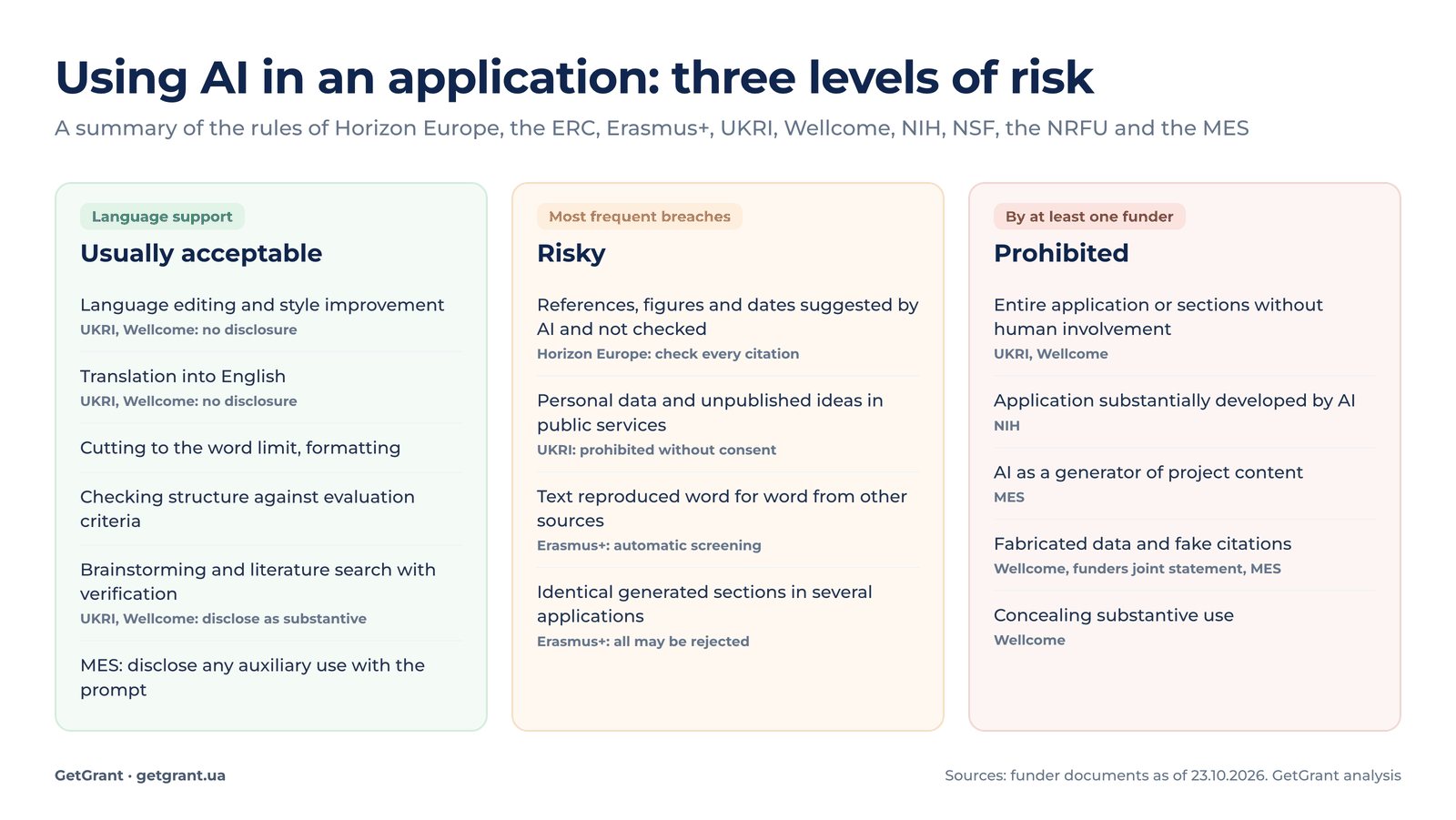
Usually acceptable uses are language editing, translation, cutting text to the character limit, checking the structure against the evaluation criteria, brainstorming and literature searches followed by verification. For UKRI and Wellcome some of these count as minimal use and do not require disclosure. For the MES any auxiliary use must be disclosed.
Risky practices are not explicitly prohibited but most often lead to breaches:
- Fabricated references and figures. Language models generate plausible but non-existent publications and statistics. Horizon Europe explicitly requires every citation to be checked, and Wellcome and the joint statement of British funders classify fake citations as unacceptable use.
- Confidential data in public tools. Personal data of team members, unpublished results and partners’ ideas should not be entered into services whose terms allow input to be used to train models. UKRI explicitly prohibits entering the sensitive or personal data of others without consent.
- Plagiarism and similarity. AI can reproduce someone else’s text word for word. Erasmus+ automatically compares applications with each other and with funded projects.
- Identical texts across several applications. If several organisations generate sections from similar prompts, the texts come out alike. For Erasmus+ this is direct grounds for scrutiny and possible rejection.
Prohibited by at least one of the funders: generating an entire application or sections without human involvement (UKRI, Wellcome), submitting an application substantially developed by AI (NIH), using AI as a content generator (MES), fabricating data and citations, and concealing substantive use (Wellcome).
How evaluators perceive text written with AI
Here it is worth distinguishing rules from assumptions. Under the European Commission’s rules, the use of AI in drafting may not be grounds for a lower score. UKRI prohibits assessors from even speculating in their assessment about whether the applicant used AI, and Wellcome does not take information about AI into account in assessment. NIH works differently: it applies technology to detect generated content, and substantially generated applications are not considered original.
More important is something else. Evaluators assess an application against the call criteria, and generic wording without specific data, methods, indicators and links to the call conditions meets those criteria poorly regardless of who wrote it. The risk of generic text is not that it will be “recognised”, but that it does not demonstrate the team’s capacity to carry out this particular project.
Protocol: how to use AI safely
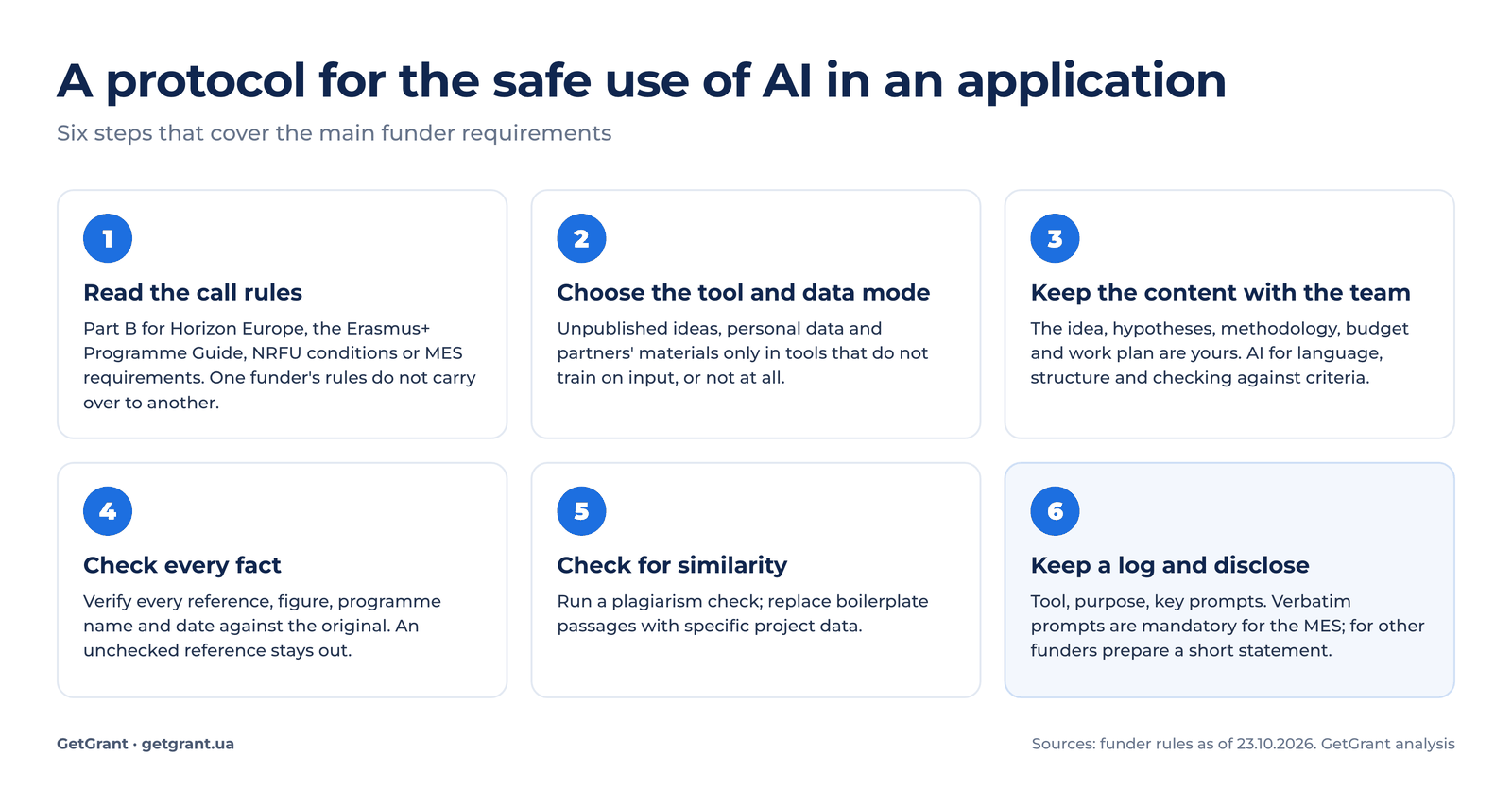
- Read the rules of the specific call. For Horizon Europe this means Part B and the topic conditions, for Erasmus+ the Programme Guide, for the MES and the NRFU the conditions of the relevant competition.
- Choose the tool and the data mode. For unpublished ideas, personal data and partners’ materials, use only tools that do not train on input data, or do not enter them at all.
- Keep the content your own. The idea, hypotheses, methodology, budget and work plan are shaped by the team. AI is appropriate for language, structure and checking alignment with the criteria.
- Check every fact against the original source. Verify every reference, figure, programme name and date against the original. A reference you have not opened does not go into the application.
- Check for similarity. Run the text through a plagiarism checker and rewrite boilerplate passages with specific data from your project.
- Keep a log and disclose the use. Record the tool, the purpose and the key prompts. For the MES verbatim prompts are mandatory; for other funders the log will help you prepare a disclosure statement quickly.
Disclosure statement template
The statement should be adapted to the funder’s requirements: for the MES add the verbatim prompts, for Wellcome enter it in the relevant field of the form, for Horizon Europe place it in Part B. An example:
During the preparation of this proposal the team used [tool name, version] for [language editing, translation into English, reducing word count, checking structure]. The ideas, hypotheses, methodology, budget and work plan were developed by the project team. All facts, figures and references were verified against original sources, and the text was checked for plagiarism. No confidential or personal data were entered into AI tools. The project team takes full responsibility for the content of the proposal.
For applications to Ukrainian funders, in Ukrainian:
Під час підготовки заявки команда використовувала [назва інструменту, версія] для [мовного редагування, перекладу англійською, скорочення обсягу тексту, перевірки структури]. Ідеї, гіпотези, методологія, бюджет і план робіт розроблені виконавцями проєкту. Усі факти, цифри і посилання перевірено за першоджерелами, текст перевірено на запозичення. Конфіденційні та персональні дані в інструменти ШІ не вводилися. Відповідальність за зміст заявки повністю несе команда проєкту.
Conclusion
In 2026 the question is no longer whether AI may be used in an application, but how to use it under the rules of a specific funder. One thing is common to all: the applicant is responsible for the content, and evaluators have no right to pass applications to AI. The differences concern disclosure and the limits of what is acceptable, from NSF’s recommendation to the MES requirement to provide verbatim prompts. The most reliable strategy is to keep the content with the team, check every fact, keep a log of AI use and disclose it even where this is only recommended. For finding and initially analysing calls, you can also use GetGrant’s AI assistant Grantoid, which answers with links to sources, but the text of the application and its substance still remain yours.
The GetGrant team helps researchers, NGOs and businesses find grants and prepare applications to Horizon Europe, the ERC, Erasmus+ and Ukrainian funds in line with funder requirements, including those on the use of AI. Current calls are collected in the GetGrant catalogue, and a tailored selection can be ordered on the services page. This article is not legal advice.
Sources
- European Commission: Horizon Europe standard application form (RIA and IA), version 5.1 of 22.01.2026
- European Commission: Horizon Europe standard briefing for experts, version 14.0 of 15.04.2026
- ERC: current position of the ERC Scientific Council on AI, updated 25.03.2026
- ERC: ERC clarifies limits on AI use in grant evaluation, 24.03.2026
- European Commission: Erasmus+ Programme Guide 2026, version 1 of 12.11.2025
- UKRI: use of generative AI in application preparation and assessment
- Wellcome: use of generative AI in our grant application process, updated 08.04.2026
- Wellcome: funders joint statement on generative AI, June 2026
- NIH: NOT-OD-25-132, 17.07.2025
- NIH: NOT-OD-23-149, 23.06.2023
- NSF: notice to the research community on generative AI, updated 21.05.2026
- NRFU: conditions of the “Advanced Fundamental Science in Ukraine 2027–2029” competition (in Ukrainian)
- NRFU: conditions of the “Individual Research Projects 2027–2028” competition (in Ukrainian)
- MES: order No. 934 of 15.06.2026 and requirements for the 2026 competitive selections, “Science in Ukraine” portal (in Ukrainian)
- UCF: “Innovative Cultural Products” competition, “Cultural Horizons” programme 2026 (in Ukrainian)

Book a consultation or leave your application idea
Tell us in a few words about your project: we will say which grants it fits and can take the application itself off your hands. We reply within one business day.