GetGrant analysis of its own data: 1,289 open calls as of 9 November 2026. 46% of deadlines fall before the New Year, 75% are formally open to Ukraine, the median amount is €530,000 or €60,000 without Horizon Europe, with conclusions for NGOs, businesses, science, culture and communities.
How many grants are actually open to Ukrainian organisations and individuals right now, who funds them, how much money is involved and when do the deadlines fall? Answers to these questions usually rely on individual round-ups or on impressions. We calculated them on a full snapshot of the GetGrant database: as of 9 November 2026 it held 2,226 records, and after cleaning 1,289 calls have a deadline no earlier than 10 November 2026.
This is a snapshot, not a permanent indicator: the GetGrant database is updated daily. Below are the methodology, deadlines by month, accessibility for applicants from Ukraine, funder jurisdictions, grant sizes and conclusions for five groups: civil society organisations, businesses, universities and researchers, culture and communities.
Short answer
- As of 9 November 2026, the GetGrant database contains 1,289 open calls, that is, calls with a deadline from 10 November 2026. They were selected from 2,226 records after removing 11 empty records and 54 duplicates.
- 46% (594 calls) close before the end of 2026: 340 in November and 254 in December. The busiest day is 1 December 2026, with 76 deadlines.
- 75% (967) are formally open to applicants from Ukraine: 189 calls name Ukraine explicitly, 683 do not restrict the applicant’s country and 95 are open to the EU and associated countries. 19% (245) are reserved for other countries, above all the United Kingdom.
- The Ukrainian segment accounts for 16.1% (208): 49 calls from Ukraine-based funders and 159 Ukrainian-language announcements by foreign funders. The remaining 84% are international calls.
- Funders: the EU accounts for 42.4%, the USA for 15.1%, the United Kingdom for 14.2% and Ukraine for 3.8%; for 22.9% of records the funder’s jurisdiction is not determined. Horizon Europe has the most open calls: 296, or 23%.
- An amount is stated in 76.4% of calls. The median maximum amount is €530,000, or €60,000 without Horizon Europe. 20.2% of calls offer less than €10,000, and 47% offer €1 million or more.
- The most frequently eligible applicants are universities (48.1% of calls) and research institutions (40.3%). Small and medium-sized enterprises and civil society organisations can apply to roughly one call in four, public authorities to 16.9%.
Methodology
The source is a full export of the GetGrant grant search index as of 9 November 2026: 2,226 records. The grant search in the GetGrant account works with this index; the public catalogue contains editorial descriptions of some of these calls. We removed 11 empty records and 54 duplicates (the same link to the announcement, or the same title with the same deadline), leaving 2,161 unique records. There are no dates such as 1970 in the data.
We consider a call open if its submission deadline is no earlier than 10 November 2026, the publication date of this article: there are 1,289 such calls. Another 662 records have a past deadline, and 210 have no date at all. Calls with permanent intake are not flagged separately in the database, and an empty date may mean either continuous intake or an unconfirmed deadline, so we did not count records without a date as open. The counter on the website’s home page includes them as well and therefore shows a higher number.
Accessibility for Ukraine is based on the field listing the countries from which applications are accepted; this is a classification of the announcement, not a legal check of the conditions. The amount is the maximum amount stated in the call card (the upper bound of the range). Amounts in other currencies were converted into euros at the European Central Bank reference rates of 6 November 2026 (the latest published at the time of calculation: $1.1165, £0.83415 and 0.9143 Swiss francs per €1) and the National Bank of Ukraine rate of 9 November 2026 (UAH 50.6455 per €1). Fields were determined from the field of knowledge attribute. One call may have several applicant types and several fields, so the shares in these distributions add up to more than 100%.
When the deadlines fall: half before the New Year
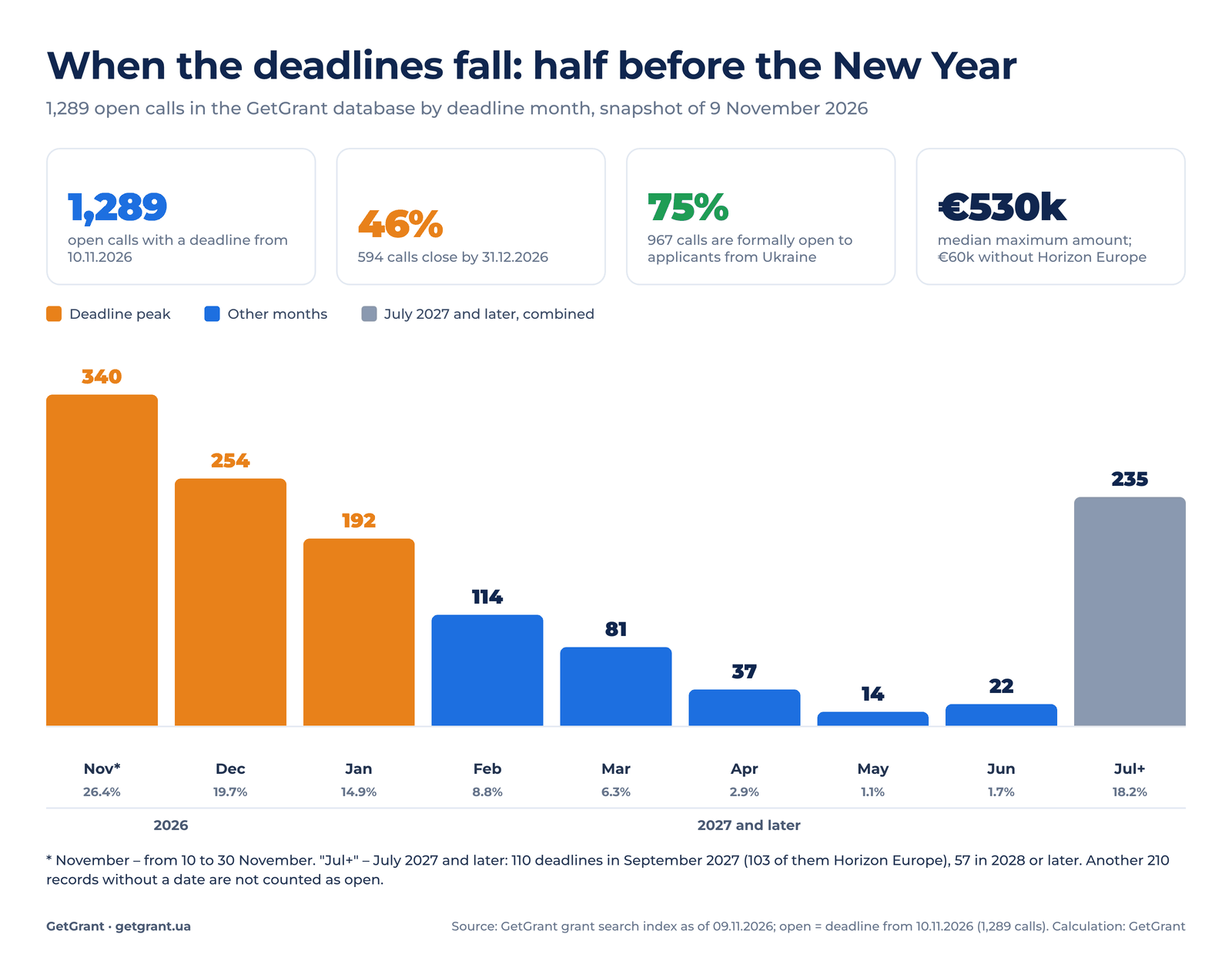
The distribution of deadlines is sharply skewed towards the coming weeks. Between 10 and 30 November, 340 calls close (26.4%), in December 254 (19.7%), and in January 2027 192 (14.9%). After that the numbers decline: 114 in February, 81 in March, 37 in April, 14 in May and 22 in June. By the end of June 2027, 1,054 calls close, or 81.8% of all open calls.
The busiest days are 1 December 2026 (76 deadlines, 16 of them Horizon Europe topics), 15 November (52) and 30 November (50). Another 235 calls have a deadline in July 2027 or later. September 2027 stands out: 110 deadlines, 103 of them Horizon Europe topics, with 67 deadlines on 22–23 September. 57 records have a date in 2028 or later: 33 of them were announced by British and 17 by American funders. These are mostly government schemes and programmes of the US National Institutes of Health (NIH), where the date given is the expiry of the announcement rather than a single deadline.
An important detail: the Ukrainian segment is much “shorter” than the international one. Of the 208 calls from Ukrainian funders and Ukrainian-language announcements, 150 (72%) close before the end of 2026, compared with 41% among international calls. The Ukrainian segment is therefore worth monitoring weekly rather than monthly.
Can you apply from Ukraine
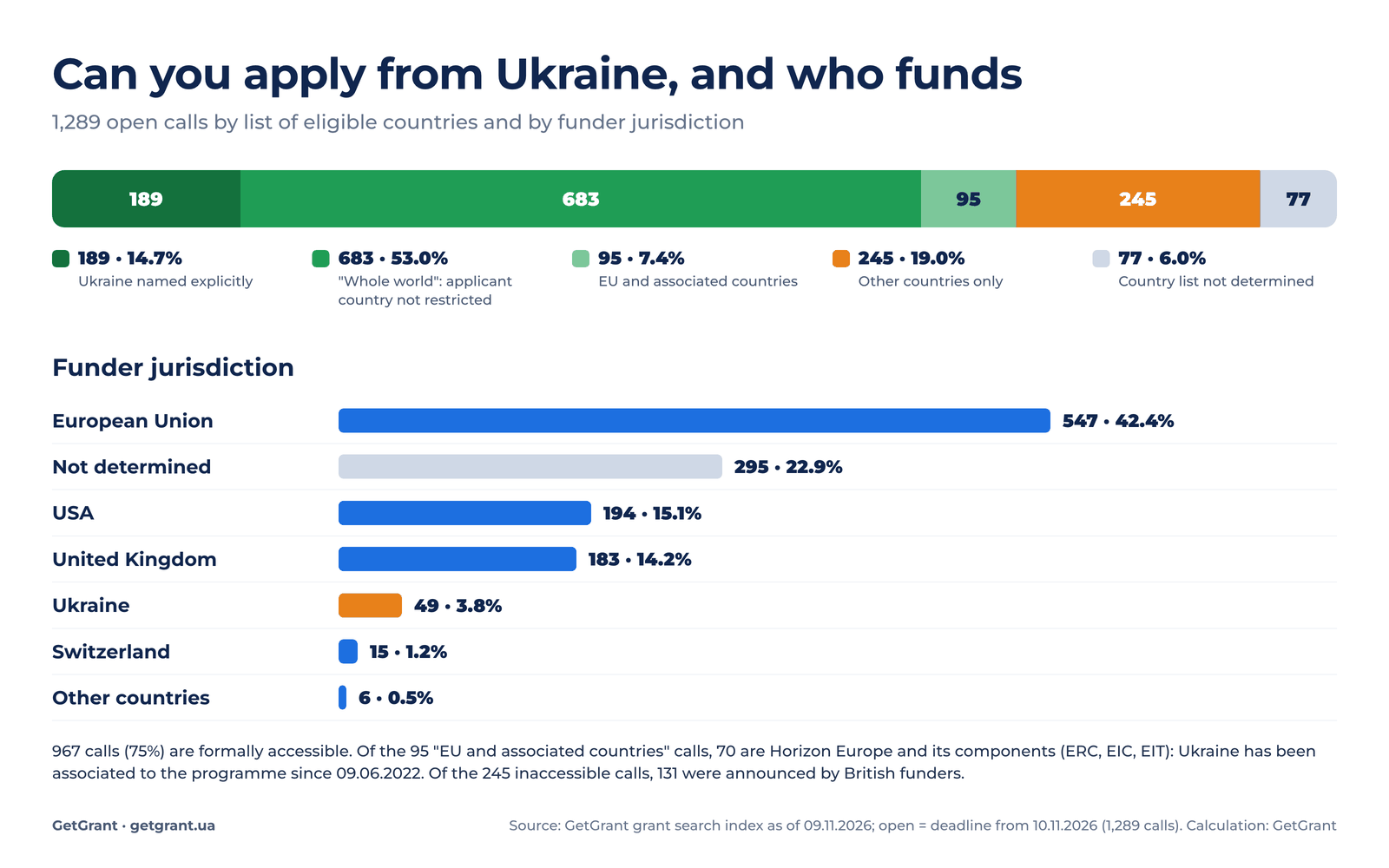
For each call, the GetGrant database records the countries from which applications are accepted. Based on this field, open calls break down as follows:
- 189 (14.7%) name Ukraine explicitly among eligible countries;
- 683 (53.0%) are marked “whole world”: the announcement does not restrict the applicant’s country, although it may restrict the type of organisation, language or partnership composition;
- 95 (7.4%) are open to EU Member States and countries associated to the relevant programme;
- 245 (19.0%) are reserved for other countries only;
- for 77 (6.0%) the list of countries is not determined.
In total, 967 calls, or 75%, are formally accessible. Most caveats concern the “EU and associated countries” category. Association is concluded with each programme separately: Ukraine has been associated to Horizon Europe since 9 June 2022 and participates in LIFE and CERV, but it is not associated to Erasmus+. Of the 95 such calls, 70 belong to Horizon Europe and its components (ERC, EIC, EIT), so access is confirmed by the association agreement unless the topic text sets specific restrictions. For the remaining 25, the conditions must be checked in each announcement. Counting only the reliable cases, 931 calls, or 72.2%, are accessible.
Of the 245 calls not open to Ukraine, 131 were announced by British funders: the UKRI research councils (71 of their 76 calls in the database) and UK government departments (33 of 35) usually fund British organisations only. Another 52 are European calls with a country list that excludes Ukraine, including 11 Horizon Europe topics with restricted participation and national programmes of Estonia and Finland.
By funder jurisdiction, open calls break down as follows: the EU 547 (42.4%), the USA 194 (15.1%), the United Kingdom 183 (14.2%), Ukraine 49 (3.8%), Switzerland 15 (1.2%) and other countries 6. For 295 records (22.9%) the funder’s jurisdiction is not determined in the database: they include EU programmes, research councils, universities and private foundations.
American calls are mostly marked “whole world” (154 of 194), but this is not yet a right to apply: NIH announcements, for example, contain a separate clause on the participation of foreign organisations, and it is worth reading first.
The Ukrainian segment and international calls
There are few Ukraine-based funders in the database: 49 open calls, or 3.8%. These are 34 grants, 8 scholarships and 7 prizes; in 26 of them a civil society organisation can be the applicant (including calls without applicant-type restrictions). Amounts here are the smallest: a median of €5,500 among the 37 calls with a known amount, and 40 of the 49 close before the end of 2026.
Another 159 calls were announced by foreign funders but have a Ukrainian description in the database. Most of them are EU programmes (82) and American and international foundations, and 89 of them name Ukraine explicitly among eligible countries. Together with Ukrainian funders, this makes 208 calls (16.1%) with a median amount of €30,000. The remaining 1,081 calls (83.9%) are international announcements in English. The practical conclusion: most of the money available to you lies in international calls, and working with them requires English-language applications and regular monitoring.
How much is offered: a median of €530,000, or €60,000 without Horizon Europe
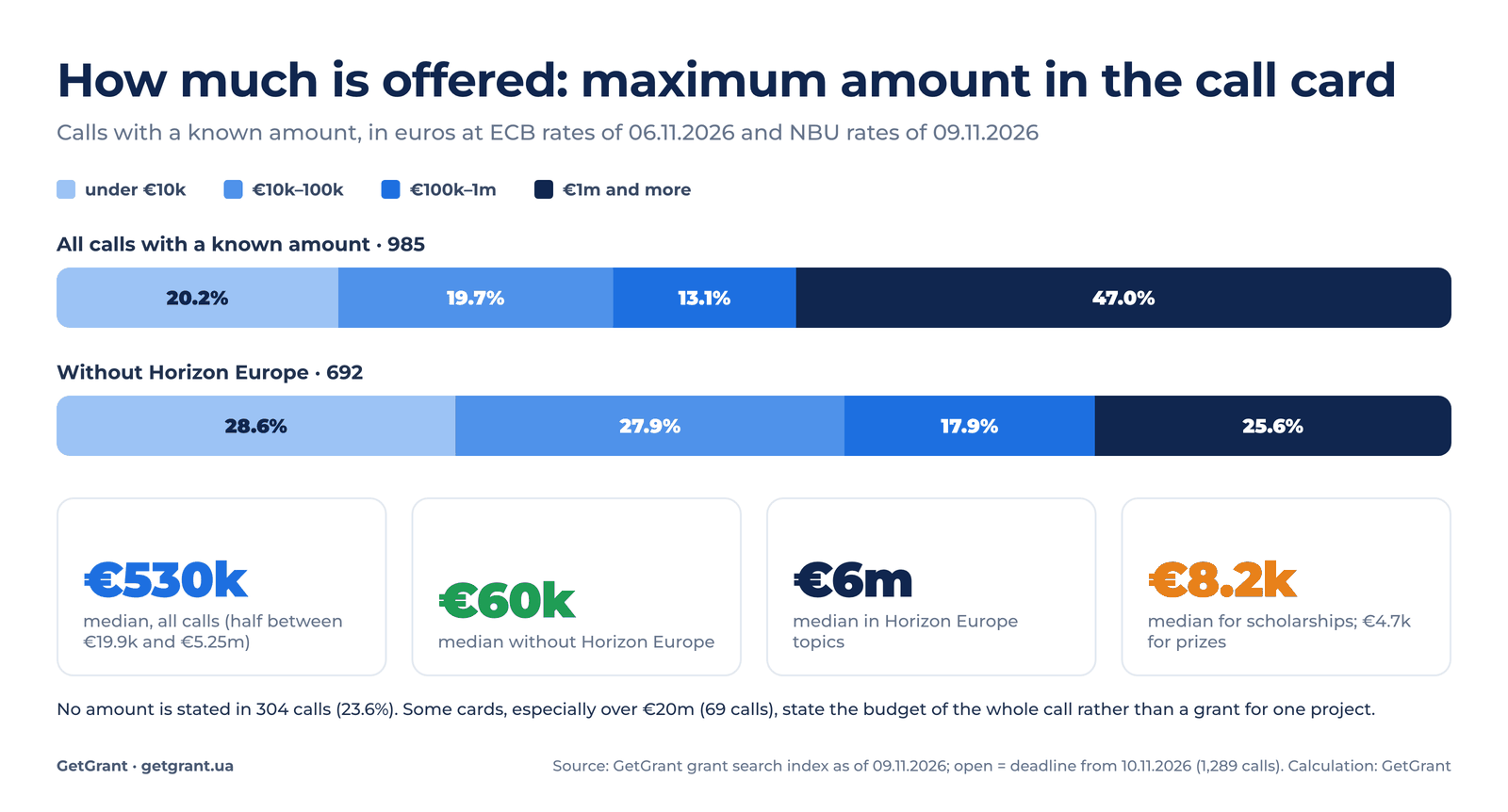
An amount is stated in 985 calls (76.4%). Another 304 (23.6%) have no amount: the funder does not publish it, states only the percentage of costs covered, or the amount depends on the project. Most of these records (235) belong to funders with an undetermined jurisdiction.
The median maximum amount is €530,000, and half of the calls fall in the range from €19,900 to €5.25 million. The distribution has two peaks: 20.2% of calls offer less than €10,000, 19.7% from €10,000 to €100,000, 13.1% from €100,000 to €1 million, and 47% €1 million or more. The top bracket is largely shaped by Horizon Europe: the median maximum EU contribution per project in this programme’s topics is €6 million. Without Horizon Europe, the median drops to €60,000 and the distribution becomes more even: 28.6% under €10,000, 27.9% from €10,000 to €100,000, 17.9% from €100,000 to €1 million and 25.6% from €1 million.
One more caveat: some cards, especially those with amounts over €20 million (69 calls), state the total budget of the call rather than the grant for one project. The median and quartiles are therefore more reliable here than the share of the largest amounts.
By type of opportunity, the picture is as expected. Grants account for 74.2% of open calls (957) with a median of €2.38 million, scholarships for 20.6% (266) with a median of €8,200, and prizes for 5.4% (69) with a median of €4,700.
Who can apply and on which topics
Universities have the widest range of opportunities: 620 calls (48.1%) accept them. They are followed by research institutions with 520 (40.3%), small and medium-sized enterprises with 322 (25.0%), civil society organisations with 316 (24.5%), individuals with 298 (23.1%), public authorities with 218 (16.9%), start-ups with 175 (13.6%), schools and colleges with 150 (11.6%), entrepreneurs with 98 (7.6%), medical institutions with 57 (4.4%) and media with 23 (1.8%). Another 309 calls (24%) do not restrict the applicant type.
By field, the leaders are education (281 calls, 21.8%), environmental studies and forestry (228, 17.7%), the arts (167, 13.0%), medicine and health (156, 12.1%) and economics (156, 12.1%). They are followed by engineering (119), business and commercialisation (110), computer science (102), political science (93) and agriculture (65). 74 calls (5.7%) do not restrict the field.
Who funds the most calls
The open calls come from 594 different funders and programmes, but the market is noticeably concentrated: the top ten account for 553 calls, or 42.9%.
- Horizon Europe – 296 (23% of all open calls);
- UKRI, the UK research councils together with Innovate UK – 76;
- the European Commission and the EU without a specified programme – 41;
- UK government departments – 35;
- the US National Institutes of Health (NIH) – 30;
- the European Institute of Innovation and Technology (EIT) with all its communities – 22;
- Creative Europe – 16;
- Cancer Research UK – 13;
- Digital Europe – 12;
- the Swiss National Science Foundation (SNSF) – 12.
For Ukrainian applicants this top ten is uneven: British government calls and 9 of the 12 SNSF calls are reserved for organisations from their own countries, whereas EIT, Digital Europe and Creative Europe are almost entirely open to Ukraine or mention it explicitly.
What this means for five groups of applicants
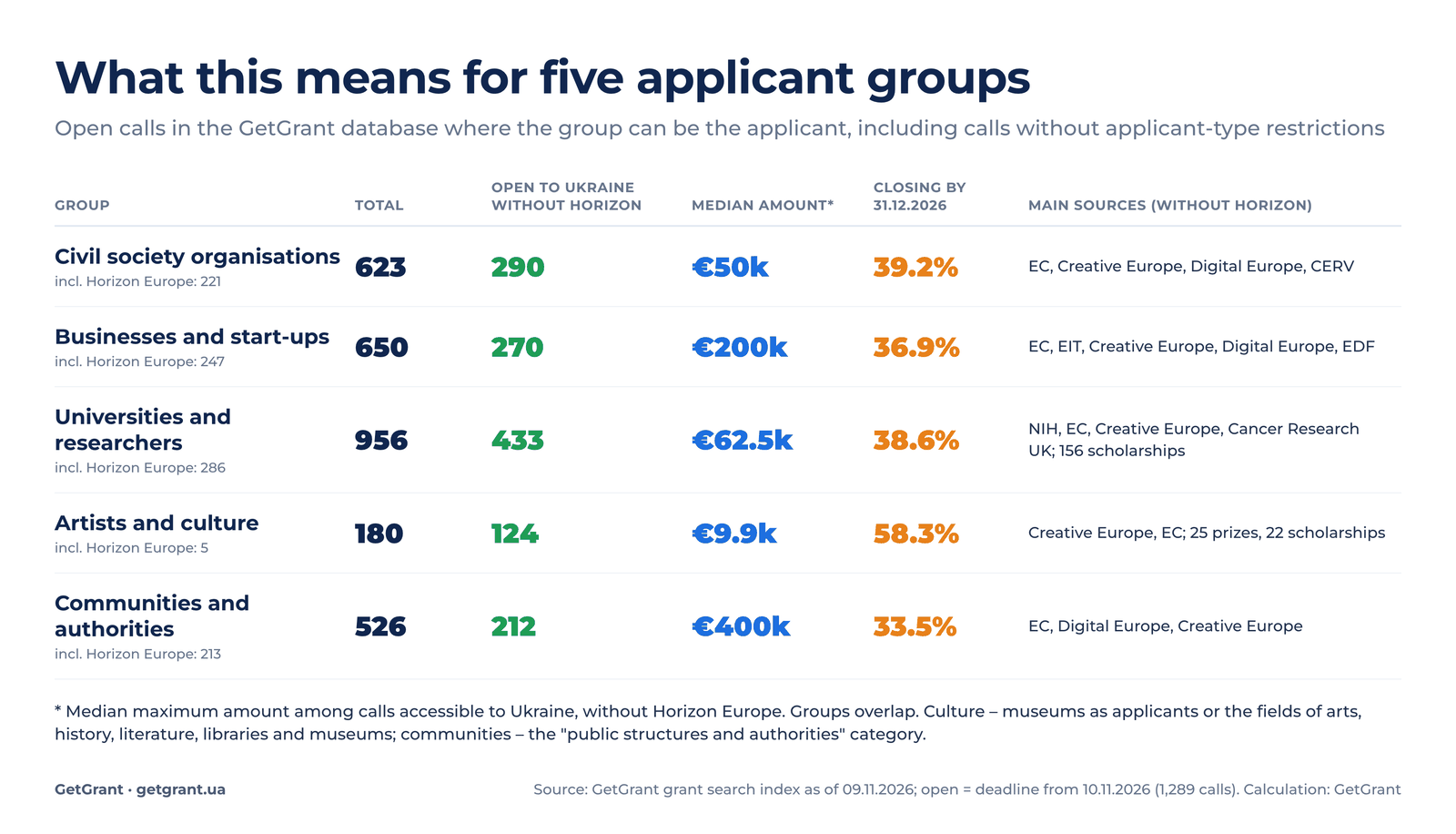
To keep the conclusions practical, for each group we separately counted calls accessible to applicants from Ukraine, excluding Horizon Europe: this programme has its own logic of consortia and large amounts, and we covered it in a separate review.
Civil society organisations
Civil society organisations can apply to 623 calls (48.3%), of which 221 are Horizon Europe topics, where they usually work as part of a consortium. Without Horizon, 290 calls are accessible to Ukraine with a median of €50,000; 89 name Ukraine explicitly and 169 close before the end of 2026. Sources include European Commission programmes (19), Creative Europe (11), Digital Europe (6) and CERV (4), in which Ukraine takes part as a participating country. Keep a separate eye on the Ukrainian segment: it has 26 calls from Ukraine-based funders, with small amounts and short deadlines.
Businesses and start-ups
Small and medium-sized enterprises, start-ups and entrepreneurs are eligible for 650 calls (50.4%), of which 247 are Horizon Europe. Without Horizon, 270 are accessible with a median of €200,000; sources include the European Commission (19), EIT (16), Creative Europe (14), Digital Europe (9) and the European Defence Fund (5). At the same time, 133 business calls outside Horizon are not accessible or have an undetermined country list, and 79 of them were announced by British funders. For businesses, the applicant country filter therefore matters more than the amount filter.
Universities and researchers
Science has the most opportunities: 956 calls (74.2%), of which 286 are Horizon Europe. Without Horizon, 433 are accessible, and more than a third of them (156) are scholarships. The median amount is €62,500; sources include NIH (29), the European Commission (23), Creative Europe (14) and Cancer Research UK (11). The biggest trap is UKRI: 72 calls for science, but mostly for British institutions only. A Ukrainian researcher can get in only as part of a British institution’s team, if the call conditions allow it.
Artists and cultural organisations
There are relatively few cultural calls: 180 (14%), and only 5 of them are Horizon Europe. 124 are accessible to Ukraine, with a median of €9,900, the smallest amounts among the five groups, but they include many prizes (25) and scholarships (22). The main source is Creative Europe (11 accessible calls). Deadlines are the shortest: 58% of cultural calls close before the end of 2026, so applications are worth planning already in November.
Communities and local self-government bodies
There is no separate category for local self-government bodies in the database; the closest is “public structures and authorities”, for which 526 calls (40.8%) are open, including 213 Horizon Europe topics. Without Horizon, 212 are accessible with a median of €400,000; sources include the European Commission (15), Digital Europe (9) and Creative Europe (9). For communities, large amounts often mean joint projects with partners and own co-financing, so the decision to apply is best taken together with the finance department well in advance.
How to use these figures
For a single organisation the market is always narrower than the headline figure: out of 1,289 calls, those not accessible from Ukraine (about a quarter), those that do not match your type of organisation and those with less than three weeks to the deadline drop out. The grant search in the GetGrant account works with the same database and filters calls by organisation type, field, amount and type of opportunity, and the Grant for your goal page matches them to a description of your idea. This is a list of candidates, not a guarantee of fit, so always check the participation conditions on the funder’s website.
Conclusion
As of 9 November 2026, the GetGrant database contains 1,289 open calls, and three quarters of them are formally accessible to applicants from Ukraine. The market has three notable features. It is international: 84% of calls are English-language announcements by foreign funders, and the share of Ukraine-based funders is 3.8%. It is short: 46% of deadlines fall in November and December 2026, and national calls are shorter still. And it is uneven in terms of amounts: the median of €530,000 rests on Horizon Europe, while a typical call outside this programme offers about €60,000. Universities and research institutions have the most opportunities, while culture has the smallest amounts and the shortest deadlines. These figures are a one-day snapshot: the database is updated daily.
The GetGrant team helps select calls that match an organisation’s profile and prepare the application: support can be ordered on the services page.
Sources
- GetGrant: grant catalogue; calculations are based on a snapshot of the GetGrant search index of 09.11.2026
- GetGrant: Horizon Europe topics
- European Central Bank: euro foreign exchange reference rates, 06.11.2026
- National Bank of Ukraine: official hryvnia exchange rates, 09.11.2026
- European Commission: Ukraine’s association agreement to Horizon Europe and Euratom enters into force, 09.06.2022
- GetGrant: Who can apply – the status of Ukraine in EU programmes

Book a consultation or leave your application idea
Tell us in a few words about your project: we will say which grants it fits and can take the application itself off your hands. We reply within one business day.