
Knight Science Journalism Fellowship
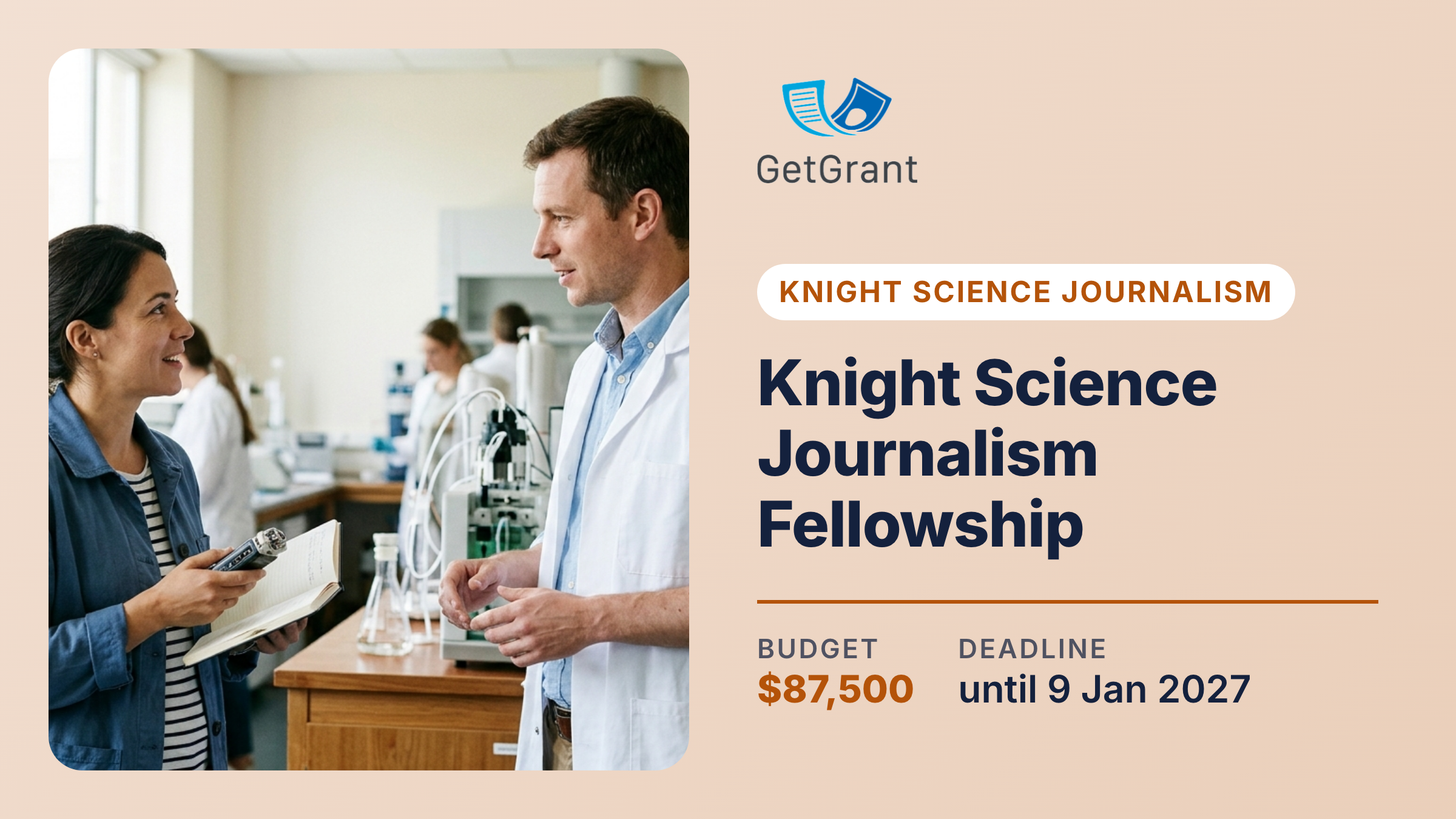
The Knight Science Journalism (KSJ) Program at the Massachusetts Institute of Technology (MIT) has opened applications for its 2027-2028 Academic-Year Fellowship. Based in Cambridge, Massachusetts, the 9.5-month residential initiative selects ten science journalists from around the world to study, conduct research, and advance their technical reporting skills.
Selected fellows receive an $87,500 stipend paid over the 9.5-month period, alongside a $5,000 travel and housing relocation allowance and health insurance coverage for themselves and eligible dependents. Qualifying fellows can also receive monthly childcare subsidies as well as subsidized transportation and institutional access.
The deadline to submit applications is January 9, 2027, at 11:59 pm Eastern Time. The fellowship is designed for full-time reporters, writers, editors, producers, and visual journalists who specialize in science, health, technology, or environmental coverage.
What is funded
Fellows receive substantial financial and logistical support during their residency in Cambridge. The award includes an $87,500 stipend disbursed across 9.5 months and a $5,000 relocation and housing stipend distributed near the start of the fellowship. MIT provides health insurance for each fellow and their accompanying family members, and eligible fellows may receive a childcare subsidy between $500 and $750 per month. Fellows also receive free or subsidized public transportation passes and discounted admission to local cultural institutions.
The program funds participation in coursework, workshops, and study trips. Fellows audit classes across MIT, Harvard University, and other area institutions, with the requirement of taking at least one science course per semester subject to instructor approval. KSJ also organizes field trips to prominent scientific institutions, such as the Woods Hole Oceanographic Institution and the Jackson Laboratory, alongside professional workshops focusing on narrative writing, data journalism, and artificial intelligence.
Fellowship project and programming
During their time in Cambridge, participants pursue an independent, journalism-related research project that leverages local research facilities and academic networks. Fellows have previously used their residency to conduct long-form reporting, develop audio and video projects, draft book proposals, or develop deep expertise in a new scientific discipline.
The program holds regular meetings throughout the academic year to monitor project development and offer editorial guidance. At the conclusion of the fellowship, participants deliver formal presentations detailing their work, which often leads to published articles, books, podcasts, or multimedia series.
Who can apply
Eligibility is open to full-time staff and freelance journalists with at least three consecutive years of experience covering science, health, technology, or the environment. Eligible roles include reporters, writers, editors, producers, illustrators, filmmakers, photojournalists, and book authors working in print, broadcast, or digital media. Part-time journalists are explicitly ineligible.
International journalists are encouraged to apply, provided they qualify for a U.S. visa, typically a J-1 visa sponsored by MIT. However, journalists holding sole citizenship in countries where U.S. visa issuance is currently suspended cannot be accommodated until restrictions are lifted. In addition, applicants must not have completed a residential fellowship lasting four months or longer within the two years prior to applying.
Conditions and requirements
Applications must be authored entirely by the applicant, and KSJ enforces a strict policy regarding the use of generative artificial intelligence. AI tools may only be utilized for minor editing tasks such as identifying spelling or grammatical errors, and any such use must be disclosed within the application form. Generating application text with AI will result in disqualification.
Practical tip. If English is not your native language, prepare your portfolio carefully and consider taking an IELTS or TOEFL exam to supplement your submission. While formal test scores are not mandatory, the donor indicates that test results can strengthen non-native English applications during the required MIT J-1 language proficiency review.
Applications are submitted on the donor’s page: ksj.mit.edu.
| Parameter | Details |
|---|---|
| Donor | Knight Science Journalism Program, Massachusetts Institute of Technology (MIT) |
| Programme | Knight Science Journalism Academic-Year Fellowship (2027-2028) |
| Budget | $87,500 stipend over 9.5 months, $5,000 relocation/housing, health insurance, childcare subsidy |
| Deadline | January 9, 2027 (11:59 pm Eastern Time) |
| Who can apply | Full-time journalists (staff or freelance) with 3+ consecutive years in science, health, tech, or environment |
| Geography | Cambridge, United States (open globally) |
| Type of support | Residential academic fellowship and research stipend |
See which other calls fit your organisation
The GetGrant database lists EU programmes, bilateral donors and foundations by organisation profile, with verified deadlines.
Frequently asked questions
Short answers based on the facts of this call
