An analysis of the Erasmus+ 2027 work programme: the €6.21 billion budget and what lies behind its growth, what is new for Ukraine, where a Ukrainian organisation can apply as lead, participation figures for 2021–2026 and an indicative call calendar.
On 15 October 2026 the European Commission adopted the annual work programme of Erasmus+ for 2027 (Decision C(2026) 7171), and at the end of October the Publications Office of the EU released it as a separate 229-page publication. It is the final year of the 2021–2027 programme and the largest annual budget of the period: up to €6,212,985,300, 19.4% more than in 2026. The document contains no deadlines or participation rules: they will appear in the Programme Guide 2027, which had not been published as of 31 October 2026.
For Ukraine, 2027 is a transition year. Formally it remains a third country not associated to the Programme, but for the first time it is named in an action preparing for association, and DiscoverEU and a dedicated Jean Monnet network are opening up for it. We compared the work programme with the 2026 work programme and the Programme Guide 2026, compiled the statistics of the National Erasmus+ Office in Ukraine for 2021–2026 and explain what of all this is actually available to Ukrainian organisations, students and staff.
Short answer
- The Erasmus+ 2027 budget is up to €6.21 billion (+19.4%), but the EU’s own budget grew by only 5%: the increase comes from the expected contributions of the United Kingdom and Switzerland.
- The international dimension, which funds Ukraine’s participation, grew by only 2%, to €442 million. KA171 rises by 9.6%, while Capacity Building in Higher Education (CBHE) shrinks by 6.2%, to €106 million.
- Ukraine is a third country not associated to the Programme (Region 2). As of 31 October 2026 there is no association agreement; the goal discussed by Ukraine and the EU is full participation from the new 2028–2034 programme.
- New for Ukraine: €4.64 million to prepare six countries, Ukraine among them, for association, a Jean Monnet network “EU-Ukraine-Moldova” worth €1.2 million, DiscoverEU for 18-year-olds and ECHE accreditation for higher education institutions from countries preparing for association “tentatively as of 2028”.
- A Ukrainian organisation can be an applicant in CBHE, in Jean Monnet actions for higher education, in Erasmus Mundus Joint Masters and in CB Youth. In most other actions it can only be a partner, and in small-scale partnerships it cannot even be a partner.
- Over five CBHE calls, the number of applications involving Ukraine grew from 73 to 197, and funded projects from 13 to 22. The success rate fell from 18% to 11%.
- The 2027 call has not been published yet. Based on the 2026 precedent, the main deadlines will fall in February–March, so an EU Login, a PIC or OID and partners should be in place now.
What this document is and how it differs from the Programme Guide
The annual work programme is a Commission financing decision: how much money goes to each action, organisations from which countries may apply and which priorities will be favoured. The document was prepared by the Directorate-General for Education, Youth, Sport and Culture (DG EAC). The programme itself is an annex in English covering about 200 of the 229 pages: priorities, descriptions of actions with budgets and budget tables.
The Programme Guide is the document for applicants: deadlines, eligibility criteria, consortium composition, grant amounts and unit costs. The work programme states explicitly that the Guide 2027 will be published after its adoption, together with the call for proposals. As of 31 October 2026 only the 2026 version is available on the Erasmus+ website, and on 29 October the National Erasmus+ Office in Ukraine said it was waiting for the calls to be announced. For reference: the 2026 call was published on 12 November 2025 and the 2025 call on 19–20 November 2024.
So in this article the action budgets and eligible applicants for 2027 come from the work programme, while amounts per project and deadlines come from the Guide 2026 as a benchmark that may still change. The budget is also conditional: it depends on the EU budget for 2027 and on the contributions of participating countries.
The 2027 budget: the largest, but not for everyone
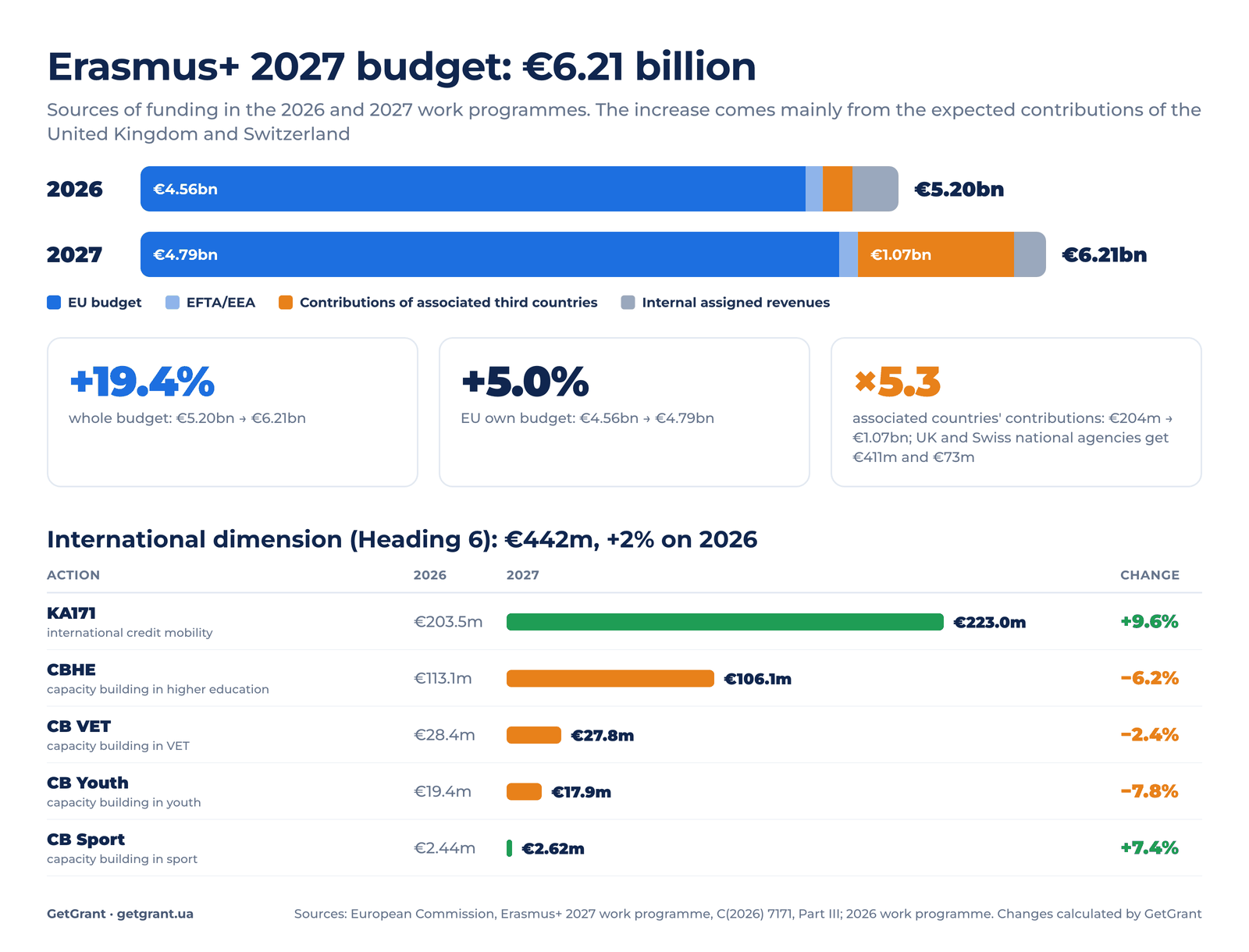
By field, the €6.21 billion is split as follows: €5.45 billion for education and training, €644 million for youth and €121 million for sport. In education the largest share goes to mobility (Key Action 1, €3.82 billion).
Compared with 2026 (€5.20 billion), the budget grew by €1.01 billion. But the EU’s own appropriations rose only from €4.56 billion to €4.79 billion (+5%). External assigned revenues, that is, contributions of associated third countries, grew from €204 million to €1.07 billion, 5.3 times. The reason is the expected accession of the United Kingdom and Switzerland: their national agencies alone receive €411 million and €73 million in Key Actions 1 and 2. This money largely flows back to the same countries, and their participation is recorded conditionally, “provided it joins Erasmus+”. The calculation is ours, based on the budget tables of the 2026 and 2027 work programmes.
For Ukraine, the international dimension matters more. It is funded under Heading 6 “Global Europe” (NDICI and IPA III). In 2027 it amounts to €442 million, only 2% more than in 2026 (€434 million). Within it, funds were reallocated: KA171 grows by 9.6%, to €223 million, while capacity building, where Ukrainian organisations can be applicants, shrinks. CBHE falls from €113.1 million to €106.1 million (−6.2%), CB Youth from €19.4 million to €17.9 million (−7.8%) and CB VET from €28.4 million to €27.8 million (−2.4%). By contrast, actions from the internal part of the budget that are open to Ukrainian universities are growing: Erasmus Mundus from €130 million to €146.5 million, Jean Monnet actions in higher education from €15.7 million to €20.1 million.
Ukraine’s status: a third country on the way to association
The countries associated to the Programme in 2027 are Norway, Iceland, Liechtenstein, North Macedonia, Türkiye and Serbia, as well as Switzerland and the United Kingdom subject to their agreements. Ukraine is not among them. In the action descriptions it appears as a third country not associated to the Programme, in the Eastern Partnership group, and for Jean Monnet networks explicitly as “Ukraine (part of Erasmus+ Region 2)”.
Preparation for association is under way, but there is no agreement yet. In July 2025, at the Ukraine Recovery Conference in Rome, the European Commission announced its commitment to associate Ukraine to Erasmus+. In November 2025 the Association Agreement subcommittee discussed full association from 2028, and in June 2026 an Interagency Working Group started work in Ukraine to begin setting up a National Erasmus+ Agency by the end of the year. We found no decision to open negotiations or to sign an agreement. The realistic horizon is the new 2028–2034 programme, which the Commission proposed in July 2025 with a budget of €40.8 billion.
For comparison: Ukraine has been associated to Horizon Europe since June 2022 and participates there on the same terms as the Member States. In Erasmus+, until association, a Ukrainian organisation can be an applicant only where this is explicitly allowed for non-associated countries.
What is new for Ukraine in 2027
Preparation for association: €4.64 million. The new action 3.22 targets Albania, Bosnia and Herzegovina, Kosovo, Moldova, Montenegro and Ukraine. The money will go to establishing and launching future Erasmus+ national agencies (teams, procedures, financial management) and to informing future beneficiaries. Grants will be awarded without a call to future national authorities or agencies. For applicants this is a signal: the Commission is funding the infrastructure without which association is impossible. There was no such action in 2026.
Jean Monnet network “EU-Ukraine-Moldova”. One of the two Jean Monnet networks on external policy in 2027 is dedicated to Ukraine and Moldova (the other is EU-Canada; in 2026 it was EU-India). The applicant can be a higher education institution from the EU, an associated country or Ukraine, and Moldovan institutions take part as full partners. The indicative budget is €1.2 million. For a Ukrainian university with strong European studies this is a rare opportunity to coordinate an international network of research and courses.
DiscoverEU for 18-year-olds. In 2027 DiscoverEU opens to young people from the same six candidate countries, with €935,000 earmarked for them. Participants receive a travel pass to explore Europe, and Eurodesk provides information support. Round dates have not been announced.
ECHE accreditation “tentatively as of 2028”. The Erasmus Charter for Higher Education (ECHE) is the basic condition for a university from the EU or an associated country to organise Erasmus+ mobility. In 2027 the Commission opens accreditation for higher education institutions and mobility consortia from non-associated countries with which it cooperates on association “tentatively as of 2028”. The accreditation is valid until 2034, but only if the country becomes associated. Ukraine is not named here; that Ukrainian universities fall under this provision is our reading in light of action 3.22, and it should be checked in the call. The accreditation brings no money.
The “Erasmus+ stands with Ukraine” priority. In education, youth and sport, special attention will be given to projects addressing the consequences of Russia’s war against Ukraine, and higher education has a separate priority: cooperation of EU universities with Ukrainian counterparts to rebuild Ukrainian higher education. For a Ukrainian partner this is an argument in negotiations with a European coordinator.
In addition, Ukraine’s national Eurydice, Euroguidance, Europass, EQF and eTwinning bodies are allocated €758,240. There is no separate line for National Erasmus+ Offices in non-associated countries, unlike in 2026 (€4.58 million); the work programme does not explain why.
Where you can be an applicant and where only a partner
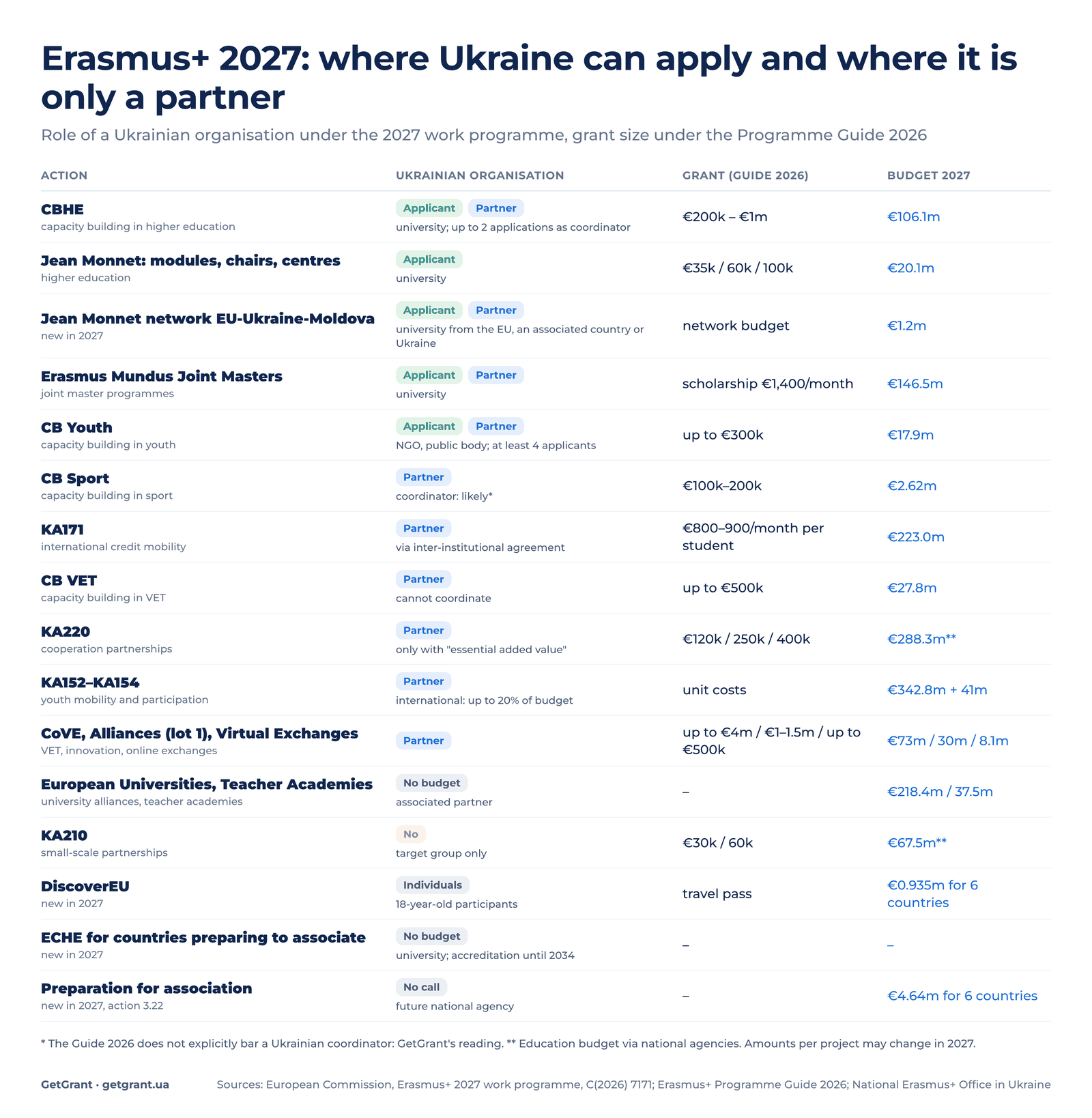
Applicant or coordinator. The largest resource is CBHE (€106.1 million). The coordinator can be a higher education institution from the EU, an associated country or a non-associated third country, Ukraine included. Under the Guide 2026, projects have three strands: fostering access to cooperation (€200,000–400,000), partnerships for transformation (€400,000–800,000) and structural reform (€600,000 – €1 million). One organisation may coordinate no more than two applications. Region 2 may submit “national” projects: at least two institutions from two EU or associated countries and at least two Ukrainian institutions, with no fewer Ukrainian organisations than European ones.
Ukrainian universities also apply on their own for Jean Monnet modules (up to €35,000), chairs (up to €60,000) and centres of excellence (up to €100,000). For Erasmus Mundus Joint Masters the work programme explicitly allows applicants from non-associated countries; a student scholarship under the Guide 2026 is €1,400 per month. In CB Youth (€17.9 million, up to €300,000 per project) a Ukrainian civil society organisation or public body can coordinate, but the consortium needs at least four applicants, including at least one from the EU or an associated country and two from two different non-associated countries of the same region. In CB Sport (€100,000–200,000) the Guide 2026 does not explicitly bar a Ukrainian coordinator, but that is our reading.
Partner only. In KA171 the applicant is a European university, and the Ukrainian one takes part through an inter-institutional agreement; a student from Ukraine in the EU receives €800–900 per month. A Ukrainian organisation can be a partner in CB VET (up to €500,000), Centres of Vocational Excellence (CoVE), Alliances for Innovation, Virtual Exchanges and KA220 cooperation partnerships, but in KA220 only if its participation brings “essential added value” without which the project would not be possible. In youth mobility, no more than 20% of the project budget may go to all activities with non-associated neighbouring countries.
No budget or not available. In European Universities and Teacher Academies Ukrainian institutions can only be associated partners, without eligible costs. In KA210 small-scale partnerships, according to the National Office, Ukrainians can only be a target group. The additional Erasmus Mundus scholarships under Heading 6 (€21.1 million) target other regions.
Ukraine in Erasmus+ 2021–2026: demand rising, success rate falling
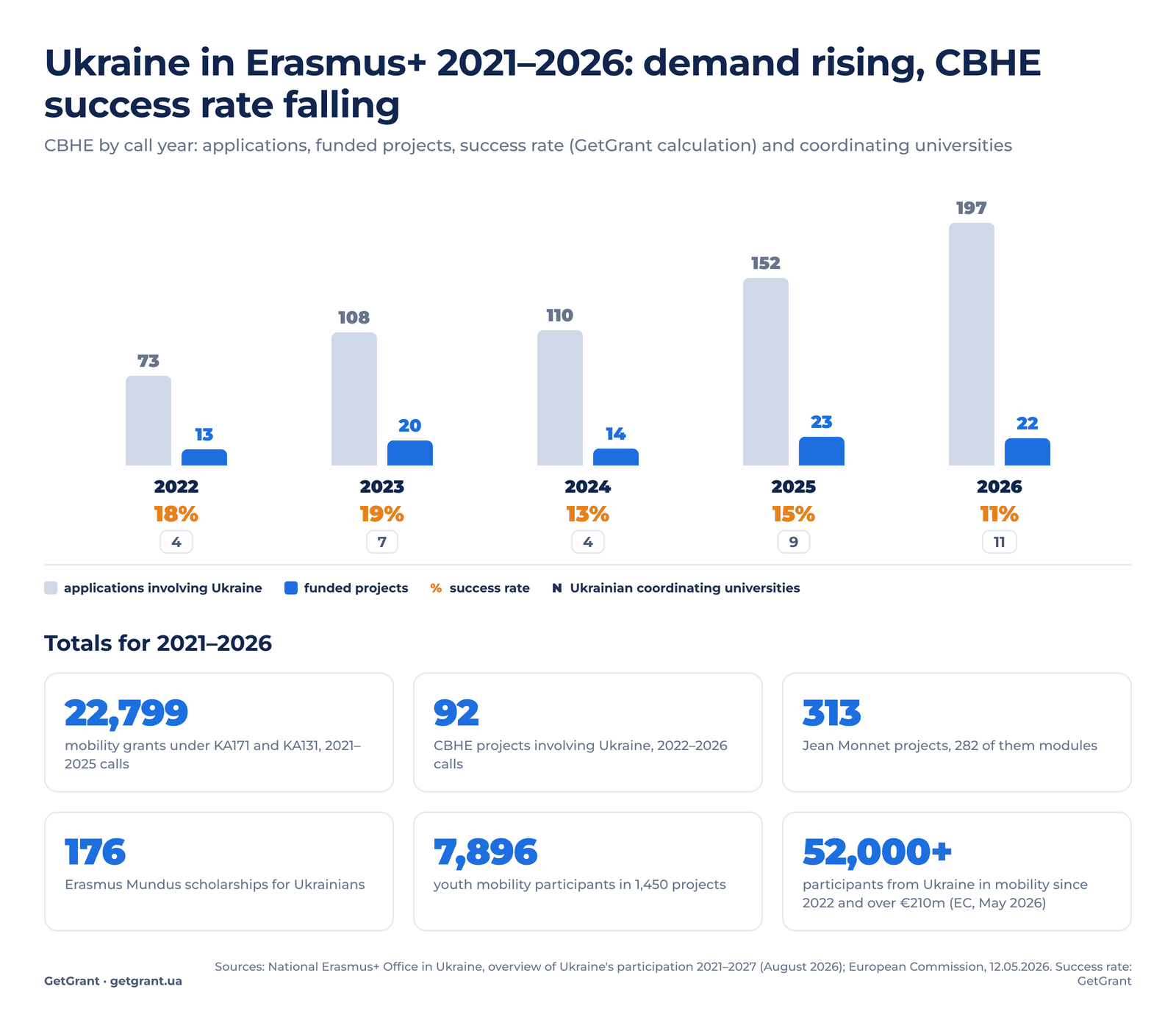
According to the National Erasmus+ Office (overview of August 2026), in the 2021–2025 calls Ukrainian universities received 22,799 individual mobility grants under KA171 and KA131. In 2021–2026, 313 Jean Monnet projects were funded, 282 of them modules, Ukrainians received 176 Erasmus Mundus scholarships, and 7,896 people took part in youth mobility. In May 2026 the European Commission put support since 2022 at more than 52,000 participants from Ukraine in mobility and more than €210 million.
The most telling trend is in CBHE. The number of applications involving Ukraine grew from 73 in the 2022 call to 197 in the 2026 call, 2.7 times. Funded projects: 13, 20, 14, 23 and 22. The success rate (our calculation): 18%, 19%, 13%, 15% and 11%. A positive trend is that Ukrainian universities increasingly coordinate projects: 4 in 2022 and 11 in 2026 according to the National Office (the EU Delegation reported 10). In the 2026 call Ukraine was among the top five countries by number of CBHE projects.
The CBHE budget for 2027 shrinks by 6.2%, while applications involving Ukraine have grown every year. If the trend continues, the winners will be applications that clearly match the priority of rebuilding higher education and have an experienced European consortium. One strong application is better than two weak ones.
Calendar: what is known about the 2027 deadlines
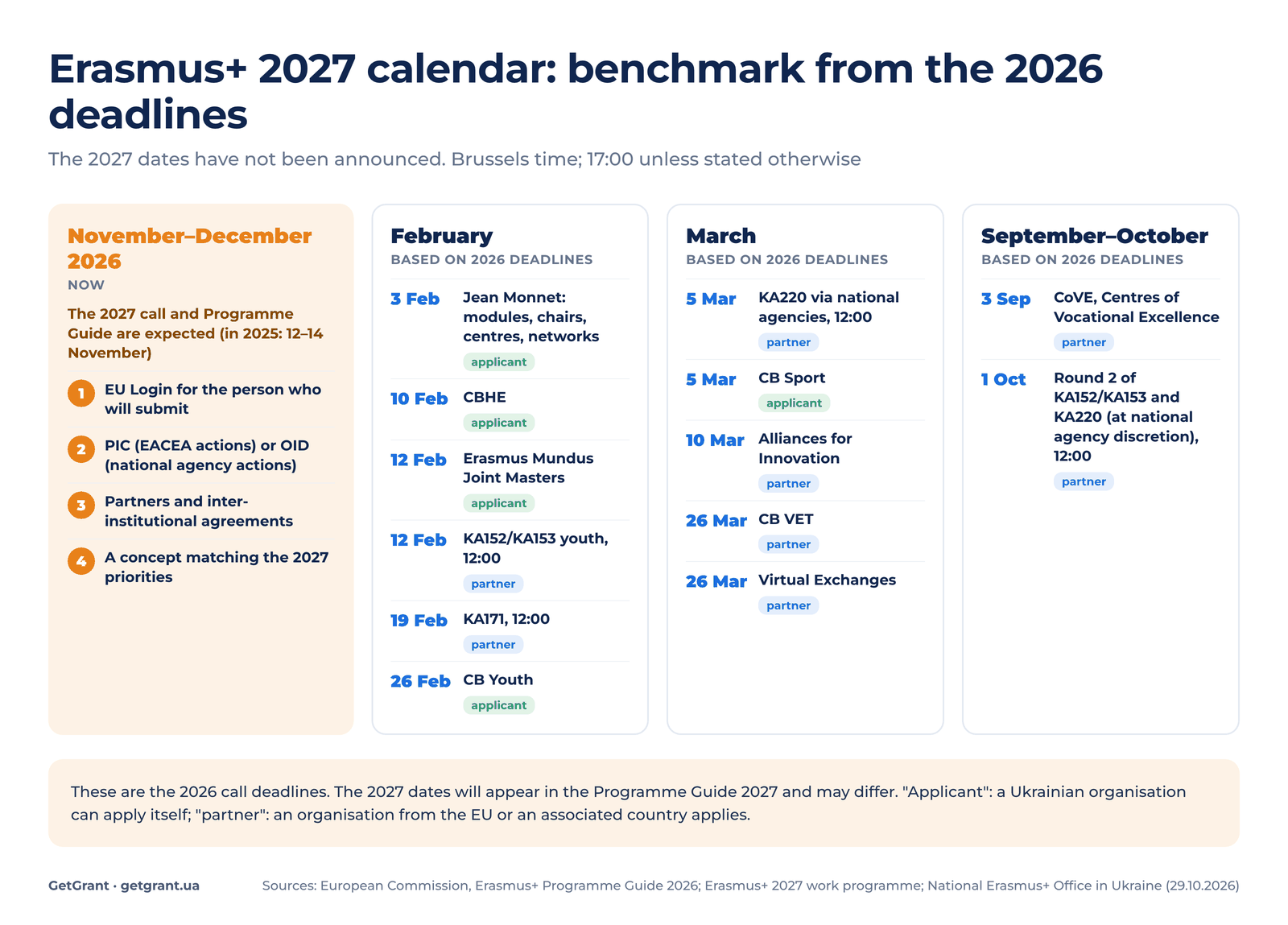
The main caveat: the 2027 deadlines do not exist yet. The work programme does not contain them, and the Guide 2027 is expected together with the call, which in 2024 and 2025 came in mid-November. Fig. 4 therefore shows the 2026 deadlines (Brussels time). They are a precedent, not a promise. In 2026 the first deadlines were in actions where a Ukrainian organisation can be an applicant: Jean Monnet on 3 February, CBHE on 10 February, Erasmus Mundus Joint Masters on 12 February, CB Youth on 26 February and CB Sport on 5 March, all at 17:00. European partners submitted KA171 by 19 February, KA220 via national agencies by 5 March and CB VET by 26 March.
From the call announcement to the first deadlines there will be two to three months, including the Christmas holidays, so it is worth starting before the Guide is out:
- Create an EU Login account for the person who will submit the application.
- Register the organisation. For actions managed by EACEA (CBHE, CB VET, CB Youth, CB Sport, Jean Monnet, Erasmus Mundus, CoVE, Alliances, Virtual Exchanges) you need a PIC on the Funding & Tenders portal; a PIC from Horizon Europe or another EU programme already works. For national agency actions to which a European partner invites you (KA171, KA220, youth mobility) you need an OID in the Erasmus+ organisation registration system.
- Find partners: the Funding & Tenders partner search, EPALE, eTwinning, SALTO-Youth OTLAS, the National Erasmus+ Office and Eurodesk.
- Prepare a concept in line with the 2027 priorities: inclusion, green and digital Erasmus+, participation in democratic life and preparedness, and, for higher education, rebuilding Ukrainian higher education.
Common mistakes
- Applying as coordinator where Ukraine can only be a partner. In CB VET, KA220, KA171, CoVE and Virtual Exchanges such an application will fail the eligibility check.
- Exceeding the CBHE limit. No more than two applications per coordinator, and in a “national” project at least two Ukrainian institutions and no fewer Ukrainian organisations than European ones.
- The wrong consortium in CB Youth. At least four applicants are needed, including two from two different non-associated countries of the same region; an “EU plus Ukraine” pair is not enough.
- Failing to justify added value in KA220. The application must show why the project would not be possible without the Ukrainian partner.
- Counting on a budget in European Universities or Teacher Academies. An associated partner has no eligible costs.
- Registering a PIC in the last week. Validation takes time, and without a PIC you cannot submit.
Who you are and where to apply
Universities. You can be an applicant in CBHE, Jean Monnet actions, the new “EU-Ukraine-Moldova” network and Erasmus Mundus Joint Masters. For KA171, update inter-institutional agreements with European partners before February and follow the ECHE accreditation.
Colleges, vocational schools and schools. You cannot be an applicant, but you can become a partner in CB VET, CoVE, Alliances for Innovation and KA220 cooperation partnerships. For schools the realistic entry point is eTwinning and partnerships with European schools that apply through their national agencies.
Civil society and youth organisations. Your action as coordinator is CB Youth, up to €300,000 per project. As a partner you can take part in youth exchanges, youth worker mobility and cooperation partnerships in youth, as well as in a separate programme, the European Solidarity Corps, if you hold a quality label.
Sport organisations. The closest action is CB Sport, €100,000–200,000 per project. As a partner you can take part in cooperation partnerships in sport, where projects related to the war against Ukraine and peace-building through sport receive special support in 2027.
Students and staff. Your route is KA171 mobility through your university (€800–900 per month for a student from Ukraine in the EU at 2026 rates), Erasmus Mundus scholarships (€1,400 per month) and, if you are 18, DiscoverEU.
Conclusion
The Erasmus+ 2027 work programme is the largest of the whole 2021–2027 period, but its 19.4% increase is largely technical: it comes from the contributions of the United Kingdom and Switzerland, while the EU’s own budget grew by 5% and the international dimension by 2%. For Ukraine, 2027 combines two trends. Capacity building in higher education, where Ukrainian universities are most active, is shrinking while competition in it is growing. At the same time, the document for the first time directly prepares Ukraine for association: it funds the future national agency and opens DiscoverEU, a dedicated Jean Monnet network and ECHE accreditation with 2028 in view. The call dates, amounts per project and the conditions of the new accreditation remain uncertain. The winners will be those who prepare registration, partners and a concept before the Guide is out and use 2027 to enter the new programme as an organisation from an associated country.
The GetGrant team helps universities, colleges, schools, civil society and sport organisations choose an Erasmus+ action that fits their profile, find European partners and prepare an application. Current calls are collected in the GetGrant catalogue, and individual support can be ordered on the services page.
Sources
- Publications Office of the EU: 2027 annual work programme “Erasmus+”, C(2026) 7171 of 15.10.2026
- European Commission: Erasmus+ 2026 annual work programme
- European Commission: Erasmus+ Programme Guide 2026, version 1
- European Commission: eligible countries, Programme Guide, Part A
- European Commission: registration of organisations, Programme Guide, Part C
- EACEA: launch of the 2026 Erasmus+ call for proposals and Programme Guide, 14.11.2025
- National Erasmus+ Office in Ukraine: the Erasmus+ 2027 financing programme has been published, 29.10.2026 (in Ukrainian)
- National Erasmus+ Office in Ukraine: overview of Ukraine’s participation in Erasmus+ 2021–2027, August 2026
- European Commission: new support initiatives announced at the Ukraine Recovery Conference in Rome, 2025
- European Commission: Building resilience and human capital for Ukraine’s European future, 12.05.2026
- EU Delegation to Ukraine: 22 new CBHE projects with 105 organisations from Ukraine, 2026
- Government of Ukraine: report on the implementation of the Association Agreement in 2025
- Verkhovna Rada Committee on Education, Science and Innovation: Interagency Working Group on preparing association to Erasmus+, 17.06.2026 (in Ukrainian)
- Council of the EU: proposal for the Erasmus+ 2028–2034 regulation, COM(2025) 549
- European Commission: Ukraine’s association agreement to Horizon Europe enters into force, 09.06.2022

Book a consultation or leave your application idea
Tell us in a few words about your project: we will say which grants it fits and can take the application itself off your hands. We reply within one business day.