GetGrant analysis of Funding & Tenders portal data: 302 Horizon Europe topics worth €7.41 billion, three deadline waves, typical grant size by action type and what is available to Ukrainian organisations.
The final two years of Horizon Europe come as a long list of topics in which it is easy to get lost: the 2026–2027 work programme, adopted on 11 December 2025, has a budget of around €14.8 billion after the amendment of 29 September 2026, and most topics are published on the Funding & Tenders portal long before submission opens. For a Ukrainian team the practical question is different: what can still be submitted in time, when exactly, and will the team meet the formal conditions.
On 31 October 2026 GetGrant opened a Horizon Europe tab on its website: every topic has its own page with a Ukrainian translation, figures from the EU portal and a “Become a partner” button for consortium building. Using these data, we calculated how many topics remain open on the publication date of this article, 6 November 2026, how they are distributed across programme parts and months, what the typical grant size is and what of all this is actually available to Ukrainian organisations.
Short answer
- On 31 October 2026 our database held 324 open and forthcoming Horizon Europe topics. 22 of them closed on 4–5 November, so from 6 November it is still possible to apply to 302 topics with an indicative budget of €7.41 billion and around 1,100 expected grants.
- Deadlines come in three waves: November–December 2026 (26 topics, the largest being MSCA Doctoral Networks worth €628 million with a deadline of 24 November), February–March 2027 (75 topics, €1.78 billion) and September 2027 (105 topics, €2.38 billion, a third of the whole budget).
- The typical EU contribution per project, measured as the median maximum amount, is €5 million in Research and Innovation Actions (RIA), €7 million in Innovation Actions (IA) and €3 million in Coordination and Support Actions (CSA).
- 63% of topics are funded as a lump sum, and only 4 two-stage topics remain (1.3%). 74% of topics have the status “Forthcoming”: submission has not opened yet and dates may still change.
- Ukraine has been associated to the whole programme since 2022. According to the topic texts, 11 topics are closed to Ukrainian organisations (€248 million, 3.3% of the budget): 10 in Cluster 4 and one in WIDERA. The remaining 291 topics are open on general terms.
- 10 topics mention Ukraine explicitly, and one of them requires a Ukrainian participant. In four WIDERA topics worth €348 million a Ukrainian organisation can be the coordinator or host institution as a Widening country.
What we counted and how
The source is the Horizon Europe topics table that GetGrant compiles daily from its own grants database and the Funding & Tenders portal API; where the data differ, the portal takes precedence. On 31 October 2026 it contained 324 topics with a deadline from that date. For this article we took topics with a deadline from 6 November: there are 302 of them, including two Euratom topics (a separate nuclear research programme to which Ukraine is also associated) without budget data. Topic budgets are indicative, especially for 2027; for two-stage topics the first-stage date is used; ERC grants and EIC topics for 2027 are not in the database.
When the deadlines fall: three waves
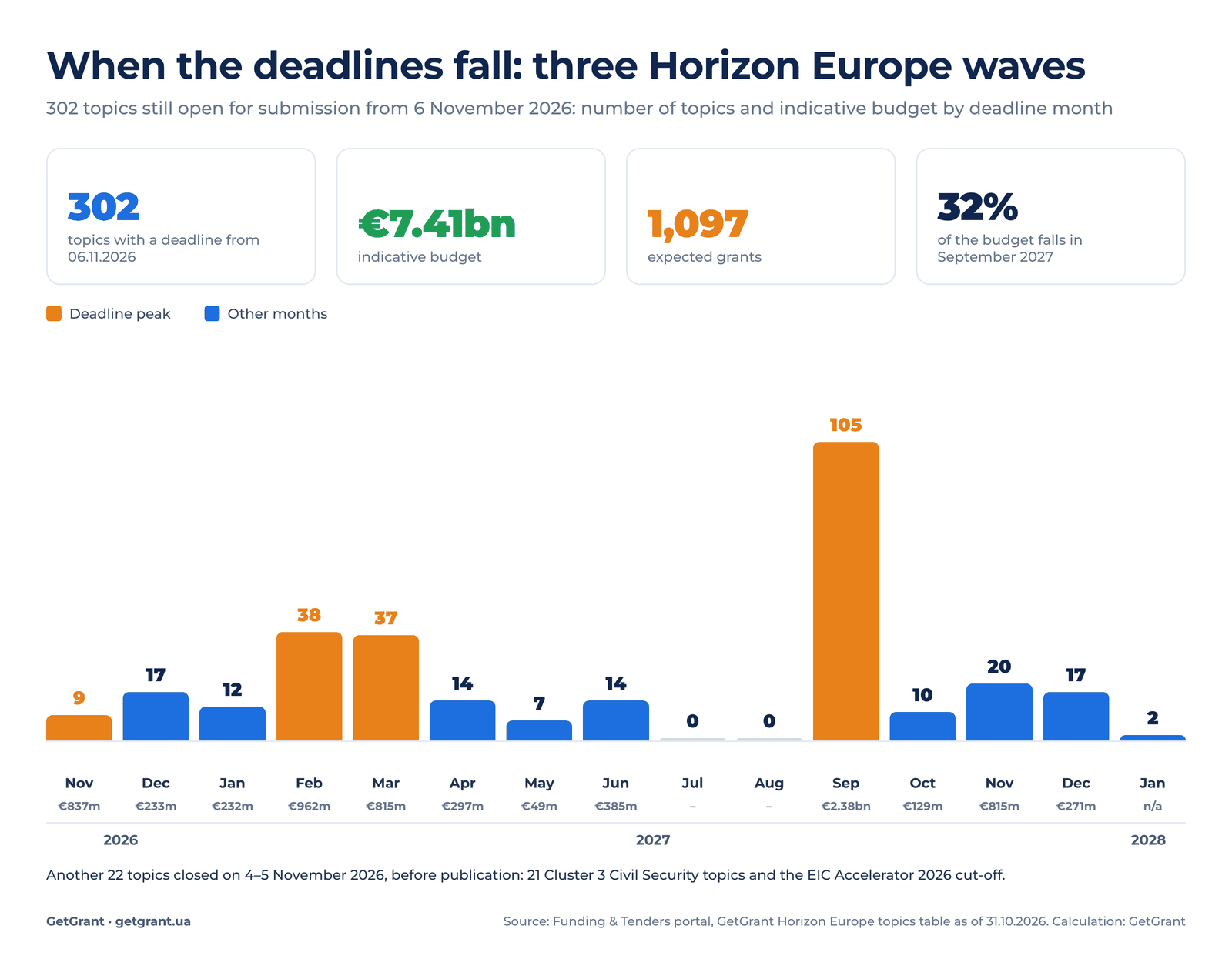
The first wave is the end of 2026. As of 31 October, November had 31 topics, but 21 of them (the Cluster 3 “Civil Security for Society 2026” call) closed on 5 November, and the EIC Accelerator 2026 short application cut-off passed on 4 November. After 6 November, 9 November topics worth €837 million remain: six EuroHPC quantum technology topics (17 November), MSCA Doctoral Networks 2026 worth €628 million and the RAISE pilot (24 November), and a topic on agricultural data (26 November). Another 17 topics close on 1 December, nine of them under the New European Bauhaus.
The second wave is February and March 2027: 75 topics worth €1.78 billion. Most of them belong to Cluster 4 (2 February and 18 March), Cluster 1 “Health” (17 February), Cluster 5 (4 and 31 March) and the horizontal “Bridging actions 2027” topics (16 February), plus Excellence Hubs in WIDERA (4 March). All 38 February topics are already open, so their conditions are final, while the March ones, except Excellence Hubs, are still “Forthcoming”.
The third wave is September 2027, the largest month of the period: 105 topics and €2.38 billion, or 32% of the budget. Almost two thirds of the topics fall on 22 and 23 September, when the Cluster 2 and Cluster 6 calls close (24 and 38 topics). September also brings the deadlines for MSCA Postdoctoral Fellowships, ERA Chairs and the EU Missions. In November 2027 another 20 topics worth €815 million close: Cluster 3 (4 November) and MSCA Doctoral Networks 2027 worth €646 million (23 November).
The practical conclusion: for the September 2027 calls You have about 10 months, which is enough to build a consortium from scratch. For February–March three to four months remain, which is realistic only with existing partners. The November and December 2026 topics are worth considering only if preparation is already under way.
Where the money is: programme parts
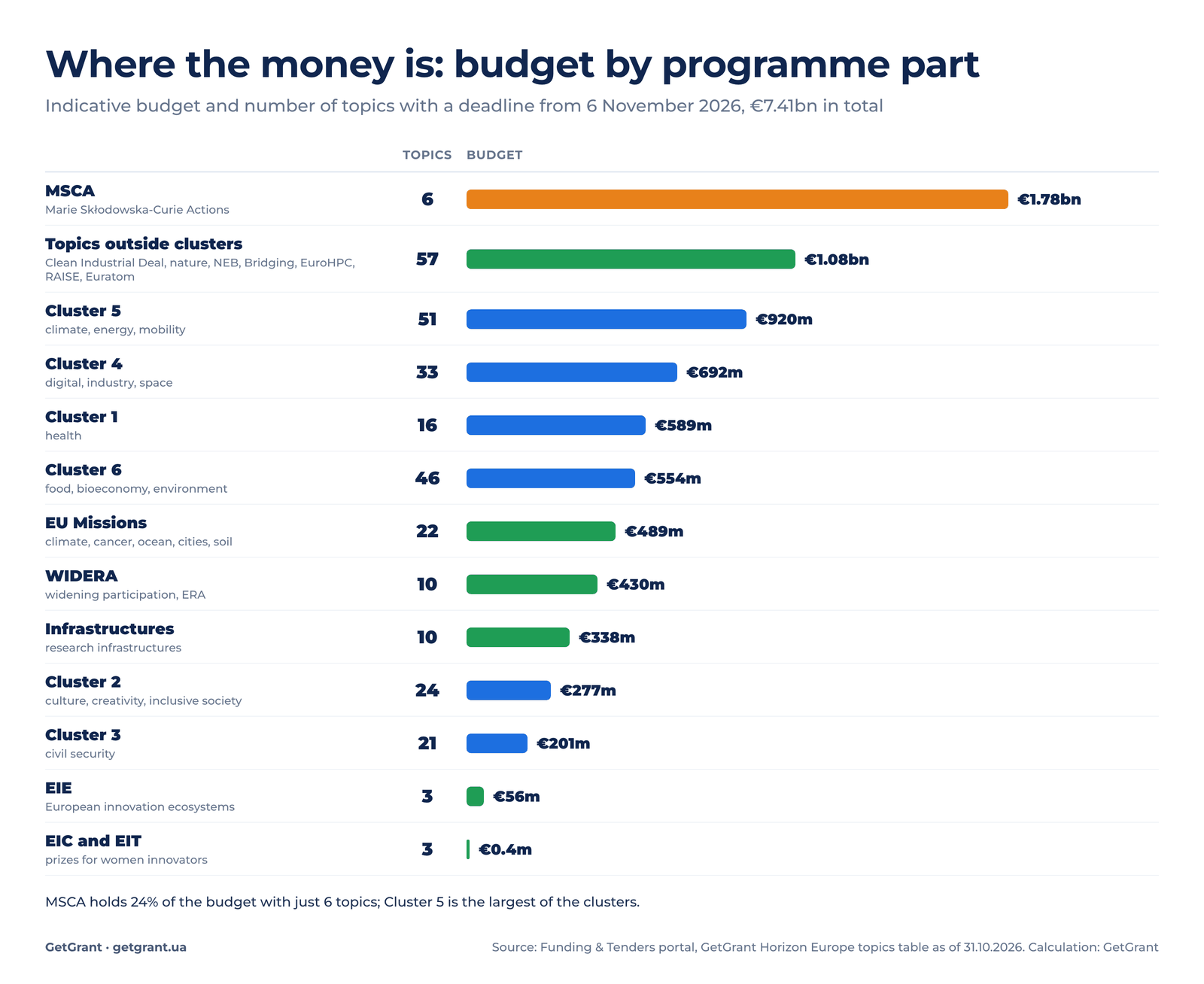
The largest share of the budget belongs not to the clusters but to the Marie Skłodowska-Curie Actions: only 6 topics, but €1.78 billion, or 24% of the total. These are two waves of Doctoral Networks (€628 million and €646 million), the 2027 Postdoctoral Fellowships (€330 million for European and €58 million for Global Fellowships), two COFUND programmes of €51 million each and “MSCA and Citizens”. For universities and research institutes this is the main resource.
Next come topics outside the clusters: 57 topics worth €1.08 billion. The largest are two topics supporting the Clean Industrial Deal (€265 million), the nature-positive economy (€219 million), the New European Bauhaus (€208 million), “Bridging actions 2027” (€203 million), EuroHPC (€125 million) and RAISE (€61 million).
Among the clusters, Cluster 5 “Climate, Energy and Mobility” leads (51 topics, €920 million), followed by Cluster 4 “Digital, Industry and Space” (33 topics, €692 million), Cluster 1 “Health” (16 topics, €589 million, the largest budget per expected grant among the clusters, about €8.9 million) and Cluster 6 “Food, Bioeconomy, Agriculture and Environment” (46 topics, €554 million). Clusters 2 “Culture, Creativity and Inclusive Society” (24 topics, €277 million) and 3 “Civil Security for Society” (21 topics, €201 million) are smaller but have the most accessible format: a median of €4 million per project.
How much one project gets
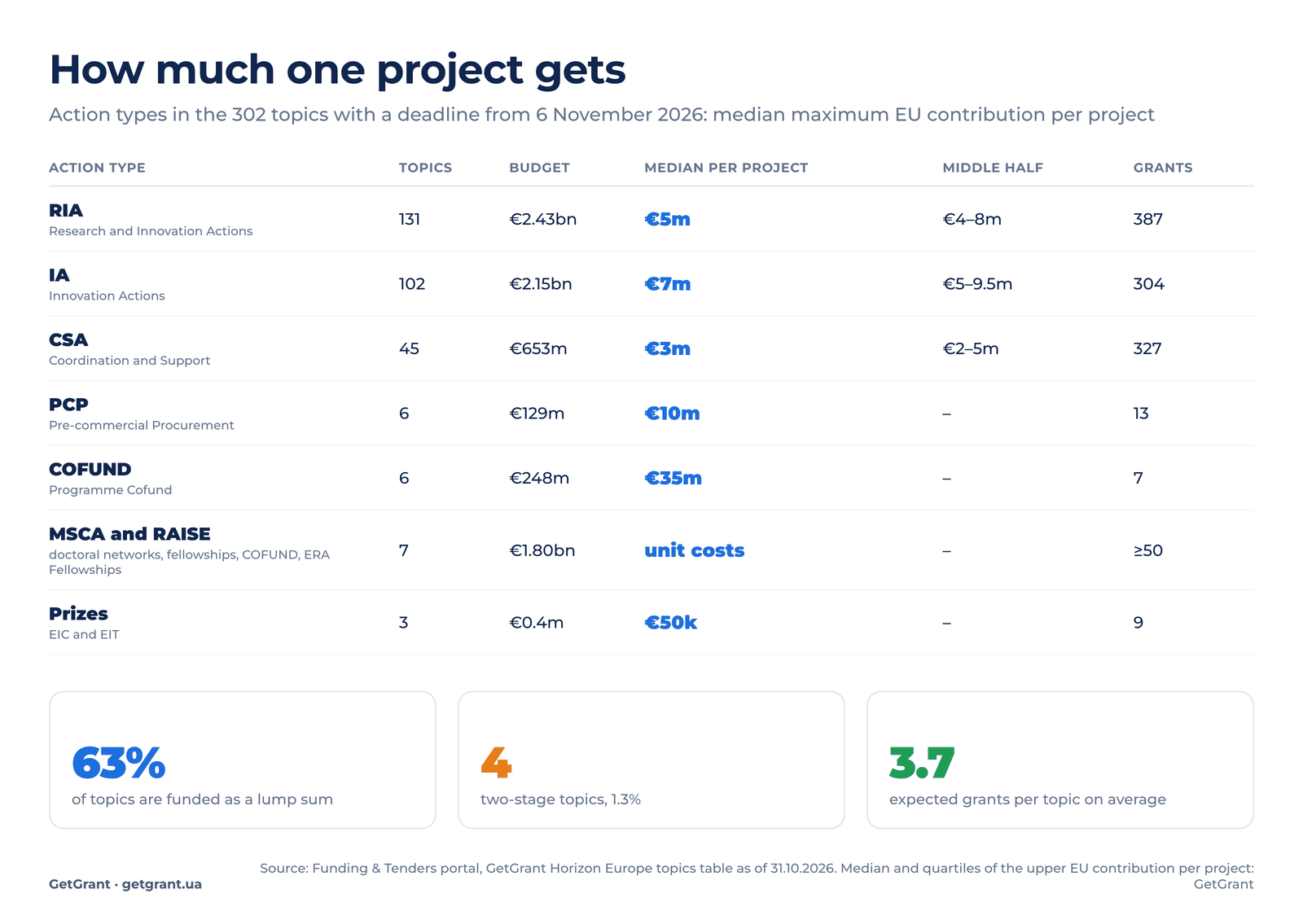
For every topic the portal states the expected EU contribution per project (an amount or a range) and the number of grants. We took the upper end of the range and calculated the median by action type:
- Research and Innovation Actions (RIA): 131 topics, €2.43 billion, median €5 million (€4–8 million for the middle half of topics), 387 expected grants;
- Innovation Actions (IA): 102 topics, €2.15 billion, median €7 million (€5–9.5 million for the middle half), 304 grants;
- Coordination and Support Actions (CSA): 45 topics, €653 million, median €3 million, 327 grants, because this group includes ERA Chairs (80 grants) and “MSCA and Citizens” (50 grants);
- Pre-commercial Procurement (PCP): 6 topics, €129 million, median €10 million, 13 grants;
- Programme Cofund Actions (COFUND): 6 topics, €248 million, one or two grants per topic.
Altogether 294 topics provide for 1,097 grants, 3.7 per topic on average. Six MSCA and RAISE topics give no number because funding is calculated with unit costs, and there are no data for the two Euratom topics. So the typical project at the end of the programme asks the EU for €3–8 million, and three or four such projects will be funded per topic.
Two more factors. 191 of the 302 topics (63%) are funded as a lump sum: payment is tied to the completion of work packages rather than to actual costs, so the budget has to be broken down by work package already in the proposal. According to the European Commission, the work programme has 41 two-stage topics, but most first stages have passed: only 4 remain open for submission (in Cluster 4 with a first stage on 2 February 2027 and in Cluster 1 on 17 February 2027).
What is actually available to Ukrainian organisations
The agreement associating Ukraine to Horizon Europe and Euratom entered into force on 9 June 2022. In the official List of Participating Countries (version 4.2 of 7 October 2026) Ukraine appears among the 23 associated countries without exceptions; by comparison, the United Kingdom is associated to the whole programme except the EIC Fund. The principle is that entities from associated countries participate under the same conditions as entities from Member States unless the topic text sets restrictions to safeguard the EU’s strategic assets, autonomy or security.
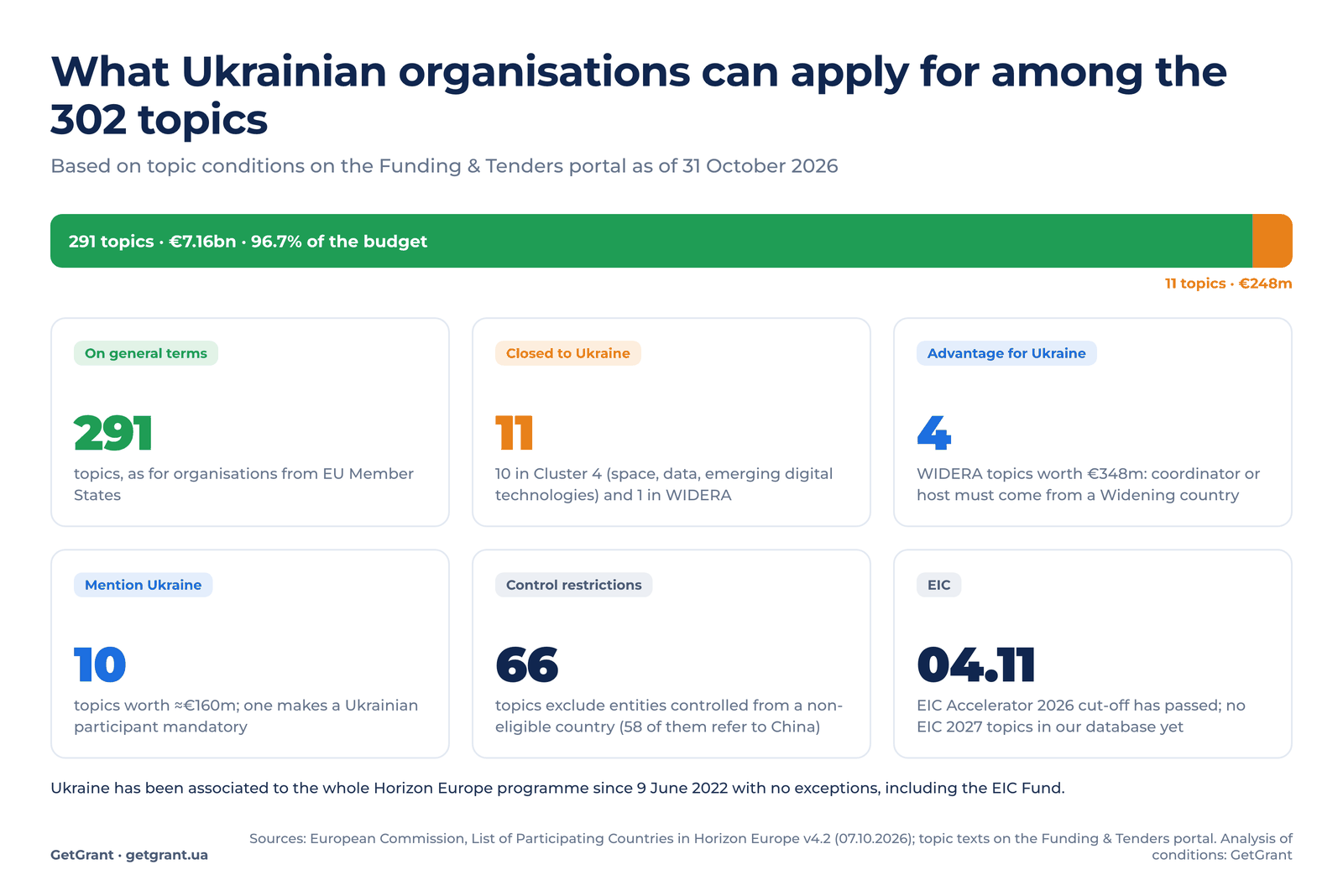
The conditions of all 302 topics give the following picture:
- 11 topics (€248 million, 3.3% of the budget) limit participation to a list that does not include Ukraine. Ten are in Cluster 4, meaning almost a third of its topics are closed: space (some only for Member States, Norway and Iceland), data and emerging digital technologies (Member States, Norway, Iceland and six associated countries, Ukraine not among them). The other one is a WIDERA topic on European research on China.
- The Cluster 3 topics for 2027 contain no explicit exclusion of Ukraine: the cybersecurity topics are open to Member States and associated countries. At the same time, 66 topics (58 of them naming China) apply a control restriction: entities directly or indirectly controlled from a non-eligible country are excluded. Ukrainian companies with foreign capital should check this before applying.
- In four WIDERA topics worth €348 million Ukraine has an advantage: the coordinator of ERA Chairs, ERA Research Managers and Excellence Hubs, and the host institution of ERA Fellowships, must be an organisation from a Widening country, and Ukraine is named explicitly in that list.
- 10 topics with a combined budget of about €160 million mention Ukraine explicitly. Only one requires its participation: “Strengthening forest research for the support of Ukraine”, where the consortium must include a Ukrainian research institution or public authority. In the other nine Ukraine is mentioned as a desirable partner, a pilot site location or context.
A separate note on the EIC. There are no restrictions for Ukraine here, but the EIC Accelerator 2026 short application cut-off passed on 4 November, and as of 31 October EIC topics for 2027 had not yet appeared in our database, so their dates are not yet determined. From 6 November only two categories of the European Prize for Women Innovators are open under the EIC. Participation conditions in the seven EuroHPC Joint Undertaking topics are also undetermined: they are not set out in the portal data, and the eligibility of a Ukrainian organisation has to be checked against the Joint Undertaking’s own documents.
Example topics for different applicants
We selected topics not closed to Ukraine for typical applicants. Figures are from the EU portal as of 31 October 2026.
For universities:
- MSCA Doctoral Networks 2026: €628 million, deadline 24 November 2026. Realistic only for those already in a network; others should plan for the wave of 23 November 2027 (€646 million).
- ERA Chairs: €175 million, 80 grants of €1.5–2.5 million, deadline 14 September 2027. A single institution from a Widening country applies to attract a leading researcher and build a team around them.
- Excellence Hubs: €100 million, 30 grants of €1.5–4.5 million, deadline 4 March 2027. At least two ecosystems from two Widening countries are required, each with academic institutions, businesses, local or regional authorities and societal actors.
For research institutes:
- Strengthening forest research for the support of Ukraine: €6 million, one grant, deadline 22 September 2027. The only topic where a Ukrainian participant is mandatory.
- Technologies for innovative processing of raw materials (IA): €49 million, 4 grants of €10–12.5 million, deadline 2 February 2027. The topic encourages cooperation with the EU’s strategic raw materials partners, “especially with Ukraine”.
For SMEs and start-ups:
- Demonstration of solid biofuel supply and conversion to high efficiency CHP from fully sustainable regional value chains: €13.5 million, 2 grants of €6.75 million, deadline 1 December 2026. The topic encourages support for the reconstruction of Ukraine through regional value chains or Ukrainian beneficiaries.
- European Prize for Women Innovators: three prizes of €50,000 to €100,000, deadline 1 December 2026. For women innovators from the EU and associated countries.
For communities and cities:
- Towards a Europe of Bioeconomy Places: €12 million, 2 grants of €6 million, deadline 22 September 2027. At least one of the three pilot sites must be fully or partially in Ukraine.
- Innovative approaches for the spatial design of neighbourhoods: €10 million, 2 grants of €5 million, deadline 1 December 2026; similar New European Bauhaus topics also have a deadline of 1 December 2027.
For civil society organisations:
- Global Human Rights and EU values: €12 million, 3 grants of €3.5–4 million, deadline 23 September 2027. The focus is on the EU Neighbourhood, which the topic defines as including Ukraine; for NGOs with analytical capacity the realistic role is that of a consortium partner.
How to plan submissions
The figures suggest a simple calendar. Until the end of 2026 it makes sense to apply only where partners and a draft already exist. November–December is better used to choose 2–3 September 2027 topics and start looking for a consortium: 223 of the 302 topics (74%) have the status “Forthcoming”, but their text is already on the portal. For the February and March topics it is advisable to have a consortium already now.
To help coordinators find You, every topic page on GetGrant has a “Become a partner” button: users of the Expert plan can leave an offer with their competences and PIC code, and other Expert users see it in the portal.
Conclusion
From 6 November 2026, 302 topics remain in Horizon Europe with an indicative budget of €7.41 billion and around 1,100 grants. The money is concentrated in two windows, February–March and September 2027, and the largest single resource for universities and research institutes is the MSCA. For Ukrainian organisations the programme is almost fully open: the exclusions concern 11 topics and 3.3% of the budget, mostly in space and digital technologies in Cluster 4, while in WIDERA Ukraine has an advantage. Still undetermined are the dates of the 2027 EIC topics and the final 2027 budgets. The main constraint is now time: a consortium can still be built for the September calls, while for the March calls partners are already needed.
The GetGrant team helps universities, research institutions, companies and civil society organisations choose a Horizon Europe topic that matches their profile, find partners and prepare a proposal. All topics are in the Horizon Europe section, and individual support can be ordered on the services page.
Sources
- European Commission Funding & Tenders portal
- European Commission: List of Participating Countries in Horizon Europe, version 4.2 of 07.10.2026
- European Commission: Ukraine’s association agreement to Horizon Europe and Euratom enters into force, 09.06.2022
- European Commission IP Helpdesk: Horizon Europe Work Programme 2026–2027 adopted, €14 billion, 41 two-stage topics
- EURAXESS: amendment of the 2026–2027 work programme of 29.09.2026, around €14.8 billion
- Horizon Europe Work Programme 2026–2027, part 11 “Widening participation and strengthening the European Research Area” (definition of Widening countries)
- GetGrant: all Horizon Europe topics

Book a consultation or leave your application idea
Tell us in a few words about your project: we will say which grants it fits and can take the application itself off your hands. We reply within one business day.