
We compare the cost of three ways to finance an investment in Ukraine in 2026: a grant, an Affordable Loans 5-7-9% loan, and a loan from an EBRD partner bank with a grant reimbursement. Limits and rates after the June changes, programme statistics, three interest calculations and typical reasons for refusal.
Figures checked against primary sources as of 7 October 2026.
In 2026 a Ukrainian company’s investment decision is less and less a choice between a non-repayable grant and a loan. The Affordable Loans 5-7-9% programme has become a fully fledged investment instrument with sector limits, EBRD and EU credit lines now attach a grant reimbursement of up to 30% of project cost to a bank loan, and the updated Vlasna Sprava scheme gives micro-businesses non-repayable funds without a mandatory new job. This article compares what each financing route costs: directly (interest, own contribution) and indirectly (time to decision, reporting, risk of rejection).
The analysis draws on decisions of the Cabinet of Ministers, statements by the Ministry of Economy and the Ministry of Finance, and the programme pages of the EBRD and the National Development Institution. Interest costs are calculated on an annuity schedule and rounded. Where official confirmation could not be found, this is stated explicitly.
Key findings
- For most investment projects the question is not “grant or loan” but “which loan carries the largest grant component”. Direct equipment grants for an ordinary company are scarce; non-repayable money mostly arrives as a reimbursement attached to a loan.
- A 5-7-9 loan wins on availability and scale: limits range from UAH 3 million for sole proprietors to UAH 250 million for energy projects, with 48 participating banks.
- A loan from an EBRD partner bank with an EU4Business grant wins on price when the equipment is listed in the technology catalogues: 10–30% reimbursed after installation, with the grant capped at EUR 300,000.
- A grant as a stand-alone instrument has the edge in three situations: a small amount at start-up (Vlasna Sprava), rebuilding a destroyed production facility, and a sector programme with a high coverage rate (orchards, greenhouses, storage facilities).
- The most expensive item is often not interest but a lost season: a project planned around a grant and rejected on formal thresholds costs more than a 7% loan obtained on time.
What changed in 2026
Financing terms were revised throughout the year, so overviews written in winter or spring are no longer accurate. The changes below directly affect the calculation.
- 1 January. The National Development Institution (NDI) began operating on the basis of the Entrepreneurship Development Fund. It now administers the 5-7-9 programme.
- 28 January. The government raised the limit for energy projects from UAH 150 million to UAH 250 million and added cogeneration.
- 2 February. The 0% Energy Loan became available: up to UAH 10 million for up to 3 years, for generating units only.
- 12 June. The government updated the programme rules: it clarified the limits by area, cut bank margins (from 12 to 5 percentage points for sole proprietors), introduced a storage requirement for solar generation loans, and capped at 20% the share of a priority-area loan that may go to working capital.
- 1 July. A recovery loan scheme started for companies damaged by shelling: 0.1% a year for the first two years, then 5, 7 or 9%, up to UAH 150 million for up to 10 years, outside the general limits.
- 1 September. A modified interest coverage ratio (operating income to interest) was introduced for medium-sized enterprises. On the same date borrowers became subject to World Bank environmental and social standards (government resolution No. 1004 of 6 August 2026); reconstruction, energy projects, generating units and high war-risk zones are exempt for the duration of martial law plus 180 days.
- September. The updated Vlasna Sprava rules took effect: up to UAH 500,000 for start-up and up to UAH 2.5 million for scaling, including top-ups. The government announced them for 1 September; according to specialist media they have applied in practice since 9 September.
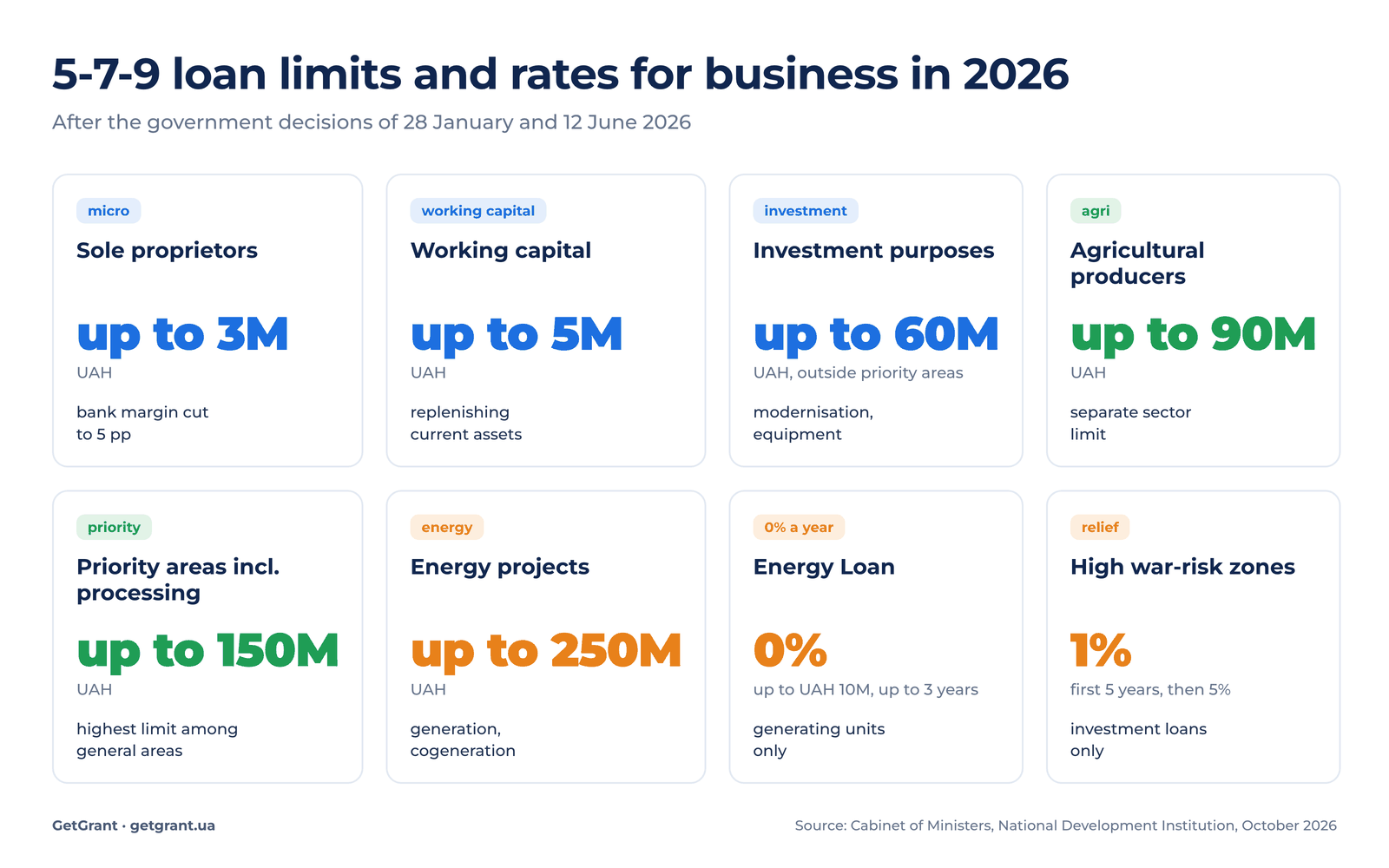
The 5-7-9 loan: limits, rates, terms
The programme is administered by the National Development Institution and involves 48 banks. Since 2024 it has been redirected from working capital towards investment: modernisation, energy efficiency and job creation.
| Area | Limit | Note |
|---|---|---|
| Sole proprietors | up to UAH 3 million | Bank margin cut to 5 pp from 12 June |
| Working capital | up to UAH 5 million | In priority areas no more than 20% of a loan may fund working capital |
| Investment purposes outside priority areas | up to UAH 60 million | Modernisation, equipment |
| Agricultural producers | up to UAH 90 million | Separate sector limit |
| Priority areas, including processing industry | up to UAH 150 million | Highest limit among general areas |
| Energy projects | up to UAH 250 million | Generation, cogeneration |
| Energy Loan | up to UAH 10 million at 0% | Up to 3 years, generating units only |
| Recovery after shelling | up to UAH 150 million | 0.1% for the first two years, term up to 10 years |
The borrower’s rate is 5, 7 or 9% a year depending on the business segment and on the creation of new jobs. For companies in high war-risk zones investment loans cost 1% a year for the first five years and 5% thereafter; this relief does not extend to working capital loans, which carry 7%.
Since 12 June a loan for a solar power plant has been issued only together with an energy storage unit of at least 2.5 kWh per kW of capacity. Ten regions are exempt: Sumy, Kharkiv, Dnipropetrovsk, Donetsk, Mykolaiv, Kherson, Odesa, Chernihiv, Poltava and Zaporizhzhia.
An officially stated processing time exists only for the Energy Loan: 5–10 working days. For other areas the bank sets the timing, and in practice it depends on how complete the borrower’s financial statements are.
Programme terms: National Development Institution, Energy Loan for business. A concise programme card is also available in the GetGrant database: Affordable Loans 5-7-9%.
A loan with a grant component: EBRD and EU4Business
This is the instrument entrepreneurs know least and, for projects with standard equipment, the one that pays best. A company takes a loan from an EBRD partner bank, buys the equipment, passes technical verification and then receives a grant reimbursing part of the investment. The reimbursement is paid by the EBRD and donors, not by the bank.
- Energy Security Support Facility (ESSF). EUR 2 billion through eight partner banks: PrivatBank, Ukrgasbank, Oschadbank, Raiffeisen Bank, UKRSIBBANK, ProCredit Bank, Ukreximbank and Credit Agricole. It focuses on generation, storage and energy efficiency and provides investment incentives of 10–30% plus risk sharing through EU guarantees.
- EU4Business-EBRD Credit Line. Up to 10% reimbursement for pre-approved technologies, up to 15% for standard and up to 20% for green technologies under the simplified approach, plus 5–15% for veterans and businesses from war-affected areas. The total may not exceed 30%, and the grant is capped at EUR 300,000.
The decisive condition is that the equipment appears in the EBRD technology catalogues (GTS or LET). The pre-approved and simplified approaches are designed for projects of up to EUR 300,000, the complex approach for up to EUR 5 million. If a model is not in the catalogue, the technology is assessed separately, and that time should be built into the project schedule.
The ESSF portfolio includes illustrative projects: a 7.2 MW solar plant costing UAH 173.5 million, of which UAH 122 million is an Ukrgasbank loan, with a payback of under four years; and a 2 MW / 4 MWh storage system costing UAH 73.5 million. For a small business the more realistic scenario is a project of up to EUR 300,000 under the simplified approach with a 15–20% reimbursement.
Programme pages: ESSF on the EBRD website, EU4Business-EBRD Credit Line.
Grants actually available to business
- Vlasna Sprava. Under the updated rules: UAH 100,000 to 300,000 for start-up with no mandatory job creation, up to UAH 500,000 with top-ups; UAH 500,000 to 1.5 million for scaling with at least one job, up to UAH 2.5 million with top-ups. The recipient undertakes to pay taxes and the unified social contribution equal to the grant amount; the project term is 2, 3 or 5 years. In detail: Vlasna Sprava 2026: full guide to the updated programme.
- Grants for processing enterprises. Up to UAH 8 million for development and up to UAH 16 million for rebuilding destroyed production (within confirmed losses), with a requirement to create at least 5 jobs.
- Sector grants for agribusiness. Orchards and berry plantations: UAH 140,000–400,000 per hectare, no more than 70% of project cost (80% in de-occupied and frontline areas). Greenhouses: up to UAH 7 million, no more than 70% of cost. Vegetable and fruit storage facilities with a capacity of 500 tonnes or more: up to 30% of construction cost (up to 50% in frontline areas), capped at UAH 4–20 million depending on capacity. Applications for orchard and greenhouse grants in 2026 are accepted until 15 October inclusive; the Ministry of Economy plans to reopen intake in the first quarter of 2027.
- A 25% reimbursement of the cost of machinery made in Ukraine (excluding VAT) with at least 60% local content.
All these programmes share three features: the grant covers part of the cost, requires confirmed co-financing and does not reimburse expenses incurred before the award decision.
Programme scale: what the 2026 statistics show
According to the Ministry of Economy, as of 14 September 2026 businesses had received 27,000 loans worth UAH 119 billion since the start of the year, and 162,000 loans worth UAH 581.5 billion since the programme began in February 2020. The Ministry of Finance, which keeps its own weekly series, reported 28,188 loans worth UAH 123.5 billion year to date as of 28 September. For comparison, on 18 March the figure stood at 5,900 loans worth UAH 27.2 billion.
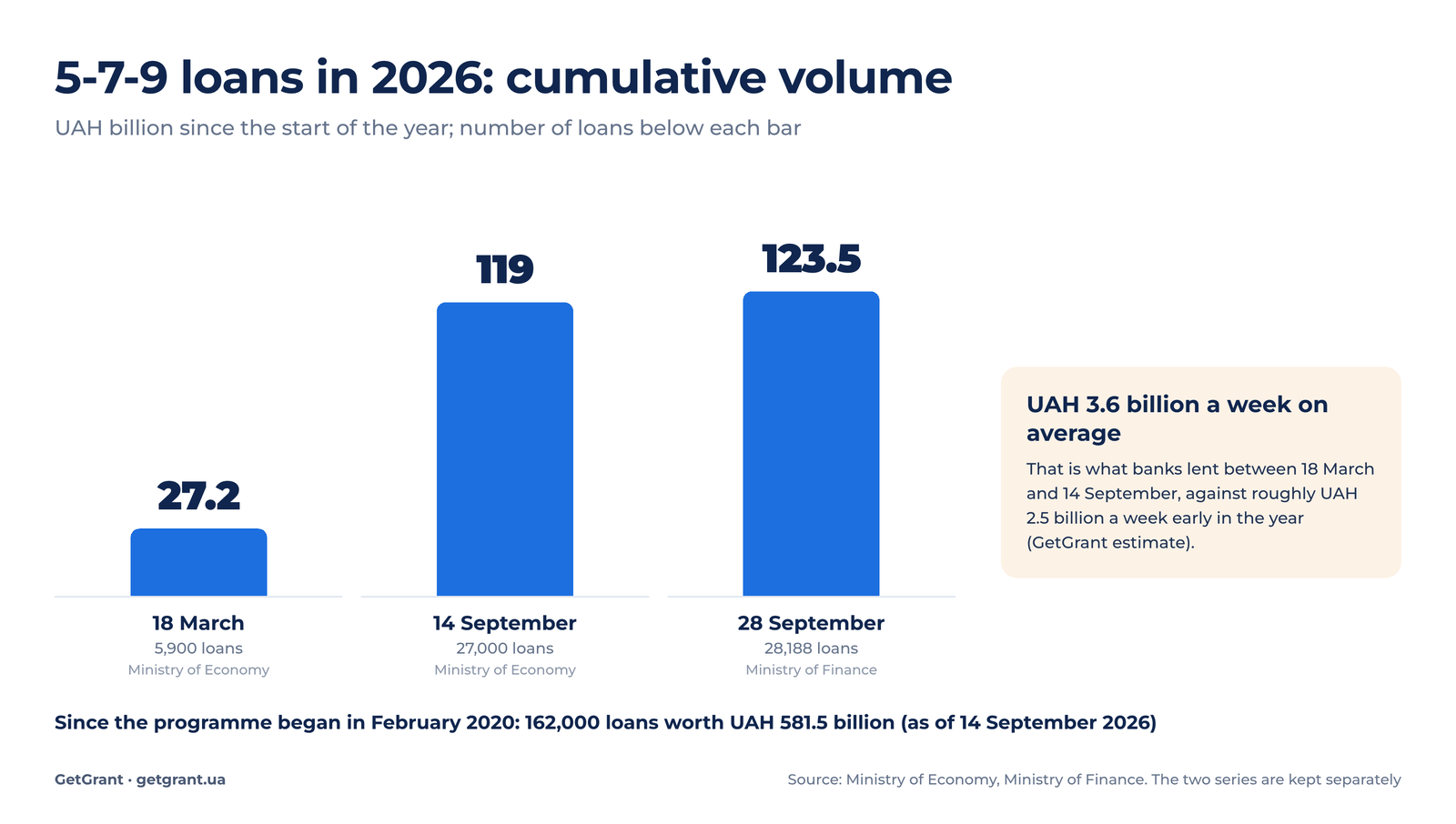
Three observations follow from these data.
The average pace has increased. By our estimate, banks lent about UAH 2.5 billion a week up to 18 March and about UAH 3.6 billion a week between 18 March and 14 September. The programme’s resource is therefore not shrinking, and access did not deteriorate after the June changes.
Demand is skewed towards preferential categories. In 2026 the largest volumes went to high war-risk zones (UAH 41 billion), the processing industry (UAH 30.7 billion) and investment projects (UAH 19.2 billion). Under the Energy Loan, 940 loans worth UAH 1.36 billion had been issued by 14 September.
The share of investment loans is falling. According to a FUIB estimate cited in Latifundist’s analysis of the agricultural sector, lending has grown by 35% since the start of 2026, yet the share of investment loans fell from a third in early 2025 to a quarter in early 2026: borrowers are increasing working capital loans and postponing capital projects. For a company that does invest, this means less competition for credit.
What each route costs: three calculations
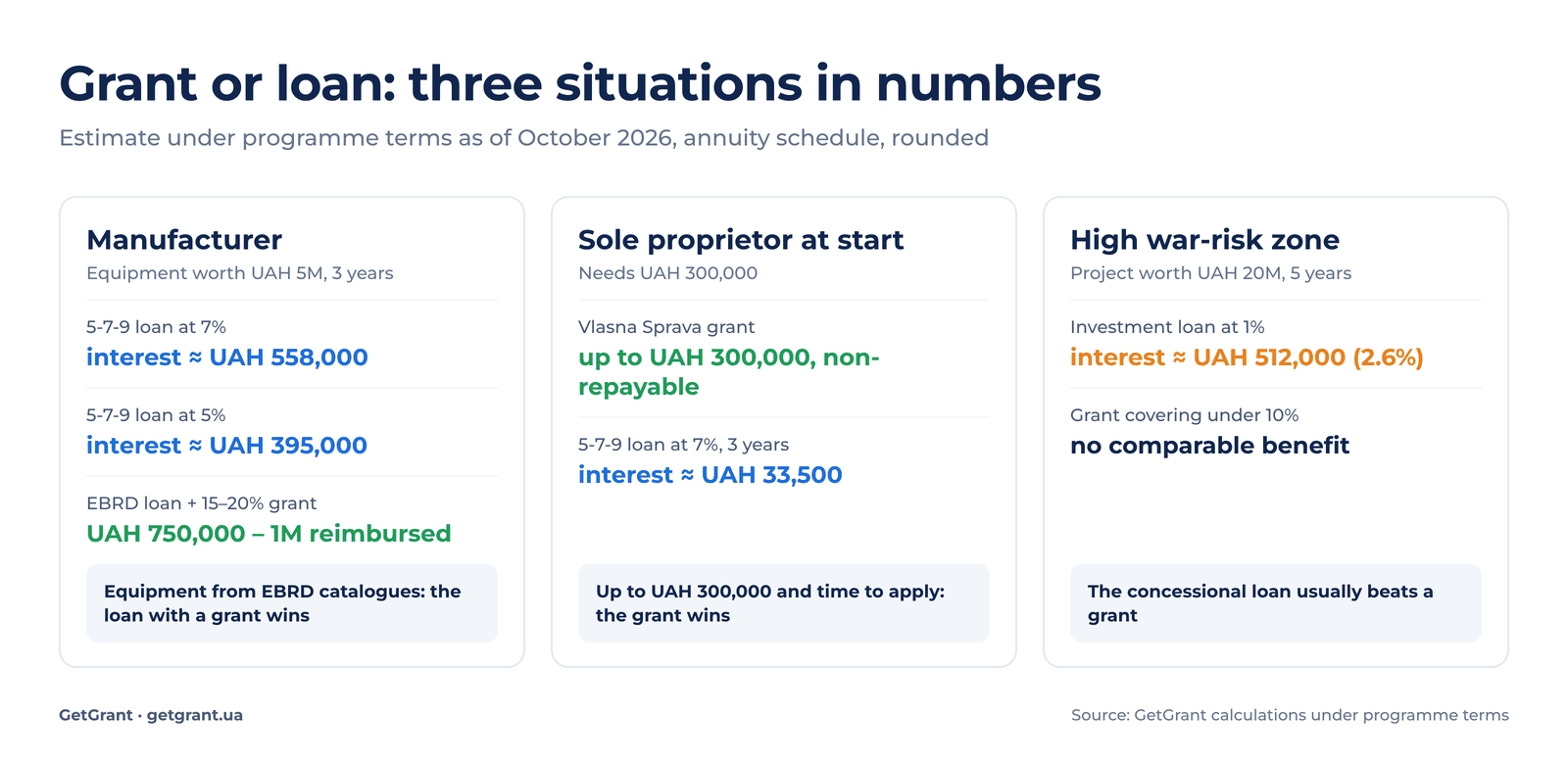
Calculation 1. A manufacturer buying equipment worth UAH 5 million
Route A: a 5-7-9 loan at 7% for three years. Total interest is about UAH 558,000. At the 5% rate available when new jobs are created, it falls to about UAH 395,000.
Route B: a loan from an EBRD partner bank with an EU4Business grant. A 15% reimbursement yields UAH 750,000; 20% for green technologies yields UAH 1 million. The loan itself is priced at a market rate, that is, above 5-7-9, so the net benefit depends on the term: over three years a 20% reimbursement usually outweighs the rate difference, while over seven years the advantage narrows.
Conclusion. For equipment listed in the EBRD catalogues, Route B is mostly cheaper. For non-standard technology or tight deadlines, Route A is simpler. Combining an EBRD grant with a 5-7-9 loan for the same equipment is usually not possible, because the reimbursement is tied to a loan under the EBRD line; this should be clarified with the bank before signing.
Calculation 2. A sole proprietor at start-up who needs UAH 300,000
Vlasna Sprava provides up to UAH 300,000 for start-up with no mandatory job. The money is non-repayable; in return the recipient prepares a business plan, reports on the use of funds and must pay taxes and the unified social contribution equal to the grant amount over the project term.
A 5-7-9 loan for a sole proprietor is capped at UAH 3 million. On UAH 300,000 at 7% over three years, total interest is about UAH 33,500 and reporting is minimal.
Conclusion. If the amount needed is within UAH 300,000 and there is time to prepare an application, the grant wins by a wide margin. If UAH 2–3 million is needed, only a loan is realistic, and a grant is better sought later, for scaling, once income is documented.
Calculation 3. A company in a high war-risk zone with a UAH 20 million project
An investment loan at 1% a year for the first five years. Total interest over five years is about UAH 512,000, or 2.6% of the project amount. A grant covering less than 10% of cost offers no comparable benefit once the time needed to prepare an application is taken into account.
Conclusion. For businesses in risk zones a concessional loan is usually better value than a grant. If the company has been damaged by shelling, two instruments should be compared: the 0.1% recovery loan and the grant of up to UAH 16 million for rebuilding processing facilities.
Instruments compared
| Criterion | Grant (Vlasna Sprava, sector grants) | 5-7-9 loan | EBRD loan with an EU grant |
|---|---|---|---|
| Repayment | Non-repayable if used as intended | Repayable, rate 0–9% | Repayable, 10–30% reimbursed after installation |
| When funds arrive | In advance (Vlasna Sprava) or after verification (sector grants) | After the credit decision | Loan at once, grant after verification |
| Who decides | Programme commission or line ministry | The bank’s credit committee | The bank and the EBRD technical consultant |
| Ceiling | UAH 2.5 million (Vlasna Sprava), sector grants up to UAH 20 million | UAH 3–250 million depending on area | EUR 300,000 of grant |
| Reporting | Intended use, jobs, taxes paid | Minimal; environmental and social standards since 1 September | Technical verification of equipment |
| Main risk | Budget exhaustion, failing the thresholds | Bank refusal, debt burden | Equipment outside the catalogue, delayed reimbursement |
How the bank decides and why it refuses
The key difference between a loan and a grant is that the decision is made not by the state but by the bank’s credit committee; the state only compensates part of the rate. Banking criteria therefore apply.
- Documented cash flow. Since 1 September an interest coverage ratio has applied to medium-sized enterprises: the bank checks whether operating income is sufficient to service the debt.
- Environmental and social standards. Since 1 September the borrower has had to meet World Bank standards. A temporary exemption applies to reconstruction, energy projects and high war-risk zones.
- Collateral or surety. Portfolio state guarantees and guarantees from international financial institutions are available for some projects; it is worth asking the bank about them directly.
- Tax discipline and reporting. Discrepancies between management and tax accounts are a typical reason an application stalls.
- Fit with the area. Choosing the wrong area means a different limit and a different rate.
In grant programmes the reasons for refusal are different: unconfirmed co-financing, expenses incurred before the decision, failing the thresholds (fewer than five new jobs for processing, a storage facility under 500 tonnes), equipment outside the approved lists.
What to do before deciding
- Identify the area and the limit: investment, energy, processing, agriculture, recovery. Both the amount and the rate depend on it.
- Check whether the planned equipment is in the EBRD technology catalogues. Access to the 15–20% reimbursement depends on it.
- Cost the project in two scenarios, with and without a grant, allowing for lost time. For a seasonal business, three months of waiting often cost more than interest.
- Reconcile financial statements and tax status before approaching the bank, not after a refusal.
- Find out whether the environmental and social standards requirement applies to the project and prepare the relevant documents.
- Ask the bank about portfolio guarantees if collateral is insufficient.
- For projects in high war-risk zones, obtain the corresponding status: it unlocks the 1% rate.
Conclusions
In 2026 non-repayable money for business exists mainly as a supplement to a loan rather than a substitute for it. A rational decision sequence is as follows: first establish whether the project meets the formal criteria of a grant programme, then estimate the cost of time to decision, and only then compare rates. A company that meets the EBRD programme criteria obtains the lowest overall cost of capital; a company in a high war-risk zone or one rebuilding after destruction obtains the cheapest loan; a micro-business at start-up obtains a grant. In all other cases the 5-7-9 loan remains the baseline instrument.
How a grant, a loan and an investment differ in obligations and risks is discussed in Grant, loan or investment: which to choose for business.
Sources
- Cabinet of Ministers: the National Development Institution begins operating (in Ukrainian).
- Cabinet of Ministers: 5-7-9 extended to energy generation (in Ukrainian).
- FinClub: changes to the 5-7-9 rules of 12 June 2026 (in Ukrainian).
- Cabinet of Ministers: recovery scheme for damaged enterprises under 5-7-9 (in Ukrainian).
- Ekonomichna Pravda: environmental and social assessment when taking a loan (in Ukrainian).
- Ministry of Economy: programme statistics as of 14 September 2026 (in Ukrainian).
- Ministry of Finance: weekly 5-7-9 report, 28 September 2026 (in Ukrainian).
- National Development Institution: Energy Loan for business (in Ukrainian).
- EBRD: Energy Security Support Facility (ESSF).
- EU4Business-EBRD Credit Line.
- Ministry of Economy: the updated Vlasna Sprava (in Ukrainian).
- Ministry of Economy: grants for processing enterprises in 2026 (in Ukrainian).
- Cabinet of Ministers: grants for vegetable and fruit storage facilities (in Ukrainian).
- Ministry of Economy: intake for orchard and greenhouse grants suspended from 16 October 2026 (in Ukrainian).
- Latifundist: state and international support for the agricultural sector in 2026 (in Ukrainian).
- Energy Efficiency Fund: GreenDIM programme (in Ukrainian).
- National Development Institution: loan for homeowner associations (in Ukrainian).
Find financing that fits your business profile
GetGrant tracks open grants, credit lines with a grant component and sector programmes, and shows the ones that match your company.