We assess farm support programmes in Ukraine in 2026 by budget execution, average payout and application windows: grants for orchards, greenhouses, processing and storage, machinery reimbursement, subsidies, the FAO and EU cycle through the State Agrarian Registry, 5-7-9 loans and donors. Plus the 15 October deadline for orchard and greenhouse grants and the draft 2027
Figures checked against primary sources as of 7 October 2026.
Ukraine budgeted UAH 14.1 billion for agricultural support in 2026, and a grant cycle run by the FAO and the EU through the State Agrarian Registry offered up to UAH 1.1 million per farm. Yet in 2025 farmers actually received UAH 5.8 billion of the UAH 10.8 billion planned, that is, 54%. The gap between what is announced and what is paid is the central question for any farm planning an investment around a grant. In October two more were added: applications for orchard and greenhouse grants close on 15 October, and the draft 2027 budget allocates UAH 5.5 billion to the sector.
This article does not list programmes; it assesses them on three criteria: budget execution, average payout and how quickly the limit is used up. Sources are statements by the Ministry of Economy and the government, FAO releases and consolidated data from sector media. International calls for agricultural research and consortia are covered separately in Agricultural Grants Ukraine 2026; the focus here is on farms and processors.
Key findings
- The most reliable instruments are the 25% reimbursement for Ukrainian-made machinery, processing grants, and orchard and greenhouse grants. In 2025 they were executed at 83–107% of plan. These are not ranked competitions but eligibility-based programmes limited by budget and application window.
- The least predictable are per-hectare and per-head subsidies and special-fund support for livestock. In 2025 between 12 and 69% of the plan was paid, so they cannot be treated as guaranteed income in a business plan.
- Applications for orchard, berry, vineyard and greenhouse grants in 2026 are accepted until 15 October inclusive. Intake is scheduled to resume in the first quarter of 2027.
- Two programmes were relaxed in 2026: processing grants now require 5 new jobs, and the minimum storage capacity was lowered to 500 tonnes.
- New windows opened in the State Agrarian Registry in October: reimbursement for building and reconstructing livestock farms (applications until 20 October) and a subsidy for Ukrainian-made mineral fertilisers (until 1 November).
Budget structure: UAH 14.1 billion
The 2026 agricultural support budget has three parts:
- UAH 9.5 billion for agricultural producers: the per-hectare subsidy for frontline areas, crop insurance, irrigation and land reclamation;
- UAH 2.6 billion for family farms: lending, livestock, cotton;
- UAH 2 billion for humanitarian demining of farmland.
Some programmes are financed from the special fund, which is fed by export duties on soybeans and rapeseed and by international assistance. Actual payments during the year can therefore deviate substantially from plan, as happened in 2025.
The main access channel for most instruments is the State Agrarian Registry (DAR): more than 80% of state support is expected to pass through it. Grants for orchards, greenhouses, storage and processing are applied for through the Diia portal.
State grants: orchards, greenhouses, processing, storage
These programmes work on an eligibility basis: if the applicant and the project meet the criteria and an authorised bank has confirmed the business plan, the ministry issues the award.
Orchards, berry plantations, vineyards
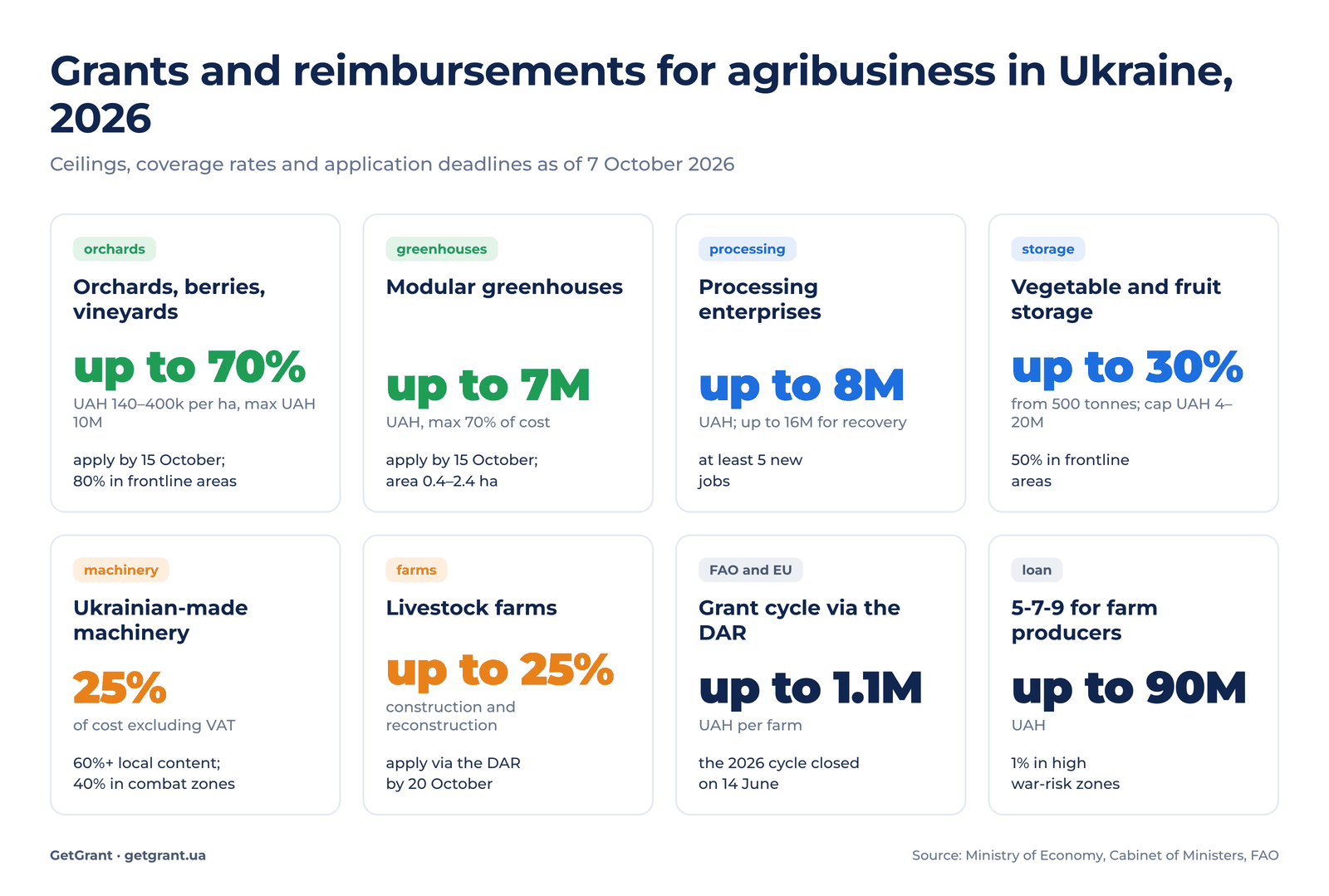
The grant pays suppliers’ invoices for materials in the planting estimate. Terms: an area of 1 to 25 hectares; UAH 140,000 to 400,000 per hectare depending on the crop; no more than 70% of project cost (80% in frontline and de-occupied areas) and no more than UAH 10 million per recipient. The applicant must be registered in the DAR and hold a right to use the land for at least 7 years.
Greenhouses
The grant funds modular greenhouses of 0.4 to 2.4 hectares: up to UAH 2 million for 0.4–0.6 ha, up to UAH 3.5 million for 0.8–1.2 ha and up to UAH 7 million for 1.6–2.4 ha, no more than 70% of project cost. In 2025 this was the only grant programme to exceed its plan: UAH 170 million against UAH 159 million planned.
Processing enterprises
A grant for purchasing equipment, delivering it and putting it into operation. Two ceilings apply in 2026: up to UAH 8 million for development and up to UAH 16 million for rebuilding damaged production (within confirmed losses). Conditions: create at least 5 jobs and, within three years, pay taxes and duties of no less than the grant amount. Base co-financing is 50/50; for frontline areas and recovery the state covers up to 80%, and up to 70% when the equipment is made in Ukraine.
According to Latifundist, over the life of the programme more than 1,000 enterprises have received grants worth UAH 5.1 billion; in 2025, 160 grants worth UAH 890 million were awarded, an average of about UAH 5.6 million per project.
Vegetable and fruit storage facilities
A new strand in 2026. The state reimburses up to 30% of construction cost (up to 50% in frontline areas). By a government decision of 22 April 2026 the minimum capacity was lowered from 3,000 to 500 tonnes, and the ceiling was tied to capacity.
| Storage capacity | Grant ceiling |
|---|---|
| from 500 tonnes | up to UAH 4 million |
| from 1,500 tonnes | up to UAH 7 million |
| from 3,000 tonnes | up to UAH 10 million |
| from 6,000 tonnes | up to UAH 20 million |
Creating permanent jobs is mandatory: at least six for the smallest 500-tonne facility, with the requirement rising for larger ones. Only new construction not started before the application is funded. No public payout statistics for this strand could be found at the time of checking.
Reimbursements and subsidies
The 25% reimbursement for Ukrainian-made machinery
The most stable programme in the sector. In 2025 it was executed at 99.7%: UAH 1.197 billion of UAH 1.2 billion went to 5,182 farms, about UAH 231,000 on average. The condition is machinery from the Ministry of Economy list with at least 60% local content, paid for through an authorised bank. The 2026 budget was raised to UAH 1.8 billion, and since April the reimbursement has been 40% for farms with at least 80% of their land in combat zones.
Per-hectare and per-head subsidies
UAH 1,000 per hectare for farms in areas of possible hostilities and in de-occupied areas; UAH 7,000 per cow (for herds of 3 to 100 cows) and UAH 2,000 per goat or sheep (5 to 500 head). In 2025 the land subsidy reached 14,100 farms, the cow subsidy 12,655 and the goat and sheep subsidy 2,704, but the plan was executed at 40, 30 and 69% respectively. This is liquidity support, not an investment instrument.
New windows in October: farms and fertilisers
Since 1 October 2026 the DAR has been accepting applications for reimbursement of up to 25% of the cost of building or reconstructing livestock farms (up to 50% in frontline areas). Applications are accepted until 20 October, and review will run until 5 December. In parallel, from 1 October to 1 November, applications are accepted for a subsidy for Ukrainian-made compound mineral fertilisers; its amount should be checked in the registry, since publications report it differently.
Crop insurance
The budget includes UAH 60 million to reimburse part of the insurance premium: up to 60% for frontline communities and up to 45% for other regions.
Humanitarian demining
The state reimburses up to 100% of the cost of a certified operator’s services for agricultural land. In 2025, UAH 1.27 billion was allocated for 61 farms. As of 23 July 2026, 100 contracts had been completed under the programme, 16,400 hectares had been returned to farmers and the value of the work exceeded UAH 966 million. The mechanism: an application through the DAR, selection of an operator, and reimbursement after a demining certificate is issued.
The FAO and EU programme through the DAR
From 13 May to 14 June 2026 the State Agrarian Registry hosted a grant cycle implemented by the Ministry of Economy and the FAO with European Union funding. It had two categories:
- up to UAH 440,500 for small agricultural producers;
- up to UAH 1,101,250 for micro and small agricultural enterprises, co-operatives and associations of producers of goods with geographical indications.
The cycle covered Dnipropetrovsk, Zakarpattia, Ivano-Frankivsk, Lviv, Chernivtsi, Volyn, Ternopil and Khmelnytskyi regions. Eligible activities depend on the region: berry and vegetable growing, aquaculture, milk production and processing; for the Carpathian regions also honey, wine, traditional Hutsul cheeses and non-timber forest products. Co-financing is mandatory.
Since 2023 the programme has provided more than UAH 217.8 million to 378 producers, about UAH 576,000 per grant on average. No further cycle had been announced at the time of checking. Because the application window lasts about a month, the practical conclusion is simple: a farm’s DAR profile should be completed in advance.
5-7-9 loans for farmers
The Affordable Loans 5-7-9% programme sets a separate limit of up to UAH 90 million for agricultural producers. In August 2026 the government further eased terms for the sector: it removed the cap on the share of a loan that may fund working capital and cut the rate on working capital loans for agricultural producers from 15 to 10%. For farms in high war-risk zones investment loans cost 1% a year for the first five years and 5% thereafter. Since 1 September borrowers have had to comply with World Bank environmental and social standards.
For large projects, storage and processing in particular, a loan often works alongside a grant: the grant covers equipment, the loan covers construction and working capital. The cost of these instruments is compared in Grant or a 5-7-9 loan for business in 2026.
International donors
- USAID AGRO Program. Runs until 13 November 2026; whether any calls are currently open should be checked on the programme pages.
- FAO Emergency and Early Recovery Response Plan for 2025–2026, worth USD 150 million: support for small farms in frontline regions, often in kind (seed, fertiliser, generators, storage equipment).
- World Bank ARISE project. Support through 5-7-9 and grants for small and medium-sized producers; the project runs until 30 September 2028 and was supplemented with a USD 50 million grant in 2025.
- Mercy Corps. The UASP programme, backed by the Howard G. Buffett Foundation, runs until 31 October 2026. Its total budget is USD 60 million; current calls should be checked on the organisation’s website.
Execution analysis: what 2025 shows
The most useful source for planning is the consolidated plan-versus-actual data for state programmes in 2025. It shows where money reached producers and where it stayed in the budget schedule.
| Programme | Plan, UAH million | Actual, UAH million | Execution | Recipients |
|---|---|---|---|---|
| Reimbursement for Ukrainian-made machinery | 1,200 | 1,197 | 100% | 5,182 |
| Processing grants | 903 | 890 | 99% | 160 |
| Greenhouse grants | 159 | 170 | 107% | 31 |
| Orchard and berry grants | 321 | 268 | 83% | 77 |
| Land demining | 2,285 | 1,271 | 56% | 61 |
| Subsidy per goat and sheep | 473 | 326 | 69% | 2,704 |
| Subsidy per hectare | 2,835 | 1,129 | 40% | 14,100 |
| Subsidy per cow | 1,418 | 421 | 30% | 12,655 |
| Irrigation | 197 | 34 | 17% | n/a |
| Livestock and processing (special fund) | 1,000 | 116 | 12% | n/a |
| Other items | 8 | 4 | 50% | n/a |
| Total | 10,799 | 5,826 | 54% |
Source: Latifundist compilation of Ministry of Economy data. For orchards and greenhouses the sources disagree on counts: the Ministry of Economy reported 69 supported projects worth UAH 438.4 million, which matches the table by amount but not by number. The average grant sizes below should therefore be read as indicative.
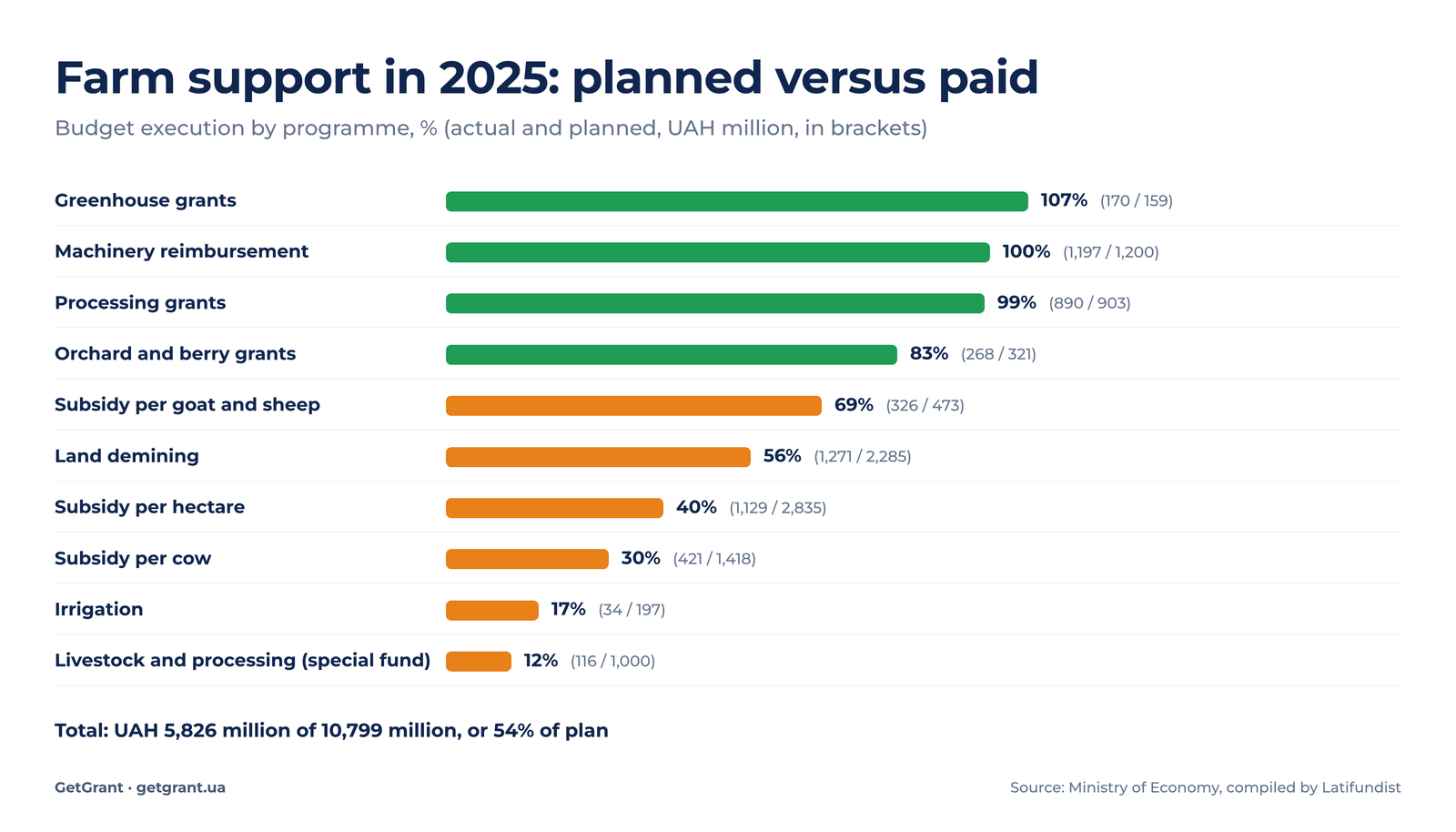
Grant programmes for equipment and plantations are executed almost in full. A farm that applied, met the criteria and passed the bank check received its money.
Average payouts differ by an order of magnitude. Processing: about UAH 5.6 million per grant; greenhouses: about UAH 5.5 million; orchards: about UAH 3.5 million; machinery: about UAH 231,000. These are instruments for farms of different scale.
Mass and special-fund programmes are underfunded. The per-hectare subsidy reached 14,000 farms, but at 40% of plan.
2026 dynamics: orchards and greenhouses
The programme budget for 2026 is UAH 465 million. The timeline according to Ministry of Economy statements:
- 17 March: the first 14 awards, worth UAH 51.5 million;
- early May: 14 businesses funded, UAH 70.8 million;
- 25 May: 20 businesses, UAH 102.5 million;
- 15 June: 35 businesses, UAH 183 million; 42 awards approved, worth UAH 215.4 million;
- 6 October: 61 awards approved, worth UAH 300 million (40 for orchards worth UAH 170 million and 21 for greenhouses worth UAH 130 million); 53 projects fully funded, worth UAH 260 million.
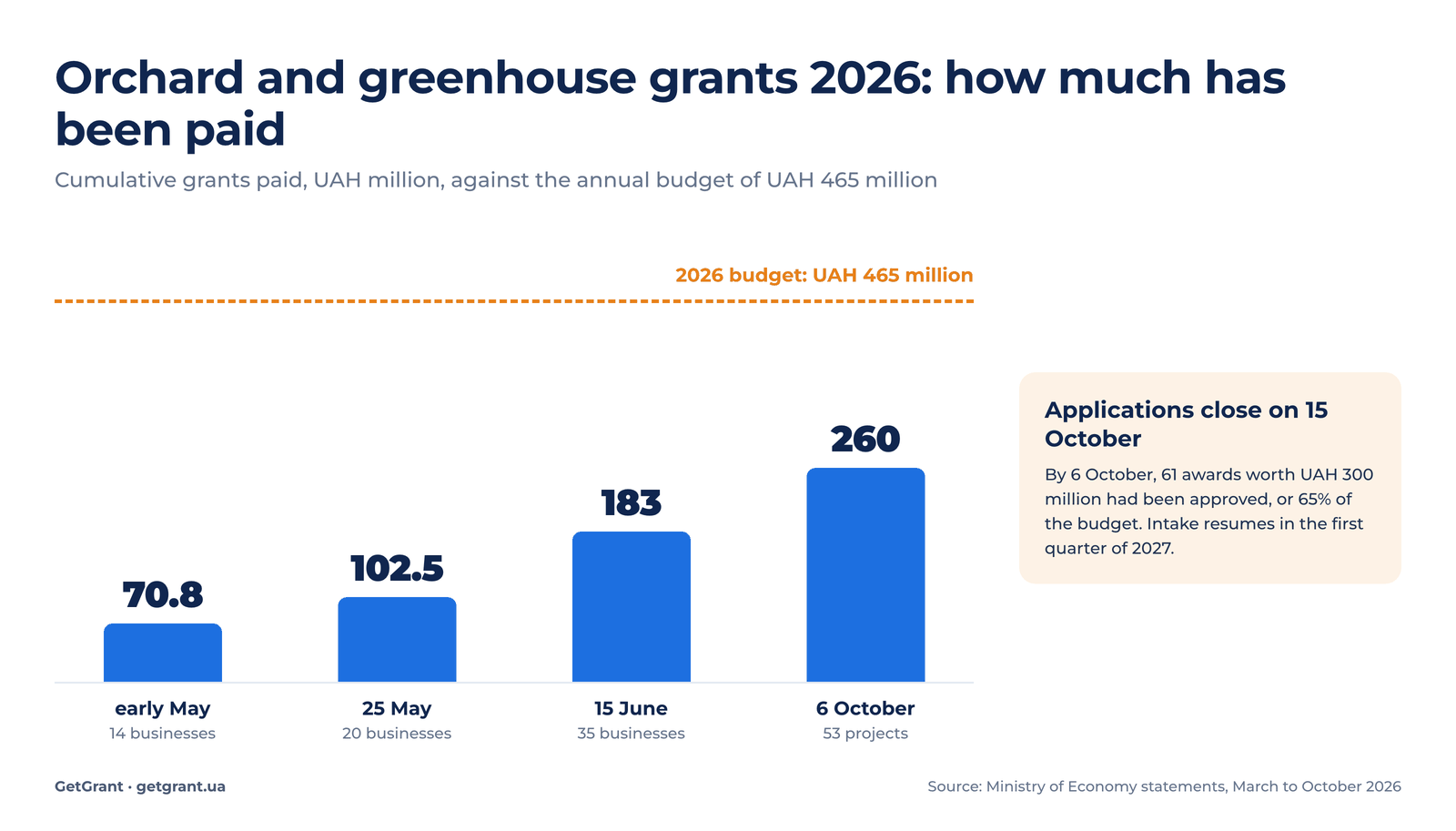
By mid-June awards covered 46% of the budget, and by 6 October 65%. The pace slowed after June and the budget has not been exhausted: intake is being closed administratively, on the budget-year calendar. The constraint in this programme is therefore not the volume of funds but the application deadline. Over the life of the programme, as of mid-June 2026, 429 grants worth UAH 1.8 billion had been awarded: 317 for orchards and berry plantations and 112 for greenhouses.
What changes in 2027
The draft state budget for 2027, approved by the government on 15 September 2026, allocates UAH 5.5 billion to the agro-industrial sector against UAH 14.1 billion in 2026. According to sector media, it includes UAH 235 million for orchards and vineyards, UAH 220 million each for greenhouses and storage facilities, UAH 2.2 billion to stimulate producers and UAH 2.6 billion for family farms. The parliamentary agrarian committee is pressing for higher spending, so the final figures may change. For planning purposes this means the main programmes remain, but an expansion of support in 2027 should not be counted on.
Who gets refused
The Ministry of Economy does not publish refusal statistics, but programme terms and bank review practice show where applications stall.
- Unconfirmed co-financing. The grant covers up to 70%, and the bank expects proof of the source of the remainder before submission.
- Expenses before the decision. Equipment, planting material or construction work paid for or started before approval is not reimbursed.
- Failing the thresholds. An orchard under 1 ha or over 25 ha, a storage facility under 500 tonnes, a processing project without five new jobs.
- Machinery outside the Ministry of Economy list or with local content below 60%.
- An incomplete DAR profile, which blocks participation in FAO programmes, subsidies and demining reimbursement.
- Tax arrears or inconsistencies in financial statements.
The FAO programme through the DAR involves selection: applications are assessed against the region’s priority activities and on the quality of the business case. A farm from the right region with the right activity has a substantial advantage over a generic project.
Three planning scenarios
A family farm with 3 ha for berries. The main instruments are the orchard grant of up to 70% of cost (up to 80% in frontline areas) and the 25% reimbursement for Ukrainian-made machinery. If an application is not submitted by 15 October, the next opportunity opens in 2027; the time until then is best used for the project design, the cost estimate and land documents.
A family farm with dairy processing and a staff of 10. Under the 2026 rules the processing grant is available if the project creates at least 5 new jobs and the farm has 50% co-financing. A smaller-scale alternative is the FAO cycle of up to UAH 1.1 million for equipment, once announced.
An agricultural enterprise growing vegetables on 200 ha. A 3,000-tonne storage facility qualifies for reimbursement of up to 30% of cost, but no more than UAH 10 million (the UAH 20 million ceiling applies from 6,000 tonnes); up to 50% in frontline areas. The remainder can be covered by a 5-7-9 loan within the UAH 90 million limit; crop insurance and, where needed, demining are also worth considering.
Calendar to the end of the year
| Date | Event |
|---|---|
| 15 October | Last day to apply for orchard, berry, vineyard and greenhouse grants in 2026 |
| 20 October | DAR applications close for reimbursement of farm construction and reconstruction |
| 31 October | Mercy Corps UASP programme ends |
| 1 November | DAR applications close for the mineral fertiliser subsidy |
| 13 November | USAID AGRO Program ends |
| 5 December | Deadline for reviewing farm reimbursement applications |
The mechanism of risky farming zones, introduced by a government resolution of 4 March 2026, should also be kept in mind: it provides support to cover land rent and the minimum tax liability. Applications for 2026 were accepted through the DAR until 1 July, so the next opportunity will arise in 2027.
Conclusions
Agricultural support in 2026 is a set of instruments of varying reliability. Grant programmes for equipment and plantations are paid almost in full but are bounded by application windows. Subsidies are widespread but depend on the special fund. Donor cycles through the DAR are short and tied to regions. The advantage lies with a farm that knows its category, has confirmed co-financing and a completed registry profile, and submits documents at the start of a window. Given the draft 2027 budget, a decision to invest under current terms is rationally taken now rather than postponed to the next season.
Sources
- Ministry of Economy: intake for orchard and greenhouse grants suspended from 16 October 2026 (in Ukrainian).
- Ministry of Economy: first orchard and greenhouse grants of 2026 (in Ukrainian).
- Ministry of Economy: orchard and greenhouse grants as of 25 May 2026 (in Ukrainian).
- Interfax-Ukraine: orchard and greenhouse grants as of 15 June 2026 (in Ukrainian).
- Ministry of Economy: grants for processing enterprises in 2026 (in Ukrainian).
- AgroTimes: storage construction grant extended to smaller facilities (in Ukrainian).
- Ministry of Economy: reimbursement for Ukrainian-made farm machinery in 2026 (in Ukrainian).
- Cabinet of Ministers: subsidies for keeping cows, goats and sheep through the DAR (in Ukrainian).
- Latifundist: reimbursement for building and reconstructing farms (in Ukrainian).
- AgroTimes: applications for mineral fertiliser support in the DAR (in Ukrainian).
- Ministry of Economy: FAO and EU grant cycle through the DAR, May 2026 (in Ukrainian).
- Cabinet of Ministers: 5-7-9 terms for farmers (in Ukrainian).
- Latifundist: state and international support for the agricultural sector in 2026, plan versus actual for 2025 (in Ukrainian).
- Buhplatforma: more than 16,000 hectares of demined land returned to farmers (in Ukrainian).
- Dengi.ua: draft 2027 state budget, spending on agriculture (in Ukrainian).
- Cabinet of Ministers: procedure for defining risky farming zones (in Ukrainian).
- World Bank: ARISE project.
- FAO: Emergency and Early Recovery Response Plan for Ukraine.
Find grants for your farm
GetGrant tracks open DAR windows, donor cycles and state grants for agribusiness and shows the ones that match your farm’s profile.